
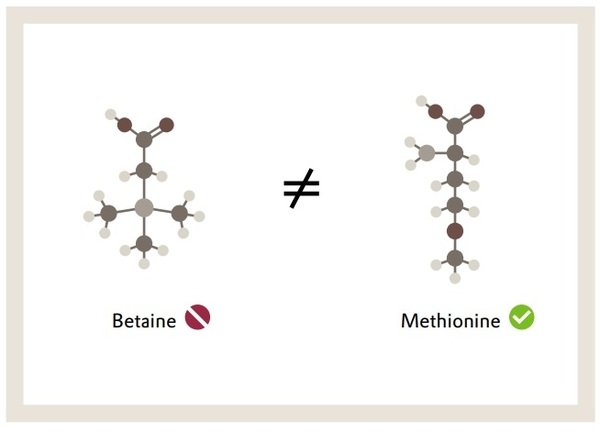
The science is clear: Betaine cannot replace methionine

1. Selhub, J. Homocysteine metabolism. Annu. Rev. Nutr. 1999, 19, 217–246, doi:10.1146/annurev.nutr.19.1.217.
2. Klünemann, M.; Romero, L.F.; Acman, M.; Milfort, M.C.; Fuller, A.L.; Rekaya, R.; Aggrey, S.E.; Payling, L.M.; Lemme, A. Multi-tissue transcriptomics demonstrates the systemic physiology of methionine deficiency in broiler chickens. animal 2024, 101143, doi:10.1016/j.animal.2024.101143.
3. Müller, M.; Lemme, A.; Machander, V. Potential of betaine to replace methionine in broiler nutrition. Proceedings of 21st European Symposium on Poultry Nutrition; #2.36 pp 4




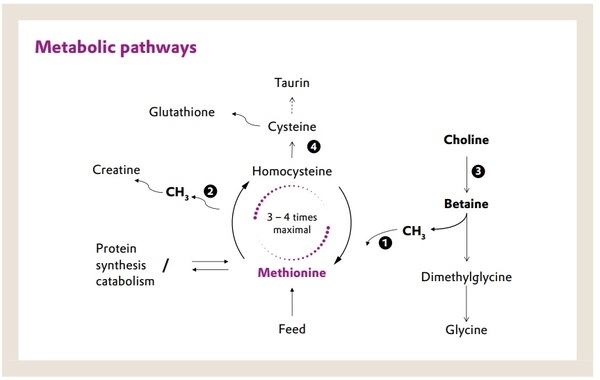
1) there is no methyl group needed for uric acid formation and no direct involvement of methionine nor betaine in this process.
2) betaine cannot transfer the methyl group to the creatine formation but can only remethylate homocysteine to methionine.
3) Research summarised by Selhub (1999), Lamers et al. (2011) and Kalhan et al (2011) clearly indicate that homocysteine is maximal 4 times recycled before it leaves torwards the transsulfuration pathway which suggests a limited capacity of betaine to recycle homocysteine. In addition, this process is in competition / interaction with remethylation by vitamine B12 which would further reduced the importance of betaine in this context.
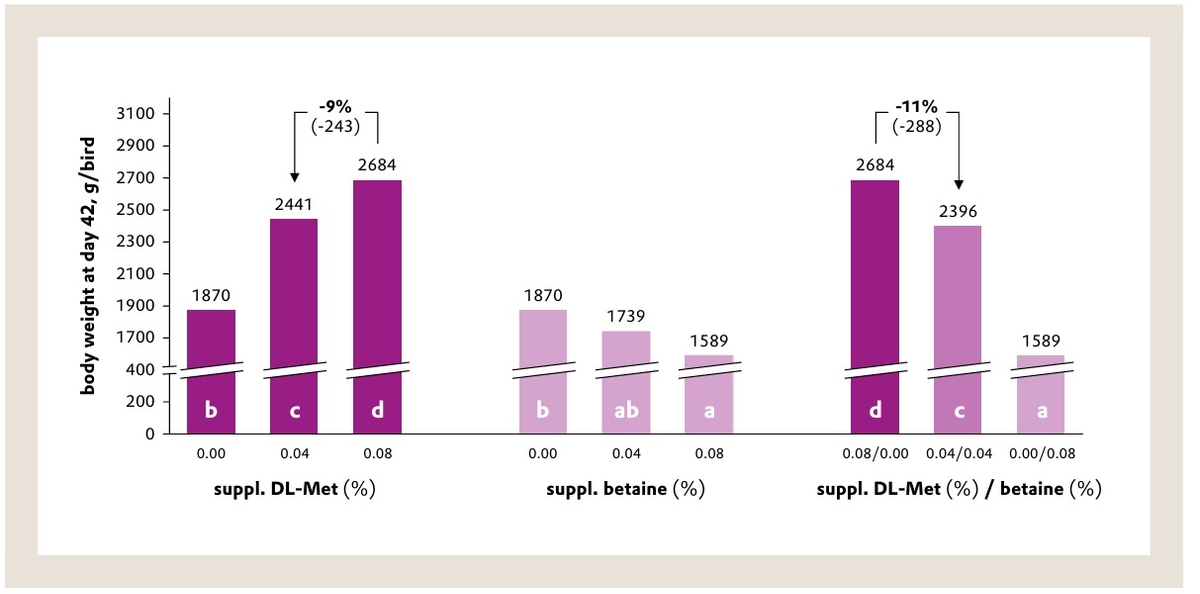
4) Especially at marginal or deficient dietary Met supply the effectiveness of remethylation is increased. However, this is not a situation we find in commercial broiler feeds. Thus, betaine will not have a sparing effect (which has been shown by several authors)
5) If dietary methionine can partly be replaced by betaine without impacting performance, this is only possible because of a (relative) over-supply with methionine. It is suggested to simply reduce dietary Met+Cys specifications instead.
6) Careful reading of publications postulating a methionine replacement or sparing potential of betaine will reveal that always important treatments are missing which would make a scientifically sound conclusion possible.
METAMINO®


Betaine may partially spare dietary methionine through its function as a methyl-group donor; however, it cannot fully replace methionine because it does not provide the amino acid functions required for protein synthesis. Similarly, betaine can substitute only for the methyl-donor function of choline and not for the structural functions of choline per se. Lowry et al. (1987) demonstrated in poultry that approximately 75% of the dietary choline requirement must be supplied as choline, whereas only 25% can be met by betaine. This limitation is likely due to the fact that betaine cannot be reduced back to choline (Pinotti et al., 2002)."


Wheat products can contain up to 4000mg/kg betaine. Animal products and most other plant products have some. Corn and soy have none that we could detect.
At least at one time, American organic broiler producers were limited to 2 pounds of methionine per ton of feed. It was thought by some producers that organic birds did better on wheat than corn based feeds. I wondered if it had something to do with re-methylating homocysteine by the betaine that was unaccounted for. Or was it because the choline and betaine were being oxidized and de-methylated to form glycine? Is that a possible factor, especially in low protein feeds? Or something else?
I do think it is important to have plenty of folate and vitamin B12 when determining choline needs. Plenty of folate, B12, choline and cystine when determining methionine requirements. I chose the order from what I think is the least to most expensive nutrients. Actually, we could never demonstrate a B12 requirement even with low choline feeds with chicks on wire floors after the first week. And there is a compound called dimethylthetin with methylating activity. It is found in shellfish and ?? I hope this is of value to you.
METAMINO®

1. Unique Function: An Irreplaceable "Osmotic Regulator"
The most distinctive feature setting betaine apart from other methyl donors (such as methionine and choline) is its unique role as an osmotic buffer.
Core Anti-Stress Mechanism: When intestinal cells (especially during summer heat stress or diarrhea), liver cells, and kidney cells face high-osmolarity environments, betaine is rapidly transported into the cells to stabilize enzyme structures and maintain cellular hydration. This form of "molecular-level hydration" is a capability methionine lacks.
Gut Health: It improves intestinal villus morphology by increasing the ratio of villus height to crypt depth. This protective effect allows animals to maintain high rates of digestion and absorption even when in a sub-optimal health state.
2. Cost-Effectiveness: Not Just a Substitute, but "Precision Savings"
The concept of "betaine sparing methionine" is essentially based on the economics of methyl donors.
Hub of Methyl Metabolism: In the body, methionine must first be converted into S-adenosylmethionine (SAM) to donate a methyl group. Relying heavily on methionine solely for methyl donation is not only costly but also increases the liver's metabolic burden (raising levels of intermediates like homocysteine).
Clear Division of Labor: Betaine can directly provide highly efficient methyl groups; the methionine thus "freed up" can be utilized more effectively for protein synthesis (such as muscle growth, egg production, or milk production). This division of labor lowers feed formulation costs (as betaine is generally cheaper than methionine) while enhancing the utilization efficiency of protein ingredients.
3. Long-Term Value: Maintaining the Continuity of "Biochemical Reaction Chains"
In modern high-density farming, animals often exist in a state of "metabolic fatigue."
Maintaining a Stable Methyl Pool: Methylation reactions are fundamental biochemical processes in the body (involved in DNA methylation, creatine synthesis, phosphatidylcholine synthesis, adrenaline synthesis, etc.). Long-term betaine supplementation ensures a replete "methyl pool," preventing disruptions in methyl supply caused by rapid growth or stress.
Improvement of carcass quality: Over the long term, betaine promotes lipid metabolism—specifically by facilitating carnitine synthesis and aiding fatty acid ß-oxidation—thereby effectively reducing backfat thickness, increasing lean meat percentage, and enhancing meat water-holding capacity (reducing drip loss). This positive impact on terminal production metrics and meat quality is a direct reflection of its "long-term value."
In summary:
Betaine should be viewed as a "three-in-one" agent: a methyl donor, an osmolyte, and a metabolic promoter. Within a formulation, it should not be regarded as merely displacing methionine; rather, by optimizing methyl metabolic pathways and protecting intestinal cell structure, it establishes a stable internal environment that facilitates the efficient utilization of methionine and other amino acids.
Its ultimate value lies in ensuring that the chain of biochemical reactions within the animal continues to operate rapidly and without interruption, even under complex conditions. This strategy of safeguarding animal health at the level of basal metabolism exemplifies the perfect integration of precision nutrition and functional additives.
METAMINO®

You are correct, Dr. Lemme, that betaine cannot replace methionine’s essential amino-acid function. However, when betaine is value-added with metabolic cofactors such as vitamins B12 and B6, it can support a controlled partial reduction of supplemental methionine.
Methionine metabolism involves three interconnected pathways: transmethylation, remethylation and transsulfuration. Betaine donates methyl groups through the BHMT pathway, vitamin B12 supports folate-dependent remethylation, and vitamin B6 acts as a cofactor in transsulfuration.
Therefore, the scientifically accurate conclusion is not that “betaine can never replace methionine,” but that it cannot replace methionine incorporated into body proteins or eliminate the animal’s minimum digestible methionine and total sulfur amino-acid requirements.