Development of the bursa of Fabricius is affected by in ovo carvacrol delivery in broiler chicks
Published: September 29, 2026
Source : M.M.Y. MEIJER 1, H. VAN DEN BRAND 2, S. NIKNAFS 1, C. PALMIERI 3, A.A. KHASKHELI 1 and E. ROURA 1 / 1 Queensland Alliance for Agriculture and Food Innovation, The University of Queensland; 2 Adaptation Physiology Group, Department of Animal Sciences, Wageningen University and Research; 3 School of Veterinary Science, The University of Queensland.
The compound carvacrol has the potential to enhance immune function, thereby reducing disease impact (Liu et al., 2019). The bursa of Fabricius serves as primary immune organ responsible for B-cell development in chicks which may represent a promising target for in ovo delivery of carvacrol to modulate early bursal development. This study aimed to explore how carvacrol affects immune function in the bursa of broiler chicks around hatching. It was hypothesised that in ovo carvacrol delivery would improve bursal development.
Bursal samples were collected on embryonic day (E)19.5, d0 and d14 (n = 10/treatment/day), to study the impact of two in ovo treatments: either 1 mL of (1) 0.9% saline or (2) carvacrol (0.5% v/v) with polysorbate 80 (1:1 v/v) in 0.9% saline. Treatments were administered into the amniotic fluid of fertile eggs at E17.5. Histomorphology was evaluated at d14. Relative mRNA expressions of IL1β, IL6, IL8, IL10, IFNγ, TNFα, NFκB, IgM, IgY and IgA were measured by qRT-PCR. Data were analysed using PROC MIXED (SAS 9.4).
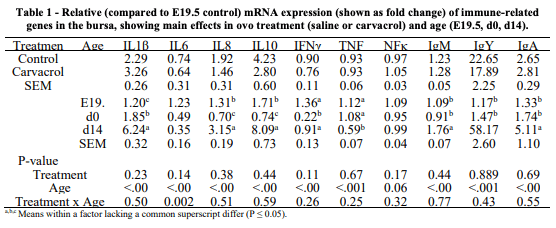
Histological analysis of bursal follicles at d14 showed that in ovo carvacrol increased cortex size (P = 0.03, Δ = 6663.06 µM²) and elevated cortex/medulla ratio (P = 0.04, Δ = 0.19), potentially indicating increased B-cell maturation. No treatment effects (P > 0.05) were observed for the genes studied, while the age variable resulted in different mRNA expression patterns. Expression of IL1β, IL8, IL10, IgM, IgY and IgA was highest in older chicks (d14). In contrast, TNFα decreased over time, while IFNγ decreased at d0, but rebounded at d14. An interaction between treatment and age on IL6 expression showed that in ovo carvacrol led to a more pronounced decrease at d14 (Δ FC = 1.10), reflecting anti-inflammatory effects.
It is concluded that in ovo injection of carvacrol decreased bursal inflammatory cytokine expression at d14, while promoting bursal cortex development.
ACKNOWLEDGEMENTS: This work was supported by AgriFutures Australia.
Presented at the 35th Annual Australian Poultry Science Symposium 2024. For information on the latest and future editions, click here.
Liu SD, Song MH, Yun W, Lee JH, Kim HB & Cho JH (2019) Poult. Sci. 98: 2026-2033.
Content from the event:

Related topics:
Authors:



Recommend
Comment
Share

Would you like to discuss another topic? Create a new post to engage with experts in the community.














Featured users in Poultry Industry

Dr. Algis Martínez  Cargill
DVM, Diplomado ACPV - Poultry Veterinarian North America Cargill
United States
United States