Effects of mushroom stump waste inclusions to broiler diets on amino acid digestibility and d1–21 performance
Published: March 25, 2026
Source : L. S. Erb, C. M. Poholsky, A. M. Lyons, and J. W. Boney / Department of Animal Science, Pennsylvania State University, University Park, PA 16802, USA.
DESCRIPTION OF PROBLEM
Considering the feed costs associated with producing broiler chickens can account for 60 to 70% of total production costs, the use of low-cost unconventional ingredients has become common practice when formulating diets. Such alternatives may include by-products that result from food crops used for human consumption. Global mushroom cultivation has increased over the last 30 yr (FAOSTAT, 2022), and as the world's second-largest producer of mushrooms, the 3-yr average of the 2021, 2022, and 2023 Agaricus mushroom crop in the United States was 321,601 metric tons (USDA-NASS, 2023). Furthermore, Pennsylvania is the foremost producer of mushrooms in the U.S., accounting for 64% of all Agaricus mushrooms produced in the U.S. from 2021 to 2023. During harvest, the mushroom head is used for human consumption, while the stump, including the stipe, volva, hypha, and mycelium, is composted as an agricultural by-product. On average, the stump waste is nearly 29% of the total mushroom weight. Therefore, roughly 93,264 metric tons of mushroom stumps are composted yearly.
The stump is fibrous and contains therapeutic bioactive compounds with antimicrobial and antioxidant activities (Atila et al., 2017). Because of its nutritive and medicinal properties, mushroom stump waste (MSW) may be a viable feedstuff generated from material previously deemed as waste. Camay (2016) found that small inclusions of a mushroom waste powder, ranging from 0.5 to 2.5%, did not affect the body weight of broilers through a 42 d production period. Similarly, Mahfutz et al. (2019) found that inclusions of mushroom stem waste, up to 2% of the diet, did not affect average daily gain, average daily FI or FCR of broilers. The objectives of the current experiment were to determine the nutrient profile of MSW (Experiment 1), determine the optimal inclusion of MSW in broiler diets based on performance metrics (Experiment 2), and measure amino acid digestibility at various MSW inclusions (Experiment 3).
MATERIALS AND METHODS
Mushroom Stump Waste Preparation
Agaricus mushrooms were plucked from the soil and the edible cap was removed. The remaining stipe, volva, hypha, and mycelium made up the “mushroom stump”. Mushroom stumps were sourced from a commercial mushroom farm in southwest Pennsylvania, in coordination with the American Mushroom Institute (American Mushroom Institute, Avondale, PA), and transported to Penn State University. Mushroom stumps were shoveled into burlap bags and then placed on racks in a small grain drier. These racks allowed the grain drier to serve as a forced-draft oven set to 66°C. The burlap sacks were turned daily and were removed after 120 h of drying. The dried product was placed on a #5 American Society for Testing and Materials screen (W.S. Tyler Industrial Group, Mentor, OH) and mechanically shaken to remove dried peat moss that had adhered to the mycelium. After sieving, the dried mushroom stumps were passed through a model F21-M hammermill (W-W Grinder Corporation, Wichita, KS) that reduced the particle size to 463 µm and yielded the final MSW product.
All live animal procedures used in the experiments herein were approved by the Pennsylvania State University Animal Care and Use Committee (IACUC PROTO201900873).
Experiment 1
Treatments of 100% corn, 100% MSW, and a non-fed control were precision-fed to 12, 20-wk-old intact Single Comb White Leghorn (SCWL) roosters. The nonfed control accounted for endogenous losses of energy and nitrogen. The 12 roosters (n = 4 birds per treatment) were fasted for 24 h, precision fed, and individually placed in battery cages with excreta collection trays placed under each cage. The roosters were arranged in a randomized complete block design and excreta were collected 24 h post-feeding and then weighed. This method was modified from that of Sibbald (1976). Physical properties of the MSW, such as its propensity to absorb moisture, created precision feeding challenges. Therefore, the amount of MSW precision fed into the crop ranged between 13.1 and 18.0 g. Following excreta collection, the excreta were dried in a convection oven at 65°C for 72 h. Once dried, the excreta were sent to a commercial laboratory (Eurofins Nutrition Analysis Center, Des Moines IA) for crude protein and gross energy analyses. True metabolizable energy corrected for nitrogen (TMEn) calculations followed those of Parsons et al., (1982):
TMEn = (FEf -- EEf + 8.22 Nf) + (EEU + 8.22 Nu)) /FC
FEf = gross energy of the total feed consumed
EEf and EEu = energy in the excreta collected from the fed birds and fasted birds, respectively
Nf and Nu = grams of nitrogen retained by the fed birds and fasted birds, respectively
FC = grams of dry feed consumed
EEf and EEu = energy in the excreta collected from the fed birds and fasted birds, respectively
Nf and Nu = grams of nitrogen retained by the fed birds and fasted birds, respectively
FC = grams of dry feed consumed
Experiment 2
Dietary Treatments
A control diet containing 0% MSW was formulated to satisfy the nutrient requirements of Cobb x Cobb straight-run broilers from d 1 to 21. Nitrogen corrected true metabolizable energy values from Experiment 1 and proximate analysis were used to create an ingredient matrix for the MSW product (Table 1), to be used in the formulation of the 5% MSW diet. Diets were formulated to be isocaloric and isonitrogenous (Table 2). The 0% MSW and 5% MSW diets were mixed at the Penn State University Poultry Education and Research Center in a Scott Surge Hopper horizontal mixer (Scott Equipment Co., New Prague, MN) for 3 min dry and 3 min post-soybean oil addition. Additional treatments (1, 2, 3, 4% MSW) were created by blending portions of the 0% MSW and 5% MSW diets in a Rapids Marion Mixer (Rapids Machinery Co., Marion, Iowa) for 3 min. To ensure that each treatment was subjected to the same mixing conditions, the 0% MSW and 5% MSW treatments were also subjected to the same 3 min of mixing. Titanium dioxide was included as an indigestible marker in each treatment diet at 0.20% from d 18 to 21 of Experiment 2. Titanium dioxide concentrations were necessary for calculation of apparent ileal amino acid digestibility (AIAAD) and amino acid digestibility coefficients in Experiment 3. The 6 dietary treatments were provided as mash.
Table 1. Mushroom stump waste nutrient profile used for diet formulation.
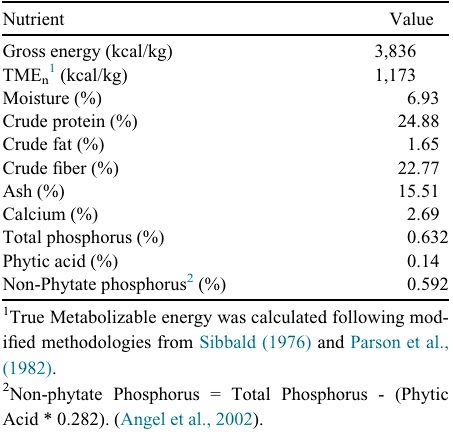
Table 2. Diet formulation and nutrient composition used to feed Cobb x Cobb straight-run broilers from d 1 to 21.
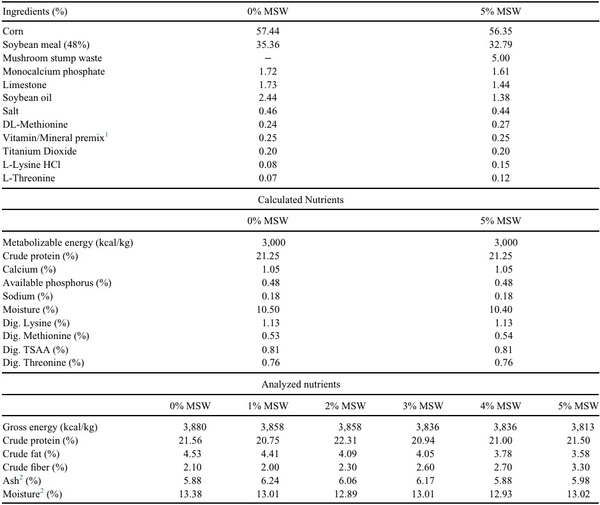
1 The vitamin and mineral premix contained the following (per lb of diet): menadione, 150 mg; B12, 2,000 MCG; B6, 250 mg; Vit. A, 1,400 KU; Vit. E, 3,000 IU; folic acid, 125 mg; choline, 70,000 mg; pantothenic acid, 1,200 mg; riboflavin, 1,200 mg; niacin, 5,000 mg; manganese, 40,000 ppm; zinc, 40,000 ppm; iron, 20,000 ppm; copper, 4,500 ppm; iodine, 600.0001 ppm; selenium, 60 ppm.
2 Moisture (%) and Ash (%) analysis were completed in triplicate and reported as an average.
Broiler Management
A total of 480 Cobb x Cobb straight-run broilers were vaccinated for Marek's disease and purchased from a commercial hatchery on day of hatch (Longenecker's Hatchery, Elizabethtown, PA). Ten birds were randomly selected, weighed and placed in one of 48 cages (Alternative Design Manufacturing and Supply Inc., Siloam Springs, AR). Feed and water were provided ad libitum. The 6 dietary treatments and 8 replicate cages per treatment totaled 48 cages arranged in a randomized complete block design. The experimental unit was one cage of 10 broilers. Lighting and temperature regimen followed breed recommendations from Cobb-Vantress. Mortalities were replaced through d 3, after which mortalities were weighed and recorded. On d 21, lights were turned on 4 h prior to bird handling to ensure full gastrointestinal tracts for digesta collection. Upon handling, body weights and remaining feed weights were recorded to calculate D1 to 21 feed intake, live weight gain, and feed conversion ratio.
Experiment 3
Selected treatments from Experiment 2 were used to determine the AIAAD and amino acid digestibility coefficients. Following weighing, birds provided 0, 1, 3, or 5% MSW were euthanized via cervical dislocation. Distal ilea, defined as the distal half of the small intestine from the Meckel's diverticulum to approximately 1 cm proximal to the ileocecal junction, were extracted and their contents flushed into a cup using a 20-mL syringe and distilled water. Digesta from approximately 5 birds per cage were pooled, frozen, and stored at −4°C until they were processed. This followed similar methodologies of Ravindran et al. (1999) and Evans et al. (2015). Digesta contents were lyophilized at −40°C for 65 h, and then both digesta and feed samples were sent to a commercial laboratory (The University of Missouri-Columbia Agricultural Experiment Station and Chemical Laboratories, Columbia, MO) for titanium dioxide concentration determination and complete amino acid profile analysis. These data were used to calculate AIAAD and AA digestibility coefficients following equations outlined by Evans et al. (2015):

Statistical Analysis
Treatments from Experiments 1 and 2 were arranged in a randomized complete block designs and data were analyzed in a one-way ANOVA using the GLM procedure of SAS version 9.4. Significant differences were determined when P ≤ 0.05. Additionally, a post hoc Fisher's least significant difference (LSD) test was used to further differentiate significant treatment means. The experimental unit in Experiment 1 consisted of one rooster while the experimental unit for Experiment 2 was a cage of 10 broilers. Select treatments from Experiment 2 were used in Experiment 3 where the experimental unit was a pooled digesta sample from one cage of broilers. These data were subjected to ANOVA using the GLM procedure of SAS version 9.4, and significance was determined when P ≤ 0.05. A Fisher's LSD test was used to further separate significant treatment means.
RESULTS AND DISCUSSION
Experiment 1: True Metabolizable Energy Corrected for Nitrogen
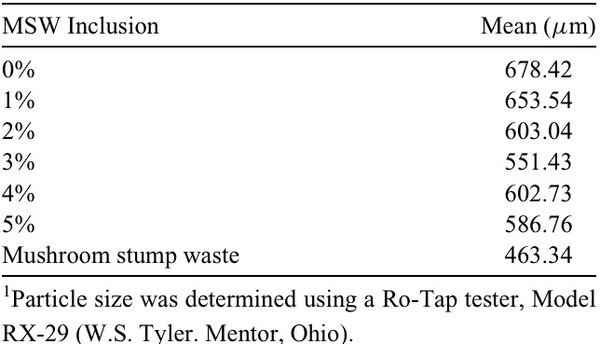
The MSW product had a TMEn value of 1,173 kcal/kg (Table 1). The corn treatment TMEn value was 3,754 kcal/kg. Proximate analysis results revealed that MSW had a crude protein value of 24.9%, crude fiber content of 22.8%, and 15.5% ash (Table 1). Given the TMEn and proximate analysis results, diets in Experiment 2 were formulated to be isocaloric and isonitrogenous across all treatments (Table 2). Particle size analysis was conducted, and descriptive data are reported in Table 3. Generally, the average particle size of the treatment diets were marginally reduced as MSW inclusion increased from 0 to 5%.
Table 3. Descriptive particle size1 data of dietary treatments and mushroom stump waste.
Experiment 2: D1-21 Broiler Performance
Day 1 to 21 bird performance is displayed in Table 4. Neither FI nor mortality were affected by MSW inclusion (P > 0.05). Birds consuming 1% MSW had increased LWG by 63 grams per bird compared to those fed 5% MSW. Birds provided 0, 2, 3 and 4% MSW were intermediate for LWG (P = 0.024). Birds consuming 1% MSW had higher average BW compared to broilers provided 4% and 5% MSW. On average, broilers consuming 1% MSW were 56 grams heavier than those fed 5% MSW. Treatments containing 0, 2, and 3% MSW were intermediate for BW (P = 0.026). Broilers consuming 1% MSW improved mortality-corrected FCR by 0.105 compared to those fed 5% MSW. Broilers fed 0, 2, 3, and 4% MSW were intermediate for FCR (P < 0.001).
Table 4. Effects of performance results for d1 to 21 Cobb x Cobb straight-run broilers fed diets containing 0, 1, 2, 3, 4, and 5% mushroom stump waste (Experiment 2).
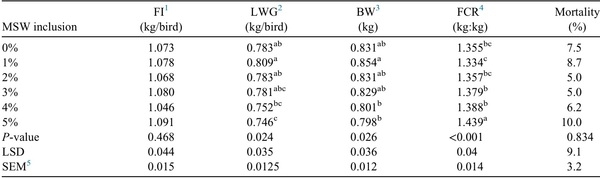
1 Feed intake per bird.
2 Live weight gain per bird.
3 Average body weight.
4 Mortality corrected feed conversion ratio (FCR= FI/ (LWG+ mortality weight)).
5 Pooled standard error of the mean.
2 Live weight gain per bird.
3 Average body weight.
4 Mortality corrected feed conversion ratio (FCR= FI/ (LWG+ mortality weight)).
5 Pooled standard error of the mean.
Feed intake results from Experiment 2 are supported by Mahfutz et al. (2019), who reported no differences in FI when Flammulina velutipes mushroom stem waste was included up to 2% in the diet. However, these authors reported that MSW inclusions did not affect FCR or LWG. Camay (2016) reported no differences in BW, LWG, or FCR when Pleurotus ostreatus mushroom waste powder was included up to 2.5% in the diet. Results from the current study support these findings as birds consuming diets containing up to 3% MSW exhibited similar performance parameters compared to those provided the control (0% MSW). Conversely, feeding 5% MSW negatively impacted bird performance compared to the control. Conflicting reports may be associated with mushroom type and processing, broiler strain, and the rate of mushroom waste included in the diet.
Due to the high crude fiber fraction of MSW (Table 1) it would suggest that the concentration of non-starch polysaccharides is also high. Tu et al. (2021) reported that 70-90% of mushroom fiber is insoluble non-starch polysaccharides, such as chitin or beta-glucans bound to chitin. Broiler performance research indicates that high levels of non-starch polysaccharides can result in an increase in digesta viscosity (Almirall et al., 1995; Latham et al., 2018). This increase could have encapsulated starches and amino acids, preventing endogenous enzymes from accessing substrates and may have contributed to low body weights and poor FCR of birds provided higher levels of MSW, such as treatments containing 4 or 5% MSW. These findings are similar to Almirall et al. (1995) who replaced corn with either high or low-viscosity barley and reported a 19.3% reduction in the body weights of broilers fed the high-viscosity barley diets compared to those consuming the traditional corn-soy diets. Overall performance results and data from past research validate the experimental model used in Experiment 2 and show that future research should consider the effects of MSW on digesta viscosity and subsequent broiler performance.
Experiment 3: Apparent Ileal Amino Acid Digestibility
Birds consuming 0, 1, 3, and 5% MSW were utilized in Experiment 3 to determine AIAAD and to calculate amino acid digestibility coefficients. The AIAAD of essential amino acids are displayed in Table 5. Broilers provided 1, 3, and 5% MSW had reduced AIAAD of leucine, histidine, phenylalanine, and valine compared to birds provided the control (P < 0.05). The AIAAD of lysine was reduced by 10.04% for birds fed 1% MSW compared to those consuming the control. Birds provided 3 and 5% MSW were intermediate for lysine digestibility (P < 0.0001). The AIAAD of methionine was reduced by 29.3% for birds fed 1% MSW compared to those fed the control. Birds consuming 3% and 5% MSW were intermediate for methionine digestibility (P < 0.0001). Birds provided 1 and 3% MSW had lower AIAAD values for threonine when compared to birds consuming the control and 5% MSW (P < 0.0001). Broilers fed 1 and 5% MSW diets had reduced AIAAD of tryptophan compared to birds fed the control and 3% MSW (P < 0.0001). The AIAAD of arginine was reduced by 14.9% for birds fed 5% MSW compared to birds consuming the control. Broilers fed 3% MSW had similar arginine digestibility to those provided the 5% MSW treatment. Broilers consuming 1% MSW were intermediate for arginine digestibility (P < 0.0001). Isoleucine digestibility followed arginine digestibility patterns (P < 0.001; Table 5). Overall, Experiment 3 analysis of essential amino acids demonstrated that increasing inclusions of MSW reduced the AIAAD for 8 of the 10 amino acids analyzed in the current study.
Table 5. The apparent ileal amino acid digestibility1 of essential amino acids when Cobb x Cobb straight-run broilers were fed 0, 1, 3 and 5% mushroom stump waste.
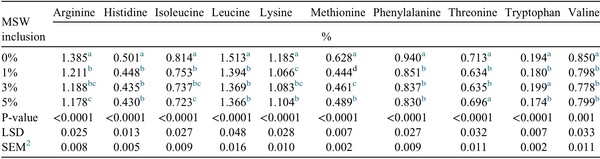
a-d Values within comparisons with different superscripts differ (P < 0.05).
1 AIAAD = [((AAdiet/Tidiet) − (AAdigesta/Tidigesta))/(AAdiet/Tidiet)] × AAdiet. Percent digestible amino acid refers to the percentage of digestible amino acid within the total diet.
2 Pooled standard error of the mean.
1 AIAAD = [((AAdiet/Tidiet) − (AAdigesta/Tidigesta))/(AAdiet/Tidiet)] × AAdiet. Percent digestible amino acid refers to the percentage of digestible amino acid within the total diet.
2 Pooled standard error of the mean.
The AIAAD results of non-essential amino acids are located in Table 6. Birds provided 1, 3, and 5% MSW had lower AIAAD for alanine, aspartic acid, cysteine, glycine, serine, and tyrosine compared to birds consuming the control (P < 0.05). Birds provided 5% MSW decreased the AIAAD of glutamic acid compared to broilers fed the control. Birds consuming 1 and 3% MSW were intermediate for glutamic acid digestibility (P < 0.0001). Proline digestibility followed glutamic acid digestibility patterns (P < 0.0001). Taurine digestibility was unaffected by MSW inclusion (P = 0.812; Table 6). Overall, Experiment 3 AIAAD results of nonessential amino acids show that increasing inclusions of MSW reduced the AIAAD for 8 of the 9 amino acids analyzed in the current study.
Table 6. The apparent ileal amino acid digestibility1 of nonessential amino acids when Cobb x Cobb straight-run broilers were fed diets containing 0, 1, 3 and 5% mushroom stump waste.
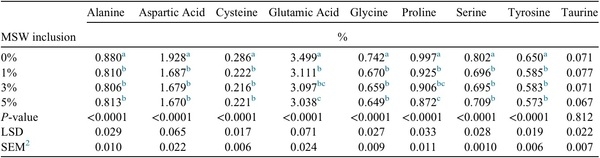
a-c Values within comparisons with different superscripts differ (P< 0.05).
1 AIAAD = [((AAdiet/Tidiet) − (AAdigesta/Tidigesta))/(AAdiet/Tidiet)] × AAdiet. Percent digestible amino acid refers to the percentage of digestible amino acid within the total diet.
2 Pooled standard error of the mean.
1 AIAAD = [((AAdiet/Tidiet) − (AAdigesta/Tidigesta))/(AAdiet/Tidiet)] × AAdiet. Percent digestible amino acid refers to the percentage of digestible amino acid within the total diet.
2 Pooled standard error of the mean.
Amino acid digestibility coefficients were unaffected by MSW inclusion (P > 0.05; Table 7 and Table 8). However, feeding 1, 3, and 5% MSW trended towards reduced cysteine (P = 0.055) and methionine (P=0.066) digestibility compared to birds consuming the control.
Table 7. Essential amino acid digestibility coefficients1 when Cobb x Cobb straight run broilers were fed diets containing 0, 1, 3 and 5% mushroom stump waste.
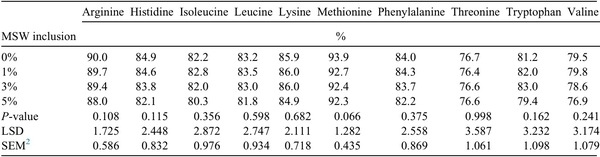
1 Amino acid digestibility coefficient = (AAdiet/Tidiet − AAdigesta/Tidigesta)/(AAdiet/Tidiet) × 100. These values are reported as a percentage out of 100.
2 Pooled standard error of the mean
2 Pooled standard error of the mean
Table 8. Nonessential amino acid digestibility coefficients1 when Cobb x Cobb straight-run broilers were fed diets containing 0, 1, 3 and 5% mushroom stump waste.
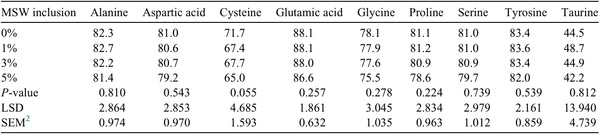
1 Amino acid digestibility coefficient (%) = (AAdiet/Tidiet − AAdigesta/Tidigesta)/(AAdiet/Tidiet) × 100. These values are reported as a percentage out of 100.
2 Pooled standard error of the mean.
2 Pooled standard error of the mean.
Considering the novelty of MSW, limited research has been conducted on its amino acid digestibility when fed to broilers. However, amino acid digestibility coefficient results from Experiment 3 are supported by Abro et al., (2016), who found that overall crude protein digestibility of Pleurotus Ostrearus mushroom inclusions up to 1% of the diet did not affect crude protein digestibility. Conversely, inclusions of 1.5% Pleurotus Ostrearus mushrooms improved crude protein digestibility when compared to the other treatments (2016). Conflicting digestibility results may be due to utilizing the entire mushroom, including the cap, rather than just the stem. Buwjoom et al., (2004) found that the cap of shiitake mushrooms yielded higher crude protein values than that of the stem. Considering these data, true amino acid digestibility analyses are needed to complete the MSW ingredient matrix and further elucidate the impact of MSW inclusions on broiler diets.
In summary, the ingredient matrix obtained from Experiment 1 and the performance results from Experiment 2 indicate that up to 3% MSW could be used as a viable feed ingredient in broiler diets. The decrease in performance observed when feeding more than 3% MSW is likely associated with the high crude fiber and ash fractions of the MSW product. More research is necessary to support this claim with MSW inclusions specifically; however, the literature supports the antinutritional effects of high levels of fiber or non-starch polysaccharides in poultry diets. The AIAAD results from Experiment 3 indicate that increasing MSW inclusions reduced digestibility for 16 of the 19 analyzed amino acids. However, these differences did not affect the amino acid digestibility coefficients. This is noteworthy as both AIAAD and amino acid digestibility coefficients follow experimental designs and calculations noted in previous papers (Ravindran et al., 1999; Evans et al., 2015). Given the results of this study, a full-term production trial, true amino acid digestibility values and viscosity results are necessary to further elucidate the efficacy of this MSW product. A method for commercially and consistently producing this MSW product is also required to conduct further research of the benefits of MSW inclusions in broiler diets.
CONCLUSIONS AND APPLICATIONS
1. Day 1 to 21 performance results indicate that supplementation of 1% MSW improved feed efficiency, LWG per bird, and average body weight when compared to broilers consuming 5% MSW.
2. Mushroom stump waste inclusion reduced AIAAD for 16 of the 19 analyzed amino acids. However, amino acid digestibility coefficients were not affected by MSW inclusions.
3. Broilers consuming diets with up to 3% MSW showed no detriment to performance or amino acid digestibility coefficients when compared to broilers consuming a control diet without MSW.
This article was originally published in 2024 J. Appl. Poult. Res. 33:100421. https://doi.org/10.1016/j.japr.2024.100421. This is an Open Access article under the CC BY-NC-ND license (http://creativecommons.org/licenses/by-nc-nd/4.0/).
REFERENCES
- Abro et al., 2016
Carcass and digestibility patterns fed different levels of mushroom (Pleurotus ostreatus) in the diet of broilerSci. Int., 28 (2016), pp. 2985-2988
- Almirall et al., 1995
The difference in intestinal viscosity produced by barley and ß-glucanase alter digesta enzyme activities and ileal nutrient digestibilities more in broiler chicks than in cocksJ. Nutr., 125 (1995), pp. 947-955
- Angel et al., 2002
Phytic acid chemistry: Influence on phytin-phosphorus availability and phytase efficacyJ. Appl. Poult. Res., 11 (2002), pp. 471-480
- Atila et al., 2017
The nutritional and medical benefits of Agaricus bisporus: a reviewJ. Microbio. Biotechnol. and Food Sci., 7 (2017), pp. 281-286
- Buwjoom et al., 2004
Chemical composition, nutrient digestibility and metabolizable energy of shiitake mushroom stalk mealPoult. Sci., 41 (2004), pp. 322-328
- Camay, 2016
Mushroom (Pleurotus ostreatus) waste powder: its influence on the growth and meat quality of broiler chickens (Gallus gallus domesticus)World J. Agric. Res., 4 (2016), pp. 98-108
- Evans et al., 2015
Effects of algae incorporation into broiler starter diet formulations on nutrient digestibility and 3 to 21 d bird performanceJ. Appl. Poult. Res., 24 (2015), pp. 206-214
- FAOSTAT 2022
FAOSTAT (2022). Food and Agriculture Organization of the United Nations Statistics Database. Available online at: http://www.fao.org/faostat/en/#data (Accessed June 2022).
- Latham et al., 2018
Efficacy of beta-mannanase on broiler growth performance and energy ultilization in the presence of increasing dietary galactomannanPoult. Sci., 97 (2018), pp. 549-556
- Mahfutz et al., 2019
Dietary inclusion of mushroom (flammulina velutipes) stem waste on growth performance, antibody response, immune status, and serum cholesterol in broiler chickensAnimals, 9 (2019), p. 692
- Parsons et al., 1982
True metabolizable energy corrected to nitrogen equilibriumPoult. Sci., 61 (1982), pp. 2241-2246
- Ravindran et al., 1999
Influence of microbial phytase on apparent ileal amino acid digestibility in feedstuffs for broilersPoult. Sci., 78 (1999), pp. 699-706
- Sibbald, 1976
A bioassay for true metabolizable energy in feedstuffsPoult. Sci., 55 (1976), pp. 303-308
- Tu et al., 2021
An insight into the mechanism of interactions between mushroom polysaccharides and starchCurrent Opin. Food Sci., 37 (2021), pp. 17-25
- USDA-NASS 2023
USDA-NASS. 2023. United States Department of Agriculture, National Agricultural Statistics Service. Agricultural Statistics Board. Accessed Feb. 2024. https://www.mushroomcouncil.org/industrystaff/research-reports/nass-report/.
Related topics:
Authors:




Recommend
Comment
Share

Would you like to discuss another topic? Create a new post to engage with experts in the community.














Featured users in Poultry Industry