Xylo-oligosaccharides and arabinoxylan supplementation enhances ileal lactate production in broiler chickens
Published: August 14, 2026
Source : C. CASTRO 1, L. OMALEKI 1, S. NIKNAFS 1, B. FLANAGAN 1, G. FENG 1, G. GONZALEZ-ORTIZ 2, M.R. BEDFORD 2 and E. ROURA 1 / 1 QAAFI, The University of Queensland; 2 AB Vista.
Xylo-oligosaccharides (XOS) are fermented in the gut by the microbiota leading to the production of short-chain fatty acids (SCFA). A previous study showed that XOS (0.5%) and arabinoxylan-rich fraction (AXRF; 1%) supplementation can improve feed efficiency and gut health in broiler chickens (Castro et al., 2023). This study aimed to evaluate microbiome composition and fermentation patterns following XOS/AXRF supplementation. The hypothesis is that XOS/AXRF supplementation would increase SCFA production and modulate the microbial community by promoting specific beneficial bacteria.
One-day-old broiler chickens (mixed-sex) were provided with a corn/soybean meal-based mash diet either with or without supplemental XOS (0.5%) and AXRF of wheat (1%). Feed and water were provided ad libitum from 1 to 42 days of age. Each treatment was fed to 8 replicate pens, with 8 chickens per pen. On day 42, one male chicken of average weight per pen was euthanised. Ileum and cecum digesta contents were collected for SCFA and microbiome analysis, respectively. QIAamp PowerFecal Pro DNA Kit was used to extract DNA from the cecum digesta, and MinION Oxford Nanopore Technology was used for long-read sequencing. The dataset was analyzed in Galaxy EU platform. Identification and quantification of SCFA was performed using 1 H NMR spectroscopy. R was used to analyze SCFA data using Mann–Whitney-Wilcoxon test, and microbial diversity and relative abundance. The results showed no significant (P > 0.05) differences in microbial alpha and beta diversity between supplemented and control birds. Faecalibacterium was the most abundant genus across both groups; mean relative abundance was 12% and 15% for XOS/AXRF supplemented and controls, respectively. Ileal lactate concentration was significantly (P < 0.05) higher in XOS/AXRF birds compared to the control group (Table 1). Studies have shown that lactate can be converted to butyrate production – known for its positive impact on gut health - by bacterial cross-feeding mechanisms. No significant differences (P > 0.05) in SCFA concentrations were observed in the cecum between the two groups.
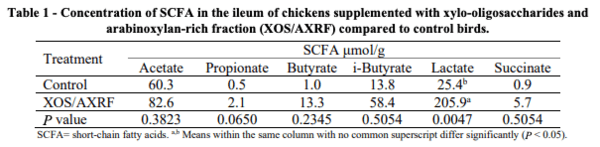
In conclusion, XOS/AXRF supplementation enhances lactate production in the ileum in broiler chickens. Thus, XOS/AXRF may potentially contribute to improving gut health.
ACKNOWLEDGEMENTS: This study has been partially funded by AB Vista.
Presented at the 35th Annual Australian Poultry Science Symposium 2024. For information on the latest and future editions, click here.
Castro C, Niknafs S, Gonzalez-Ortiz G, Tan X, Bedford M & Roura E (2023) Proceedings of the Australian Poultry Science Symposium 34: 193.
Content from the event:

Related topics:
Authors:



AB Vista
AB Vista
Show more
Recommend
Comment
Share

Would you like to discuss another topic? Create a new post to engage with experts in the community.












Featured users in Poultry Industry

Dr. Algis Martínez  Cargill
DVM, Diplomado ACPV - Poultry Veterinarian North America Cargill
United States
United States