I. INTRODUCTION
Poultry house moisture contributes to many of the issues that poultry farms experience. As moisture builds in the litter/bedding, microbial populations thrive, more ammonia is generated, and the incidence and severity of footpad dermatitis increases. Much of the moisture in the house comes from the birds themselves, so in order to control moisture, one must understand the current moisture loads in the house. For example, broilers grow faster and convert feed more efficiently than 35 years ago. Broilers will drink 1.8-2.0 ml of water for every gram of feed consumed under typical rearing conditions (Czarick and Lacy, 2001; Fairchild and Czarick, 2006; Williams et al, 2013). As a result, birds are drinking more water and adding more water to the house environment through excretion and respiration, which means that ventilation rates should be increased proportionally. However, that is not what is practiced in many cases. Other things that have changed that affect house moisture levels include tighter housing, which has less air leakage. This means that proper ventilation rates are more important today because air exchange due to leakage is much less. It also means that the ability to remove moisture from the house has become more efficient. In order to maintain optimal bedding and air quality conditions for the birds, the houses have to be ventilated appropriately.
The use of circulation fans systems has been employed for several decades. These systems were developed and tested to provide more uniform house temperature and conserve energy (Czarick and Fairchild, 2003). While those systems were effective, the desire to have drier floors requires an air circulation system capable of moving more air across the floor. The objective of the current study was to evaluate the effect of moving 20% of the total house air volume every minute on the poultry house environment and the subsequent impact on litter moisture and footpad dermatitis.
II. METHOD
A series of 10 trials were conducted on poultry farms in Northeast Georgia during the months with cold weather (October-April). The farms utilized used litter (pine shavings was the original bedding) ranging from 2 to 5+ years and had an approximate depth of 15-20 cm. On each farm, one house served as the control and the other house was the treatment. The circulation fan system in these houses was replaced with 61 cm diameter, 1/3 horsepower fans, which move approximately 2.6 m3 /s (Munters CX24, Munters Corporation, Amesbury, MA). Enough fans were installed to move approximately 20% of the total house air volume every minute, which generated an air speed of 0.1 - 0.8 m/s. The circulation fans were installed 30 cm to the side of the radiant tube heaters (which were installed in the center of the house and 15 cm from the ceiling). The fans were operated continuously starting when the house heating system was turned on to preheat the house and remained on for the entire grow-out period. The environment of both houses were managed according to the farm’s normal operating procedures with the exception of minimum ventilation, which was manually adjusted as needed to maintain house relative humidity (Rh) at 60% or lower. All of the farms utilized were with the same integrator that was raising the broilers to a market weight of approximately 2.04 kg, which was typically achieved in 40-42 d.
Temperature and Rh were recorded using a temperature/Rh sensor. The temperature/Rh sensors (Onset HOBO External Temperature/RH sensor data logger- MX2302A; Bourne, MA) were connected to a datalogging system that recorded the data every five minutes. Footpad dermatitis and litter moisture were evaluated weekly. Footpad dermatitis lesions on 200 birds per house were quantified using a 3-point evaluation system where 0 = no lesions, 1= minor lesion (less than half the footpad area, and 2 = severe lesion that was larger than half the footpad area. Litter samples were taken across the width of the brooding area at four locations on both farms (30 cm off the inside drinker line towards the center and 30 cm off the outside drinker towards the sidewall) and down the length of the brooding area at four to six locations (n = 16- 24 per house per sample day). Samples were transferred to a lab where a 200 g homogenized sample was oven dried over a period of 24 h at 70-75 °C. Samples were reweighed to calculate moisture content. No statistical analysis other than descriptive statistics were utilized.
III. RESULTS
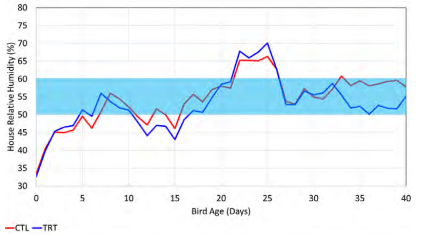
All trials yielded similar results and the results from one of those trials are presented. These studies were replicated in four flocks on one farm and one flock on a second farm with a total of five flocks. The farms did a good job of maintaining the house Rh at 60% or lower (Figure 1) in both control and treatment houses. Litter moisture was lower and more uniform in the houses with more air movement compared to the control.
Figure 1 - House relative humidity. Note that the house Rh was 60% or less most of the time. The one period where it increased above 60% was due to a rainy weather.
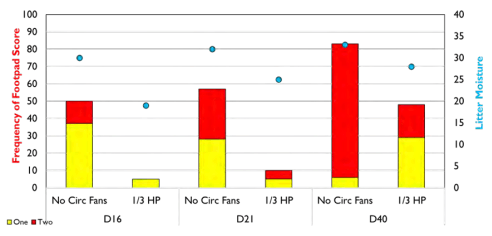
Average house litter moisture and footpad dermatitis scores are presented in Figure 2. Houses with more air movement had lower litter moisture and subsequently less incidence and severity of footpad dermatitis than the control houses.
Figure 2 - Footpad lesion scores (%) and litter moisture (%) on days 16, 21 and 40 of the grow-out (Mou, 2020). The red bars are footpad scores of 2, the yellow bar are footpad scores of 1 and the difference between these two and 100 are the footpad scores of 0. The blue dot is litter moisture on the day that footpad scores were recorded. No Circ Fans = houses with no circulation fans and 1/3 HP = houses with high-volume air circulation fans.
IV. DISCUSSION
Wet litter is highly correlated with poor bird performance, health, and welfare (Dunlop et al., 2016). Moisture contributes to many issues that concern poultry growers such as litter quality, ammonia concentration, footpad dermatitis, coccidiosis, and microbial levels (Martland, 1985; Bilgili et al., 2009; Shepherd and Fairchild, 2010; De Jong et al., 2012; Kazuyo et al., 2013). Drier houses tend to provide better environments for poultry than those with high moisture, although dust concentrations may be higher. The removal of litter moisture is aided by heat and air movement. Air temperatures are typically warmer near the ceiling and circulation fans are used to not only break up the vertical stratification but can also move air from warmer areas of the house to cooler areas. The results of this study are similar to those observed by Weaver and Meijerhof (1991) where lower Rh was associated with less incidence and severity of footpad dermatitis and lameness due to leg problems. The results of this study demonstrated that the combination of maintaining relative humidity below 60% and increasing air movement, provided with high volume circulation fans, resulted in lower and more uniform litter moisture across the width of the house. This in turn resulted in lower frequency and severity of footpad dermatitis. Lu (2019) reported that birds with more air movement, in houses with proper brooding temperature, did not chill the birds. While not shown in the paper, birds were distributed more evenly across the width of the houses that had the increased air movement. This is due to more uniform temperatures from wall to wall, and is generally considered to be a sign that the chickens are at the correct temperature because they are not huddling in groups (a sign that they are cold) or gathering along the side-walls (a sign that they are too warm). The circulation fans not only distribute the warm air at the ceiling and warmer parts of the house, but also reduce the hot areas that can occur below the radiant heaters (Mou, 2020).
Utilizing a combination of ventilating to maintain Rh below 60% and increased air movement with circulation fans provided a better environment (demonstrated by lower incidence and severity of footpad dermatitis) for the broilers in these trials. This included drier litter and more uniform floor temperatures.
Presented at the 35th Annual Australian Poultry Science Symposium 2024. For information on the latest and future editions, click here.