Behind the Mess: Causes of Wet Litter in Broilers
Published: February 14, 2026
Source : Dr. S. Sridhar / Product Manager – Optima Poultry Pvt Ltd
What is Wet Litter?
Wet litter in meat chicken production is a major concern due to its impact on animal welfare, flock health, environmental sustainability, and production efficiency. It arises when water addition (excreta, spillage) exceeds removal (evaporation), leading to litter moisture above 25 %, which compromises its cushioning and insulating properties. The causes are multifactorial, involving housing design, micro and macro environmental conditions, nutrition, health, and management intensity.
A. Environmental and Housing Factors:
The condition of litter in a meat chicken shed is strongly influenced by its environment and housing design. At the start of a flock, bedding material is applied fresh and free of manure, but once birds are introduced, it quickly becomes litter, a mixture of bedding and excreta. As manure builds up, the physical and chemical properties of the litter change, although some inherent characteristics of the original bedding (e.g, water-holding capacity, texture) can persist throughout multiple grow-outs.
Contributing factors:
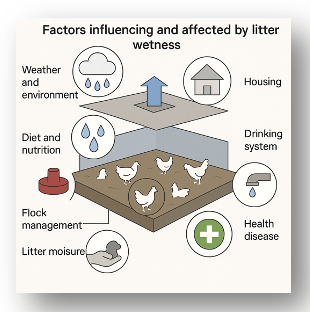
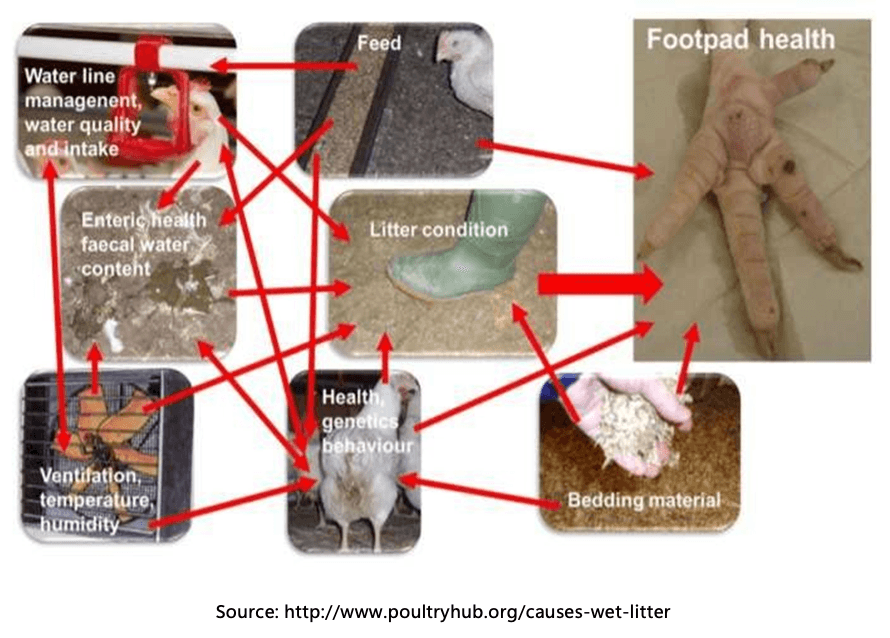
The causes of wet litter are multifactorial and interconnected, and key influences include:
- Housing design - flooring type, insulation, ventilation effectiveness.
- Environmental conditions – temperature, humidity, air exchange rates.
- Water management – drinker leakage, spillage, condensation, or shed leaks.
- Litter type and quantity – material properties, depth, and re-use cycles.
- Management practices – stock density, heating strategy, and manure handling.
Management perspective:
No single dominant cause of wet litter exists. Instead, management practices determine whether risk factors become problems. For example, poor water-holding litter may not cause issues if additional bedding or effective ventilation is provided. Likewise, excess shed humidity can be managed by adjusting ventilation or heating. Preventive steps, such as maintaining drinker lines, regulating water pressure, and repairing leaks, are often more effective than reactive measures. Ultimately, the knowledge and skills of farm staff play a decisive role. While research often focuses on litter materials or shed design, day- to-day practices such as timely bedding additions, equipment maintenance, and careful water management are critical for preventing wet litter and maintaining a healthy flock environment.
B. Litter Material Properties:
The properties of bedding materials play a central role in determining whether litter remains dry or becomes wet during a grow- out. Large amounts of water are continuously added to the litter through bird excretion and drinker spillage. Estimates suggest up to 3.2 L/m² per day may be deposited, leading to more than 100 L/m² over a 56-day cycle. A flock of 20,000 birds alone may excrete 2,500 L/ day. While modern shed design and ventilation can manage this normal load, additional risks arise if evaporation is reduced (e.g. during high humidity) or if extra water is added through poor diet, disease, or certain feed ingredients.
For effective performance, the bedding materials should combine good water- holding capacity with fast drying rates. Other critical traits include friability (the ability to stay loose and workable by birds, resistance to caking, and control of water activity to limit microbial growth. These qualities directly influence how litter interacts with moisture and how long it maintains a suitable condition.

Research has compared a wide range of bedding types, including wood products (sawdust, shavings, bark, chips), rice hulls, peanut hulls, corn cobs, sand, straw, sugarcane bagasse, shredded paper, and clay. Moisture content values alone can be misleading when comparing bedding types, because bulk density strongly affects water capacity per floor area. Another key property is friability, as friable litter stays loose, allows bird scratching, maintains aerobic conditions, and speeds drying. As moisture increases, particles become more cohesive, reducing friability and increasing the risk of cake formation. Thresholds have been described where litter is:
- Free-flowing at 10% moisture,
- Easy flowing at 18%,
- Cohesive/sticky at 22–31%.
This relationship is explained by rising water activity, which causes particles to soften, stick, and eventually form a dense, low- porosity crust. Once caking occurs, wet litter problems escalate and compromise both flock health and shed environment.
C. Manure Cake Formation:
Cake is a compressed, moist layer on the litter surface that holds feces and increases bird contact with moisture, leading to dermatitis and disease risk. It develops when litter moisture is high and friability is reduced, preventing fresh excreta from mixing into the bedding. Larger particle bedding materials such as straw, rice hulls, bagasse, and pine needles accelerate caking, while pine shavings are less prone. Cake layers can reach 5– 10 cm in thickness. Management usually involves de- caking, where the layer is removed, or tilling, where it is broken and mixed into litter. However, cake tends to reform if moisture remains high.
D. Water Activity and Wet Litter:
Water activity (Aw) reflects the availability of free water in litter and is more closely linked to microbial, chemical, and physical changes than total moisture content. High Aw favors growth of both bacteria and fungi. For example, growth thresholds include 0.95 for E. coli, 0. 92– 0. 95 for Salmonella spp, 0. 90– 0. 97 for Clostridium spp, 0.98 for Campylobacter spp, and 0.75–0. 85 for Aspergillus spp. Research shows that keeping Aw below 0. 90 (25– 35 % moisture) suppresses Salmonella and E. coli, while levels below 0. 84 further reduce pathogen survival.
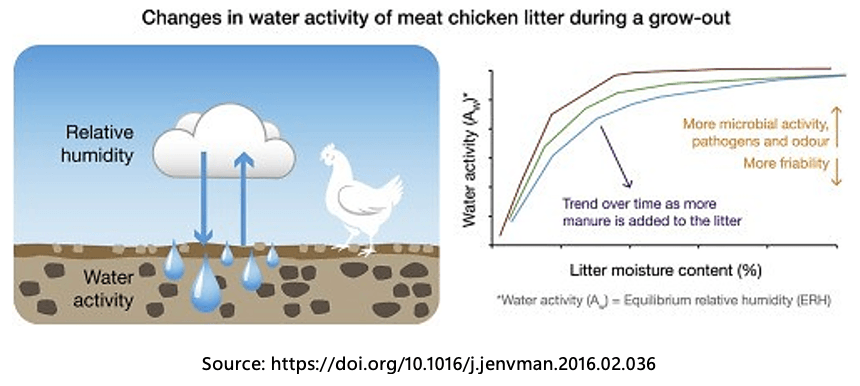
Aw rises non- linearly with moisture, reaching 0.98–0.99 when litter moisture exceeds 38– 55 %, similar to fresh excreta. If litter Aw equals or exceeds excreta, droppings remain wet. Therefore, maintaining litter moisture below 30–35 % is critical. Aw also interacts with shed humidity moisture moves in or out of litter depending on gradients so ventilation, heating, and humidity control are essential to limit wet litter.
E. Housing and Ventilation:
Shed design and ventilation strongly influence litter by controlling temperature, humidity, and airflow. Relative humidity above 72– 75 % is sufficient to cause wet litter and caking. Proper insulation, thermostatically controlled ventilation, and temperature regulation help prevent condensation and excess water absorption.
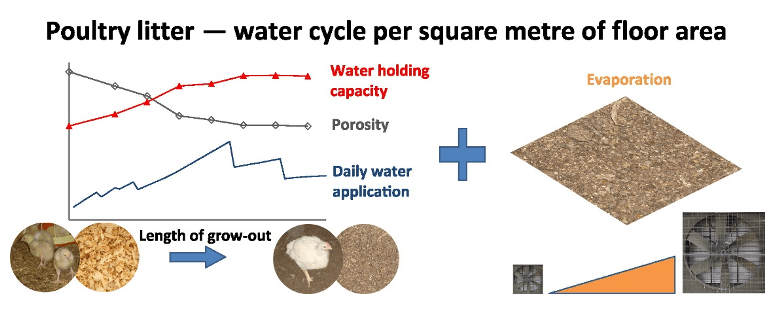
Poor ventilation, such as side- only systems, leads to uneven airflow, condensation, and localised wet spots, while excessive airflow can stress birds and cause crowding. The key is achieving uniform airflow that conditions incoming air to hold moisture and evenly dries litter. Since farm sheds vary widely, universal solutions are difficult; however, ventilation systems must continuously adapt to modern genetics and nutrition that increase water excretion, making effective airflow and humidity control essential for litter management.
F. Disease and Health Factors:
Diseases that cause diarrhoea are major contributors to wet litter condition, with intestinal coccidiosis (E. maxima, E. acervulina, E. necatrix) and necrotic enteritis (Clostridium perfringens) being most important. These often occur together, and while AGPs have been widely used to prevent outbreaks, global pressure is pushing towards vaccines and alternative strategies. Dysbacteriosis, linked to imbalanced gut flora, soluble NSP, coccidia, and C. perfringens, also leads to greasy droppings between 20 –30 days of age but can be reduced through dietary management and probiotics. Other reported diseases include Infectious Bronchitis, IBD, biogenic amine toxicity, and runting– stunting syndrome. Whole grain feeding has been shown to improve gut integrity and reduce dilated proventriculus. While diseases can worsen litter moisture, they usually act as secondary triggers, with environment, nutrition, and management playing the primary role.
G. Nutritional Factors and Wet Litter:
Wet litter is strongly influenced by nutrition, especially water intake. Poor gut integrity or excess nutrients increase water loss via diarrhoea or urine. Diets must closely match flock requirements to minimize voluntary water intake. Viscous grains like wheat and barley (rich in soluble NSP) can cause wet litter, but NSP- degrading enzymes (xylanase, β- glucanase) largely mitigate this. Similarly, phytase use has sometimes been linked to wet litter, though this was more related to higher soybean meal inclusion instead of animal proteins. Phytase alters calcium (Ca), phosphorus (P), and sodium (Na) interactions, which affect litter quality. Correct application of matrix values for Ca, P, and Na is crucial, as excessive Ca or high dietary electrolyte balance (DEB) can worsen litter moisture. Phytase improves Na digestibility, influencing nutrient absorption but also altering water balance. Studies show that adjusting Ca, P, and Na reduces litter moisture significantly. Grain Na variability and water hardness (Ca, Mg levels) also contribute.
H. Footpad Dermatitis (FPD) and Wet Litter:
FPD (foot-burn) arises mainly from excessive litter moisture and ammonia, making it both an economic loss (chicken paws are highly valuable) and a welfare issue. Validated FPD scoring and automated foot scanning are now used in processing plants. Prevention focuses on keeping litter dry, especially in early rearing.
Conclusion:
Wet litter in poultry sheds is a complex issue arising from multiple interrelated causes. Among these micro- environment and housing factors contribute most directly, while disease and nutrition play secondary but significant roles. Preventive measures such as drinker management, ventilation (RH 50– 60 %), and balanced use of Ca, P, Na, and DEB are critical. Enzymes and whole grain feeding can further support gut integrity and litter quality. Since FPD prevalence can affect up to 30– 40 % of birds, improving litter conditions is essential for both welfare and economics. Ultimately, a combination of research, extension, and education is required to sustainably reduce wet litter problems.
Note: The content of this article is based on a survey review (Dunlop et al., 2016, https:// doi. org/ 10.1016/ j.scitotenv. 2016. 03. 147) and may differ from individual reference findings.
Related topics:
Authors:

Recommend
Comment
Share

Would you like to discuss another topic? Create a new post to engage with experts in the community.











FIGAP MEXICO 2026 - INTERNATIONAL EXHIBITION
FIGAP Mexico is the International Exhibition for the Feed Industry
Hy-Line International
Hy-Line International is a laying hen genetics company. Its flagship lines are the Hy-Line W-80, Hy-Line W-36, and Hy-Line Brown
Featured users in Poultry Industry