The Role of Preharvest Natural Infection and Toxin Contamination in Food and Feed Safety in Maize, South-East Hungary, 2014–2021
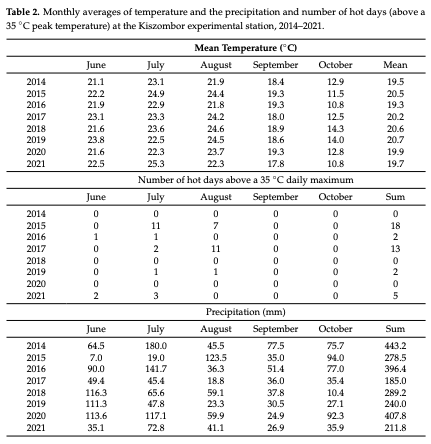
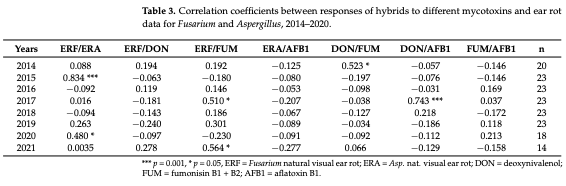
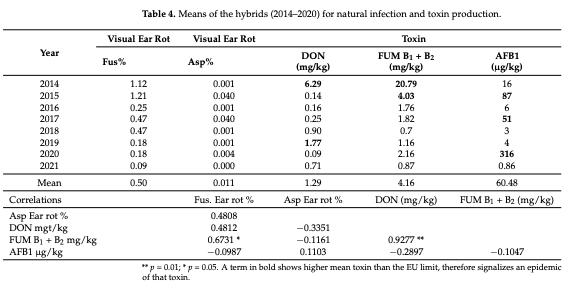
Mycotoxins originating in the preharvest period represent a less studied research problem, even though they are of the utmost practical significance in maize production, determining marketability (within EU limits), and storage ability, competitiveness, and profit rate. In this study, 18–23 commercial hybrids were tested between 2014 and 2021. Natural infection from Fusarium spp. was higher than 1.5%, and for Aspergillus spp. this was normally 0.01% or 0, much lower than would be considered as severe infection. In spite of this, many hybrids provided far higher toxin contamination than regulations allow. The maximum preharvest aflatoxin B1 was in 2020 (at 2286 µg/kg), and, in several cases, the value was higher than 1000 µg/kg. The hybrid differences were large. In Hungary, the presence of field-originated aflatoxin B1 was continuous, with three AFB1 epidemics in the 8 years. The highest DON contamination was in 2014 (at 27 mg/kg), and a detectable DON level was found in every hybrid. FUMB1+B2 were the highest in 2014 (at 45.78 mg/kg). At these low infection levels, correlations between visual symptoms and toxin contaminations were mostly non-significant, so it is not feasible to draw a conclusion about toxin contamination from ear rot coverage alone. The toxin contamination of hybrids for a percentage of visual infection is highly variable, and only toxin data can decide about food safety. Hybrids with no visual symptoms and high AFB1 contamination were also identified. Preharvest control, including breeding and variety registration, is therefore of the utmost importance to all three pathogens. Even natural ear rot and toxin data do not prove differences in resistance, so a high ear rot or toxin contamination level should be considered as a risk factor for hybrids. The toxin control of freshly harvested grain is vital for separating healthy and contaminated lots. In addition, proper growing and storage conditions must be ensured to protect the feed safety of the grain.
Keywords: preharvest mycotoxins; Fusarium graminearum; Fusarium verticillioides; Aspergillus flavus; deoxynivalenol; fumonisin; aflatoxin; natural infection; natural toxin contamination; changing environmental conditions
1. Introduction
![Table 1. Mycotoxin contamination of moldy and regular corn samples in Hungary, 1993–1999 [24]. The line row for means and rate M/R was calculated by Mesterhazy (2022).](/_next/image/?url=https%3A%2F%2Fimages.engormix.com%2FE_articles%2F56598_711.png&w=1200&q=100)
2. Materials and Methods
2.1. Field Tests
2.1.1. Plant Material
2.1.2. Experimental Design
2.1.3. Harvest, Evaluation of Infection, and Sample Preparation
2.2. Toxin Analysis
2.2.1. Sample Preparation
2.2.2. Chromatography
2.2.3. MS/MS Analysis
2.3. Statistical Methods
3. Results
3.1. Natural Ear Rot and Toxin Contamination of Hybrids, 2014–2021
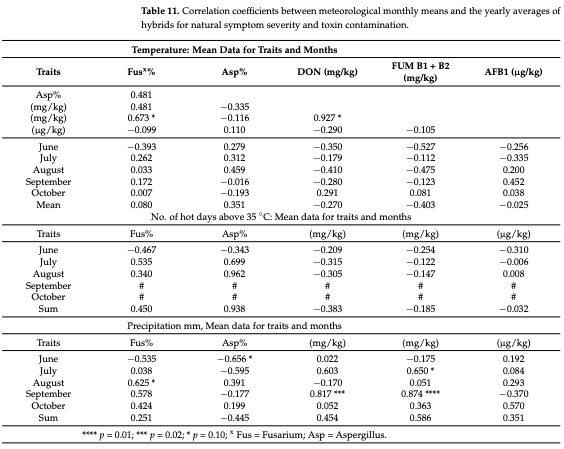
3.2. Correlations between Natural Ear Rot Infection Severity and Natural Toxin Contamination
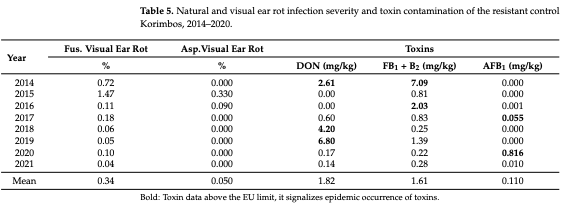
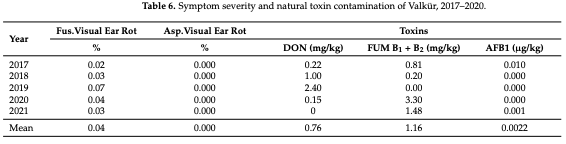
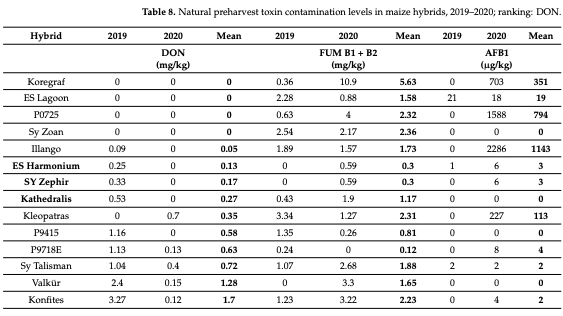
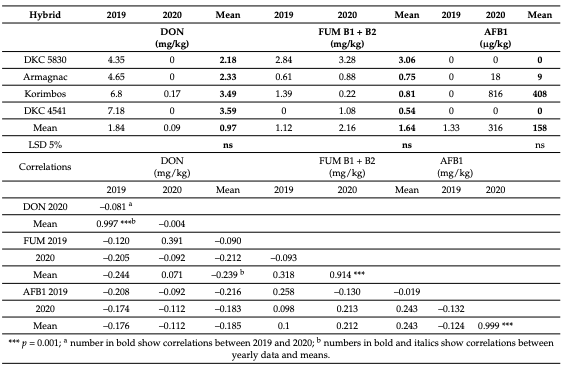
3.3. Natural Toxin Contamination in Two Years’ Trials, 2017/2018 and 2019/2020
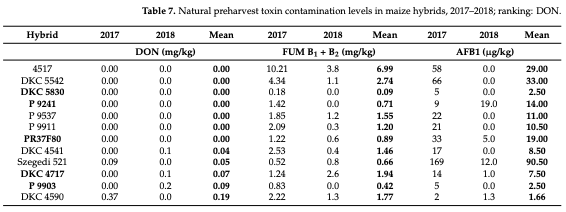
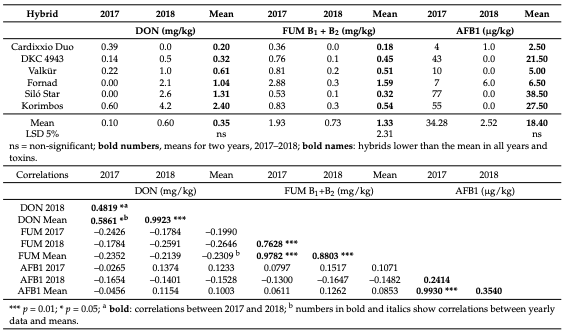
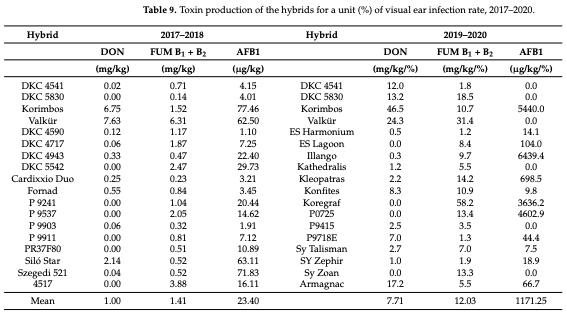
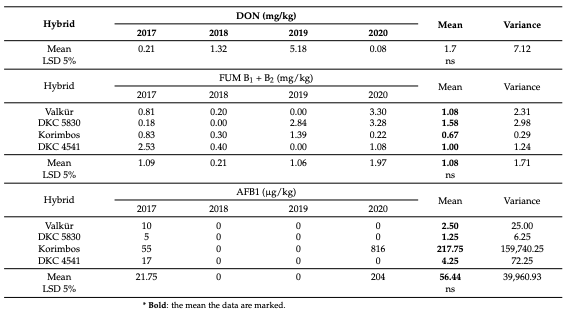
3.4. Toxin Production for 1% Ear Rot Coverage
4. Discussion
4.1. Mycotoxins and Their Preharvest Character
4.2. Reasons for Controversial Visual Ear Rot and Toxin Data
4.3. Toxin Forecasting
4.4. What Is the Usefullness of Natural Toxin Data?
4.5. Adaptation to Environmental Stresses
4.6. Control Measurements
5. Conclusions
1. Christensen, C.M.; Kaufmann, H.H. Grain Storage, the Role of Fungi in Quality Loss; University of Minnesota Press: Minneapolis, MN, USA, 1969; Library of Congress Catalog Card number: 70-76174; 153p.
2. Document 32006R1881; Commission Regulation (EC) No 1881/2006 of 19 December 2006 setting maximum levels for certain contaminants in foodstuffs; Official Journal of the European Union: Brussels, Belgium, 2006; L 364/5.
3. Document 32002L0032; Commission Regulation Directive 2002/32/EC of the European Parliament and of the Council of 7 May 2002 on undesirable substances in animal feed; Official Journal of the European Union: Brussels, Belgium, 2002; 2002L0032—EN—20.10.2006—006.001—1, (OJ L 140, 30.5, p. 10).
4. Commission Regulation 2006/576/EC; Commission recommendation of 17 August 2006 on the presence of deoxynivalenol, zearalenone, ochratoxin A, T-2 and HT-2 and fumonisins in products intended for animal feeding; Official Journal of the European Union: Brussels, Belgium, 2006; Volume I.229, pp. 7–9.
5. Desjardins, A.E. Fusarium Mycotoxins, Chemistry, Genetics, and Biology; American Phytopathological Society (APS) Press: St. Paul, MN, USA, 2016; 260p., ISBN 10-0-89054-335-6.
6. Logrieco, A.; Visconti, A. (Eds.) An Overview on Toxigenic Fungi and Mycotoxins in Europe; Kluwer Academic Publishers: Dordrecht, The Netherlands, 2004; 252p., ISBN 1-4020-2645-5.
7. Munkvold, G.P.; White, D.G. (Eds.) Compendium of Corn Diseases; The American Phytopathological Society (APS) Press: St. Paul, MN, USA, 2016; 165p.
8. Mesterházy, Á.; Bartók, T.; Kászonyi, G.; Varga, M.; Tóth, B.; Varga, J. Common resistance to different Fusarium spp. causing Fusarium head blight in wheat. Eur. J. Plant Path. 2005, 112, 267–281. [CrossRef]
9. Shotwell, O.L.; Hesseltine, C.W.; Goulden, M.L. Incidence of aflatoxin in southern corn, 1969–1970. Cereal Sci. Today 1973, 18, 192–196.
10. Anderson, H.W.; Nehring, E.W.; Wichser, W.R. Aflatoxin contamination of corn in the field. J. Agric. Food Chem. 1975, 23, 775–782. [CrossRef] [PubMed]
11. Lillehoj, E.B.; Kwolek, W.F.; Fennell, D.I.; Milburn, M.S. Aflatoxin incidence and association with bright greenish yellow fluorescence and insect damage in a limited survey of freshly harvested high-moisture corn. Cereal Chem. 1975, 52, 403–412.
12. Widstrom, N.W. Breeding strategies to control aflatoxin contamination of maize through host plant resistance. In Aflatoxin in Maize: Proceedings of the Workshop; Zuber, M.S., Lillehoj, E.B., Renfro, B.L., Eds.; CIMMYT: México-Veracruz, El Batán, Mexico, 1987; pp. 212–220.
13. Fennel, D.; Lillehoj, E.B.; Kwolek, W.F. Aspergillus flavus and other fungi associated with insect-damaged field corn. Cereal Chem. 1975, 52, 314–321.
14. Payne, G.A. Aspergillus flavus infection of maize: Silks and kernels. In Aflatoxin in Maize: Proceedings of the Workshop; Zuber, M.S., Lillehoj, E.B., Renfro, B.L., Eds.; CIMMYT: México-Veracruz, El Batán, Mexico, 1987; pp. 119–129.
15. Lillehoj, E.B.; Kwolek, W.F.; Manwiller, A.; Du Rant, J.A.; La Prade, J.C.; Homer, E.S.; Reid, J.; Zuber, M.S. Aflatoxin production in several corn hybrids grown in South Carolina and Florida. Crop Sci. 1976, 16, 483–485. [CrossRef]
16. Abbas, H.K.; Cartwright, R.D.; Xie, W.; Shier, W.T. Aflatoxin and fumonisin contamination of corn (Zea mays) hybrids in Arkansas. Crop Prot. 2006, 25, 1–9. [CrossRef]
17. Gursoy, N.; Bicici, M. A review on current situation of toxigenic fungi and mycotoxin formation in Turkey. In An Overview on Toxigenic Fungi and Mycotoxins in Europe; Logrieco, A., Visconti, A., Eds.; Kluwer Academic Publishers: Dordrecht, The Netherlands, 2004; pp. 237–246. 252p., ISBN 1-4020-2645-5.
18. Abbas, H.K.; Mascagni, H.J., Jr.; Bruns, H.A.; Shier, W.T.; Damann, K.E. Effect of planting density, irrigation regimes, and maize hybrids with varying ear size on yield, and aflatoxin and fumonisin contamination levels. Am. J. Plant Sci. 2012, 3, 1341–1354. [CrossRef]
19. Abbas, H.K.; Zablotowicz, R.M.; Shier, W.T.; Johnson, B.J.; Phillips, N.A.; Weaver, M.A.; Abel, C.A.; Bruns, H.A. Aflatoxin and fumonisin in corn (Zea mays) infected by common smut Ustilago maydis. Plant Dis. 2015, 99, 1236–1240. [CrossRef]
20. Lillehoj, E.B. The aflatoxin-in-maize problem: The historical perspective. In Aflatoxin in Maize: Proceedings of the Workshop; Zuber, M.S., Lillehoj, E.B., Renfro, B.L., Eds.; CIMMYT: México-Veracruz, El Batán, Mexico, 1987; pp. 13–30. ISBN 968-6127-12-7.
21. Astoreca, A.; Vaamonde, G.; Dalcero, A.; Marin, S.; Ramos, A. Abiotic factors, and their interactions influence on the co-production of aflatoxin B1 and cyclopiazonic acid by Aspergillus flavus isolated from corn. Food Microbiol. 2014, 38, 276–283. [CrossRef]
22. Castaneda, N.; Laguna, S.; Rodríguez, Y.; Anguiano, G.L.; Guzmán-de-Peña, D. Limestone effect upon aflatoxin in naturally contaminated corn (Abstr.). In Aflatoxin and fumonisin elimination and fungal genomics workshops, San Antonio, Texas, 23–25 October 2002. Mycopathologia 2004, 157, 428.
23. Moretti, A.; Logrieco, A.; Visconti, A.; Bottalico, A. An overview of mycotoxins and toxigenic fungi in Italy. In An Overview on Toxigenic Fungi and Mycotoxins in Europe; Logrieco, A., Visconti, A., Eds.; Kluwer Academic Publishers: Dordrecht, The Netherlands, 2004; pp. 141–160. 252p., ISBN 1-4020-2645-5.
24. Varga, J.; Tóth, B.; Mesterházy, A.; Téren, J.; Fazekas, B. Mycotoxigenic fungi and mycotoxins in foods and feeds in Hungary. In An Overview on Toxigenic Fungi and Mycotoxins in Europe; Logrieco, A., Visconti, A., Eds.; Kluwer Academic Publishers: Dordrecht, The Netherlands, 2004; pp. 123–139. 252p., ISBN 1-4020-2645-5.
25. Masic, Z.; Bocarov-Stancic, A.; Sinovec, Z.; Dilas, S.; Adamovic, M. Mycotoxins in food in Serbia and Montenegro. In An Overview on Toxigenic Fungi and Mycotoxins in Europe; Logrieco, A., Visconti, A., Eds.; Kluwer Academic Publishers: Dordrecht, The Netherlands, 2004; pp. 201–218. 252p., ISBN 1-4020-2645-5.
26. Mesterházy, Á.; Szieberth, D.; Szabó, B.; Berényi, A.; Tóth, B. Mycotoxin contamination of maize (Zea mays L.) samples in Hungary, 2012–2017. Cereal Res. Comm. 2022, 50, 1–9. [CrossRef]
27. Bhatnagar, D.; Rajasekaran, K.; Cary, J.W.; Brown, R.L.; Yu, J.; Cleveland, T.E. Molecular Approaches to Development of Resistance to Preharvest Aflatoxin Contamination. In Mycotoxins: Detection Methods, Management, Public Health and Agricultural Trade; CABI (CAB International): Cambridge, MA, USA, 2008; pp. 257–276.
28. Cleveland, T.E.; Dowd, P.F.; Desjardins, A.E.; Bhatnagar, D.; Cotty, P.J. United States Department of Agriculture–Agricultural Research Service research on pre-harvest prevention of mycotoxins and mycotoxigenic fungi in US crops. Pest Manag. Sci. 2003, 59, 629–642. [CrossRef]
29. Akello, J.; Ortega-Beltran, A.; Katati, B.; Atehnkeng, J.; Augusto, J.; Mwila, C.M.; Mahuku, G.; Chikoye, D.; Bandyopadhyay, R. Prevalence of aflatoxin- and fumonisin-producing fungi associated with cereal crops grown in Zimbabwe and their associated risks in a climate change scenario. Foods 2021, 10, 287. [CrossRef]
30. Magan, N.; Medina, A.; Aldred, D. Possible climate-change effects on mycotoxin contamination of food crops pre- and postharvest. Plant Pathol. 2011, 60, 150–163. [CrossRef]
31. Rossi, V.; Scandolara, A.; Battilani, P. Effect of environmental conditions on spore production by Fusarium verticillioides, the causal agent of maize ear rot. Eur. J. Plant Pathol. 2009, 123, 159–169. [CrossRef]
32. Giorni, P.; Magan, N.; Battilani, P. Environmental factors modify carbon nutritional patterns and niche overlap between Aspergillus flavus and Fusarium verticillioides strains from maize. Int. J. Food Microbiol. 2009, 130, 213–218. [CrossRef]
33. Bush, B.J.; Carson, M.L.; Cubeta, M.A.; Hagler, W.M.; Payne, G.A. Infection and fumonisin production by Fusarium verticillioides in developing maize kernels. Phytopathology 2004, 94, 88–93. [CrossRef]
34. Klich, M.A. Aspergillus flavus: The major producer of aflatoxin. Mol. Plant Path. 2007, 8, 713–722. [CrossRef]
35. Miedaner, T.; Juroszek, P. Global warming and increasing maize cultivation demand comprehensive efforts in disease and insect resistance breeding in north-western Europe. Plant Pathol. 2021, 70, 1032–1046. [CrossRef]
36. Buric, D.; Doderovic, M. Projected temperature changes in Kolašin (Montenegro) up to 2100 according to EBU-POM and ALADIN regional climate models. Q. J. Hung. Meteorol. Serv. 2020, 124, 427–445. [CrossRef]
37. Yu, J.; Hennessy, D.A.; Tack, J.; Wu, F. Climate change will increase aflatoxin presence in US corn. Environ. Res. Lett. 2022, 17, 054017. [CrossRef]
38. Battilani, P.; Toscano, P.; Van der Fels-Klerck, H.J.; Moretti, A.; Leggieri, M.C.; Brera, C.; Rortais, A.; Goumperis, T.; Robinson, T. Aflatoxin B1 contamination in maize in Europe increases due to climate change. Sci. Rep. 2016, 6, 24328. [CrossRef] [PubMed]
39. Chauhan, Y.S.; Wright, G.C.; Rachaputi, N.C. Modelling climatic risks of aflatoxin contamination in maize. Aust. J. Exp. Agric. 2008, 48, 358–366. [CrossRef]
40. Chauhan, Y.; Tatnell, J.; Krosch, S.; Karanja, J.; Gnonlonfin, B.; Wanjuki, I.; Wainaina, J.; Harvey, J. An improved simulation model to predict pre-harvest aflatoxin risk in maize. Field Crops Res. 2015, 178, 91–99. [CrossRef]
41. Damianidis, D.; Ortiz, B.V.; Bowen, K.L.; Windham, G.L.; Hoogenboom, G.; Hagan, A.; Knappenberger, T.; Abbas, H.K.; Scully, B.T.; Mourtzinis, S. Minimum temperature, rainfall, and agronomic management impacts on corn grain aflatoxin contamination. Agron. J. 2018, 110, 1697–1708. [CrossRef]
42. Moretti, A.; Pascale, M.; Logrieco, A.F. Mycotoxin risks under a climate change scenario in Europe. Trends Food Sci. Technol. 2019, 84, 38–40. [CrossRef]
43. Mesterházy, Á.; Lemmens, M.; Reid, L.M. Breeding for resistance to ear rots caused by Fusarium spp. in maize—A review. Plant Breed. 2012, 131, 1–19. [CrossRef]
44. Van der Fels-Klerx, H.J.; Vermeulen, L.C.; Gavai, A.K.; Liu, C. Climate change impacts on aflatoxin B1 in maize and aflatoxin M1 in milk: A case study of maize grown in Eastern Europe and imported to the Netherlands. PLoS ONE 2019, 14, e0218956. [CrossRef]
45. Rodriguez, A.; Sultan, Y.; Magan, N. Climate change factors and Aspergillus flavus: Effects on gene expression, growth, and aflatoxin production. World Mycotoxin J. 2015, 8, 171–179.
46. Gasperini, A.M.; Rodriguez-Sixtos, A.; Verheecke-Vaessen, C.; Garcia-Cela, E.; Medina, A.; Magan, N. Resilience of biocontrol for aflatoxin minimization strategies: Climate change abiotic factors may affect control in non-GM and GM-maize cultivars. Front. Microbiol. 2019, 10, 2525. [CrossRef]
47. Bandyopadhyay, R.; Atehnkeng, J.; Ortega-Beltran, A.; Akande, A.; Falade, T.D.O.; Cotty, P.J. "Ground-truthing" efficacy of biological control for aflatoxin mitigation in farmers' fields in Nigeria: From field trials to commercial usage, a 10-year study. Front. Microbiol. 2019, 10, 2528. [CrossRef]
48. Mesterhazy, A.; Szieberth, D.; Toldine, E.T.; Nagy, Z.; Szabó, B.; Herczig, B.; Bors, I.; Tóth, B. Updating the Methodology of Identifying Maize Hybrids Resistant to Ear Rot Pathogens and Their Toxins—Artificial Inoculation Tests for Kernel Resistance to Fusarium graminearum, F. verticillioides, and Aspergillus flavus. J. Fungi 2022, 8, 293. [CrossRef]
49. Mesterhazy, A. Resistance of corn to Fusarium ear rot and its relation to seedling resistance. Phytopath. Z. 1982, 103, 218–231. [CrossRef]
50. Mesterhazy, A. Relationship between resistance to stalk rot and ear rot of corn influenced by rind resistance, premature death, and the rate of drying of the ear. Maydica 1983, 28, 425–437.
51. Mesterhazy, A.; Kovács, K. Breeding corn against fusarial stalk rot, ear rot and seedling blight. Acta Phytopath. Acad. Sci. Hung. 1986, 21, 231–249.
52. Szabó, B.; Toth, B.; Toth Toldine, E.; Varga, M.; Kovacs, N.; Varga, J.; Kocsube, S.; Palagyi, A.; Bagi, F.; Budakov, D.; et al. A new concept to secure food safety standards against Fusarium species and Aspergillus flavus and their toxins in maize. Toxins 2018, 10, 372. [CrossRef]
53. Mesterhazy, A.; Toldine Toth, E.; Szel, S.; Varga, M.; Toth, B. Resistance of maize hybrids to Fusarium graminearum, F. culmorum, and F. verticillioides ear rots with toothpick and silk channel inoculation, as well as their toxin production. Agronomy 2020, 10, 1283. [CrossRef]
54. Hong, S.B.; Go, S.J.; Shin, H.D.; Frisvad, J.C.; Samson, R.A. Polyphasic taxonomy of Aspergillus fumigatus and related species. Mycologia 2005, 97, 1316–1329. [CrossRef]
55. Anonymous. Analytical procedure of Bonafarm Babolna Feed UPLC-MS/MS method, approved by the National Accreditation Authority under the code NAH-1254-14-1560/2016, issued on 14 December 2016, approval for mycotoxins was issued under No. BBVM-111:2015. Available online: www.babolnatakarmany.hu/labor (accessed on 12 October 2021).
56. Sváb, J. Biometriai Módszerek a Kutatásban (Methods for Biometrics in Research), 3rd ed.; Mezőgazdasági Kiadó (Agr. Publ. House): Budapest, Hungary, 1981; 557p, ISBN 963-231-0136.
57. Weber, E. Grundriss der Biologischen Statistik (Fundaments of the Biological Statistics); VEB Fisher Verlag: Jena, Germany, 1967; 706p.
58. Lanubile, A.; Machietto, V.; Marocco, A. Breeding maize for resistance to mycotoxins. In Mycotoxin Reduction in Grain Chains; Leslie, J.F., Logrieco, A.F., Eds.; Wiley Blackwell: Oxford, UK, 2014; pp. 37–58. 352p, ISBN 978-0-8138-2083-5.
59. Pechanova, O.; Pechan, T.; Williams, W.P.; Luthe, D.S. Proteomic analysis of maize rachis: Potential roles of constitutive and induced proteins in resistance to Aspergillus flavus infection and aflatoxin accumulation. Proteomics 2011, 11, 114–127. [CrossRef]
60. Pechanova, O.; Pechan, T. Maize–pathogen interactions: An ongoing combat from a proteomics perspective. Int. J. Mol. Sci. 2015, 16, 28429–28448. [CrossRef]
61. Smart, M.G.; Wicklow, D.T.; Caldwell, R.W. Pathogenesis of Aspergillus ear rot of maize: Light microscopy of fungal spread from wounds. Phytopathology 1990, 80, 1287–1294. [CrossRef]
62. Mesterházy, Á.; Kovács, G., Jr.; Kovács, K. Breeding resistance for Fusarium ear rot (FER) in corn. In Proceedings of the 18th International Conference on Maize and Sorghum Genetics and Breeding, Belgrade, Yugoslavia, 4–9 June 2000; Acta Biologica Iugoslavica, Serija F, Genetika; Volume 32, pp. 495–505.
63. Kelly, S.M.; Wallin, J.R. Systemic infection of maize plants by Aspergillus flavus. In Aflatoxin in Maize: Proceedings of the Workshop; Zuber, M.S., Lillehoj, E.B., Renfro, B.L., Eds.; CIMMYT: México-Veracruz, El Batán, Mexico, 1987; pp. 187–193.
64. Payne, G.A. Process of contamination by aflatoxin-producing fungi and their impact on crops. In Mycotoxins in Agriculture and Food Safety; Bhatnagar, D., Sinha, K.K., Eds.; CRC Press: Boca Raton, FL, USA, 1998; pp. 279–310. 520p, ISBN 9780824701925.
65. Barnett, N.M.; Naylor, A.W. Amino acid and protein metabolism in Bermuda grass during water stress. Plant Physiol. 1966, 41, 1222–1230. [CrossRef]
66. Payne, G.A.; Hagler, W.M. Effect of specific amino acids on growth and aflatoxin production by Aspergillus parasiticus and Aspergillus flavus in defined media. Appl. Environ. Microbiol. 1983, 46, 805–812. [CrossRef]
67. Amaike, S.; Keller, N.P. Aspergillus flavus. Annu. Rev. Phytopathol. 2011, 49, 107–133. [CrossRef]
68. Cotty, P.J.; Bhatnagar, D. Variability among atoxigenic Aspergillus flavus strains in ability to prevent aflatoxin contamination and production of aflatoxin biosynthetic pathway enzymes. Appl. Environ. Microbiol. 1994, 60, 2248–2252. [CrossRef]
69. Battilani, P.; Barbano, C.; Piva, G. Aflatoxin B1 contamination in maize related to the aridity index in North Italy. World Mycotoxin J. 2008, 1, 449–456. [CrossRef]
70. Battilani, P.; Pietri, A.; Barbano, C.; Scandolara, A.; Bertuzzi, T.; Marocco, A. Logistic regression modeling of cropping systems to predict fumonisin contamination in maize. J. Agric. Food Chem. 2008, 56, 10433–10438. [CrossRef]
71. Thompson, M.E.H.; Raizada, M.N. Fungal pathogens of maize gaining free passage along the silk road. Pathogens 2018, 7, 81. [CrossRef]
72. Wilson, D.M.; Payne, G.A. Factors affecting Aspergillus flavus group infection and aflatoxin contamination of crops. In The Toxicology of Aflatoxins: Human Health, Veterinary and Agricultural Significance; Eaton, D.L., Groopman, J.D., Eds.; Academic Press: San Diego, CA, USA, 1994; pp. 309–325.
73. Battilani, P.; Leggieri, M.C.; Rossi, V.; Giorni, P. AFLA-maize, a mechanistic model for Aspergillus flavus infection and aflatoxin B1 contamination in maize. Comput. Electron. Agric. 2013, 94, 38–46. [CrossRef]
74. Miraglia, M.; Marvin, H.J.P.; Kleter, G.A.; Battilani, P.; Brera, C.; Coni, E.; Cubadda, F.; Croci, L.; De Santis, B.; Dekkers, S.; et al. Climate change and food safety: An emerging issue with special focus on Europe. Food Chem. Toxicol. 2009, 47, 1009–1021. [CrossRef] [PubMed]
75. Assunção, R.; Martins, C.; Viegas, S.; Viegas, C.; Jakobsen, L.S.; Pires, S.; Alvito, P. Climate change and the health impact of aflatoxins exposure in Portugal—An overview. Food Addit. Contam. Part A 2018, 35, 1610–1621. [CrossRef] [PubMed]
76. EFSA (European Food Safety Authority); Maggiore, A.; Afonso, A.; Barrucci, F.; De Sanctis, G. Climate change as a driver of emerging risks for food and feed safety, plant, animal health and nutritional quality. EFSA Supporting Publications 2020, EN-1881, 146. [CrossRef]
77. Brown, R.L.; Bhatnagar, D. Foreword: Aflatoxins in maize and other crops. World Mycotoxin Journal 2015, 8, 135–136. [CrossRef]
78. Gaikpa, D.S.; Miedaner, T. Genomics-assisted breeding for ear rot resistances and reduced mycotoxin contamination in maize: Methods, advances, and prospects. Theoretical and Applied Genetics 2019, 132, 2721–2739. [CrossRef]
79. Hruska, Z.; Yao, H.; Kincaid, R.; Tao, F.; Brown, R.L.; Cleveland, T.E.; Rajasekaran, K.; Bhatnagar, D. Spectral-based screening approach evaluating two specific maize lines with divergent resistance to invasion by aflatoxigenic fungi. Frontiers in Microbiology 2020, 10, 3152. [CrossRef]
80. Logrieco, A.F.; Battilani, P.; Leggieri, C.M.; Haesaert, G.; Jiang, Y.; Lanubile, A.; Mahuku, G.; Mesterhazy, A.; Ortega-Beltran, A.; Pasti, M.A.; et al. Perspectives on global mycotoxin issues and management from the MycoKey Maize Working Group. Plant Disease 2020, 105, 525–537. [CrossRef]
81. Blaney, B.J.; O'Keeffe, K.O.; Bricknell, L.K. Managing mycotoxins in maize: Case studies. Australian Journal of Experimental Agriculture 2007, 47. In press. Available online: https://www.researchgate.net/profile/Barry-Blaney/publication/29660388 (accessed on 23 May 2019).
82. Logrieco, A.; Mule, G.; Moretti, A.; Bottalico, A. Toxigenic Fusarium species and mycotoxins associated with maize ear rot in Europe. European Journal of Plant Pathology 2002, 108, 597–609. [CrossRef]
83. Mesterházy, Á.; Vojtovics, M. A kukorica Fusarium okozta fertőzöttségének vizsgálata 1972–1975-ben (Investigation of Fusarium species in corn kernels 1972–1975). Növénytermelés 1977, 26, 367–378.
84. Wu, F.; Mitchell, N.J. How climate change and regulations can affect the economics of mycotoxins. World Mycotoxin Journal 2016, 9, 653–663. [CrossRef]
85. Medina, A.; Rodriguez, A.; Magan, N. Effect of climate change on Aspergillus flavus and aflatoxin B1 production. Frontiers in Microbiology 2014, 5, 348. [CrossRef]
86. Mesterházy, Á.; Varga, M.; Tóth, B.; Kótai, C.; Bartók, T.; Véha, A.; Ács, K.; Vágvölgyi, C.; Lehoczki-Krsjak, S. Reduction of deoxynivalenol (DON) contamination by improved fungicide use in wheat. Part 2. Farm scale tests with different nozzle types and updating the integrated approach. European Journal of Plant Pathology 2018, 151, 1–20. [CrossRef]
87. Mesterhazy, A. Updating the Breeding Philosophy of Wheat to Fusarium Head Blight (FHB): Resistance Components, QTL Identification and Phenotyping—A review. Plants 2020, 9, 1702. [CrossRef]
88. Mauro, A.; Battilani, P.; Cotty, J.P. Atoxigenic Aspergillus flavus endemic to Italy for biocontrol of aflatoxins in maize. BioControl 2014, 60, 125–134. [CrossRef]
89. Steward, P.R.; Thierfelder, C.; Dougill, A.J.; Ligowe, I. Conservation agriculture enhances resistance of maize to climate stress in a Malawian medium-term trial. Agriculture, Ecosystems & Environment 2019, 277, 95–104. [CrossRef]
90. Pruter, L.S.; Weaver, M.; Brewer, M.J. Overview of risk factors and strategies for management of insect-derived ear injury and aflatoxin accumulation for maize grown in subtropical areas of North America. Journal of Integrated Pest Management 2020, 11, 13. [CrossRef]
91. Dowd, P.F. Involvement of arthropods in the establishment of mycotoxigenic fungi under field conditions. In Mycotoxins in Agriculture and Food Safety; Sinha, K.K., Bhatnagar, D., Eds.; Marcel Dekker, Inc.: New York, NY, USA, 1998; pp. 307–350.
92. Wu, F.; Guclu, H. Aflatoxin regulations in a network of global maize trade. PLoS ONE 2012, 7, e45151. [CrossRef]
93. Alberts, J.; Rheeder, J.; Gelderblom, W.; Shephard, G.; Burger, H.-M. Rural subsistence maize farming in South Africa: Risk assessment and intervention models for reduction of exposure to fumonisin mycotoxins. Toxins 2019, 11, 334. [CrossRef]
94. Mesterházy, Á.; Oláh, J.; Popp, J. Losses in the grain supply chain: Causes and solutions. Sustainability 2020, 12, 2342. [CrossRef]
95. Mesterhazy, A.; Szabó, B.; Szél, S.; Nagy, Z.; Berényi, A.; Tóth, B. Novel Insights into the Inheritance of Gibberella Ear Rot (GER), Deoxynivalenol (DON) Accumulation, and DON Production. Toxins 2022, 14, 583. [CrossRef]