Explore

Advertise on Engormix

Differential Expression of Hypothalamic Genes in Laying Hens Housed in Caged and Cage-Free Systems Under Commercial Conditions in the Tropics

Published: May 18, 2026
Source : Roy Rodriguez-Hernández 1; María Paula Herrera-Sánchez 1,2; Rafael Suárez-Mesa 2; Edgar Oviedo-Rondón 3 and Iang Schroniltgen Rondón-Barragán 1,2.
Summary

Author details:
1 Poultry Research Group, Faculty of Veterinary Medicine and Zootechnics, University of Tolima, Altos de Santa Helena, Ibagué, Tolima, Colombia; 2 Immunobiology and Pathogenesis Research Group, Faculty of Veterinary Medicine and Zootechnics, University of Tolima, Ibagué, Tolima, Colombia; 3 Prestage Department of Poultry Science, North Carolina State University, Raleigh, NC, USA.

Growing public concern regarding animal welfare and food quality in intensive production systems has increased research interest in the welfare of farm animals, especially laying hens. Welfare evaluations have traditionally been based on the Five Freedoms framework and physiological and behavioral stress indicators, such as corticosterone levels; however, inconsistencies in these measures underscore the need for complementary assessment tools.

In this study, a transcriptomic approach was used to investigate gene expression in laying hens housed in two different egg production systems as an exploratory study. Hypothalamic gene expression profiles were compared between hens raised in conventional cages and those raised in cage-free systems under commercial conditions.

The results revealed that housing conditions associated with each production system significantly influence hypothalamic gene expression. Pivotal differences were found in pathways related to hormonal activity, cytoskeletal structure, and neuropeptide hormone signaling.

Abstract

Increasing concerns over animal welfare and food quality in intensive animal production systems have motivated enhanced scientific investigation into farm animal welfare, particularly laying hens. Traditional welfare assessments have relied mainly on the Five Freedoms framework and stress indicators such as corticosterone levels and behavioral responses; however, the reliability of these measurements can vary, necessitating the exploration of alternative methods.

This research utilizes transcriptomic methodology to gain a deeper understanding of the genetic mechanisms influencing animal welfare in egg production systems. This study examined the hypothalamic transcriptome from hens reared under two distinct egg production systems: conventional cages and cage-free environments.

Our findings indicated that the housing conditions associated with the egg production system can modulate genetic expression within the hypothalamus. The production systems affected pathways related to hormone activity, cytoskeletal organization, and neuropeptide hormone function, influencing feed intake, hormone regulation, metabolism, and stress response.

Keywords

welfare; hens; omics; production; RNA-Seq

Introduction

Global consumers have ongoing concerns about the effects of animal production systems on animal welfare and their effects on quality attributes of food products from intensive production systems [1]. Due to consumer concerns, research on animal welfare has been strengthened [2]. Welfare has become one of the most important and essential topics for modern animal production because animals are sentient beings capable of suffering and experiencing emotional states [3,4]. Several studies highlight the effects of environments on the welfare and egg quality of laying hens across different production systems [5–8]. Hens housed in poor welfare conditions experience increased stress, reduced egg production, and higher mortality rates [9,10]. However, animal welfare measurements have been primarily based on the Five Freedoms, with a focus on preventing unnecessary suffering, especially in production animals [11]. For years, the stress response has been used as an indicator for welfare monitoring in response to stressful factors, such as environmental, social, and health conditions, and research on stress has focused on the adrenal glands to measure corticosterone, heterophils/lymphocytes, cortisol levels in eggs, feathers, and serum, as well as behavior patterns [12–16]. Nevertheless, these indicators have shown varying results depending on the sample time, and some have been found unreliable or difficult to apply in large bird populations [12,17]. Therefore, alternatives that complement classical measurements, provide new data insight into production animals’ welfare issues, or find new biomarkers are needed.
Nowadays, omics methodologies provide a comprehensive strategy for the thorough examination of biological systems and responses that represent the composition and operational mechanisms of a specific biological system within a particular context or level [18]. Transcriptomics, a powerful tool in molecular biology, has revolutionized animal welfare research by providing insights into the genetic mechanisms underlying growth, development, welfare, and discovery of new biomarkers for specific clinically and economically important physiological and pathological conditions, which allows for a more holistic perspective of animal welfare [11,19–21]. The hypothalamus is responsible for integrating various internal and external stimuli and coordinating the body’s physiological and behavioral responses to stressors, and likewise, it is a key component of the hypothalamic–pituitary–adrenal axis, which is the primary neuroendocrine system involved in the stress response [22,23]. The hypothalamus also regulates other physiological processes relevant to animal welfare, such as body temperature, feeding behavior, and metabolism [24–26]. The hypothalamus integrates and coordinates the physiological and behavioral responses to environmental and internal challenges, making it a crucial target for animal welfare research and assessment [22,27,28]. This study aimed to identify differentially expressed genes in the hypothalamus tissues from hens housed in two production systems in commercial conditions as a hypothesis-generating screen to prioritize candidate genes and pathways associated with CC versus CF housing under commercial conditions.

2. Materials and Methods

2.1. Animals and Management

This research was conducted at a commercial farm situated in Ibague city, Tolima department, central Colombia (between 02◦52′59′′–05◦19′59′′ N latitude and 74◦24′18′′–76◦06′23′′ W longitude), at an elevation of 1250 m above sea level with an average temperature of 25 ◦C. The Tolima department is positioned between the central and eastern mountain ranges of the Colombian Andes.
A total of 60,000 one-day-old Hy-Line Brown pullets were placed in cages measuring 76.22 × 66.05 m at a stocking density of 16 birds per cage (315 cm2/bird). Until 15 weeks of age, all pullets were reared under uniform sanitary conditions, management practices, and feeding protocols. Subsequently, the same flock was divided and transferred to two distinct housing systems—conventional cage (CC) and cage-free (CF)—within the same facility until 82 weeks of age.
In the CC system, 45,000 hens were housed in pyramidal multi-deck batteries of vertical cages within Californian-style facilities (40 × 40 × 45 cm per cage), equipped with four levels, nipple drinkers, and cooling panel ventilation. Each cage accommodated four hens (450 cm2/hen). For the purposes of this study, 720 hens were evaluated across 15 replicates of 12 cages each (48 birds/replicate), totaling 180 cages assessed in the CC system.
The CF system utilized aviary-type housing with deep-litter floors comprising rice husks, conventional house structures with open mesh-sided sheds, and natural wind-based ventilation. Each house featured communal two-level wooden nest boxes (10 nests per level, 40 × 40 × 40 cm per nest; five hens/nest) and 4 m of perch space per level. A total of 14,850 hens were distributed among two poultry houses at a density of 1111 cm2/bird. These were further divided into 15 rooms used as CF replicates, with 990 hens per room.
Environmental temperature and humidity were recorded hourly over 26 weeks (24 h/day, 7 days/week) using a Hobo data logger (Onset Corp., Cape Cod, MA, USA), resulting in 10,145 data points. Recorded temperatures showed minimal variation, with CF averaging 24.45 ± 2.80 ◦C and CC averaging 24.7 ± 2.81 ◦C; humidity differed by 7% between the two systems throughout the study.
Lighting was managed following the Hy-Line Brown Commercial Management Guide, employing cool-white LED fixtures at an intensity of 15–20 lux at bird head level and maintaining a 14 h light:10 h dark photoperiod during production. Diets were formulated in accordance with Hy-Line Brown Layer Management Guidelines and were consistent for both housing systems based on age. Overall health and nutritional management adhered strictly to standard poultry company policies.

2.2. Sample Collection

From each housing system, clinically normal hens were selected using a predefined screening and randomization procedure. Eligibility criteria included the following: normal posture and gait; absence of respiratory signs, diarrhea, or external lesions; normal feather coverage for age; no evidence of severe keel deviation on palpation; and absence of overt ectoparasite infestation. From eligible birds, individuals were randomly selected using computer-generated random numbers applied to cage/pen location lists to ensure spatial dispersion within the house. At 80 weeks of age, six hens (CC: n = 3; CF: n = 3) were selected as biological replicates, since as a welfare study, we applied the principles of the three Rs to reduce the impact on the animals. Hens were euthanized by cervical dislocation followed by decapitation. Brains were rapidly removed, and the hypothalamus was dissected using standard avian neuroanatomical landmarks: rostral boundary at the optic chiasm, caudal boundary at the mammillary bodies, dorsal boundary at the hypothalamic sulcus, and lateral boundaries adjacent to the third ventricle. Approximately 50–100 mg of hypothalamic tissue per hen was collected, immediately placed in RNAlater® stabilization solution (ThermoFisher Scientific, Waltham, MA, USA), and stored at −20 ◦C. The tissue samples were then sent to Novogene laboratory (Sacramento, CA, USA) for processing.

2.3. RNA Isolation

Total RNA was isolated from the hypothalamus of three hens housed in CC and three hens housed CF using the QIAGEN RNeasy Plus Mini kit (Qiagen, Hilden, Germany) and following the protocol, according to the manufacturer’s instructions. RNA degradation and contamination were visualized on 1% agarose gels. RNA purity was checked using a NanoPhotometer® spectrophotometer (IMPLEN, Westlake Village, CA, USA) and concentrations were determined using the Qubit® RNA Assay Kit in Qubit® 2.0 Fluorometer (Life Technologies, Carlsbad, CA, USA). RNA integrity and quantitation were assessed using the RNA Nano 6000 Assay Kit of the Bioanalyzer 2100 system (Agilent Technologies, Santa Clara, CA, USA).

2.4. Library Preparation and Transcriptome Sequencing

A total of 1 µg RNA per sample was utilized as input for RNA sample preparation. Sequencing libraries were constructed with the NEBNext® UltraTM RNA Library Prep Kit for Illumina® (NEB, Ipswich, MA, USA), in accordance with the manufacturer’s guidelines, and index codes were incorporated to assign sequences to respective samples. mRNA was isolated from total RNA using poly-T oligo-attached magnetic beads. Fragmentation was conducted via divalent cations at elevated temperatures in NEBNext First Strand Synthesis Reaction Buffer (5X) (New England Biolabs, Ipswich, MA, USA). Subsequently, first-strand cDNA synthesis was performed using random hexamer primers and M-MuLV Reverse Transcriptase (RNase H-) (APExBIO, Houston, TX, USA), while second-strand synthesis employed DNA Polymerase I and RNase H. Exonuclease and polymerase activities converted residual overhangs into blunt ends. Following adenylation of 3’ termini, NEBNext Adaptor with a hairpin loop was ligated to facilitate hybridization. For selection of cDNA fragments preferentially ranging from 150 to 200 bp, purification was conducted with the AMPure XP system (Beckman Coulter, Beverly, MA, USA). Next, 3 µL USER Enzyme (NEB, USA) was applied to size-selected, adaptor-ligated cDNA at 37 ◦C for 15 min and subsequently at 95 ◦C for 5 min prior to PCR amplification. PCR was executed using Phusion High-Fidelity DNA Polymerase (New England Biolabs, Ipswich, MA, USA), Universal PCR Primers, and Index (X) Primer. The resulting PCR products were purified (AMPure XP system) and assessed for library quality on the Agilent Bioanalyzer 2100 system.
Transcriptome sequencing was carried out using NovaSeq 6000 PE150 (Illumina, San Diego, CA, USA). Raw paired-end reads underwent quality assessment (FastQC) and sample-wide summarization (MultiQC); adaptors and low-quality bases were removed following standard trimming protocols. Clean reads were mapped to the chicken reference genome (https://www.ncbi.nlm.nih.gov/assembly/GCF_000002315.6/) (accessed on 20 December 2021). Reference genome indexing was completed and paired-end clean reads were aligned using HISAT2 version 2.0.5 (Johns Hopkins University Center for Computational Biology, Washington, DC, USA). Read quantification was conducted using Feature Counts version 1.5.0-p3 (Bioconductor, Seattle, WA, USA). Gene expression levels were estimated by calculating fragments per kilobase million (FPKM) based on gene length and read count. Differentially expressed genes (DEGs) between cage and cage-free groups were identified using the DESeq2 package. Library size normalization was applied, and dispersion parameters were estimated using empirical Bayes shrinkage. Genes exhibiting p adj < 0.05 and log2 - fold change < −1 or > 1 were classified as differentially expressed.

2.5. Functional Analysis of Differentially Expressed Genes

Differentially expressed genes (DEGs) were used for Gene Ontology (GO—categorizes genes based on function) and Kyoto Encyclopedia of Genes and Genomes (KEGG—focuses on identifying how genes are involved in specific, well-defined biological pathways and networks) enrichment analyses using the clusterProfiler package (Version 4.12.0) with the org.Gg.eg.db annotation database (Version 3.19.1) in R (Version 4.4.0) [29]. Enrichment was conducted against a background universe defined as all genes retained after expression filtering and tested in the DESeq2 model. Ensemble gene identifiers were mapped to Entrez IDs prior to enrichment. Over-representation analysis was performed using the hypergeometric framework implemented in clusterProfiler; multiple testing across terms was controlled using the Benjamini–Hochberg procedure, and GO/KEGG terms were considered significant at q-value < 0.05.

3. Results

Given the small number of biological replicates (n = 3 per system), this study is exploratory in nature. We prioritized the detection of broad and consistent effects and interpreted the DEG set as a prioritized list of candidate genes that allow us to generate hypotheses about the potential effects of the production system.

3.1. Raw Sequence Reads

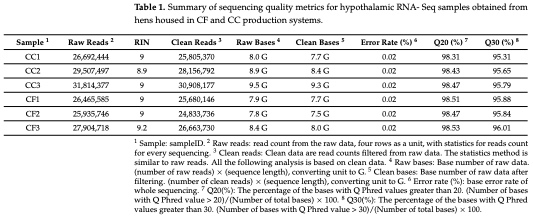
A total of six cDNA libraries were constructed from the hypothalamus of laying hens housed in CC and CF systems, and the raw reads for each library were between 25 and 31 million; after filtering to remove low-quality and linker sequences, between 22 and 30 million clean reads remained. Among these clean reads, more than 98% had quality scores at Q20, and more than 95% at Q30 levels, (Table 1), with GC contents between 49.58 and 50.26%
Table 1. Summary of sequencing quality metrics for hypothalamic RNA- Seq samples obtained from hens housed in CF and CC production systems.
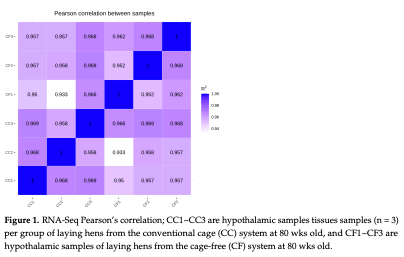
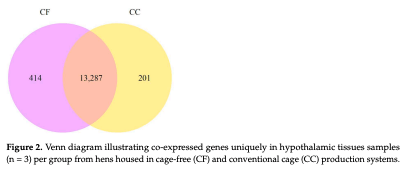
Pairwise Pearson correlations of gene expression levels among samples were high (r > 0.952; Figure 1) and were used as descriptive quality control for library-level consistency. However, given that n = 3 per system, these correlations should not be interpreted as statistical evidence of within-system homogeneity. Furthermore, 414 genes were uniquely expressed in CF and 201 in CC, with 13,287 genes co-expressed in hypothalamus tissues from hens housed in CF and CC production systems (Figure 2).

3.2. Differentially Expressed Genes
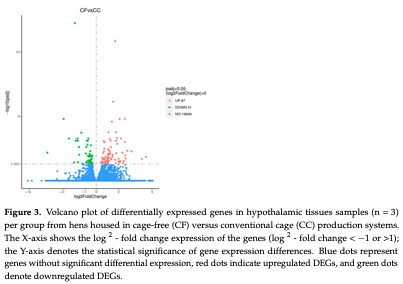
A total of 138 differentially expressed genes (DEGs) were identified in the hypothalamic tissues of the CF group versus CC group, of which 87 were upregulated and 51 were downregulated (Figure 3).
Figure 1. RNA-Seq Pearson’s correlation; CC1~CC3 are hypothalamic samples tissues samples (n = 3) per group of laying hens from the conventional cage (CC) system at 80 wks old, and CF1~CF3 are hypothalamic samples of laying hens from the cage-free (CF) system at 80 wks old.
Figure 2. Venn diagram illustrating co-expressed genes uniquely in hypothalamic tissues samples (n = 3) per group from hens housed in cage-free (CF) and conventional cage (CC) production systems.
Figure 3. Volcano plot of differentially expressed genes in hypothalamic tissues samples (n = 3) per group from hens housed in cage-free (CF) versus conventional cage (CC) production systems. The X-axis shows the log 2 - fold change expression of the genes (log 2 - fold change < −1 or > 1); the Y-axis denotes the statistical significance of gene expression differences. Blue dots represent genes without significant differential expression, red dots indicate upregulated DEGs, and green dots denote downregulated DEGs.
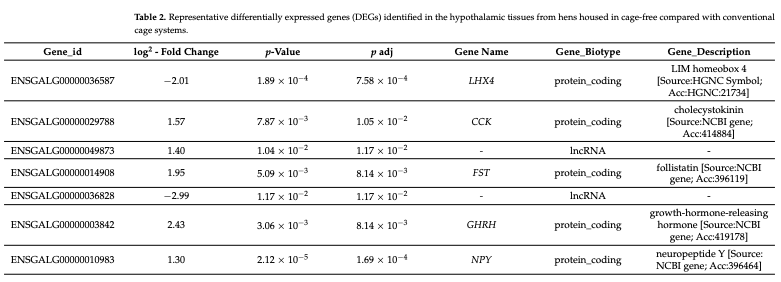
The most representative DEGs were LHX, CCK, FST, GHRH, NPY and others listed in Table 2. All DEGs are shown in Supplementary Table S1.
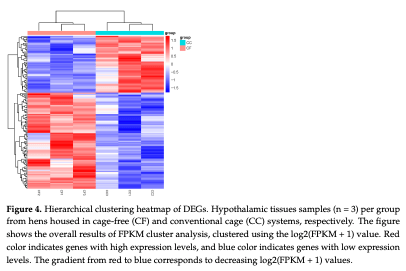
The FPKM hierarchical clustering map (Figure 4) visually reflects the expression patterns of the genes in the samples and highlights the reproducibility and reliability of the dataset. The groups of CC and CF are grouped in different clades.
Figure 4. Hierarchical clustering heatmap of DEGs. Hypothalamic tissues samples (n = 3) per group from hens housed in cage-free (CF) and conventional cage (CC) systems, respectively. The figure shows the overall results of FPKM cluster analysis, clustered using the log2(FPKM + 1) value. Red color indicates genes with high expression levels, and blue color indicates genes with low expression levels. The gradient from red to blue corresponds to decreasing log2(FPKM + 1) values.

3.3. Functional Analysis

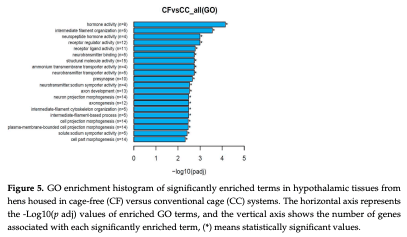
Enrichment analysis of the DEGs was performed to identify biological functions and pathways significantly associated with the observed transcriptional differences. Using a threshold of p < 0.05, the comparison between the CF and CC group yielded 30 enriched Biological Process terms, 15 Cellular Component terms, and 15 Molecular Function terms. The most DEGs were involved in hormone activity pathways (n = 8), followed by intermediate filament organization pathways (n = 5) and neuropeptide hormone activity pathways (n = 4) (p-value < 0.05) (Figure 5).
Figure 5. GO enrichment histogram of significantly enriched terms in hypothalamic tissues from hens housed in cage-free (CF) versus conventional cage (CC) systems. The horizontal axis represents the -Log10(p adj) values of enriched GO terms, and the vertical axis shows the number of genes associated with each significantly enriched term, (*) means statistically significant values.
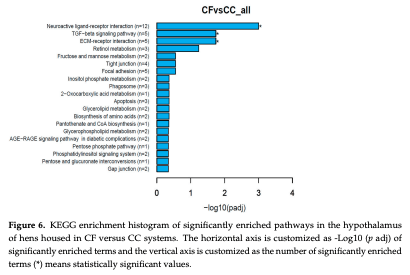
These DEGs were related to structural molecular activity, plasma-membrane-bounded cells, neuron projection morphogenesis, cell projection morphogenesis, and cell part morphogenesis (Figure 5). In the KEGG pathway analysis, three significantly enriched pathways were identified: neuroactive ligand–receptor interaction (12 genes), ECM–receptor interaction (5 genes), and the TGF-beta signaling pathway (5 genes) (Figure 6).
Figure 6. KEGG enrichment histogram of significantly enriched pathways in the hypothalamus of hens housed in CF versus CC systems. The horizontal axis is customized as -Log10 (p adj) of significantly enriched terms and the vertical axis is customized as the number of significantly enriched terms (*) means statistically significant values.

4. Discussion

Animal welfare has become a significant issue in modern animal production and welfare parameters have become increasingly important compared with other egg quality attributes [1]. Likewise, it has been shown that restrictive production systems affect the welfare of laying hens due to limiting behavior, increasing social stress, and causing cage-related physical and anxiety-associated problems. These concerns have led to regulatory reassessments in the European Union and several U.S. states [16,30].
It has been shown that the conditions in which birds are kept can affect the expression of genes related to oxidative stress, bone formation, and productive performance, among other aspects, in laying hens housed in both caged and cage-free systems [31–33]. Additionally, hens showed differences in egg and meat quality between CC and CF systems [8,34].
The hypothalamus plays a central role in regulating physiological and behavioral responses to stress, metabolism, and reproduction [35–37]. It coordinates essential processes such as thermoregulation, appetite, and growth by stimulating the pituitary gland to secrete hormones that modulate multiple endocrine and physiological systems [38]. This occurs because the hypothalamus controls the input and output of information to and from the autonomic, neuroendocrine, and central nervous systems [39]. Activation of the autonomic nervous system during stress prepares the animal for the fight-or-flight response [40,41]. In conventional cages, hens may experience insufficient physical stimulation, leading to metabolic disorders and frustration due to the lack of nesting opportunities [42]. In contrast, cage-free systems such as aviaries offer hens greater behavioral freedom but may also increase the incidence of aggression and cannibalism [42,43].
The hypothalamus integrates internal and external cues and is therefore a plausible target for housing-associated transcriptional modulation. Cage-free environments allow hens to perform natural behaviors such as foraging, nesting, and social interaction, which may enhance hypothalamic function and improve physiological and behavioral regulation [39,42,44]. Furthermore, hens in the aviary demonstrated increased physical activity and reduced anxiety-like behaviors, suggesting that increased space and environmental complexity provided by the cage-free system may benefit hens’ psychological state [45,46]. In the present study, we did not collect concurrent behavioral or physiological welfare endpoints in the sequenced individuals; therefore, any links between hypothalamic transcriptional differences and welfare should be considered hypothesis-generating and interpreted in the context of prior phenotypic literature.
Transcriptome studies include the research by Wang and Ma [47], which sequenced and analyzed the hypothalamus and pituitary expression profiles in high- and low-yielding laying Chinese Dagu chickens. A total of 39 DEGs were identified in the six pituitary cDNA libraries, including 20 upregulated genes (GFRA4, LAMA1, CFD, ESR1) and 19 downregulated genes (OVCH2, VCAN, CATHL2, SLC7A10) in low-yielding hens. In the six hypothalamic cDNA libraries, seven DEGs were found, of which four were upregulated. Three were downregulated (MANBAL1, XYLT2L) in low-yielding hens. DEGs were mainly enriched in glycosaminoglycan biosynthesis in the KEGG pathway, showing one of the first glycosyltransferases (XYLT2L) discovered. Changes in XYLT in hypothalamic tissues served as biomarkers for diseases associated with fibrosis and/or extracellular matrix turnover. Likewise, Ma et al. [48] compared laying hen breeds with different egg-laying rates and showed 753 DEGs in the hypothalamus, including 383 upregulated and 370 downregulated genes. They proposed MRE11A and MAP7 as core regulators of egg laying performance. Also, Xu et al. [49] conducted RNA sequencing of hypothalamic and pituitary tissues from low- and high-yielding Changshun green-shell laying hens to identify critical pathways and candidate genes associated with egg production rate. Their analysis highlighted ion channel genes (KCNG4, KCNC4, and KCNV1), as well as genes involved in signal transduction (PARD6A, CREB3L3, OTP, MIOX, CNTN6, GPR68, SSTR4, CARTPT, NMS, GAD2, CPLX1, and TAFA1). Moreover, transcriptomic analyses of the hypothalamus have also been used to investigate other biological processes in chickens, such as incubation behavior. Chen et al. [50] identified key pathways and candidate genes associated with incubation in Changshun green-shell hens, an indigenous chicken breed from China, by comparing the hypothalamic transcriptome between the egg-laying and incubation period, reporting five candidate genes (POMC, IGF1R, CHAD, VCL, and MYL9) with putative regulatory roles of incubation behavior in chickens.
Despite these findings, there remains limited information on transcriptomic studies performed on hypothalamic tissue of laying hens from the same genetic line raised under identical conditions until 16 weeks of age and then subjected to two different types of production systems, CC and CF, and how the systems could influence gene expression. Our study evaluated the transcriptome of laying hens housed in two production systems, CC and CF, to elucidate the regulatory mechanisms underlying differential gene expression associated with potential stress caused by the production system.
RNA-Seq technology allows for detecting and quantifying differential gene expression, as well as interactions between genes that could influence the complexity of biological system through pathway analysis [51]. In our study, clean reads were obtained for each sample between 24,833,736 and 30,908,177 with a Q30 from 95.31% to 96.01% for the CC and CF groups, respectively. The values obtained in this study are lower than the read counts reported by Mishra et al. [32], who obtained 368,631,338 and 404,984,978 reads including hypothalamus samples. Other research reported higher clean-read counts between 39,184,490 and 46,344,096 but with lower Q30 from 92.73% to 93.45% [52]. However, a lower number of clean reads have been reported with values ranging from 19,695,915 to 24,200,913 with Q30 from 94.79% to 95.30% [50]. Gene expression was quantified using the FPKM normalization method, and the Pearson correlation coefficient among biological replicates exceeded 0.952. This value surpassed those reported by Ma et al. [48] and Chen et al. [50], which were greater than 0.859 and 0.795, respectively. As indicated by these authors, this higher correlation coefficient, as observed in our study, demonstrates the efficacy of biological replicates. Furthermore, 414 genes were uniquely expressed in the CF group, 201 genes were uniquely expressed in the CC group, and 13,287 genes were co-expressed in the hypothalamus tissues examined. Previous studies have reported 15,307 and 14,190 expressed genes in the hypothalamus of chickens fed low-energy diets and with different egg-laying rates, with a higher number compared to our results [48,53].
The exploratory analysis identified 138 genes differentially expressed in the hypothalamus from hens housed CF compared to CC (p adj < 0.05). Among these, 51 genes were downregulated and 87 were upregulated. Some upregulated genes were CCK, FST, GHRH, and NPY, while LHX4 was identified as a downregulated gene. The CCK gene encodes the hormone cholecystokinin, a satiety hormone that also functions as a neurotransmitter [54,55]. In chickens, the CCK gene has been reported to have higher expression in the hypothalamus than in the small intestine and other visceral regions [54]. The expression of this gene increases in hypothalamic tissues subjected to heat stress, as well as its levels in the intestine and serum [56,57]. However, a notable reduction in CCK gene expression levels in hens exposed to higher temperatures has been reported [58]. Furthermore, higher levels of CCK in the brain may affect feed intake by reducing the amount of food consumed due to high metabolic rates [55,58]. Neuropeptide Y (NPY) and CCK jointly participate in regulating appetite, and increased expression of both genes has been associated with feed intake stimulation. [59]. It has been observed that laying hens housed in CF systems tend to exhibit greater locomotor activity and higher feed consumption, which may be influenced by increased expression of NPY and CCK, potentially enhancing intestinal motility [56].
The FST gene encodes the protein follistatin, which has been studied in the oviduct of laying hens [60,61]. Follistatin promotes proliferation and differentiation of luminal epithelial cells, contributing to improved eggshell formation [60]. However, follistatin has been reported to inhibit activin through an antagonistic mechanism and regulate follicle-stimulating hormone (FSH) levels in neuronal cells [62]. In broiler chickens, FST gene expression in the hypothalamus has been linked to organ development [38]. In laying hens, the FST gene has been studied for its role during reproduction, and it has been found to be upregulated in the hypothalamus during the incubation phase [61]. In our study, the increased expression of FST in the CF group in our study may reflect enhanced nesting or incubation-related behaviors, which hens can express more freely in CF environments than the hens housed in CC [9]. Another upregulated gene was the gene which encodes growth-hormone-releasing hormone [63]. This hormone modulates growth hormone (GH) production and contributes to appetite regulation in avian species [58,63]. The expression of this gene is affected by high ambient temperature, where their expression is significantly decreased in heat-exposed chickens [64]. This may be due to reduced feed intake in stressed animals, and the impact of elevated corticosterone (CORT) levels on GH expression [64,65]. In our study, the GHRH gene was upregulated in the CF group but downregulated in the CC group, suggesting that the downregulation of GHRH in the CC group could potentially affect muscle growth and weight [64].
The LHX4 gene codifies the LIM homeobox 4 protein, which is crucial for the development of the pituitary gland and for the differentiation of cells responsible for producing Adrenocorticotropic Hormone (ACTH) and GH, two hormones critical for metabolism, growth, and stress response [66,67]. In addition, mutations in this gene can cause combined pituitary hormone deficiency, including disorders linked to impaired GH production [68]. This study did not evaluate mutations in the LHX4 gene, and further research is needed to determine their function in the chicken hypothalamus. However, the upregulation of the LHX4 gene in the CC group may be related to increased cell survival in the tissues, as during periods of stress, apoptosis and autophagy pathways can be activated as adaptive responses to maintain cellular homeostasis [69,70]. Thus, the increased LHX4 expression in CC-housed birds in our study could reflect a compensatory mechanism associated with tissue regulation, and this overexpression could be associated with stress-induced activation of the hypothalamic–pituitary–adrenal axis in birds possibly associated with the system and its restrictions. On the other hand, long non-coding RNAs (lncRNAs) were significantly upregulated and downregulated. lncRNAs play key regulatory roles in gene transcription and participate in diverse cellular processes, including chromatin remodeling, transcriptional control, and post-transcriptional regulation [71]. Further studies are required to elucidate the mechanisms by which the differentially expressed lncRNAs identified in this analysis interact with protein-coding genes and influence hypothalamic function in hens raised under distinct production systems.
The function of differentially expressed genes was evaluated by GO and KEGG enrichment analysis. GO terms enriched in the CF versus CC comparison includes intermediate filament organization, hormonal activity, and neuropeptide hormone activity. In KEGG analysis, the enriched terms were neuroactive ligand–receptor interaction, ECM–receptor interaction, and TGF-beta signaling pathway. The neuroactive ligand–receptor interaction pathway corresponds closely to the GO terms of hormone activity and neuropeptide hormone activity and is involved in regulating neuronal and neuroendocrine signaling systems [72,73]. This suggests that the neuroactive ligand–receptor interaction pathway may play a key role in reproductive processes, stress response and brooding-behavior control in laying hens [74,75]. Another enriched pathway was the ECM–receptor interaction pathway. The extracellular matrix (ECM) is a complex network of macromolecules essential for maintaining cellular and tissue integrity and function, which was also enriched in the analysis [76]. Within this pathway, the COL1A2 gene, which encodes the collagen type I alpha 2 chain, was upregulated. ECM has been reported to regulate critical cellular processes such as adhesion, differentiation, and survival [77,78]. Previous research has reported greater enrichment of this pathway in ducks housed in cages compared to soil– water systems, suggesting that the housing system may affect collagen gene expression and potentially affect the skeletal muscle [74,79]. The TGF-beta signaling pathway was also enriched and has previously been associated with bone development, embryogenesis, and reproductive processes in chickens [80,81]. Under stress conditions, the hypothalamic TGF-beta pathway has been shown to play a role in heat stress adaptation in sows by mediating the assimilation of environmental signals [82]. A similar thermoregulatory or stress-modulating function could occur in the hypothalamus of chickens raised in intensive production systems. For all the reasons mentioned above, multi-omics strategies play a vital role in analyzing biological differences among animals [83], Recent studies, for example, have used single-cell transcriptomic technologies to investigate performance-related traits in chickens, including hypothalamic function [84,85]. Therefore, multi-omics approaches should be applied to hens housed in cage and cage-free production systems to more comprehensively explore the biological differences between these environments.
Our exploratory findings demonstrate that housing conditions can influence hypothalamic gene expression, particularly in pathways related to hormone activity, intermediate filament organization, and neuropeptide hormone signaling. These pathways are closely associated with the regulation of feed intake, FST-mediated reproductive processes, metabolic homeostasis, and physiological stress responses. Overall, our results provide molecular evidence that production systems can influence both neuroendocrine and physiological processes in laying hens. This transcriptomic analysis highlights the importance of considering housing conditions when assessing animal welfare in modern poultry production.

Limitations

A major limitation of this study is the relatively small sample size (n = 3 per group), which reduces statistical power and could limit the detection of differentially expressed genes with moderate effect sizes. The small number of biological replicates may also affect the stability of the dispersion estimates and the robustness of the GO and KEGG enrichment analyses. Therefore, the transcriptomic findings should be interpreted as exploratory and hypothesis-generating, rather than as definitive evidence of causal biological mechanisms.

5. Conclusions

This exploratory study shows that egg production systems can influence the hypothalamic gene in laying hens, particularly in pathways related to hormone signaling, metabolic regulation, and stress responses. These transcriptomic differences provide molecular evidence that housing conditions can affect neuroendocrine function, with important implications for animal welfare, productivity and long-term health. Multi-omics studies are needed to determine potential candidate genes that can serve as biomarkers for hen performance and welfare assessments.
   
This article was originally published in Animals 2026, 16, 671. https://doi.org/10.3390/ani16040671. This is an Open Access article under the terms and conditions of the Creative Commons Attribution (CC BY) license.

  • Alonso, M.E.; González-Montaña, J.R.; Lomillos, J.M. Consumers’ Concerns and Perceptions of Farm Animal Welfare. Animals 2020, 10, 385. [CrossRef] [PubMed]
  • Fraser, D.; Weary, D.M.; Pajor, E.A.; Milligan, B.N. A Scientific Conception of Animal Welfare that Reflects Ethical Concerns. Anim. Welf. 1997, 6, 187–205. [CrossRef]
  • Temple, D.; Manteca, X. Animal welfare in extensive production systems is still an area of concern. Front. Sustain. Food Syst. 2020, 4, 545902. [CrossRef]
  • Le Neindre, P.; Bernard, E.; Boissy, A.; Boivin, X.; Calandreau, L.; Delon, N.; Deputte, B.; Desmoulin-Canselier, S.; Dunier, M.; Faivre, N.; et al. Animal consciousness. EFSA Support. Publ. 2017, 14, 1196E. [CrossRef]
  • Barnett, J.L.; Hemsworth, P.H. Science and its application in assessing the welfare of laying hens in the egg industry. Aust. Vet. J. 2003, 81, 615–624. [CrossRef] [PubMed]
  • El-Sabrout, K.; Aggag, S.; Mishra, B. Advanced practical strategies to enhance table egg production. Scientifica 2022, 2022, 1393392. [CrossRef]
  • Tainika, B.; Şekeroğlu, A. Environmental enrichments in laying hen production systems with emphasis on welfare and egg quality. Turk. J. Agric.-Food Sci. Technol. 2021, 9, 1398–1406. [CrossRef]
  • Rodríguez-Hernández, R.; Rondón-Barragán, I.S.; Oviedo-Rondón, E.O. Egg Quality, Yolk Fatty Acid Profiles from Laying Hens Housed in Conventional Cage and Cage-Free Production Systems in the Andean Tropics. Animals 2024, 14, 168. [CrossRef]
  • Lay, D.C., Jr.; Fulton, R.M.; Hester, P.Y.; Karcher, D.M.; Kjaer, J.B.; Mench, J.A.; Mullens, B.A.; Newberry, R.C.; Nicol, C.J.; O’Sullivan, N.P.; et al. Hen welfare in different housing systems. Poult. Sci. 2011, 90, 278–294. [CrossRef]
  • Tahamtani, F.M.; Hansen, T.B.; Orritt, R.; Nicol, C.; Moe, R.O.; Janczak, A.M. Does rearing laying hens in aviaries adversely affect long-term welfare following transfer to furnished cages? PLoS ONE 2014, 9, e107357. [CrossRef]
  • Voogt, A.M.; Ursinus, W.W.; Sijm, D.T.; Bongers, J.H. From the Five Freedoms to a more holistic perspective on animal welfare in the Dutch Animals Act. Front. Anim. Sci. 2023, 4, 1026224. [CrossRef]
  • Tilbrook, A.J.; Fisher, A.D. Stress, health and the welfare of laying hens. Anim. Prod. Sci. 2020, 61, 931–943. [CrossRef]
  • Guevara, R.D.; Pastor, J.J.; Manteca, X.; Tedo, G.; Llonch, P. Systematic review of animal-based indicators to measure thermal, social, and immune-related stress in pigs. PLoS ONE 2022, 17, e0266524. [CrossRef]
  • Gross, W.B.; Siegel, H.S. Evaluation of the heterophil/lymphocyte ratio as a measure of stress in chickens. Avian Dis. 1983, 27, 972–979. [CrossRef]
  • Scanes, C.G. Biology of stress in poultry with emphasis on glucocorticoids and the heterophil to lymphocyte ratio. Poult. Sci. 2016, 95, 2208–2215. [CrossRef]
  • EFSA Panel on Animal Health Animal Welfare (AHAW); Nielsen, S.S.; Alvarez, J.; Bicout, D.J.; Calistri, P.; Canali, E.; Drewe, J.A.; Garin-Bastuji, B.; Gonzales Rojas, J.L.; Gortázar Schmidt, C.; et al. Welfare of laying hens on farm. EFSA J. 2023, 21, e07789. [CrossRef]
  • Siegford, J.M.; Berezowski, J.; Biswas, S.K.; Daigle, C.L.; Gebhardt-Henrich, S.G.; Hernandez, C.E.; Thurner, S.; Toscano, M.J. Assessing activity and location of individual laying hens in large groups using modern technology. Animals 2016, 6, 10. [CrossRef]
  • Dai, X.; Shen, L. Advances and trends in omics technology development. Front. Med. 2022, 9, 911861. [CrossRef]
  • Parreira, J.R.; de Sousa Araújo, S. Studying the animal transcriptome: State of the art and challenges in the context of animal and veterinary sciences. Proteom. Domest. Anim. Farm Syst. Biol. 2018, 421–446. [CrossRef]
  • Goossens, E.; Dehau, T.; Ducatelle, R.; Van Immerseel, F. Omics technologies in poultry health and productivity–part 2: Future applications in the poultry industry. Avian Pathol. 2022, 51, 418–423. [CrossRef]
  • Jia, X.; Kang, Z.; Wang, G.; Zhang, K.; Fu, X.; Li, C.; Lai, S.; Chen, S.Y. Long-read sequencing-based transcriptomic landscape in longissimus dorsi and transcriptome-wide association studies for growth traits of meat rabbits. Front. Vet. Sci. 2024, 11, 1320484. [CrossRef]
  • Brown, E.J.; Vosloo, A. The involvement of the hypothalamopituitary-adrenocortical axis in stress physiology and its significance in the assessment of animal welfare in cattle. Onderstepoort J. Vet. Res. 2017, 84, 1–9. [CrossRef] [PubMed]
  • Mormède, P.; Andanson, S.; Aupérin, B.; Beerda, B.; Guémené, D.; Malmkvist, J.; Manteca, X.; Manteuffel, G.; Prunet, P.; van Reenen, C.G.; et al. Exploration of the hypothalamic–pituitary–adrenal function as a tool to evaluate animal welfare. Physiol. Behav. 2007, 92, 317–339. [CrossRef]
  • Hough, D.; Swart, P.; Cloete, S. Exploration of the hypothalamic-pituitary-adrenal axis to improve animal welfare by means of genetic selection: Lessons from the South African Merino. Animals 2013, 3, 442–474. [CrossRef]
  • Labad, J.; Salvat-Pujol, N.; Armario, A.; Cabezas, Á.; Arriba-Arnau, A.; Nadal, R.; Martorell, L.; Urretavizcaya, M.; Monreal, J.A.; Crespo, J.M.; et al. The role of sleep quality, trait anxiety and hypothalamic-pituitary-adrenal axis measures in cognitive abilities of healthy individuals. Int. J. Environ. Res. Public Health 2020, 17, 7600. [CrossRef]
  • Beckford, R.C.; Ellestad, L.E.; Proszkowiec-Weglarz, M.; Farley, L.; Brady, K.; Angel, R.; Liu, H.C.; Porter, T.E. Effects of heat stress on performance, blood chemistry, and hypothalamic and pituitary mRNA expression in broiler chickens. Poult. Sci. 2020, 99, 6317–6325. [CrossRef]
  • Liu, H.; Xiong, X.; Pu, F.; Wang, J.; Li, Y.; Xi, Y.; Ma, S.; Bai, L.; Zhang, R.; Liang, L.; et al. Stocking density affects transcriptome changes in the hypothalamic-pituitary-gonadal axis and reproductive performance in ducks. Ital. J. Anim. Sci. 2022, 21, 955–966. [CrossRef]
  • Yusof, N.N.M.; Rutherford, K.M.D.; Jarvis, S.; Valente, L.; Dwyer, C.M. Parity and housing effects on the behavioural and hypothalamic–pituitary–adrenal axis responses of pregnant ewes. Animal 2023, 17, 101006. [CrossRef] [PubMed]
  • Yu, G.; Wang, L.G.; Han, Y.; He, Q.Y. ClusterProfiler: An R Package for Comparing Biological Themes Among Gene Clusters. OMICS J. Integr. Biol. 2012, 16, 284–287. [CrossRef] [PubMed]
  • Shields, S.; Shapiro, P.; Rowan, A. A decade of progress toward ending the intensive confinement of farm animals in the United States. Animals 2017, 7, 40. [CrossRef]
  • Herrera-Sánchez, M.P.; Rodríguez-Hernández, R.; Rondón-Barragán, I.S. Stress-Related Gene Expression in Liver Tissues from Laying Hens Housed in Conventional Cage and Cage-Free Systems in the Tropics. Vet. Med. Int. 2024, 2024, 4107326. [CrossRef]
  • Yang, L.; Yuan, F.; Rong, L.; Cai, J.; Yang, S.; Jia, Z.; Li, S. Transcriptomic and metabolomic profile analysis of muscles reveals pathways and biomarkers involved in flavor differences between caged and cage-free chickens. Foods 2022, 11, 2890. [CrossRef]
  • Rodríguez-Hernández, R.; Oviedo-Rondón, E.O.; Rondón-Barragán, I.S. Identification of reliable reference genes for expression studies in the magnum of laying hens housed in cage and cage-free systems. Vet. Med. Sci. 2021, 7, 1890–1898. [CrossRef]
  • Fu, Y.; Wang, J.; Schroyen, M.; Chen, G.; Zhang, H.J.; Wu, S.G.; Li, B.M.; Qi, G.H. Effects of rearing systems on the eggshell quality, bone parameters and expression of genes related to bone remodeling in aged laying hens. Front. Physiol. 2022, 13, 962330. [CrossRef]
  • Mishra, S.K.; Chen, B.; Zhu, Q.; Xu, Z.; Ning, C.; Yin, H.; Wang, Y.; Zhao, X.; Fan, X.; Yang, M.; et al. Transcriptome analysis reveals differentially expressed genes associated with high rates of egg production in chicken hypothalamic-pituitary-ovarian axis. Sci. Rep. 2020, 10, 5976. [CrossRef]
  • Wan, Y.; Zhang, Z.; Lin, D.; Wang, X.; Huang, T.; Su, J.; Zhang, J.; Li, J.; Wang, Y. Characterization of CRH-Binding Protein (CRHBP) in chickens: Molecular cloning, tissue distribution and investigation of its role as a negative feedback regulator within the hypothalamus–pituitary–adrenal axis. Genes 2022, 13, 1680. [CrossRef]
  • Xin, Q.; Ma, N.; Jiao, H.; Wang, X.; Li, H.; Zhou, Y.; Zhao, J.; Lin, H. Dietary energy and protein levels during the prelay period on production performance, egg quality, expression of genes in hypothalamus-pituitary-ovary axis, and bone parameters in aged laying hens. Front. Physiol. 2022, 13, 887381. [CrossRef]
  • Piórkowska, K.; Zukowski, K.; Połtowicz, K.; Nowak, J.; Ropka-Molik, K.; Derebecka, N.; Wesoły, J.; Wojtysiak, D. Identification of candidate genes and regulatory factors related to growth rate through hypothalamus transcriptome analyses in broiler chickens. BMC Genom. 2022, 21, 509. [CrossRef]
  • Atzori, M.; Cuevas-Olguin, R.; Esquivel-Rendon, E.; Garcia-Oscos, F.; Salgado-Delgado, R.C.; Saderi, N.; Miranda-Morales, M.; Treviño, M.; Pineda, J.C.; Salgado, H. Locus ceruleus norepinephrine release: A central regulator of CNS spatio-temporal activation? Front. Synaptic Neurosci. 2016, 8, 25.
  • Won, E.; Kim, Y.K. Stress, the autonomic nervous system, and the immune-kynurenine pathway in the etiology of depression. Curr. Neuropharmacol. 2016, 14, 665–673.
  • Jarczok, M.N.; Jarczok, M.; Thayer, J.F. Work stress and autonomic nervous system activity. In Handbook of Socioeconomic Determinants of Occupational Health: From Macro-Level to Micro-Level Evidence; Springer International Publishing: Cham, Switzerland, 2020; pp. 1–33.
  • Hofmann, T.; Schmucker, S.S.; Bessei, W.; Grashorn, M.; Stefanski, V. Impact of housing environment on the immune system in chickens: A review. Animals 2020, 10, 1138.
  • Bos, B.; Koerkamp, P.W.G.; Groenestein, K. A novel design approach for livestock housing based on recursive control—With examples to reduce environmental pollution. Livest. Prod. Sci. 2003, 84, 157–170.
  • Ieraci, A.; Mallei, A.; Popoli, M. Social isolation stress induces anxious-depressive-like behavior and alterations of neuroplasticity-related genes in adult male mice. Neural Plast. 2016, 2016, 6212983.
  • Shimizu, C.; Wakita, Y.; Tsuchiya, Y.; Nabeshima, T. Influence of housing systems on physical, emotional, and cognitive functions with aging in DBA/2CrSlc mice. Animals 2020, 10, 746.
  • Fiorilla, E.; Ozella, L.; Sirri, F.; Zampiga, M.; Piscitelli, R.; Tarantola, M.; Ponzio, P.; Mugnai, C. Effects of housing systems on behaviour and welfare of autochthonous laying hens and a commercial hybrid. Appl. Anim. Behav. Sci. 2024, 274, 106247.
  • Wang, C.; Ma, W. Hypothalamic and pituitary transcriptome profiling using RNA-sequencing in high-yielding and low-yielding laying hens. Sci. Rep. 2019, 9, 10285.
  • Ma, Z.; Jiang, K.; Wang, D.; Wang, Z.; Gu, Z.; Li, G.; Jiang, R.; Tian, Y.; Kang, X.; Li, H.; et al. Comparative analysis of hypothalamus transcriptome between laying hens with different egg-laying rates. Poult. Sci. 2021, 100, 101110.
  • Xu, W.; Mu, R.; Gegen, T.; Ran, T.; Wu, Q.; Wen, D.; Wang, F.; Chen, Z. Transcriptome analysis of hypothalamus and pituitary tissues reveals genetic mechanisms associated with high egg production rates in Changshun green-shell laying hens. BMC Genom. 2023, 24, 792.
  • Chen, Z.; Wen, D.; Cen, J.; Mu, R. Hypothalamic transcriptome profile from laying period to incubation period of Changshun green-shell laying hens. Poult. Sci. 2024, 103, 103950.
  • Jones, E.F.; Haldar, A.; Oza, V.H.; Lasseigne, B.N. Quantifying transcriptome diversity: A review. Brief. Funct. Genom. 2024, 23, 83–94.
  • Uyanga, V.A.; Bello, S.F.; Qian, X.; Chao, N.; Li, H.; Zhao, J.; Wang, X.; Jiao, H.; Onagbesan, O.M.; Lin, H. Transcriptomics analysis unveils key potential genes associated with brain development and feeding behavior in the hypothalamus of L-citrulline-fed broiler chickens. Poult. Sci. 2023, 102, 103136.
  • Jehl, F.; Désert, C.; Klopp, C.; Brenet, M.; Rau, A.; Leroux, S.; Boutin, M.; Lagoutte, L.; Muret, K.; Blum, Y.; et al. Chicken adaptive response to low energy diet: Main role of the hypothalamic lipid metabolism revealed by a phenotypic and multi-tissue transcriptomic approach. BMC Genom. 2019, 20, 1033.
  • Reid, A.M.; Dunn, I.C. Gastrointestinal distribution of chicken gastrin-cholecystokinin family transcript expression and response to short-term nutritive state. Gen. Comp. Endocrinol. 2018, 255, 64–70.
  • Jelokhani, M.; Vazir, B.; Zendehdel, M.; Jahandideh, A. Interactions of cholecystokinin and glutamatergic systems in feeding behavior of neonatal chickens. Arch. Razi Inst. 2022, 77, 681.
  • He, S.; Lin, J.; Jin, Q.; Ma, X.; Liu, Z.; Chen, H.; Ma, J.; Zhang, H.; Descovich, K.; Phillips, C.J.; et al. The relationship between animal welfare and farm profitability in cage and free-range housing systems for laying hens in China. Animals 2022, 12, 2090.
  • Luo, J.J.; Chen, W.; Qu, H.; Liu, Y.Q.; Luo, C.L.; Ji, J.; Shu, D.M.; Wang, J. Dietary Supplementation with Yucca Alleviates Heat Stress in Growing Broilers Exposed to High Ambient Temperature. Front. Vet. Sci. 2022, 9, 850715.
  • Song, Z.; Liu, L.; Sheikhahmadi, A.; Jiao, H.; Lin, H. Effect of heat exposure on gene expression of feed intake regulatory peptides in laying hens. BioMed Res. Int. 2012, 2012, 484869.
  • Chen, X.Y.; Li, R.; Wang, M.; Geng, Z.Y. Identification of differentially expressed genes in hypothalamus of chicken during cold stress. Mol. Biol. Rep. 2014, 41, 2243–2248.
  • Wasti, S.; Sah, N.; Kuehu, D.L.; Kim, Y.S.; Jha, R.; Mishra, B. Expression of follistatin is associated with egg formation in the oviduct of laying hens. Anim. Sci. J. 2020, 91, e13396.
  • Dushyanth, K.; Shukla, R.; Chatterjee, R.N.; Bhattacharya, T.K. Expression and polymorphism of Follistatin (FST) gene and its association with growth traits in native and exotic chicken. Anim. Biotechnol. 2022, 33, 824–834.
  • Tumurgan, Z.; Kanasaki, H.; Tumurbaatar, T.; Oride, A.; Okada, H.; Kyo, S. Roles of intracerebral activin, inhibin, and follistatin in the regulation of Kiss-1 gene expression: Studies using primary cultures of fetal rat neuronal cells. Biochem. Biophys. Rep. 2020, 23, 100785.
  • Zhang, L.; Cao, J.; Wang, Z.; Dong, Y.; Chen, Y. Melatonin modulates monochromatic light-induced GHRH expression in the hypothalamus and GH secretion in chicks. Acta Histochem. 2016, 118, 286–292.
  • Okuyama, H.; Khan, M.S.I.; Tsukada, A.; Tachibana, T. Heat exposure alters the mRNA expression of growth-and stress-related genes in chicks. Livest. Sci. 2017, 198, 97–103.
  • Xie, X.Z.; Liang, C.; Li, M.H.; Chen, Z. Effects of GABA on the thymus cytokines of Wenchang Chickens submitted to heat stress. Braz. J. Poult. Sci. 2017, 19, 143–150.
  • Ren, G.; Chen, H.; Zhang, L.Z.; Lan, X.Y.; Wei, T.B.; Li, M.J.; Jing, Y.J.; Lei, C.Z.; Wang, J.Q. A coding SNP of LHX4 gene is associated with body weight and body length in bovine. Mol. Biol. Rep. 2010, 37, 417–422.
  • Gergics, P.; Brinkmeier, M.L.; Camper, S.A. Lhx4 deficiency: Increased cyclin-dependent kinase inhibitor expression and pituitary hypoplasia. Mol. Endocrinol. 2015, 29, 597–612.
  • Carvalho, L.R.; Nishi, M.Y.; Correa, F.A.; Moreira Marques, J.; Arnhold, I.J.P.; Mendonca, B.B. PROP1-Related Combined Pituitary Hormone Deficiency. GeneReviews at GeneTests: Medical Genetics Information Resource; University of Washington: Seattle, WA, USA, 2000; pp. 1–18.
  • Raetzman, L.T.; Ward, R.; Camper, S.A. Lhx4 and Prop1 are required for cell survival and expansion of the pituitary primordia. Development 2002, 129, 4229–4239. [PubMed]
  • Pritchett, E.M.; Van Goor, A.; Schneider, B.K.; Young, M.; Lamont, S.J.; Schmidt, C.J. Chicken pituitary transcriptomic responses to acute heat stress. Mol. Biol. Rep. 2023, 50, 5233–5246. [PubMed]
  • Degalez, F.; Charles, M.; Foissac, S.; Zhou, H.; Guan, D.; Fang, L.; Klopp, C.; Allain, C.; Lagoutte, L.; Lecerf, F.; et al. Enriched atlas of lncRNA and protein-coding genes for the GRCg7b chicken assembly and its functional annotation across 47 tissues. Sci. Rep. 2024, 14, 6588.
  • Zhao, P.; Hu, W.; Wang, H.; Yu, S.; Li, C.; Bai, J.; Gui, S.; Zhang, Y. Identification of differentially expressed genes in pituitary adenomas by integrating analysis of microarray data. Int. J. Endocrinol. 2015, 1, 164087.
  • Xiao, G.; Wang, L.G.; Han, Y.; He, Q.Y. ClusterProfiler: An R Package for Comparing Biological Themes Among Gene Clusters. OMICS J. Integr. Biol. 2012, 16, 284–287.

Related topics:
Authors:
Edgar O. Oviedo-Rondón
North Carolina State University - NCSU
Roy Rodriguez Hernandez
Universidad de Tolima - Colombia
María Paula Herrera-Sánchez
Universidad de Tolima - Colombia
Iang Schroniltgen Rondón-Barragán
Show more
Recommend
Comment
Share
Profile picture
Would you like to discuss another topic? Create a new post to engage with experts in the community.
Featured users in Poultry Industry
Fernanda Lima de Souza Castro
Cargill
Cargill
Gerente de serviços técnicos
United States
Shivaram Rao
Shivaram Rao
Pilgrim´s
PhD Director Principal de Nutrición y Servicios Técnicos de Pilgrim’s Pride Corporation
United States
Jose Salazar
Jose Salazar
Grupo Nutec
United States