I. INTRODUCTION
The emergence of zoonoses, antimicrobial resistance, and more recently pandemics, has led to a rapid escalation of society demands regarding animal production and consumption. In addition to conventional practices like the genetic selection and vaccination strategies, numerous emerging solutions such as the supplementation of probiotics or short chain fatty acids in animal feed are being pursued to enhance animal health and resilience to disease. The glyceride of lauric acid (GLA) has demonstrated numerous notable direct antimicrobial and antiviral properties (Nitbani et al. 2022; Hornung, Amtmann et Sauer 1994; Nakatsuji et al. 2009; Lieberman, Enig et Preuss 2006; Matsue et al. 2019; Welch et al. 2020) which allows its use for disease prevention and medication reduction purposes. Furthermore, numerous studies conducted on human and rodent models described the potent immunomodulatory properties of lauric acid, and more generally medium chain fatty acids (MCFA, Bhutia et Ganapathy 2015). Lauric acid have been observed to enhance the differentiation, activation and antigen presenting capabilities of macrophages (Lee et al. 2003) and dendritic cells (Weatherill et al. 2005).
Moreover, studies on inflammatory models demonstrated that the inclusion of lauric acid in diets promotes the differentiation of Th1 and Th17 T lymphocytes while disfavoring the regulatory T cells (Haghikia et al. 2015a; Bhutia et Ganapathy 2015; Hammer et al. 2017). Wong et al. (2009) showed that lauric acid also enhances B cell activation leading to increased secretion of IgG antibodies (Hammer et al. 2017). These immune modulations exacerbate clinical conditions of inflammatory diseases (Bhutia et Ganapathy 2015) but may improve the immunocompetence during viral infections. Hence, lauric acid sources such as GLA can be used to enhance the immune response against viral pathogens like infectious bronchitis virus (IBV). In this study, we hypothesize that the glycerides of lauric acid supplementation in chicken diets improves the kinetics and levels of humoral and cell-mediated immune response to viral infections. To test this hypothesis, we used an in vivo model of broilers vaccinated with a live attenuated IBV strain.
II. MATERIAL AND METHODS
A total of 200, 1-day-old male Ross 308 were assigned randomly to 3 experimental groups: non-vaccinated (NV), vaccinated and non GLA supplemented (VC) and vaccinated supplemented with GLA (VG) at 3 kg/ton (Adisseo NL, Ruisvoorn, Netherlands). Broiler from the vaccinated groups received, by eye nose drop, a dose of the attenuated live IBV strain 1/96 on day 1 (Ceva, Libourne, France). No other vaccine has been administrated to the birds. The body weight was measured individually on the 1st, 7th, 14th, and 28th day.
A) Antibodies quantification in chicken sera: Total IgY and IBV-specific antibodies were quantified weekly in sera of 12 broilers/group. The indirect ELISA were performed by Chicken IgY kit #ab189577 (Abcam, Cambridge, UK) and the Idexx IBV Ab kit 99-09262 (Westbrook, ME, US).
B) Chicken IFN-γ ELISpot assays: Chicken spleens, isolated and subsequently cut into pieces, were gently mashed, in RPMI culture medium (Thermo Fischer Scientific, Waltham, Massachusetts, US), to extract the cells. The splenocytes were filtrated through Falcon® 40 µm cell strainer then centrifuged at 150 g for 5 min then resuspended in RPMI medium. The cell suspension recentrifuged for 30 min at 400g in presence of the density gradient medium Histopaque® 1077 (Sigma-Aldrich). Splenic leukocytes were collected, suspended in the culture medium, supplemented with 8% of foetal calf serum and 2 % of chicken serum and 1% of L-glutamine (Thermo Fischer Scientific, Waltham, Massachusetts, US). 3×10⁵ live cells / 200 μL of medium were distributed in wells of coated plates Mabtech® ELISpot Plus Chicken IFN-γ (Stockholm, Sweden) and subseauently incubated for 24 hours at 41°C and 5 % CO2 in presence of three distinct stimulation groups: without stimulation (control), Concanavalin A (Con A) at 5 µg/mL (Sigma-Aldrich, Saint-Louis, Missouri, US), and the 261-280 peptide of IBV nucleocapsid protein (N 261-280) described by (Qin et al. 2021), at a concentration of 30 µg/mL (synthetised by Genscript Biotech, Piscataway, New Jersey, US). The IFN-γ ELISpot images were acquired using an NI-E® microscope and NIS Elements® software (Nikon, Tokyo, Japan). The numbers and sizes of IFN-γ spots were measured by ImageJ software.
C) Cytokines quantification: Protein lysates were prepared from 107 isolated chickens’ splenocytes by using Invitrogen® cell lysis buffer II in presence of Pierce protease inhibitor (Thermo Fischer Scientific, Waltham, Massachusetts, US). Protein concentrations were measured by Interchim® BCA assay kit (Montluçon, France). The cytokines (IL-2, IL-6, IL-10, IL-16, IL-21, IFN-α, IFN-γ and M-CSF) concentrations were measured by Milliplex® chicken cytokine/chemokine panel 1 kit for multiplex ELISA (Merck-Millipore, Burlington, Massachusetts, US) according to the manufacturer’s instructions.
D) Statistical analysis: All statistical analyses were conducted using JMP statistical software (SAS Institute, Cary, NC, USA). The measured parameters were analysed using either ANOVA with Tukey's test or an independent two-tailed t-test.
III. RESULTS
A) Vaccine administration reduced broilers performances: The performances results indicate that broilrs from the two vaccinated groups (VC: vaccinated control and VG: vaccine + GLA) showed a 15% lower average body weight compared to the non-vaccinated (NV) group starting from day 7 (average BW of 165 vs. 194g respectively, p < 0.001). The average body weight gain in the vaccinated groups was affected only during days 1-14 with a reduction of 19% and 12 % during days 1-7 and days 7-14, respectively (p < 0.001), but no significant differences were observed during 14- 28-day period. The decline in broilers’ performance can be attributed to the potential fever and lethargy following the administration of the vaccine via eye/nose drops.
B) GLA supplementation reduced total IgY secretion in the blood: Sera from the vaccinated control (VC) group presented significantly higher levels of total IgY antibodies compared to the NV group on day 7 (P < 0.05) and the VG group on day 14 (P < 0.01). Overall, the VC demonstrated numerically higher levels of total IgY antibodies in the blood sera compared to the GLA supplemented groups, regardless the vaccine administration. These findings suggest that GLA supplementation in the diet may have an impact on total IgY antibodies secretion.
C) GLA supplementation increased primary humoral immune response: The kinetics of anti-IBV antibodies levels in chicken sera showed an overall pattern of anti-IBV antibodies titers with two distinct phases in both vaccinated groups. A first phase occurred during the first week, possibly indicating a primary anti-IBV humoral response, followed by a secretion phase starting at the third week. No significant differences were observed between the GLA-supplemented (VG) and the control group on the second phase, 21 and 28 d. However, the VG group presented significantly higher levels of anti-IBV antibodies at day 7 measured by ELISA OD (P < 0.05) and as ratio on total IgY. These results indicate a higher humoral primary immune response in presence of GLA in diets.
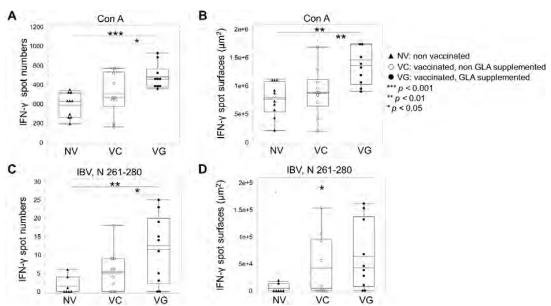
Figure 1 - Boxplot representing chicken IFN-γ ELISpot quantification of splenocytes stimulated with Con A or IBV N 261- 280 peptide. Individual quantification of spot numbers (A and C) and sizes (B and D) of chicken splenocytes IFN-γ ELISpot after stimulation with Con A pan T cell (A and B) or with IBV specific N 261-280 peptide (C and D) antigens, for 24 hours. Data are individually presented by dark triangles (▲) for the non-vaccinated group and circles for the vaccinated groups supplemented (●) or not (○) with glycerides of lauric acid. Horizontal bars represent the mean and median values. Statistical differences were evaluated by impaired two tailed T-test.
D) GLA and IBV-vaccine administration did not affect the cytokines production spleens: The quantification of cytokines revealed no effect of GLA supplementation nor vaccination on T cell proliferation, asindicated by low levels of IL-2 in all experimental groups. Neither vaccination nor the GLA supplementation affected the basal levels of cytokines secretion by T lymphocytes subsets in the spleen like IFN-γ, IL-10 and IL-21 at day 21.
E) GLA supplementation in diet improved overall and IBV-specific T cell-mediated response: To gain a deeper understanding of the specific and the overall cellular immune response, we conducted chicken IFN-γ ELISpot assays to assess the effects of GLA on Th1/CTL like responses after 24 hours of stimulation with Con A or IBV N 261-280 peptide. Following Con A stimulation, splenocytes from VG group showed a 2-fold increase of average number of IFN-γ spots (680 ± 41 vs. 388 ± 41 spots) and spot surfaces (1.46×10⁶ ± 1.8×10⁵ vs. 7.66×10⁵ ± 0.96×105 µm2 ) compared to the NV group (P < 0.001, Fig. 1A-B). They also demonstrated significantly higher spot numbers and surfaces compared to the VC group (504 spots/well and 8.85×105 µm2, respectively). Upon stimulation with IBV N 261-280 peptide, splenocytes from VG group displayed significantly higher average spot numbers (12 ± 3 spots/well) compared to the NV (2 ± 0.9 spots/well, P = 0.006) and VC (5 ± 1.8 spots/well, P < 0.05, Fig. 1C). Moreover, a significantly higher average spot surface was observed in VG group (63569 µm2 ) compared to the NV group (4482 µm2 , P < 0.05). Spot surfaces and numbers of splenocytes did not reveal any significant differences between the NV and groups (Fig. 1). These findings suggest that GLA supplementation in diet increased the proportions and activity of total and IBV-specific effector/memory Th1/CTL like lymphocytes.
IV. CONCLUSIONS
In summary, our study suggests that GLA supplementation in chicken diet improved both humoral and cellular immune response against IBV. It increased the primary humoral response in the first week of broilers life which predict of a better secondary humoral response (Gussem et al. 2021) and higher survival rate (Wit, Swart et Fabri 2010a) after a IBV challenge. The effector/memory lymphocytes and the levels of specific T cell-mediated response were enhanced in proportion and intensity, ensuring an efficient cellular response. Altogether, our results show that the GLA-induced modulations of immune response are adapted to intracellular infections like IBV and may enhance the efficiency of vaccines.
ACKNOWLEDGEMENTS AND CONFLICTS OF INTEREST: We express our gratitude to the technician and engineers from the Centre of Expertise and Research in Nutrition (CERN) of Adisseo France (Malicone, France). The glycerides of lauric acid are commercialized by Adisseo NL (Ruisvoorn, Netherlands).
Presented at the 35th Annual Australian Poultry Science Symposium 2024. For information on the latest and future editions, click here.