Utilising dynamic time warping in data mining for free-range layers
Published: October 27, 2026
Source : A. IQBAL 1, Y.A. ADEJOLA 1, S. POKHREL 1, I. RUHNKE 1, M. WELCH 2 and T.Z. SIBANDA 2 / 1 School of Environmental and Rural Science, University of New England; 2 School of Science and Technology, University of New England.
Traditionally, laying flocks have been compared for performance outcomes and subjected to pregrouping based on known predetermined variables (e.g., breed, age, diet, housing or management strategies). However, cluster analysis can use the outcome target parameters (e.g., performance) and identify homogeneous groups (clusters) based on similarities in the outcome data (e.g., egg production) (Sibanda et al., 2020). These clusters can then be used for classification or benchmarking purposes.
This study aimed to assess whether the egg-laying rate curve can be used to benchmark high- and low-performing laying flocks. From a statistical perspective, the egg-laying rate curve is a temporal sequence of laying rate, and each individual curve can be treated as an individual time series. Dynamic time warping (DTW) based clustering was used to group similarly shaped curves (time series) while taking into account the short-term peaks and drops in egg-laying rate. This enabled classification of sequences varying over time, such as with peaks and drops in egg production.
Laying rate data from 51 free-range egg-laying flocks (as 51 time-series) were subjected to DTW-based clustering. The number of clusters was determined by analysing the within-cluster sum of squares, leading to 3 clusters with 15, 28 and 8 flocks assigned to Cluster 1, Cluster 2 and Cluster 3, respectively. To confirm whether the clusters were different in terms of performance, the clusters were compared using one-way ANOVA. Significant differences in laying rate, floor eggs, and egg weight were found among the clusters during the early laying period. Most parameter disparities were found in the late laying period. Also, the clusters differed significantly in total eggs/hen housed (Table 1), having high (Cluster 1), medium (Cluster 3), and low (Cluster 2) egg production.
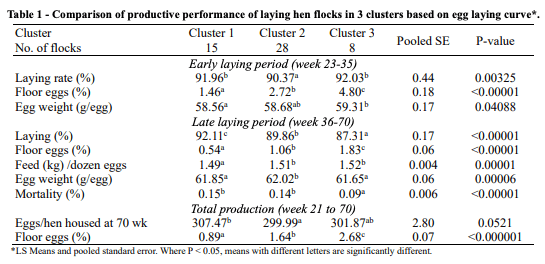
Thus, DTW can be useful for benchmarking laying hen flocks. Investigating the management and input differences among the clusters could help identify novel factors that improve egg production.
ACKNOWLEDGEMENTS: The authors are grateful to Australian Eggs for funding this project.
Presented at the 35th Annual Australian Poultry Science Symposium 2024. For information on the latest and future editions, click here.
Sibanda TZ, Welch M, Schneider D, Kolakshyapati M, & Ruhnke I (2020) Animals 10(5): 855.
Content from the event:

Related topics:
Authors:


Recommend
Comment
Share

Would you like to discuss another topic? Create a new post to engage with experts in the community.














Featured users in Poultry Industry