Factors Affecting Flock Uniformity in Broiler Production: Individual, Environmental, and Management Characteristics
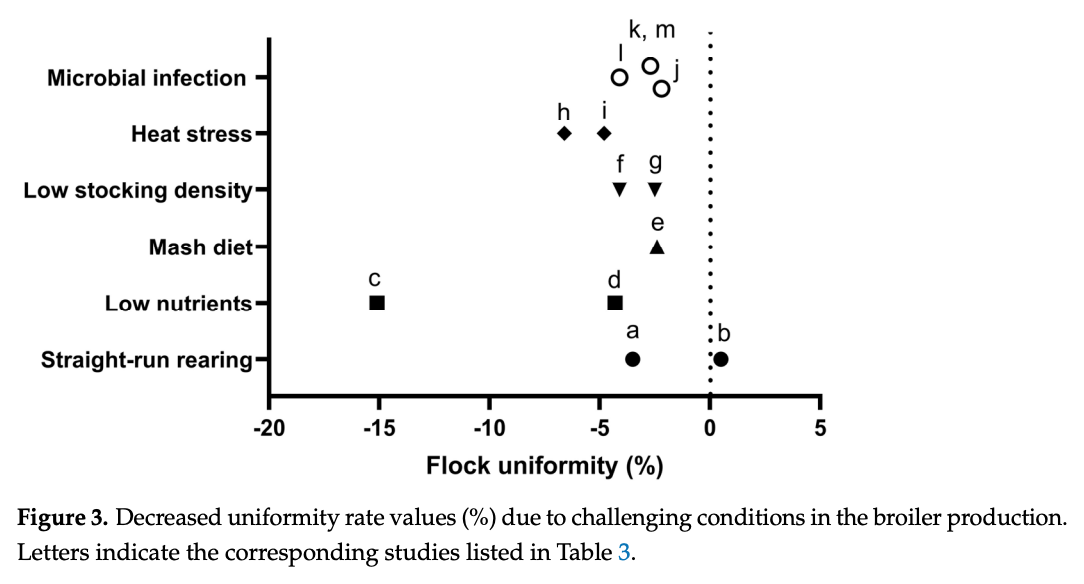
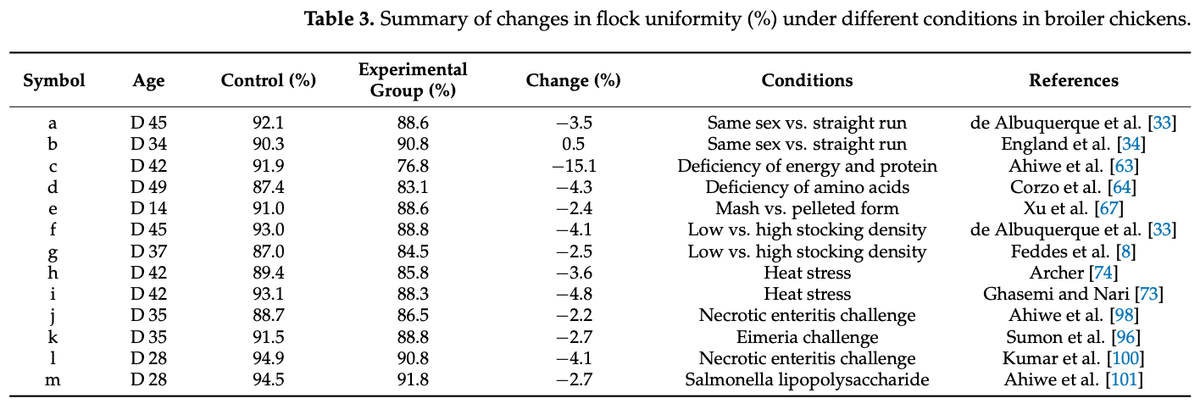
Flock uniformity is a critical factor influencing productivity, production efficiency, animal welfare, and overall economic outcomes in broiler production. Despite its importance, uniformity is often overlooked in commercial settings, where production goals typically focus on maximizing average BW and overall flock performance rather than minimizing variation among individual birds. This review aims to summarize the diverse factors that affect flock uniformity in broilers. Under standard conditions between days 14 and 49, flock uniformity typically reaches approximately 90%. Both intrinsic factors, such as genetics, initial BW, age, sex, and rearing method, and extrinsic factors, including housing, management, and vaccination practices, have been shown to influence uniformity. Environmental and management challenges, such as heat stress, nutrient deficiencies, microbial infections, high stocking density, feed form, and mixed-sex rearing, can further reduce uniformity by 2.5–15%. These findings highlight the high sensitivity of flock uniformity to multiple stressors, which may interact rather than act independently. Moreover, these findings highlight the need to consider both baseline and challenging factors in broiler production and support the development of targeted management and environmental strategies to improve flock uniformity and enhance overall production efficiency.
Keywords: broilers; flock uniformity; gut health; environmental effects; microbial infection; nutrition
1. Introduction
2. Factors Influencing Flock Uniformity
2.1. Genetics and Initial BW
2.2. Age
2.3. Same Sex or Mixed Sex Rearing

2.4. Housing and On-Farm Management
2.5. Stocking Density
2.6. Nutrient Deficiency and Feed Form
2.7. Heat Stress
2.8. Microbial Infection
2.9. Vaccination Practices
3. Summary of Factors That Affect Flock Uniformity
4. Interrelationship Between the Factors Affecting Flock Uniformity
5. Conclusions
Tavárez, M.A.; Solis de los Santos, F. Impact of genetics and breeding on broiler production performance: A look into the past, present, and future of the industry. Anim. Front. 2016, 6, 37–41. [CrossRef]
Lundberg, R.; Scharch, C.; Sandvang, D. The link between broiler flock heterogeneity and cecal microbiome composition. Anim. Microbiome 2021, 3, 54. [CrossRef]
Mulder, H.; Hill, W.; Vereijken, A.; Veerkamp, R. Estimation of genetic variation in residual variance in female and male broiler chickens. Animal 2009, 3, 1673–1680. [CrossRef]
Gous, R. Nutritional and environmental effects on broiler uniformity. Worlds Poult. Sci. J. 2018, 74, 21–34. [CrossRef]
Vasdal, G.; Granquist, E.G.; Skjerve, E.; de Jong, I.C.; Berg, C.; Michel, V.; Moe, R.O. Associations between carcass weight uniformity and production measures on farm and at slaughter in commercial broiler flocks. Poult. Sci. 2019, 98, 4261–4268. [CrossRef] [PubMed]
Waldroup, P.; Oviedo-Rondon, E. Models to estimate amino acid requirements for broiler chickens: A review. Int. J. Poult. Sci. 2002, 1, 106–113. [CrossRef]
Wolc, A.; White, I.; Avendano, S.; Hill, W. Genetic variability in residual variation of body weight and conformation scores in broiler chickens. Poul. Sci. 2009, 88, 1156–1161. [CrossRef] [PubMed]
Feddes, J.; Emmanuel, E.; Zuidhoft, M. Broiler performance, body weight variance, feed and water intake, and carcass quality at different stocking densities. Poult. Sci. 2002, 81, 774–779. [CrossRef]
England, A.; Gharib-Naseri, K.; Kheravii, S.K.; Wu, S.-B. Influence of sex and rearing method on performance and flock uniformity in broilers—Implications for research settings. Anim. Nutr. 2023, 12, 276–283. [CrossRef] [PubMed]
Hartcher, K.; Lum, H. Genetic selection of broilers and welfare consequences: A review. Worlds Poult. Sci. J. 2020, 76, 154–167. [CrossRef]
Rowe, S.J.; White, I.M.; Avendaño, S.; Hill, W.G. Genetic heterogeneity of residual variance in broiler chickens. Genet. Sel. Evol. 2006, 38, 617–635. [CrossRef]
Iung, L.H.d.S.; Carvalheiro, R.; Neves, H.H.d.R.; Mulder, H.A. Genetics and genomics of uniformity and resilience in livestock and aquaculture species: A review. J. Anim. Breed. Genet. 2020, 137, 263–280. [CrossRef] [PubMed]
Hassan, F.; Atallah, S.; Reda, R. Comparison of performance, meat quality, and profitability of Cobb, Hubbard, and Ross broiler strains. Eur. Poult. Sci. 2021, 85, 1–13. [CrossRef]
Tona, K.; Onagbesan, O.; Kamers, B.; Everaert, N.; Bruggeman, V.; Decuypere, E. Comparison of Cobb and Ross strains in embryo physiology and chick juvenile growth. Poult. Sci. 2010, 89, 1677–1683. [CrossRef]
Pascalau, S.; Cadar, M.; Raducu, C.; Marchis, Z. Evaluation of productive performances in Ross 308 and Cobb 500 hybrids. Anim. Biol. Anim. Husb. 2017, 9, 22–27.
Nowaczewski, S.; Babuszkiewicz, M.; Szablewski, T.; Stuper-Szablewska, K.; Cegielska-Radziejewska, R.; Kaczmarek, S.; Sechman, A.; Lis, M.; Kwa´sniewska, M.; Racewicz, P. Effect of weight and storage time of broiler breeders’ eggs on morphology and biochemical features of eggs, embryogenesis, hatchability, and chick quality. Animal 2022, 16, 100564. [CrossRef]
Van Emous, R.; Mens, A.; Winkel, A. Effects of diet density and feeding frequency during the rearing period on broiler breeder performance. Br. Poult. Sci. 2021, 62, 686–694. [CrossRef]
Pinchasov, Y. Relationship between the weight of hatching eggs and subsequent early performance of broiler chicks. Br. Poult. Sci. 1991, 32, 109–115. [CrossRef] [PubMed]
Neto, R.M.; Surek, D.; da Rocha, C.; Dahlke, F.; Maiorka, A. The effect of grouping one-day-old chicks by body weight on the uniformity of broilers. J. Appl. Poult. Res. 2013, 22, 245–250. [CrossRef]
Zuidhof, M.; Schneider, B.; Carney, V.; Korver, D.; Robinson, F. Growth, efficiency, and yield of commercial broilers from 1957, 1978, and 2005. Poult. Sci. 2014, 93, 2970–2982. [CrossRef]
Coban, O.; Lacin, E.; Aksu, M.; Kara, A.; Sabuncuoglu, N. The impact of slaughter age on performance, carcass traits, properties of cut-up pieces of carcasses, and muscle development in broiler chickens. Eur. Poult. Sci. 2014, 78, 1–10. [CrossRef]
Malila, Y.; Juthawut, U.; Srimarut, Y.; Chaiwiwattrakul, P.; Uengwetwanit, T.; Arayamethakorn, S.; Punyapornwithaya, V.; Sansamur, C.; Kirschke, C.P.; Huang, L. Monitoring of white striping and wooden breast cases and impacts on quality of breast meat collected from commercial broilers (Gallus gallus). Asian-Australas J. Anim. Sci. 2018, 31, 1807. [CrossRef]
Rubio, A.; Conrad, S.; Juzaitis-Boelter, C.; Wishon, C.; Fahrenholz, A. The impact of marker selection, in-line near-infrared spectroscopy (NIR), and feed mix time on the coefficient of variation (mix uniformity), body weight uniformity and broiler growth performance during the starter, grower, and finisher periods. Poult. Sci. 2023, 102, 103109. [CrossRef] [PubMed]
Da Costa, M.; Colson, G.; Frost, T.; Halley, J.; Pesti, G. Evaluation of starter dietary digestible lysine level on broilers raised under a sex-separated or straight-run housing regime, part 2: Economics of sex separation and digestible lysine level for maximum returns. Poult. Sci. 2017, 96, 3282–3290. [CrossRef]
Alkie, T.N.; Yitbarek, A.; Hodgins, D.C.; Kulkarni, R.R.; Taha-Abdelaziz, K.; Sharif, S. Development of innate immunity in chicken embryos and newly hatched chicks: A disease control perspective. Avian Pathol. 2019, 48, 288–310. [CrossRef]
Liu, X.; Wang, C.; Wang, Y.; Wang, C.; Sun, X.; Zhu, Y.; Yang, X.; Zhang, L.; Liu, Y. Age-associated changes in the growth development of abdominal fat and their correlations with cecal gut microbiota in broiler chickens. Poult. Sci. 2023, 102, 102900. [CrossRef]
Andretta, I.; Kipper, M.; Schirmann, G.D.; Franceschina, C.S.; Ribeiro, A.M.L. Modeling the performance of broilers under heat stress. Poult. Sci. 2021, 100, 101338. [CrossRef]
Akram, M.Z.; Sureda, E.A.; Comer, L.; Corion, M.; Everaert, N. Assessing the impact of hatching system and body weight on the growth performance, caecal short-chain fatty acids, and microbiota composition and functionality in broilers. Anim. Microbiome 2024, 6, 41. [CrossRef] [PubMed]
Galosi, L.; Falconi, R.; Biagini, L.; Corrales Barrios, Y.; Roncarati, A. LED Light Applied to the Feeder: Impact on Growth Performances of Chickens under Productive Conditions. Vet. Sci. 2023, 10, 306. [CrossRef] [PubMed]
Galosi, L.; Todini, L.; Menchetti, L.; Carbajal, A.; Palme, R.; Ruggiero, N.; Falconi, R.; Roncarati, A. Effect of a Broiler-Specific Light Spectrum on Growth Performance and Adrenocortical Activity in Chickens: A Pilot Study on a Commercial Farm. Vet. Sci. 2024, 11, 618. [CrossRef]
Da Costa, M.; Colson, G.; Frost, T.; Halley, J.; Pesti, G. Straight-run vs. sex separate rearing for two broiler genetic lines Part 2: Economic analysis and processing advantages. Poult. Sci. 2017, 96, 2127–2136. [CrossRef] [PubMed]
Petkov, E.; Ignatova, M.; Popova, T. Effect of the sex separate and straight-run type of rearing on the performance, carcass and meat chemical composition in fast growing broilers. Bulg. J. Agric. Sci. 2020, 26, 652–658.
de Albuquerque, R.; Marchetti, L.K.; Fagundes, A.C.A.; Bittencourt, L.C.; da Trindade Neto, M.A.; de Lima, F.R. Efeito de diferentes densidades populacionais e do sexo sobre o desempenho e uniformidade em frangos de corte. Braz. J. Vet. Res. Anim. Sci. 2006, 43, 581–587. [CrossRef]
England, A.D.; Gharib-Naseri, K.; Kheravii, S.K.; Wu, S.-B. Rearing broilers as mixed or single-sex: Relevance to performance, coefficient of variation, and flock uniformity. Poult. Sci. 2022, 101, 102176. [CrossRef]
Da Costa, M.; Zaragoza-Santacruz, S.; Frost, T.; Halley, J.; Pesti, G. Straight-run vs. sex separate rearing for 2 broiler genetic lines Part 1: Live production parameters, carcass yield, and feeding behavior. Poult. Sci. 2017, 96, 2641–2661. [CrossRef] [PubMed]
Linhoss, J.; Davis, J.; Campbell, J.; Purswell, J.; Griggs, K.G.; Edge, C. Light intensity and uniformity in commercial broiler houses using lighting programs derived from Global Animal Partnership (GAP) lighting standards. J. Appl. Poult. Res. 2023, 32, 100309. [CrossRef]
Nega, T.E.; Assefa, T.; Bekele, D.; Tesema, A. Influence of Daylength, Light Color, Light Intensity, and Sources on the Performance of Growers, and Layers of Different Strains of Chicken: A Review. EC Nutr. 2024, 19, 01–171.
Falana, O.; Linhoss, J.; Davis, J.; Campbell, J.C.; Edge, C.M.; Lane, A.; Griggs, K.G.; Smith, C.R.; Purswell, J.L. Using spatial modeling to evaluate LED light intensity and uniformity in commercial broiler houses during brooding and tunnel conditions. Appl. Eng. Agric. 2024, 40, 189–198. [CrossRef]
Nissa, S.S.; Sheikh, I.U.; Altaie, H.A.; Adil, S.; Banday, M.T.; Kamal, M.; Alqhtani, A.H.; Swelum, A.A.; Khafaga, A.F.; Al-Shehri, M. Impacts of various lighting programs on chicken production and behavior—A review. Ann. Anim. Sci. 2024, 24, 1065–1079. [CrossRef]
Griffin, A.; Renema, R.; Robinson, F.; Zuidhof, M. The influence of rearing light period and the use of broiler or broiler breeder diets on forty-two-day body weight, fleshing, and flock uniformity in broiler stocks. J. Appl. Poult. Res. 2005, 14, 204–216. [CrossRef]
Zuidhof, M.; Fedorak, M.; Ouellette, C.; Wenger, I. Precision feeding: Innovative management of broiler breeder feed intake and flock uniformity. Poult. Sci. 2017, 96, 2254–2263. [CrossRef]
Mushtaq, M.; Pasha, T.; Mushtaq, T.; Akram, M.; Mahmood, S.; Farooq, U.; Parvin, R. Growth, water intake, litter moisture, carcass and physiological traits of broiler chickens fed varying levels and sources of potassium under phase feeding system. Livest. Sci. 2014, 159, 61–66. [CrossRef]
Mgbeahuruike, A.C.; Agina, O.A.; Anyanwu, M.U.; Emejuo, N.T.; Ekere, S.O.; Ugwu, P.C.; Uju, C.N.; Andong, F.A. Microbial contamination of poultry feed and the effects on birds’ performance. Anim. Res. Int. 2023, 20, 4834–4861.
Sheikh, I.; Nissa, S.; Zaffer, B.; Bulbul, K.; Akand, A.; Ahmed, H.; Hasin, D.; Hussain, I.; Hussain, S. Ammonia production in the poultry houses and its harmful effects. Int. J. Vet. Sci. Anim. Husb. 2018, 3, 30–33.
Mesa, D.; Muniz, E.; Souza, A.; Geffroy, B. Broiler-housing conditions affect the performance. Rev. Bras. De Ciência Avícola 2017, 19, 263–272. [CrossRef]
Wang, C.; Bing, A.; Wang, X.; Zhao, J.; Lin, H.; Jiao, H. High ambient humidity aggravates ammonia-induced respiratory mucosal inflammation by eliciting Th1/Th2 imbalance and NF-κB pathway activation in laying hens. Poult. Sci. 2022, 101, 102028. [CrossRef] [PubMed]
Hofmann, T.; Schmucker, S.S.; Bessei, W.; Grashorn, M.; Stefanski, V. Impact of housing environment on the immune system in chickens: A review. Animals 2020, 10, 1138. [CrossRef] [PubMed]
De Jong, I.C.; Schokker, D.; Gunnink, H.; Van Wijhe, M.; Rebel, J.M. Early life environment affects behavior, welfare, gut microbiome composition, and diversity in broiler chickens. Front. Vet. Sci. 2022, 9, 977359. [CrossRef]
Estevez, I. Density allowances for broilers: Where to set the limits? Poult. Sci. 2007, 86, 1265–1272. [CrossRef]
Liu, Z.; Xue, J.; Huang, X.; Chen, Y.; Wang, Q.; Zhang, S.; Wang, C. Effect of stocking density on growth performance, feather quality, serum hormone, and intestinal development of geese from 1 to 14 days of age. Poult. Sci. 2021, 100, 101417. [CrossRef]
Goo, D.; Kim, J.; Choi, H.; Park, G.; Han, G.; Kil, D.Y. Effect of stocking density and sex on growth performance, meat quality, and intestinal barrier function in broiler chickens. Poult. Sci. 2019, 98, 1153–1160. [CrossRef]
Shakeri, M.; Zulkifli, I.; Soleimani, A.; o’Reilly, E.; Eckersall, P.; Anna, A.; Kumari, S.; Abdullah, F. Response to dietary supplementation of L-glutamine and L-glutamate in broiler chickens reared at different stocking densities under hot, humid tropical conditions. Poult. Sci. 2014, 93, 2700–2708. [CrossRef]
Franco-Rosselló, R.; Navarro-Villa, A.; Polo, J.; Solà-Oriol, D.; García-Ruiz, A.I. Improving broiler performance at market age regardless of stocking density by using a pre-starter diet. J. Appl. Poult. Res. 2022, 31, 100232. [CrossRef]
Kwon, B.-Y.; Lee, H.-G.; Jeon, Y.-S.; Song, J.-Y.; Kim, S.-H.; Kim, D.-W.; Kim, C.-H.; Lee, K.-W. Research Note: Welfare and stress responses of broiler chickens raised in conventional and animal welfare-certified broiler farms. Poult. Sci. 2024, 103, 103402. [CrossRef]
Brickett, K.; Dahiya, J.; Classen, H.; Gomis, S. Influence of dietary nutrient density, feed form, and lighting on growth and meat yield of broiler chickens. Poult. Sci. 2007, 86, 2172–2181. [CrossRef]
Teng, P.-Y.; Choi, J.; Yadav, S.; Tompkins, Y.; Kim, W.K. Effects of low-crude protein diets supplemented with arginine, glutamine, threonine, and methionine on regulating nutrient absorption, intestinal health, and growth performance of Eimeria-infected chickens. Poult. Sci. 2021, 100, 101427. [CrossRef]
Arshad, M.; Bhatti, S.; Hassan, I.; Rahman, M.; Rehman, M. Effects of bile acids and lipase supplementation in low-energy diets on growth performance, fat digestibility and meat quality in broiler chickens. Braz. J. Poult. Sci. 2020, 22, eRBCA-202. [CrossRef]
Ahmadi-Sefat, A.A.; Taherpour, K.; Ghasemi, H.A.; Gharaei, M.A.; Shirzadi, H.; Rostami, F. Effects of an emulsifier blend supplementation on growth performance, nutrient digestibility, intestinal morphology, and muscle fatty acid profile of broiler chickens fed with different levels of energy and protein. Poult. Sci. 2022, 101, 102145. [CrossRef] [PubMed]
Chen, X.; Zhang, G.-M.; Wang, W.-W.; Liu, G.-H.; Cai, H.-Y.; Purba, A.; Zheng, A.-J. Compound non-starch polysaccharide enzymes improve growth performance, slaughter performance, immune function, and apparent utilization rate of nutrients in broiler chickens fed a low-metabolizable energy diet. Front. Vet. Sci. 2023, 10, 1162811. [CrossRef]
Bromfield, J.I.; Hoffman, L.C.; Horyanto, D.; Soumeh, E.A. Enhancing growth performance, organ development, meat quality, and bone mineralisation of broiler chickens through multi-enzyme super-dosing in reduced energy diets. Animals 2021, 11, 2791. [CrossRef]
Saleh, A.A.; Amber, K.A.; Soliman, M.M.; Soliman, M.Y.; Morsy, W.A.; Shukry, M.; Alzawqari, M.H. Effect of low protein diets with amino acids supplementation on growth performance, carcass traits, blood parameters and muscle amino acids profile in broiler chickens under high ambient temperature. Agriculture 2021, 11, 185. [CrossRef]
Ojediran, T.; Fasola, M.; Oladele, T.; Onipede, T.; Emiola, I. Growth performance, flock uniformity and economic indices of broiler chickens fed low crude protein diets supplemented with lysine. Arch. Zootec. 2017, 66, 543–550. [CrossRef]
Ahiwe, E.U.; Ejiofor, I.; Iwuji, T.C.; Ahamba, I.S.; Giwa, A.L. Flock uniformity, blood indices, and nutrient retention of broiler chickens fed low energy and protein diets supplemented with multi-enzyme. Poult. Sci. J. 2023, 11, 29–37.
Corzo, A.; McDaniel, C.; Kidd, M.; Miller, E.; Boren, B.; Fancher, B. Impact of dietary amino acid concentration on growth, carcass yield, and uniformity of broilers. Aust. J. Agric. Res. 2004, 55, 1133–1138. [CrossRef]
Behre, E.; Gous, R. Effect of dietary protein content on growth, uniformity and mortality of two commercial broiler strains. S. Afr. J. Anim. Sci. 2008, 38, 293–302.
Mccafferty, K.; Purswell, J. Effects of production time, die condition, and feed mill on the physical quality of commercial broiler diets. J. Appl. Poult. Res. 2024, 33, 100430. [CrossRef]
Xu, Y.; Stark, C.; Ferket, P.; Williams, C.; Brake, J. Effects of feed form and dietary coarse ground corn on broiler live performance, body weight uniformity, relative gizzard weight, excreta nitrogen, and particle size preference behaviors. Poult. Sci. 2015, 94, 1549–1556. [CrossRef]
Novotný, J.; Horáková, L.; Riháˇcek, M.; Zálešáková, D.; Št’astník, O.; Mrkvicová, E.; Kumbár, V.; Pavlata, L. Effect of different feed particle size on gastrointestinal tract morphology, ileal digesta viscosity, and blood biochemical parameters as markers of health status in broiler chickens. Animals 2023, 13, 2532. [CrossRef]
Rueda, M.; Bonilla, S.; de Souza, C.; Starkey, J.; Starkey, C.; Mejia, L.; Pacheco, W. Evaluation of particle size and feed form on performance, carcass characteristics, nutrient digestibility, and gastrointestinal tract development of broilers at 39 d of age. Poult. Sci. 2024, 103, 103437. [CrossRef]
Abdel-Moneim, A.-M.E.; Shehata, A.M.; Khidr, R.E.; Paswan, V.K.; Ibrahim, N.S.; El-Ghoul, A.A.; Aldhumri, S.A.; Gabr, S.A.; Mesalam, N.M.; Elbaz, A.M. Nutritional manipulation to combat heat stress in poultry–A comprehensive review. J. Therm. Biol. 2021, 98, 102915. [CrossRef]
Khan, R.U.; Naz, S.; Ullah, H.; Ullah, Q.; Laudadio, V.; Qudratullah; Bozzo, G.; Tufarelli, V. Physiological dynamics in broiler chickens under heat stress and possible mitigation strategies. Anim. Biotechnol. 2023, 34, 438–447. [CrossRef]
Brugaletta, G.; Teyssier, J.-R.; Rochell, S.J.; Dridi, S.; Sirri, F. A review of heat stress in chickens. Part I: Insights into physiology and gut health. Front. Physiol. 2022, 13, 934381. [CrossRef]
Ghasemi, H.A.; Nari, N. Interactive effects of methionine source and carnitine supplementation on growth performance, immunity, antioxidant status, and HSP70 gene expression in broilers reared under heat stress conditions. J. Appl. Poult. Res. 2023, 32, 100374. [CrossRef]
Archer, G.S. Evaluation of an extract derived from the seaweed Ascophyllum nodosum to reduce the negative effects of heat stress on broiler growth and stress parameters. Animals 2023, 13, 259. [CrossRef] [PubMed]
Sumanu, V.O.; Naidoo, V.; Oosthuizen, M.C.; Chamunorwa, J.P. Adverse effects of heat stress during summer on broiler chickens production and antioxidant mitigating effects. Int. J. Biometeorol. 2022, 66, 2379–2393. [CrossRef] [PubMed]
Gogoi, S.; Kolluri, G.; Tyagi, J.S.; Marappan, G.; Manickam, K.; Narayan, R. Impact of heat stress on broilers with varying body weights: Elucidating their interactive role through physiological signatures. J. Therm. Biol. 2021, 97, 102840. [CrossRef]
Mazzoni, M.; Zampiga, M.; Clavenzani, P.; Lattanzio, G.; Tagliavia, C.; Sirri, F. Effect of chronic heat stress on gastrointestinal histology and expression of feed intake-regulatory hormones in broiler chickens. Animal 2022, 16, 100600. [CrossRef] [PubMed]
Cedraz, H.; Gromboni, J.G.G.; Garcia, A.A.P.; Farias Filho, R.V.; Souza, T.M.; Oliveira, E.R.d.; Oliveira, E.B.d.; Nascimento, C.S.d.; Meneghetti, C.; Wenceslau, A.A. Heat stress induces expression of HSP genes in genetically divergent chickens. PLoS ONE 2017, 12, e0186083. [CrossRef]
Mahmoud, K.Z.; Edens, F.; Eisen, E.; Havenstein, G. The effect of dietary phosphorus on heat shock protein mRNAs during acute heat stress in male broiler chickens (Gallus gallus). Comp. Biochem. Physiol. Part C Toxicol. Pharmacol. 2004, 137, 11–18. [CrossRef]
Choi, J. Challenges in Poultry Production Systems and Nutritional Interventions. Animals 2025, 15, 530. [CrossRef]
Blake, D.P.; Marugan-Hernandez, V.; Tomley, F.M. Spotlight on avian pathology: Eimeria and the disease coccidiosis. Avian Pathol. 2021, 50, 209–213. [CrossRef]
Goo, D.; Choi, J.; Ko, H.; Choppa, V.S.R.; Liu, G.; Lillehoj, H.S.; Kim, W.K. Effects of Eimeria maxima infection doses on growth performance and gut health in dual-infection model of necrotic enteritis in broiler chickens. Front. Physiol. 2023, 14, 1269398. [CrossRef]
Choi, J.; Goo, D.; Sharma, M.K.; Ko, H.; Liu, G.; Paneru, D.; Choppa, V.S.R.; Lee, J.; Kim, W.K. Effects of different Eimeria inoculation doses on growth performance, daily feed intake, gut health, gut microbiota, foot pad dermatitis, and Eimeria gene expression in broilers raised in floor pens for 35 days. Animals 2023, 13, 2237. [CrossRef]
Akram, M.Z.; Sureda, E.A.; Corion, M.; Comer, L.; Everaert, N. Linking gastrointestinal tract structure, function, and gene expression signatures to growth variability in broilers: A novel interpretation for flock uniformity. Poult. Sci. 2024, 103, 104158. [CrossRef]
Goo, D.; Kim, W.K. Additional Valine and Isoleucine Impact Growth Performance, Intestinal Health, and Muscle Growth in Broilers Under Necrotic Enteritis Challenges. Animals 2025, 15, 2641. [CrossRef]
Choi, J.; Marshall, B.; Ko, H.; Shi, H.; Singh, A.K.; Thippareddi, H.; Holladay, S.; Gogal, R.M., Jr.; Kim, W.K. Antimicrobial and immunomodulatory effects of tannic acid supplementation in broilers infected with Salmonella Typhimurium. Poult. Sci. 2022, 101, 102111. [CrossRef] [PubMed]
Choi, J.; Kong, B.; Bowker, B.C.; Zhuang, H.; Kim, W.K. Nutritional strategies to improve meat quality and composition in the challenging conditions of broiler production: A review. Animals 2023, 13, 1386. [CrossRef] [PubMed]
Choi, J.; Tompkins, Y.H.; Teng, P.-Y.; Gogal, R.M., Jr.; Kim, W.K. Effects of tannic acid supplementation on growth performance, oocyst shedding, and gut health of in broilers infected with eimeria maxima. Animals 2022, 12, 1378. [CrossRef] [PubMed]
Choi, J.; Ko, H.; Tompkins, Y.H.; Teng, P.-Y.; Lourenco, J.M.; Callaway, T.R.; Kim, W.K. Effects of eimeria tenella infection on key parameters for feed efficiency in broiler chickens. Animals 2021, 11, 3428. [CrossRef]
Teng, P.-Y.; Yadav, S.; de Souza Castro, F.L.; Tompkins, Y.H.; Fuller, A.L.; Kim, W.K. Graded Eimeria challenge linearly regulated growth performance, dynamic change of gastrointestinal permeability, apparent ileal digestibility, intestinal morphology, and tight junctions of broiler chickens. Poult. Sci. 2020, 99, 4203–4216. [CrossRef]
Ko, H.; Choi, J.; Goo, D.; Cervantes, H.M.; Kim, W.K. Dose-dependent contribution of Eimeria tenella to Salmonella infection in broilers: Impacts on growth, immunity, and cecal microbiota. Poult. Sci. 2025, 104, 105958. [CrossRef]
Boulton, K.; Nolan, M.J.; Wu, Z.; Psifidi, A.; Riggio, V.; Harman, K.; Bishop, S.C.; Kaiser, P.; Abrahamsen, M.S.; Hawken, R. Phenotypic and genetic variation in the response of chickens to Eimeria tenella induced coccidiosis. Genet. Sel. Evol. 2018, 50, 63. [CrossRef]
Freem, L.; Summers, K.M.; Gheyas, A.A.; Psifidi, A.; Boulton, K.; MacCallum, A.; Harne, R.; O’Dell, J.; Bush, S.J.; Hume, D.A. Analysis of the progeny of sibling matings reveals regulatory variation impacting the transcriptome of immune cells in commercial chickens. Front. Genet. 2019, 10, 1032. [CrossRef]
Leveque, G.; Forgetta, V.; Morroll, S.; Smith, A.L.; Bumstead, N.; Barrow, P.; Loredo-Osti, J.; Morgan, K.; Malo, D. Allelic variation in TLR4 is linked to susceptibility to Salmonella enterica serovar Typhimurium infection in chickens. Infect. Immun. 2003, 71, 1116–1124. [CrossRef]
Schwarz, R.S.; Jenkins, M.C.; Klopp, S.; Miska, K.B. Genomic analysis of Eimeria spp. populations in relation to performance levels of broiler chicken farms in Arkansas and North Carolina. J. Parasitol. 2009, 95, 871–880. [CrossRef]
Sumon, S.M.R.; Kumar, A.; Wu, D.; Wu, S.-B.; Gharib-Naseri, K. Butyric and valeric glycerides blend prevents adverse impacts of coccidiosis challenge in broiler chickens. Poult. Sci. 2025, 104, 105879. [CrossRef]
Leung, H.; Patterson, R.; Barta, J.; Karrow, N.; Kiarie, E. Nucleotide-rich yeast extract fed to broiler chickens challenged with Eimeria: Impact on growth performance, jejunal histomorphology, immune system, and apparent retention of dietary components and caloric efficiency. Poult. Sci. 2019, 98, 4375–4383. [CrossRef]
Ahiwe, E.; Chang’a, E.; Abdallh, M.; Al-Qahtani, M.; Kheravii, S.; Wu, S.; Graham, H.; Iji, P. Dietary hydrolysed yeast cell wall extract is comparable to antibiotics in the control of subclinical necrotic enteritis in broiler chickens. Br. Poult. Sci. 2019, 60, 757–765. [CrossRef] [PubMed]
Xue, G.; Wu, S.; Choct, M.; Pastor, A.; Steiner, T.; Swick, R.A. Impact of a Macleaya cordata-derived alkaloid extract on necrotic enteritis in broilers. Poul. Sci. 2017, 96, 3581–3585. [CrossRef] [PubMed]
Kumar, A.; Sharma, N.K.; Kheravii, S.K.; Keerqin, C.; Ionescu, C.; Blanchard, A.; Wu, S.-B. Potential of a mixture of eugenol and garlic tincture to improve performance and intestinal health in broilers under necrotic enteritis challenge. Anim. Nutr. 2022, 8, 26–37. [CrossRef] [PubMed]
Ahiwe, E.; Abdallh, M.; Chang’a, E.; Al-Qahtani, M.; Omede, A.; Graham, H.; Iji, P. Influence of autolyzed whole yeast and yeast components on broiler chickens challenged with salmonella lipopolysaccharide. Poult. Sci. 2019, 98, 7129–7138. [CrossRef] [PubMed]
Zaheer, T.; Abbas, R.Z.; Imran, M.; Abbas, A.; Butt, A.; Aslam, S.; Ahmad, J. Vaccines against chicken coccidiosis with particular reference to previous decade: Progress, challenges, and opportunities. Parasitol. Res. 2022, 121, 2749–2763. [CrossRef] [PubMed]
Kong, D.; He, Y.; Wang, J.; Chi, L.; Ao, X.; Ye, H.; Qiu, W.; Zhu, X.; Liao, M.; Fan, H. A single immunization with H5N1 virus-like particle vaccine protects chickens against divergent H5N1 influenza viruses and vaccine efficacy is determined by adjuvant and dosage. Emerg. Microbes Infect. 2024, 13, 2287682. [CrossRef]
Marouf, S.; Ibrahim, H.M.; El-Naggar, M.S.; Swelum, A.A.; Alqhtani, A.H.; El-Saadony, M.T.; El-Tarabily, K.A.; Salem, H.M. Inactivated pentavalent vaccine against mycoplasmosis and salmonellosis for chickens. Poult. Sci. 2022, 101, 102139. [CrossRef]
Guérin, J.-L.; Balloy, D.; Pinson, M.; Jbenyeni, A.; Delpont, M. Vaccination technology in poultry: Principles of vaccine administration. Avian Dis. 2024, 67, 489–494. [CrossRef]
Goura, R.S. Debeaking, Dusting and Vaccination. Pract. Man. Dairy Cattle Buffaloes Prod. Manag. 2025, 175.
Marangon, S.; Busani, L. The use of vaccination in poultry production. Rev. Sci. Tech.-Off. Int. Des Epizoot. 2007, 26, 265. [CrossRef]
Chuwatthanakhajorn, S.; Chang, C.-S.; Ganapathy, K.; Tang, P.-C.; Chen, C.-F. Comparison of immune-related gene expression in two chicken breeds following infectious bronchitis virus vaccination. Animals 2023, 13, 1642. [CrossRef]




















United States
United States