Content sponsored by:
ABTL Advanced Bio-Agro Tech Ltd
Levelling Up-Value Chain Driving Inclusive Growth In Poultry Industry
Published: February 7, 2025
Source : O.P. Singh, Managing Director at ABTL. Dr. Pragati Salutgi, Technical Executive
The poultry industry is one of the fastest-growing sectors in global agriculture, providing a critical source of protein through meat and eggs. Beyond its contribution to food security, the poultry value chain serves as a significant driver of economic development, offering opportunities for inclusive growth across rural and urban communities. By leveraging its multi- faceted value chain, the industry can address social, economic, and environmental challenges while fostering equitable development.
Understanding the Poultry Value Chain
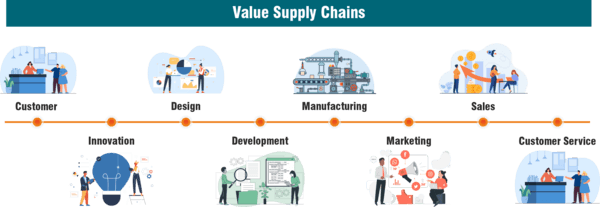
The concepts of supply chain and value chain are interrelated, as they both focus on the processes that transform raw materials into finished products and services. However, their perspectives differ, and understanding the correlation between the two can enhance business efficiency and value creation.
The supply chain and value chain are interconnected frameworks that complement each other. While the supply chain ensures the smooth flow of goods and services, the value chain ensures each step contributes to customer value and competitive advantage. Businesses that harmonize these concepts can achieve sustainable growth, operational efficiency, and enhanced customer satisfaction. The poultry industry has historically worked towards building a robust supply chain and in part succeeded in doing so. Now, what remains to be explored and captured are strategies and implementation to establish a robust value chain for the poultry industry to thrive.

The relationship or link between/among key variables that reflects reality includes only the key variables that are influential and have an impact on the outcome.
Meanwhile, simulation model starts from the “Broiler Chicks Lookup” variable where policy maker/farmers decide how many breeders can be reared in their whole process as a flock. All square boxes denote level variable which plays an important role in the poultry supply chain.

BY ALIGNING THE SUPPLY CHAIN AND VALUE CHAIN:
- Businesses can deliver high-quality products efficiently and cost-effectively.
- They can address consumer demands while optimizing resource use and profitability.
- It fosters an integrated approach where operational processes (supply chain) and customer-focused strategies (value chain) work in tandem.
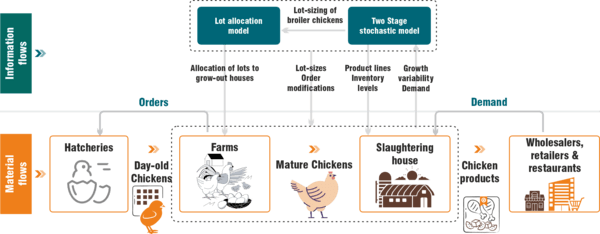
The methodology includes two models: (i) a two-stage stochastic model that supports lot-sizing and inventory management decisions while considering scenarios of chicken growth uncertainty; and (ii) a mixed-integer linear programming model that supports lot allocation. The results of implementing the methodology in a poultry company farm improved costs by 8.6% while meeting tactical, biological, and biosecurity constraints.
THE ROLE OF THE POULTRY VALUE CHAIN IN INCLUSIVE GROWTH
1. Job Creation and Livelihoods
The poultry industry is labor-intensive, creating employment at every stage of the value chain. For instance:
- Small-scale farmers can participate in rearing birds or producing feed ingredients.
- Women and youth often find opportunities in backyard poultry farming, egg collection, and retail.
- Skilled jobs arise in areas such as veterinary services, feed production, and processing.
2. Empowerment of Marginalized Groups
The low entry barriers in poultry farming enable participation by marginalized groups, particularly in rural areas. Programs aimed at supporting women and smallholder farmers with microfinance, training, and access to markets have been shown to uplift communities economically and socially.
3. Food Security and Nutrition
Poultry products provide an affordable source of high-quality protein. Strengthening the value chain ensures consistent supply, enhances affordability, and contributes to the nutritional well-being of vulnerable populations. Poultry is rich in high-quality protein, vitamins (like B12), and minerals (like iron and zinc), which are critical for muscle growth, immune function, and overall health. Eggs are an excellent source of protein (about 6 grams per egg), along with essential nutrients such as vitamins A, D, B12, and folic acid, which support cognitive development, immune function, and general well-being. Poultry meat and eggs are particularly important in combating protein-energy malnutrition (PEM), especially in vulnerable groups like children and pregnant women.
4. Market Integration and Rural Development
By linking rural producers with urban markets and export opportunities, the poultry value chain bridges the urban-rural divide. Value chain interventions, such as cooperatives and farmer organizations, facilitate collective bargaining, reduce transaction costs, and ensure better prices for smallholders.
5. Economic Growth and Export Potential
Poultry is a significant contributor to agricultural GDP in many countries. Investments in advanced processing facilities and compliance with international standards can enhance export potential, bringing foreign exchange earnings and economic stability.


STRATEGIES FOR STRENGTHENING THE VALUE CHAIN
To maximize the poultry value chain's contribution to inclusive growth, stakeholders must address these challenges through coordinated efforts:
- Capacity Building: Training programs on modern farming techniques, biosecurity, and financial literacy can empower farmers and improve productivity.
- Access to Finance: Tailored credit schemes and microfinance can help small-scale producers invest in better inputs and infrastructure.
- Policy Support: Governments should provide supportive policies, including subsidies for feed and vaccines, and promote fair trade practices.
- Public-Private Partnerships (PPPs): Collaborations between governments, private companies, and non-governmental organizations can facilitate investment in critical infrastructure and technology.
- Market Linkages: Digital platforms and farmer cooperatives can improve market access and reduce dependency on intermediaries.
- Social Mapping: Social mapping of meat consumption in India reveals significant variation across rural, semi-urban, and urban populations due to cultural, economic, and geographic factors. The consumption of meat is higher in urban areas but is growing in semi-urban and rural regions due to economic growth, improved disposable income and changing dietary preferences.
- Changing market dynamics: Various studies published by agencies like- KPMG's Report on Indian Poultry Industry, Behavioral Shifts in Food Choices (International Journal of Consumer Studies, 2019), Euromonitor collectively demonstrate that the changing food habits in India—marked by a preference for packaged chicken and eggs—are influenced by a combination of urbanization, rising incomes, health consciousness, convenience, and concerns over food safety. The shift reflects broader social, economic, and cultural transformations, as consumers in India increasingly seek standardized, branded, and hygienic products that align with modern lifestyles. It is to be noted, that these changes need to be factored in while developing value chain that suits the current notion and trends of the market.
The supply chain and value chain are interconnected frameworks that complement each other. While the supply chain ensures the smooth flow of goods and services, the value chain ensures each step contributes to customer value and competitive advantage. Businesses that harmonize these concepts can achieve sustainable growth, operational efficiency, and enhanced customer satisfaction.
In sum, developing an inclusive and resilient poultry value chain is not only an economic necessity but also a social imperative. It aligns with the goals of nutritional security, economic empowerment, and sustainability, all while responding to the broader trends in food consumption.
Related topics:
Authors:


Recommend
Comment
Share

Would you like to discuss another topic? Create a new post to engage with experts in the community.
Featured users