I. INTRODUCTION
Agricultural industries are on the cusp of a digital revolution. Rising demand for higher yields, combined with constraints on finite resources such as land and water, has placed increased pressure on the input side of agriculture. The increased demand on agricultural outputs from an increasing global population and socioeconomic growth has intensified the pressure on the agricultural sector to produce more with less. Current projections for population growth estimate that the world population will reach 9 billion people by 2050 and, in order to feed this number of people, overall food production will need to increase by approximately 70% between 2007 and 2050 (FAO, 2009). Traditionally, to meet this increase in demand, the agricultural sector would more often than not apply the ‘bigger is better’ principle and expand production by clearing more land or increasing the intensity of production. However, this strategy is becoming increasingly difficult from an environmental perspective and is often in conflict with spreading population centres that prioritise arable land for urban development. Adding to this dilemma is the estimate from the Food and Agriculture Organisation that between 20-40 % of annual global crop production is lost to pests and diseases. To counter this inefficiency, a simplistic approach would be to apply more fertiliser and/or insecticides yet paradoxically (from a production volume view) consumers and governments are demanding fewer chemicals be applied. This somewhat parallels the current direction of poultry production. Traditional technologies such as antibiotic growth promoters are facing increased scrutiny and pressure globally to be reduced or removed entirely. While poultry production can expand by adding more sheds (within limits) to meet rising demand, the volume of poultry products that can be produced from each unit on a square metre basis has also faced downward pressure on account of reduced stocking densities. These scenarios have the potential to impair the growth in production volume and lead to shortages in food production at the very moment when more is required. It is also evident that the poultry industry cannot rely on past expansion strategies alone to meet this increased demand. To help meet this challenge, a proposed key to facilitate increased food production in a time of tightening inputs lies with Agriculture 4.0 and big data technologies.
a) Smart Farming
The development and application of smart farming began in the late 1990’s with the introduction of precision farming whereby technology was applied to the production of agricultural commodities for the first time. However, precision farming focussed largely on farm machinery used in the production of crops with assistive technologies such as global positioning systems to reduce overlap when turning at the ends of the field and therefore improving sowing, harvesting and fuel efficiencies. The next iteration of smart farming is termed Agriculture 4.0 which is a continuation of precision farming and is hailed as the new era in modern agriculture. The foundations of Agriculture 4.0 rely on the increased use of mechanised processes (from paddock to plate) that are supported by the Internet of Things (IoT), big data, wireless/mobile communications and cloud computing. Agriculture 4.0 monitors each step of the food production chain from the first input to the last output.
The Internet of Things and big data are terms used to describe technologies that are embedded in everyday objects and are interconnected via the internet and ultimately produce large data sets. For poultry production, this will result in more sensors and data inputs at each step of the value-chain. However, a consequence of this will be that the data sets produced will be so big and vast that traditional data processing software is insufficient to handle these data sets. Importantly, big data also refers to the use of predictive analysis that moves beyond the basics of reporting data and analyses data for correlations and patterns from which businesses may then extract value.
b) Data acquisition
Data acquisition is perhaps one of the easiest components of big data for poultry production. Currently, there are numerous sources of data acquisition ranging from the production statistics on the breeder farm right through the value chain to consumer preferences at the retail level. However, not all of these data are collated and able to be analysed in depth, with some sources of data analysed (at best) or sitting unanalysed in isolation (at worst). Yet to achieve improved efficiency, it is important that all of these data are captured and analysed in a holistic manner.
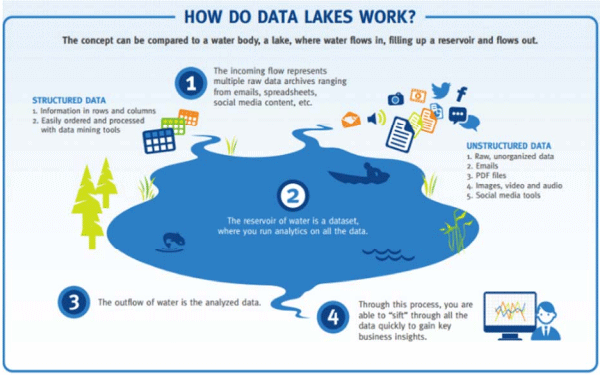
It is often described that organisations build a data lake which is akin to constructing a man-made water reservoir (Figure 1). First the dam is created, is then filled with water (data) and once the lake begins to fill, the water (data) is then used for other value adding purposes. A data lake provides a platform for rapid data accumulation and, potentially, its application. While this represents a significant advancement, the transformation analysis and application of the data is more complex and represents a major challenge to organisations. After a data lake is created, the propensity to measure and capture data increases significantly and may lead to an overload of data. Measuring something for the sake of measuring it should be avoided for “sometimes what counts, can’t be counted and what can be counted, doesn’t count (Cameron, 1963). For each new data stream, an analysis of the proposed benefits should be applied prior to its creation, and a review after it is active, to evaluate the value of the data. The value of data streams may be under or overestimated and it is the analysis and interpretation of these data where expertise is required in order to maximise the value and application of big data.
Figure 1 - A Data Lake: how does it work? (Source: Realworldanalystics.com)
c) When good info goes bad: the cost of data errors
Efficient poultry production is reliant on accurate data. Performance targets currently exist for each step of the production chain from the breeder farms, through to the hatchery, for on farm growth, feed efficiency as well as processing. For most integrators, these values may be summarised as cents/kg of poultry meat products or cents/dozen eggs for table egg producers. If we accept the average benchmark of a 1% error rate in manual data entry and multiply this by the instances of manual data entry, the consequences of these missteps can be profound. The human ability to catch or avoid errors is inherently flawed and if data needs to be entered multiple times, this only exacerbates the problem. A common business concept is the 1-10- 100 rule which illustrates the importance of correcting data entry mistakes at the source. According to the 1-10-100 rule, it costs $1 to verify the accuracy of the data at the point of entry, $10 to correct or clean up the data in batch form, and $100 (or more) per record if no corrective action is performed. While the absolute value of individual and cumulative data errors to companies may differ, the principle remains the same. Reliable and timely data are essential. Using the underlying technologies of Agriculture 4.0 to capture and report this data automatically using connected sensors and online platforms will lead to increased accuracy and facilitate timely decision making.
The following categories of data described in this paper represent some suggested data streams for big data in poultry production with a focus on streams that have the potential to be transformational.
II. ON FARM DATA
a) Environment
With the advent of tunnel ventilation for poultry housing over three decades ago, the ability to control and monitor environmental conditions such as temperature, relative humidity, ventilation, lighting, air quality and heat index/bird comfort has advanced significantly. Since these technologies currently exist and are widely used, the focus of this review will concentrate on emerging technologies and identify opportunities for development. However, it is worthwhile noting that, although regulation and monitoring of environmental conditions has increasingly become more automated, the reporting and dissemination of these records beyond the farm is often fragmented and remains an area for improvement.
b) Water
Water meters are more common on farms than feed measuring devices; however, not every farm or shed has these. It is perhaps stating the obvious that water consumption is a crucial indicator as to the health of birds and, by extrapolation, may give some indication of feed intake. Yet water data is often over looked on farm or not recorded and reported in a manner so that it best supports the optimal management of flocks. Recording hourly, if not daily water intake data would assist in identifying trends in consumption, particularly decreased intake which may precede a health problem and provide an opportunity for early investigation and intervention.
c) Feed
When it comes to poultry production, key drivers of efficiency and profitably are centred around feed. While feed is but one of the many components of poultry production, its contribution to production efficiency warrants particularly close attention. Feed costs reportedly account for 60-70% of production costs and, therefore, its importance to the economics of a poultry company cannot be over-emphasised.
However, somewhat paradoxically, this metric is perhaps the least well reported. The volume of feed consumed for each batch or production cycle is approximated on-farm using varying combinations of feed mill weigh bridge receipts and subjective estimates which range from somewhat technologically advanced to throwing rocks at silos. Of the more technologically advanced methods for feed usage estimation, some are prone to error and require considerably more maintenance than others. Whichever method is used, although it might be considered a step forward in monitoring feed, the accuracy of the data may be questionable and therefore potentially misleading. The need (and desire) to accurately measure and report feed intake in real-time is significant and the benefits of these data should not be underestimated.
Another factor which contributes to the imprecision of feed reporting is that, despite best intentions, more often than not feed usage is reported after the batch has finished and with incomplete data. The accuracy of this also relies on the estimate of feed left in the silo at the end of the batch. Given the above methods that are routinely used to estimate silo inventory, application of more accurate feed volume monitoring is key to providing meaningful data daily and even hourly, and in real time. Emphasising the potential of this data stream to improve poultry production decision making results in the ability to benchmark flocks, sheds, farms and changes in management/nutrition. Currently unless research farms are available, the ability to accurately quantify effects on performance/efficiency of birds in response to changes in feed formulation, feed additives and feed manufacture is limited. The potential to monitor feed delivery into sheds, and therefore calculate daily feed consumption, is perhaps one of the most significant challenges on-farm, yet the opportunities here are enormous.
d) Live body weight and uniformity
Live body weights and flock uniformity are important to assess growth, feed efficiency and underlying health or welfare issues (Vranken et al., 2005). Currently, the average body weight and uniformity of birds is obtained by manual weighing of a subset of the flock or, less commonly, automatic weighing platforms. Manual weighing of birds is laborious and limits the number of birds sampled, potentially misrepresenting the flock. Automatic weigh platforms are subject to the vagaries of bird behaviour and body weight. Heavier birds are less likely to step onto the weigh platforms leading to an underestimation of flock body weight by as much as 30% (Chedad et al., 2003). Concordantly, this scenario is most evident towards the end of the production cycle in broilers when broiler body weights are crucial to scheduling pick up times. Image analysis techniques that estimate bird body weight based on the surface area of the bird in conjunction with weigh platforms are in development with results showing improved accuracy (less than 5% error) when compared to manual weighing (Vranken et al., 2005).
e) Biosensors
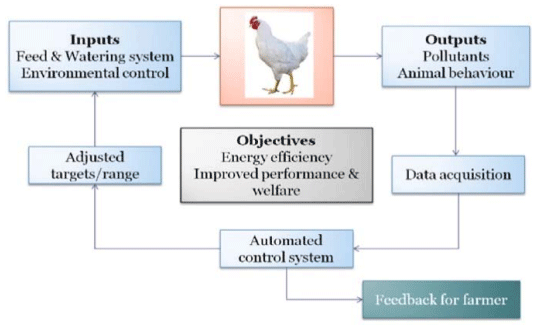
An emerging area in livestock farming is the use of advanced biosensor technologies such as microfluidics, sound analysers and image detection algorithms (Neethirajan, 2017). Sound analysers have been reported to be effective at predicting ‘stress’ levels in laying hens (Lee et al., 2015) thermal comfort of chicks during the brooding stage (Moura et al., 2008), growth performance of broilers (Fontana et al, 2015) and chicks pre-hatch (Exadaktylos et al., 2011). The monitoring of the spatial distribution of birds may provide indicators of bird behaviour, environmental conditions and bird activity. It is envisaged that these sensors will be incorporated into poultry production units and feed data (information) to poultry livestock managers to enable appropriate decision-making relating to the management of the birds. Currently, the adoption of these technologies is low; however, these technologies represent the direction for which poultry production is heading and will further contribute to filling the data lake.
Figure 2 - Schematic of how biosensors may be used on poultry farms to improve production. (Adapted from Corkery et al., 2013).
III. LIMITATIONS AND BARRIERS TO ADOPTION
Digital technology is a key enabler across the food chain; however, despite clear trends in other countries, Australia lags significantly in using digital information and software platforms. Impediments to the adoption of digital technology are multifactorial but can largely be attributed to the capital constraints required to implement such systems and inadequate telecommunications coverage, especially on farms located in remote areas. Efforts to improve connectivity to the internet in remote areas are making progress, yet internet access still remains inconsistent, unreliable and slow in many areas. Work around solutions to this are expensive and, given the fragmented location and ownership of farms, it is unlikely a single poultry farm could justify the capital required.
Another consideration in adopting digital monitoring and reporting technologies is that of data ownership and security. In fully integrated companies where farms are owned or managed by the company, the issues around data ownership and transparent reporting are perhaps less controversial than in situations where contract growers are engaged. Similarly, larger organisations are more likely to have dedicated IT departments and security protocols in place than smaller operators. In situations where contract growers are employed, sensitivities pertaining data sharing and security may occur with concerns raised as to how the data will be stored, shared and interpreted by poultry companies. The latter may impact contract negotiations or payments and would need clarification at the onset of a data project. Whichever the case, the information generated would benefit both parties provided clear undertakings as to how the data will be used were provided.
IV. CONCLUSIONS
The adoption of technology for monitoring and management should be based on some fundamentals, otherwise there is the risk of being overwhelmed with erroneous or meaningless data. An ideal technology in poultry production should be able to explain an underlying biological process, translate this information into a meaningful action, be cost effective, robust, reliable and precise as well as solution focussed. A caveat to the use of big data for poultry production is that the combination of people and data is critical to success. Skilled people will be required to interpret the data as well as managing flocks in the field; big data is not a replacement for skilled people rather a tool to enable decision making. To maximise the value of big data in poultry production, a whole value-chain approach will need to be employed and will also require adjustments in how data are currently shared. An overarching objective of using big data in poultry production should be to provide the right data to the right person at the right time. Achieving meaningful data sets and analysis thereof will facilitate increased data driven decisions and improve production efficiency.
Presented at the 29th Annual Australian Poultry Science Symposium 2018. For information on the latest and future editions, click here.