
Content sponsored by:
FIGAP MEXICO 2026 - INTERNATIONAL EXHIBITION
How Artificial Intelligence Reduces Costs in Agribusiness Production Management
Published: June 12, 2026
Source : FIGAP
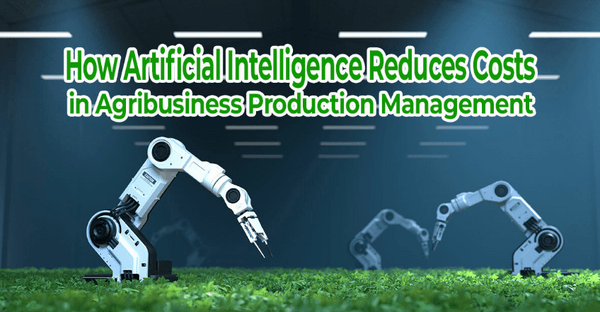
The adoption of Artificial Intelligence (AI) in agribusiness has evolved from a futuristic concept into a measurable reality that drives cost reduction, operational efficiency, and production resilience.
For agribusiness and livestock executives, AI represents a strategic opportunity to transform operational expenses into high-yield investments, ensuring more profitable and sustainable production amid global market challenges.
For agribusiness and livestock executives, AI represents a strategic opportunity to transform operational expenses into high-yield investments, ensuring more profitable and sustainable production amid global market challenges.
The Economic Impact of AI in Agribusiness
Recent global data reveals the growing financial impact of AI technologies in agriculture. The following table summarizes key global trends and cost savings achieved through AI-driven applications:
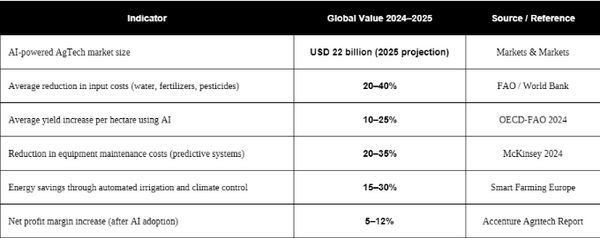
These figures demonstrate that AI adoption not only improves productivity but also optimizes resource usage and enhances global competitiveness, particularly in developing economies where profitability is highly sensitive to cost fluctuations.
Key Application Areas and Cost-Benefit Overview
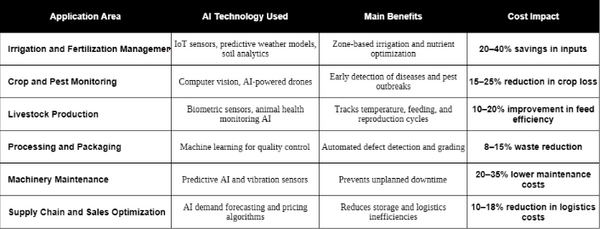
Example: A smart irrigation system that integrates weather forecasts, soil sensors, and machine learning can reduce water usage by up to 35% and energy consumption for pumping by 25%, maintaining or even improving yield levels.
Real-World Use Cases
- Smart Irrigation (Chile, Mexico, Brazil): Precision irrigation systems enable real-time water adjustment. Chilean vineyard producers report annual savings of up to USD 400 per hectare due to lower water and energy usage.
- Livestock Monitoring (Uruguay): AI-based collars detect rumination and activity anomalies, reducing veterinary costs and mastitis losses by 15–20%.
- Predictive Maintenance (Mexico & Argentina): AI-equipped harvesters detect early signs of mechanical wear, avoiding critical downtime and saving USD 8,000–12,000 per machine per season.
Artificial Intelligence is redefining the way agribusinesses plan, produce, and commercialize their goods. Beyond cost savings, it enables a new paradigm of efficiency and intelligence, turning data into a strategic asset.
For senior executives, the real question is not if AI should be adopted, but how and when to integrate it into the company’s long-term growth strategy — ensuring both financial return and operational sustainability.
FAO (2024): Artificial Intelligence for Smart Agriculture: Pathways for Emerging Economies.
World Bank (2025): Precision Farming Enables Climate-Smart Agribusiness.
McKinsey & Company (2024): How AI and Automation Transform Global Agribusiness.
OECD-FAO (2024–2033): Agricultural Outlook Report.
Accenture (2024): AI in AgTech: Scaling Profitability and Sustainability.
Related topics:
Recommend
Comment
Share

Would you like to discuss another topic? Create a new post to engage with experts in the community.

Featured users