In ovo delivery of grapefruit essential oil improves gut development in broiler hatchlings
Published: November 3, 2026
Source : J.N.K. DISANAYAKA 1, S. NIKNAFS 1, A.A. KHASKHELI 1, M.M.Y. MEIJER 1 and E. ROURA 1 / 1 Queensland Alliance for Agriculture and Food Innovation, University of Queensland, Australia.
Essential oils (EO) are widely known for their capabilities as potential alternatives to antibiotic growth promoters. EO have been reported to improve gut functionality by altering intestinal permeability and gut microbiota, inhibiting unwanted bacterial proliferation, and improving digestive secretions and nutrient absorption in broilers (Brenes and Roura, 2010). However, little is known about potential applications of EO on embryonic development. The objective of the present study was to investigate the impact of in ovo delivery of EO on embryonic development and hatchability in broilers. It was hypothesized that selected EO have the potential to improve embryonic development when applied in ovo.
Seven EO treatments including coriander, bergamot, clary sage, lemon myrtle, lemongrass, grapefruit, and cinnamon bark were individually delivered to the amniotic fluid of Ross 308 fertile eggs (n=24 eggs per treatment) at day 17.5 of incubation. One ml of EO solution comprised of 5 µl EO, 5 µl emulsifier polysorbate 80, and 990 µl of 0.9% (v/v) saline were used as the delivery volume. The control group consisted of 1 mL saline injection. Hatchability, chick quality (navel score and deformity) and bodyweight at hatch were measured (n=24). Residual yolk sac, heart, intestine, and gizzard and proventriculus weights were also recorded at hatch (n=6). The relative organ weight and the ratio of chick birthweight to initial egg weight were analysed with one way ANOVA and Tukey’s multiple comparison using R statistical software version 4.3.1.
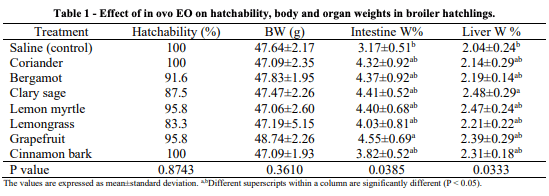
Table 1 summarises the main results obtained in the experiment. Hatchability, chick quality, body weight, yolk residue, heart and, gizzard and proventriculus weights were not significantly (P > 0.05) affected by the EO injections compared to the control. In contrast, grapefruit EO and clary sage EO increased (P < 0.05) intestine and liver weights, respectively. The increment of the liver weight could be a sign of an increase in pro-inflammatory responses (i.e., toxicity) due to the EO concentration. In conclusion, there was no negative impact of the in ovo delivery of the selected EO, on either hatchability, or day-old chick quality. Grapefruit EO showed promising results on improving gut development that warrant further studies.
ACKNOWLEGMENTS: This work was supported by AgriFutures Australia and Delacon Biotechnik.
Presented at the 35th Annual Australian Poultry Science Symposium 2024. For information on the latest and future editions, click here.
Brenes A & Roura E (2010) Anim. Feed Sci. Technol. 158: 1-14.
Content from the event:

Related topics:
Authors:



Recommend
Comment
Share

Would you like to discuss another topic? Create a new post to engage with experts in the community.










Featured users in Poultry Industry

Dr. Algis Martínez  Cargill
DVM, Diplomado ACPV - Poultry Veterinarian North America Cargill
United States
United States