Introduction
In Brazil, with the purpose of using rendered, animal- origin byproducts as protein sources, in a safer manner, rendering plants produce animal meals and fats, to be used as feedstuffs, under a series of requirements foreseen in Instruction Norm No. 15, dated October the 29th 2003, the Brazilian Ministry of Agriculture, Livestock and Food Supply (MAPA), in order to establish standards for hygienic-sanitary conditions and Good Manufacturing Practices (GMP).
According to Cerutti (2002), several worldwide episodes, which threatened and intimidated the consumption of food of animal and vegetable origin, definitively stated the need for the implementation of a traceability and certification program for poultry products. Amongst such episodes, we can quote the dioxin crisis in Belgium (1999) and Germany (2000/2001) and different cases of EEB in many European countries, Canada, the United States and Japan. Recently, the emergence of foot and mouth disease sprouts in Brazil and the dissemination of the virus of Avian Influenza throughout the world, once again, prove the enormous importance of effective programs for issues of food safety and animal sanitation.
The importance of Brazilian poultry in the worldwide scenery is limited by economic indexes, this is to say, it is the third place among the main chicken producers since 2003, being China the second one and the United States the first. At present, the production of chicken meat in Brazil is that of 10.98 million tons, China produces 12.1 million tons and the United States 15.98 million tons. Regarding exports, Brazil shipped, in 2009, 3.63 million tons of chicken meat, representing 64.3% of the meat exports of the country (Ubabef, 2010). Thus, the development of a technique that could help the certification process could ease the permanence of the Brazilian poultry industry in this scenario.
Initially, the technique of stable isotopes was used in geophysics and geochemical studies. In recent decades, they have been applied, in a growing and continuous manner in agricultural, ecologic and physiologic research, thus, they are a promising alternative for process studies related to digestion, absorption and metabolism of nutrients in humans and animals, as well as in studies to identify sources and quality of products of animal and vegetal products (Gannes et al., 1998).
The research line of the Center of Stable Isotopes (Subject Project FAPESP) has, as its main objective, that of tracing the inclusion of ingredients of animal origin in the diet of birds, filling certain market niches, with the aim of taking care of the restriction imposed by the consumers, assuring a fair play with companies of competing countries.
Material and Methods
Four experiments were carried out:
Experiment 1: One hundred and fifty male Cobb broilers, one day old, were used and distributed into five treatments containing 0, 1, 2, 4 and 8% of inclusion of bovine meat and bone meal. They were killed at 42 days of age and samples of the Pectorallis major (n=4) were collected.
Experiment 2: Eighty male Cobb broilers, one day old, were distributed into five treatments containing 0, 2, 4, 8 and 16% of bird viscera meal inclusion. They were killed at 42 days of age and samples of the pectoral muscle, keel and tibia were collected (n=4).
Experiment 3: One hundred and ninety two male Cobb broilers, one day old, were collected and distributed into 12 treatments, in which T2, T3, T4, T5 y T6, were subjected to a strictly vegetable diet (0% FV), passing to a diet containing viscera meal (8% FV) after 7, 14, 21, 28 and 35 days. A contrary diet was applied to birds in treatments T7, T8, T9, T10 and T11, which started with a FV diet and afterwards they went on a vegetable diet. T12 birds, remained with a FV diet throughout the experimental period and T1 birds (control), remained on a diet free of ingredients of animal origin during the complete period. At day 42, birds were killed and samples of the pectoral muscle (Pectorallis major) (n=4) were collected.
Experiment 4: One hundred and fifty male broilers were used and distributed into five treatments; T1: diet based on corn and soybean barn; T2: 6.7% yeast; T3: 6% bovine meat and bone meal; T4: 4.3% birds viscera meal and T5: 3% meat and bone meal + 2.2% birds viscera meal. At day 42, birds were killed and samples of the pectoral muscle (n=4) were collected.
The results obtained by means of the isotopic analysis of carbon and nitrogen were subjected to the multivariate analysis of variance (MANOVA), with the aid of the GLM procedure (General Linear Model) of the statistical program SAS (1999). As of the data generated by the error matrices, for each tissue, regions (ellipses) were delineated with a 95% confidence in order to verify differences between the means of the experimental treatments and the means of the control group (strictly vegetable diet).
Results and Discussion
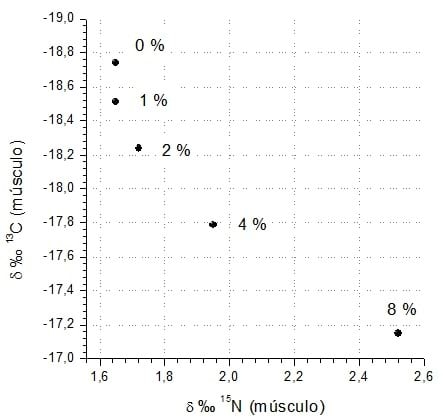
The first experiment proved that, as growing levels of bovine meat and bone meal were included, in broilers diet, the isotopic pair (d13C versus d15N) of the muscular tissue of the breast, presented a proportional isotopic enrichment (Fig. 1), indicating the possibility of tracing the ingredient of animal origin in the feed of such birds.
These results in carbon and nitrogen indicated enrichment in the muscular tissue similar to that of the diets, proving the statement of DeNiro & Epstein (1976) who declared that animals isotopically consume up to ± 2‰ of 13C and up to ± 3‰ 15N, respectively.
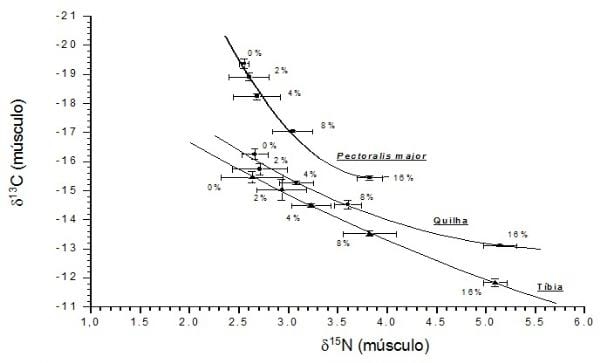
In experiment 2, broilers were subjected to diets with growing percentages of inclusion of viscera meal in the diet, being killed at day 42. It analyzed different tissues with different metabolisms, as in the case of the tibia and the keel, comparing them with the tissue of the pectoral muscle(Fig. 2). Due to the linear behavior between d13C and d15N, data suggest the inclusion of the tibia in the traceability process. Variations observed between the tissues may be related, in part, to the differences in the percentagel composition of the biochemical fractions, such as lipids, carbohydrates and proteins (DeNiro & Epstein, 1978).
Figure 1. Graph of a double isotopic axis of the means of d13C and d15N, in the pectoral muscle of broilers subject to diets containing bovine meat and bone meal at 42 days of age (experiment 1).
Figure 2. Mean values of the isotopic pairs (d13C y d15N) of tissues (breast muscle, keel and tibia) of broilers subjected to diets containing offal meal (experiment 2).
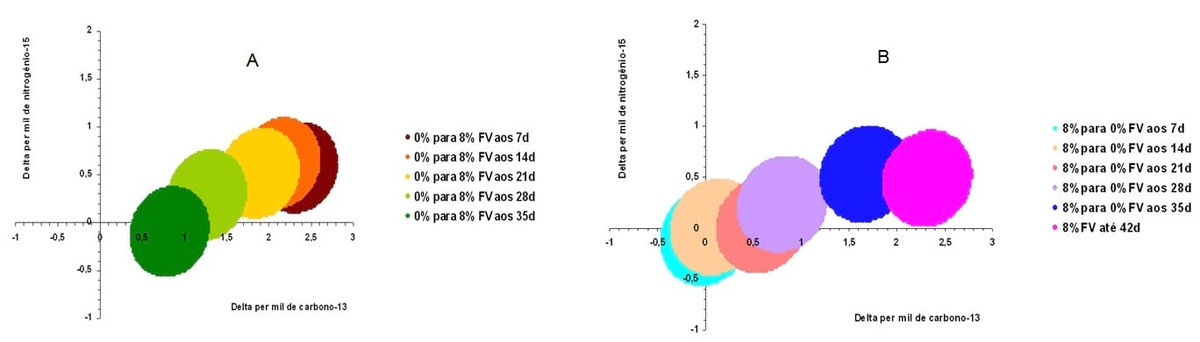
The muscle of the third experimentshows that treatments T2, T3 and T4, are the ones which differentiate themselves from the control group, due to the fact that those confidence regions do not overlap any of the axis of the graph (Fig.3A). Fig. 3B verifies that the values of the isotopic pairs of the Pectoralis major in treatments T11 y T12 were the only ones to significantly differ from those of the control group.
Figure 3. Confidence regions of the values of d13C and d15N of the Pectoralis major of broilers 42 days of age in different treatments (experiment 3).
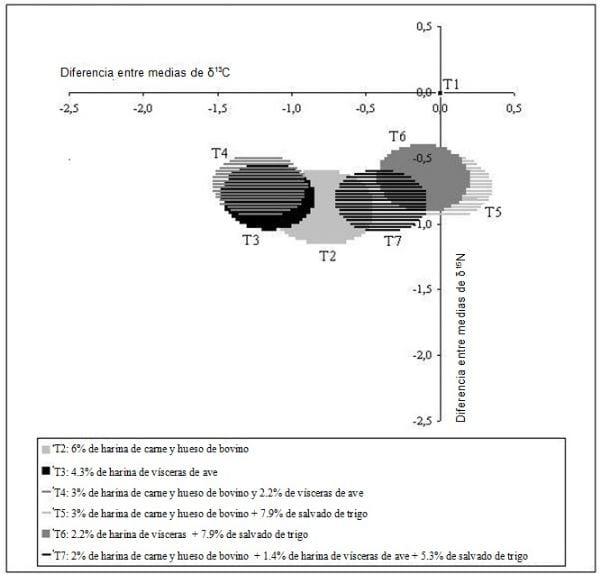
In the fourth study, treatments with the only addition of animal origin meals, are different to those of the exclusively vegetable diet treatment, nonetheless, the treatment with the inclusion of bovine meat and bone meal plus wheat barn as well as the treatment with viscera meal plus wheat meal did not differ (Fig. 4).
Figure 4. Confidence regions made up by the difference between the isotopic values of δ13C and δ15N of the Pectoralis major muscle in broilers, 42 days old in each treatment when compared to the control treatment (experiment 4).
Results seem to be of a particular importance for the technologic advance related to the certification process, when birds are raised without the use of ingredients of an animal origin, taking care of specific market segments. However, complementary studies should be performed in order to evaluate the practical potential for the application of this technique within the poultry sector, which could help the traceability process, which is an important tool for the certification of poultry products.
Conclusion
The use of the technique of carbon stable isotopes (13C/12C) and nitrogen (15N/14N) is a potential alternative for the certification process of broilers, whenever birds are raised without the use of animal origin ingredients.
Bibliography
Cerutti M. 2002. Rastreabilidade na indústria avícola. Avicultura Industrial. Disponível em:http://www.aviculturaindustrial.com.br/site/dinamica.asp?tipo_tabela=cet&LogonInvalido=sim,%20sim,%20sim,%20sim&id=2164&categoria=processamento. Acesso em 10/01/2005.
DeNiro MJ & Epstein S. 1976. You are what you eat (plus a few ‰) the carbon isotope cycle in food chains. Geological Society of America 6:834. (Abstract).
DeNiro MJ & Epstein S. 1978. Influence of diet on the distribution of carbon isotopes in animals. Geochimica Cosmochimica Acta 42:495-506.
Gannes LZ, Del-Rio CM, Koch P. 1998. Natural abundance variations in stable isotopes and their potential uses in animal physiological ecology. Comparative Biochemistry and Physiology. 119A(3):725-737.
UBABEF - União Brasileira de Avicultura. Relatório Anual 2009/2010. Disponível em: http://www.brazilianchicken.com.br/publicacoes/relatorio-anual-2010.pdf Acesso em: 17 set. 2010.
SAS Institute Inc. SAS/STATTM. 1999. SAS user''''s guide for windows enviroment. 8.0 ed. Cary (NC): SAS Institute Inc.