Use of an artichoke (Cynara Scolymus)-based additive in poultry nutrition
Published: October 20, 2011
Source : BF Iglesias1*, JO Azcona1, MV Charrière1, G Leonardi2, AL Porzio2 - 1Section Poutry, INTA - EEA Pergamino, CC31, Buenos Aires, Argentina; 2Soaljo SRL, Buenos Aires, Argentina
Summary
An experiment was carried out using Cobb broilers in order to evaluate the effect of Tiare® AS 1100, an additive based on artichoke (Cynara scolymus) dry extract, on broiler performance. Six treatments with 6 repetitions of 10 birds each were evaluated, using a 2 x 3 block factorial arrangement (2 challenge conditions and 3 levels of Tiare®). The use of diets containing corn contaminated with mycotoxins and reused frying oil was a challenge strong enough to cause poorer bird performance. The inclusion of Tiare® resulted in improved broiler performance, particularly on feed conversion ratio.
Key Words: Broilers, Performance, Mycotoxins, Liver protector.
Introduction
Any action leading to a better exploitation of the nutrients eaten by birds will produce both economic and environmental benefits. In this sense, an experience was carried out on broiler chickens to evaluate the effect of the Tiare® AS 1100 additive, based on a dry extract of artichoke (Cynara scolymus) on the performance of broiler chickens. Its primary aromatic bitter substance, the cynarin, confers choleretic, colagoge, hepatoprotective and cholesterol-lowering properties, which are synergized by ortodio-phenolic alcohols (Schilcher & Heil, 1992). For some authors, the most active compounds would be the phenolic acids, chlorogenic and neochlorogenic and, to a lesser extent, cynarin (Lietti, 1977). Prior to the experience, it was determined that this additive improved the EMAn up to 77kcal/kg (diet containing 7% of lipids) and that such improvement would be associated with an increase of two percentage points on the digestibility of lipids. This study included, besides conventional ingredients, corn contaminated with mycotoxins and frying oil to generate situations likely to rise on the field and to evaluate if the inclusion of Tiare® provides an advantage in this case, in particular.
Materials & Methods
We used 360 Cobb-500 male chickens, housed in batteries until the age of 28 days and moved to floor pens until the age of 49 days. We evaluated 6 treatments (Table 1) with 6 repetitions on 10 birds, each forming a factorial arrangement in blocks (2 terms of challenge and 3 levels of Tiare®). The Duncan test for mean separation was applied, using the InfoSTAT® software (2008), considering an α error of 0.05.
The food offered in flour form, according to the following feeding plan, based on the Cobb recommendations: Starter (1 - 7 days), Growth (8 - 28 days) and Terminator (29 - 42 days). Diets were formulated using the DAPP, N-utrition® 2.0 software (2003).
Table 1. Trateatments
Treatments | Characteristics |
1. - Control. | Diet with common corn and new oil |
2.- Control + Tiare® 150 | Idem T1 + 150g/tn Tiare® |
3.- Control + Tiare® 300 | Idem T1 + 300g/tn Tiare® |
4.- Challenge | Diet with contaminated corn and used frying oil |
5.- Control + Tiare® 150 | Idem T4 + Tiare® 150g/tn |
6.- Challenge + Tiare® 300 | Idem T4 + Tiare® 300g/tn |
The mycotoxins content in corn was 25 ppb of aflatoxin B1 and 900 ppb of T2.
Diets used are listed in Table 2.
Table 2. Composition and contribution of nutrients from the experimental diets
Ingredients (%) | 1 - 7 days | 8 - 28 days | 29 - 42 days |
Corn* | 51,520 | 56,105 | 61,894 |
Soya flour (40) | 40,610 | 35,331 | 27,749 |
Oil* | 4,177 | 5,000 | 5,000 |
Meat flour | 3,186 | ||
Innophos | 1,619 | 1,567 | 0,635 |
Small shell pieces | 1,105 | 1,078 | 0,693 |
Coccidiostate | 0,050 | 0,050 | 0,050 |
Premix | 0,200 | 0,200 | 0,150 |
Salt | 0,485 | 0,409 | 0,237 |
Lysine | 0,033 | 0,128 | |
Threonine | 0,036 | ||
DL-Metionine | 0,182 | 0,177 | 0,213 |
Coline | 0,050 | 0,050 | 0,030 |
Nutrients (%) | |||
Protein | 21,00 | 19,20 | 18,00 |
Lipids | 7,03 | 7,92 | 8,39 |
Raw Fiber | 3,15 | 2,91 | 2,57 |
Ca | 1,00 | 0,96 | 0,90 |
Available P | 0,50 | 0,48 | 0,45 |
EMA | 3026 | 3117 | 3197 |
EMV Poultry | 3288 | 3383 | 3476 |
Lysine | 1,18 | 1,08 | 1,03 |
Met+Cis | 0,87 | 0,78 | 0,79 |
Tryptophan | 0,26 | 0,23 | 0,20 |
Threonine | 0,83 | 0,75 | 0,72 |
Arginine | 1,47 | 1,32 | 1,20 |
Lysine Dig. | 1,08 | 0,99 | 0,95 |
Met+Cis Dig. | 0,80 | 0,75 | 0,74 |
Tryptophan Dig. | 0,24 | 0,21 | 0,18 |
Threonine Dig. | 0,74 | 0,66 | 0,63 |
*Corn and used frying oil varied as shown in Table 1.
Measurements
Body weight: Individual (batch average) and weekly.
Food intake: By batch, considering bird-day and cumulative form.
Conversion: By batch on a weekly basis.
Mortality: Daily.
Food intake: By batch, considering bird-day and cumulative form.
Conversion: By batch on a weekly basis.
Mortality: Daily.
Results and Discussion
Table 3 shows the zootechnical results obtained, and Figure 1 shows the percentage comparison of different doses of Tiare® vs. treatments without the additive.
Table 3. Zootechnical results (42 days)
Intake (g) | Weight (g) | Conversion: | Weight/Conversion | |
1.- Control | 4453 | 2694 | 1,653 | 1630 |
2.- Control + Tiare®150 | 4451 | 2708 | 1,643 | 1649 |
3.- Control + Tiare®300 | 4407 | 2748 | 1,604 | 1714 |
4.- Challenge | 4373 | 2604 | 1,679 | 1551 |
5.- Challenge + Tiare®150 | 4458 | 2698 | 1,653 | 1633 |
6.- Challenge + Tiare®300 | 4526 | 2705 | 1,674 | 1617 |
Diet Effect | ||||
Control | 4437 | 2717 | 1.634b | 1664a |
Challenge | 4452 | 2669 | 1.669a | 1600b |
Tiare® Effect | ||||
0g/tn | 4413 | 2649 | 1,666 | 1590b |
150g/tn | 4455 | 2703 | 1,648 | 1641ab |
300g/tn | 4466 | 2726 | 1,639 | 1665a |
Probability | ||||
Diet | 0,72 | 0,08 | <0,01 | <0,01 |
Tiare® | 0,55 | 0,07 | 0,11 | 0,03 |
Interaction | 0,17 | 0,48 | 0,06 | 0,30 |
Contrasts | ||||
straight Linear | 0,30 | 0,02 | 0,04 | 0,01 |
Straight Quadratic | 0,74 | 0,58 | 0,68 | 0,59 |
CV% | 2,8 | 2,9 | 1,9 | 4,1 |
Averages in the same column and data set with different letters differ statistically (p≤)0.05).
In general there were no differences in food intake due to treatments.
Birds that consumed diets with Challenge showed a trend (P < 0.08) to weigh less than those that consumed diets Control.
Birds that consumed diets with Challenge showed a trend (P < 0.08) to weigh less than those that consumed diets Control.
Figure 1. Percentage zootechnical parameters comparison of treatment without Tiare®
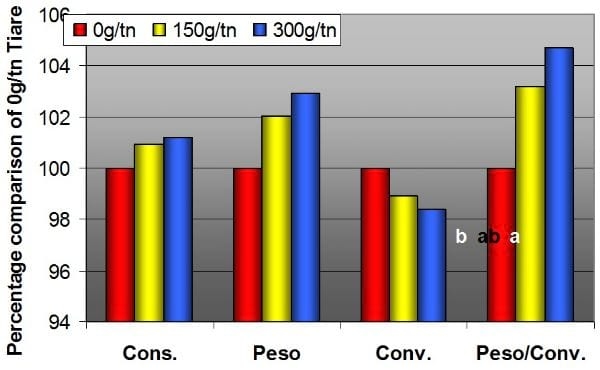
The inclusion of Tiare® showed a trend (P < 0.07) to improve the live weight of birds, at 42 days of treatment with 300 g/tn, Tiare® showed a better performance than diets without Tiare® in 77 g (1.2%, average of diets Control and Challenge, Figure 1). At the same time, comparing within each type of diet, with the 300 g/tn Tiare® dose, a 2% weight improvement was reached in the Control diet and of 3.8% in the Challenge diets, which would indicate that there was greater response to Tiare® in the latter situation.
As to the effect of the Tiare® dose, up to 28 days there was a quadratic response, but then it became linear, achieving greater weight with the higher dose used in this test (300 g/tn, Figure 1).
The conversion of chickens that received food with Challenge was worse than that of the Control Group (Table 1).
The inclusion of Tiare® showed a trend (P < 0.11) towards conversion improvement. Response to dosage for this parameter was quadratic until 28 days of life and then became lineal from this age on (Figure 1).
The weight/conversion ratio of chickens that received food with Challenge was worse than that of the Control Group.
With the addition of Tiare® improvement in this parameter was achieved, with significant differences at extreme levels of Tiare®.
The dosage response was the same as in the case of weight and conversion.
Conclusions
- By supplying diets containing corn with mycotoxins and used frying oil a challenge was produced which resulted in worse performance of birds, particularly in worse conversion and weight/conversion ratio.
- The inclusion of Tiare®, regardless of the type of food, led to an improvement in the performance of the birds, effect which is even more convincing, considering the weight/conversion ratio.
- On the basis of these results, the inclusion of Tiare® enabled improvements, both concerning the diet Control and the diet Challenge, which could be explained by its action on the improved utilization of lipids and a hepatoprotector effect.
Bibliography
DAPP, N-utrition. 2003. Software para formulación de raciones a mínimo costo. Versión 2.0. Colón, Entre Ríos, Argentina.
InfoSTAT. 2008. Software estadístico. Versión 2008p para Windows®. Córdoba, Argentina.
Lietti A. 1977. Choleretic and cholesterol lowering properties of two artichoke extracts. Fitoterapia 48:153-158.
Schilcher H & Heil BM: Artischockenextrakt - Eine aktuelle Standortbestimmung. Therapeutikon 1992:6:410-417.
Content from the event:

Recommend
Comment
Share

Would you like to discuss another topic? Create a new post to engage with experts in the community.







Life Rainbow
Life Rainbow Co., Ltd. is a feed additives specialist, with expertise in the manufacure of mycotoxins deactivation enzymes by gene cloning technology. With

Adisseo – a Bluestar Company
Adisseo is one of the world’s leading experts in feed additives, based worlwide to produce and market nutritional solutions for sustainable animal feed.





Featured users in Poultry Industry

Dr. Algis Martínez  Cargill
DVM, Diplomado ACPV - Poultry Veterinarian North America Cargill
United States
United States
Shivaram Rao
Pilgrim´s
PhD Director Principal de Nutrición y Servicios Técnicos de Pilgrim’s Pride Corporation
United States
United States