Explore

Advertise on Engormix

Exogenous phytase and intestinal uptakes of amino acids

Published: August 18, 2026
Source : P.H. SELLE, S.P. MACELLINE, P.V. CHRYSTAL and S.Y. LIU / 1 Poultry Research Foundation within The University of Sydney. Camden 2570 NSW, Australia.
Summary

The impacts of exogenous phytase on intestinal uptakes of amino acids, which are pivotal to protein utilisation, are reviewed. The likelihood is that phytases enhance amino acid intestinal uptakes as oligopeptides conducted via the peptide carrier, PepT-1, and as monomeric amino acids via Na+-dependent transport systems. Phytate and phytase have profound reciprocal effects on sodium (Na) which may impact the function of the sodium pump (Na+ ,K+ -ATPase). The functionality of Na+-dependent amino acid transporters, directly, and PepT-1, indirectly, depend on the sodium pump. 

I. INTRODUCTION

Exogenous phytases increased apparent ileal digestibility coefficients of 17 amino acids by an average of 4.13% (0.833 versus 0.800) in one meta-analysis (Cowieson et al., 2017); however, the scale of responses varies. Phytases increased apparent ileal digestibility coefficients of 16 amino acids by averages of 12.7%, 7.24% and 9.15%, respectively, across three selected assays (Amerah et al., 2014; Truong et al., 2015; Martínez-Vallespín et al., 2022) with a pronounced overall increase of 9.58% (0.853 versus 0.779). Although the other two assays reported greater distal ileal responses, 500 FTU/kg phytase increased proximal jejunal digestibilities of 16 amino acids by an average of 49.7% (0.720 versus 0.481) in Truong et al. (2015). The differences in these outcomes merit closer examination and the likelihood is that small intestinal uptakes of amino acids are more rate-limiting on broiler growth performance than protein digestion by endogenous proteolytic enzymes in the gut lumen (Croom et al., 1999). Increases in digestibility of protein/amino acids generated by phytase are consequences of the corresponding anti-nutritive effects of the substrate, phytate (myo-inositol hexaphosphate; IP6).

II. PROTEIN DIGESTION

Pepsin and peptide end-products of pepsin digestion initiate and regulate protein digestive processes (Hersey, 1987). However, an additional 7.80 g/kg dietary phytate significantly depressed pepsin activity in the proventriculus of broiler chickens by 6.31% (14.84 versus 15.84 nmol/mg) in Liu et al. (2009). The genesis of this observation is that protein bound to phytate in binary protein-phytate complexes is refractory to pepsin digestion (Vaintraub and Bulmaga, 1991). Indeed, under in vitro conditions, IP6 phytate must be degraded to IP2 and IP1 phytate for complete alleviation of pepsin inhibition (Yu et al., 2012). The likelihood is that the refractory properties of phytate-complexed protein promote compensatory hypersecretions of pepsin and HCl and support for this has been generated in rats (Mitjavila et al., 1973) and pigs (Decuypere et al., 1981). Protective hypersecretions of mucin and sodium bicarbonate (NaHCO3) are generated to counteract the ‘internal aggressors’, pepsin and HCl (Allen and Flemström, 2005). Accordingly, Onyango et al. (2009) found that Mg-K-phytate increased crude mucin excretion by a 2.6-fold factor (8.00 versus 3.05 g/bird) over a 54-hour period in broiler chickens. Additionally, Selle et al. (2009) found that phytase increased apparent ileal Na digestibility by 92.3% (-0.04 versus -0.52) in association with an average increase of 5.08% (0.806 versus 0.767) in the digestibility of 17 amino acids. The negative Na digestibility coefficient in the control birds is indicative of endogenous Na flows, probably arising from pancreatic secretions of NaHCO3 into the duodenum (Case et al., 1970), but phytase attenuates the need for protective hypersecretions of NaHCO3 and mucin.

III. INTESTINAL UPTAKES OF AMINO ACIDS
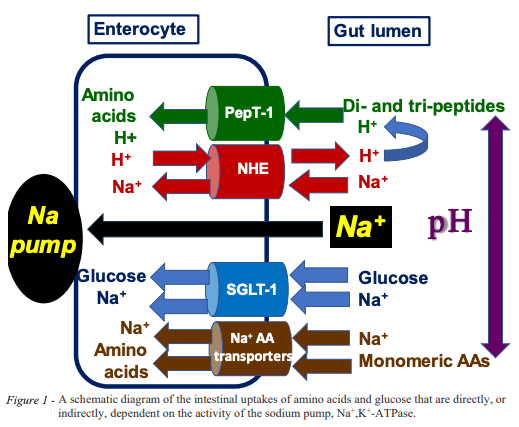
The following approximations are instructive in respect of amino acid intestinal uptakes. About 10% of amino acids are absorbed as single entities via several Na+-independent transport systems, but a further 15% are absorbed via numerous Na+ -dependent transport systems. Pivotally, some 75% of amino acids are absorbed as di- and tri-peptides, or oligopeptides, via the peptide transporter, PepT-1 (Krehbiel and Matthews, 2003). However, PepT-1 is a protoncoupled carrier and functions in tandem with the Na+ /H+ exchanger, NHE. Therefore, PepT-1 is indirectly Na+-dependent as it is reliant on the provision of protons from NHE, which is in turn reliant on the activity of the ‘sodium pump’ (Na+ ,-K+ -ATPase). The intestinal uptakes of amino acids and glucose, as outlined, are illustrated in Figure 1. 
Figure 1 - A schematic diagram of the intestinal uptakes of amino acids and glucose that are directly, or indirectly, dependent on the activity of the sodium pump, Na+,K+-ATPase.
Interestingly, Dilworth et al. (2005) reported that sodium phytate or phytate extracted from sweet potato reduced small intestinal Na+ ,-K+-ATPase activity by approximately 70% in rats. Therefore, it is relevant that 500 and 1000 FTU/kg phytase has been shown to increase Na+,K+ -ATPase concentrations by a collective 18.2% (11.52 versus 9.75 µmol/mg) in the jejunal mucosa of broiler chickens (Liu et al., 2008). Also, Akter et al. (2019) reported that phytase increased Na+ ,K+-ATPase activity by 42.9% (89.88 versus 62.88 nmol/mg protein/minute) in the jejunal mucosa of broilers offered diets with three tiers of Na concentrations. Clearly, the reciprocal impacts of phytate and phytase on the activity of Na+ ,K+- ATPase carry huge implications for the Na+-dependent intestinal uptakes of nutrients which includes amino acids and glucose absorption, which principally takes place via the Na+- dependent transporter, SGLT-1 (Wright, 1993).

IV. PEPT-1 AND PHYTASE

It has been proposed that the functionality of PepT-1, the transporter responsible for intestinal uptakes of most amino acids, is advantaged by exogenous phytase (Selle et al., 2023). One plank for this proposal was that the prime factor influencing PepT-1 activity is the presence of substrates in the gut lumen; di- and tri-peptides (Wang et al., 2017). It is plausible that phytase, by rendering proteins more vulnerable to pepsin digestion, is facilitating the conversion of polypeptides to oligopeptides along the digestive tract, which would up-regulate PepT-1 activity. In support, elevated dietary protein levels have been shown to increase mRNA abundance for PepT-1 in poultry (Osmanyan et al., 2018). A second plank was that PepT1/NHE activity is favoured by relatively low small intestinal pH levels (Kennedy et al., 2002). However, phytase P and Ca matrix values allow reduced levels of limestone and dicalcium phosphate in broiler diets, both of which have very high acid binding capacities (Lawlor et al., 2005). This should favour PepT-1/NHE activity by lowering dietary acid binding capacities and depressing pH levels along the small intestine. In support of this, increased dietary limestone inclusions from 3.0 to 18.7 g/kg was associated with a decrease of 7.95% (0.718 versus 0.780) in mean ileal digestibilities of 17 amino acids in Amerah et al. (2014). Finally, PepT-1 is, effectively, a Na+-dependent transporter given that it requires proton donation from the Na+/H+ exchanger, NHE, for the co-transport of oligopeptides (Spanier, 2014). The unequivocal impact of phytase on apparent Na digestibility coefficients in broiler chickens was demonstrated by Truong et al. (2014, 2015, 2017). Collectively, exogenous phytase increased Na digestibility by 30.5% (–2.443 versus–3.517) in proximal jejunum, 30.2% (–1.425 versus –2.043) in distal jejunum, 42.7% (–0.839 versus –1.465) in proximal ileum and 25.5% (–0.327 versus– 0.439) in distal ileum at 28 days post-hatch.

V. SODIUM PUMP (Na+,K+-ATPase) AND PHYTASE

Phytase increased apparent Na digestibility coefficients along the small intestine by a pronounced average of 32.5% (-1.259 versus -1.866) in the above data. The genesis of this response may be a combination of attenuated endogenous NaHCO3 secretions and enhanced function of Na+,K+-ATPase (Liu et al., 2008). Importantly, sodium pump activity is highly dependent on cytoplasmic Na concentrations within enterocytes (Therien and Blostein, 2000). This raises the possibility that if Na is partitioned to the pancreas to provide endogenous secretions of NaHCO3, then Na concentrations within enterocytes could be depleted to the extent that Na+,K+-ATPase activity is depressed and Na+-dependent intestinal uptakes of amino acids are compromised. This is not established and there may be other causes of depressed Na+,K+-ATPase activity, including the possibility that phytase facilitates the rephosphorylation of the sodium pump by liberating phytate-bound phosphorus , as suggested by Martinez-Amezcua et al. (2006).
While speculative, the pronounced improvements in amino acid digestibilities in response to exogenous phytase may stem from increases in amino acid intestinal uptakes as oligopeptides driven by PepT-1. Certainly, further research into the phytate-phytase axis in relation to the functions of Pept-1, NHE and Na+,K+-ATPase in broiler chickens is justified. This could provide strategies for chicken-meat producers to take greater advantage of the ‘protein effect’ of exogenous phytases. 
   
Presented at the 35th Annual Australian Poultry Science Symposium 2024. For information on the latest and future editions, click here.

1. Akter, M., Graham, H., & Iji, P. A. (2019). Journal of Animal Science and Technology, 61, 87–97.

2. Allen, A., & Flemström, G. (2005). American Journal of Physiology: Cell Physiology, 288, C1–C19.

3. Amerah, A. M., Plumstead, P. W., Barnard, L. P., & Kumar, A. (2014). Poultry Science, 93, 906–915.

4. Case, R. M., Scratcherd, T., & Wynne, R. D. A. (1970). Journal of Physiology, 210, 1–15.

5. Croom, W. J., Brake, J., Coles, B. A., Havenstein, G. B., Christensen, V. L., McBride, B. W., Peebles, E. D., & Taylor, I. L. (1999). Journal of Applied Poultry Research, 8, 242–252.

6. Cowieson, A. J., Ruckebusch, J.-P., Sorbara, J. O. B., Wilson, J. W., Guggenbuhl, P., & Roos, F. F. (2017). Animal Feed Science and Technology, 225, 182–194.

7. Decuypere, J. A., Knockaert, P., & Henderickx, H. K. (1981). Journal of Animal Science, 53, 1297–1308.

8. Dilworth, L. L., Omoruyi, F. O., Simon, O., & Asemota, H. N. (2005). Diabetologia Croatica, 34, 59–65.

9. Hersey, S. J. (1987). Physiology of the Gastrointestinal Tract (Vol. 2, pp. 947–957).

10. Kennedy, D. J., Leibach, F. H., Ganapathy, V., & Thwaites, D. T. (2002). Pflügers Archiv, 445, 139–146.

11. Krehbiel, C. R., & Matthews, J. C. (2003). Amino Acids in Animal Nutrition (2nd ed., pp. 41–70). CABI Publishing, Wallingford, UK.

12. Lawlor, P. G., Lynch, P. B., Caffrey, P. J., O’Reilly, J. J., & O’Connell, M. K. (2005). Irish Veterinary Journal, 58, 447–452.

13. Liu, N., Ru, Y. J., Li, F. D., & Cowieson, A. J. (2008). Journal of Animal Science, 86, 3432–3439.

14. Liu, N., Ru, Y. J., Li, F. D., Wang, J.-P., & Lei, X.-G. (2009). Archives of Animal Nutrition, 63, 292–303.

15. Martinez-Amezcua, C., Parsons, C. M., & Baker, D. H. (2006). Poultry Science, 85, 470–475.

16. Martínez-Vallespín, B., Männer, K., Ader, P., & Zentek, J. (2022). Animals, 12, 1955.

17. Mitjavila, S., de Saint Blanquat, G., & Derache, R. (1973). Nutrition & Metabolism, 15, 163–170.

18. Onyango, E. M., Asem, E. K., & Adeola, O. (2009). British Journal of Nutrition, 101, 836–842.

19. Osmanyan, A. K., Harsini, S. G., Mahdavi, R., Fisinin, V. I., Arkhipova, A. L., Glazko, T. T., Kovalchuk, S. N., & Kovosky, G. Y. (2018). Amino Acids, 50, 353–357.

20. Selle, P. H., Ravindran, V., & Partridge, G. G. (2009). Animal Feed Science and Technology, 153, 303–313.

21. Selle, P. H., Macelline, S. P., Chrystal, P. V., & Liu, S. Y. (2023). Animals, 13, 603.

22. Spanier, B. (2014). Journal of Physiology, 592, 871–879.

23. Therien, A. G., & Blostein, R. (2000). American Journal of Physiology: Cell Physiology, 279, C541–C566.

24. Truong, H. H., Yu, S., Peron, A., Cadogan, D. J., Khoddami, A., Roberts, T. H., Liu, S. Y., & Selle, P. H. (2014). Animal Feed Science and Technology, 198, 248–256.

25. Truong, H. H., Bold, R. M., Liu, S. Y., & Selle, P. H. (2015). Animal Feed Science and Technology, 209, 240–248.

26. Truong, H. H., Yu, S., Moss, A. F., Partridge, G. G., Liu, S. Y., & Selle, P. H. (2017). Animal Feed Science and Technology, 223, 13–22.

27. Vaintraub, I. A., & Bulmaga, V. P. (1991). Journal of Agricultural and Food Chemistry, 39, 859–861.

28. Wang, C.-Y., Liu, S., Xie, X.-N., & Tan, Z.-R. (2017). Drug Design, Development and Therapy, 11, 3511–3517.

29. Wright, E. M. (1993). Annual Review of Physiology, 55, 575–589.

30. Yu, S., Cowieson, A., Gilbert, C., Plumstead, P., & Dalsgaard, S. (2012). Journal of Animal Science, 90, 1824–1832.


Content from the event:
Related topics:
Authors:
Dr. Peter Selle
Shemil Macelline
Peter Chrystal
Dr Sonia Yun Liu
Show more
Recommend
Comment
Share
Profile picture
Would you like to discuss another topic? Create a new post to engage with experts in the community.
Featured users in Poultry Industry
Dr. Algis Martínez
Dr. Algis Martínez
DVM, Diplomado ACPV - Poultry Veterinarian North America Cargill
United States
Shivaram Rao
Shivaram Rao
PhD Director Principal de Nutrición y Servicios Técnicos de Pilgrim’s Pride Corporation
United States
Kim Litteken
Kim Litteken
Marketing and Customer Service Manager
United States