Home
Search
Explore
Publish
Explore

Advertise on Engormix
Home
Publish
Search

Influence of extruded soybean meal with varying fat and oleic acid content on nitrogen-corrected apparent metabolizable energy in broilers

Published: October 20, 2026
Source : Muhammad Ali 1; Michael Joseph 1; Maria Camila Alfaro-Wisaquillo 1; Gustavo Adolfo Quintana-Ospina 1; Lina-Maria Penuela-Sierra 1,2; Danny Patino 3; Thien Vu 4; Rouf Mian 5; Ondula Toomer 4; and Edgar Orlando Oviedo-Rondon 1.
Summary
Author details:
1 Prestage Department of Poultry Science, North Carolina State University, Raleigh, NC 27695, USA; 2 College of Veterinary Medicine and Zootechnia, University of Tolima, Ibague, Colombia; 3 Trouw Nutrition, South & Central America, Guatemala, Guatemala; 4 Food Science & Market Quality and Handling Research Unit, ARS, USDA, Raleigh, NC 27695, USA; and 5 Soybean & Nitrogen Fixation Research Unit, ARS, USDA, Raleigh, NC 27695, USA.

High oleic (HO) soybeans may serve as a value-added feed ingredient; providing amino acids and estimating their dietary energy value for broilers is essential. In this study, we determined the apparent metabolizable energy (AME), AME corrected for zero nitrogen retention (AMEn), digestibility, and nitrogen (N) retention of HO full-fat (HO-FF) soybean as compared to solvent-extracted soybean meal (SE-SBM), normal oleic full-fat (NO-FF) and extruded expeller (NO-EE) soybean. A total of 240 Ross-708 male broilers were selected, with 8 replicates per treatment and 6 chicks per cage. The AME and AMEn were estimated using the difference method with a 30% inclusion of test ingredients using a corn-soy reference diet with partial and total excreta collection. The index method with partial excreta collection used titanium dioxide as an inert marker. The same starter diet was provided for all birds for 14 d, followed by the reference and assay diets for the next 6 adaptation days. Total excreta were collected twice a day for 3 d. The AME and AMEn values determined for the HO-FF and NOFF were higher (P < 0.001) than the NO-EE and SESBM. The AME of SE-SBM and NO-EE were similar with both methods, but the AMEn of SE-SBM was lower than the NO-EE only with the partial collection method. The agreement between AME and AMEn values determined by partial and total excreta collection analysis was 98%. Data from the total excreta collection method yielded higher AME and AMEn values (P < 0.001) than those from the partial collection method. In summary, HO-FF and NO-FF soybean meals had similar AME and AMEn values. The HO-FF soybean had 39 and 24% higher AME and AMEn than SESBM. Hence, high oleic full-fat soybean meal could serve as a valuable alternative feed ingredient to conventional SE-SBM meals in broiler diets, providing additional energy while providing amino acids and more oleic acid to enrich poultry meat products.

Key words: apparent metabolizable energy, apparent metabolizable energy corrected by nitrogen, high oleic soybean, full-fat soybean meal, broiler 

INTRODUCTION
Soybean meal (SBM) is frequently used in poultry diets due to its high protein content, ideal amino acid (AA) profile, and digestibility (Ravindran et al., 2014). However, soybean products also contribute 20 to 30% of ME in poultry diets. The ME values of SBMs vary according to processing techniques (Pacheco et al., 2013; Rueda-Agudelo and Giraldo-Mejía, 2018; Mateos et al., 2019; Thanabalan et al., 2021; Abdollahi et al., 2022), varieties or genotypes (Parsons et al., 2000; Valencia et al., 2009; Loeffler et al., 2013), and geographical origins (de Coca-Sinova et al., 2008; Silva et al., 2022). Recently, soybean cultivars with varying high oleic (HO) fatty acid profiles (high oleic, low linolenic acid) have been developed to enhance the shelf-life and unsaturated fatty acid profile of soybeans and enrich meat products with oleic acid (Slaughter et al., 2019; Knowlton, 2022). The standardized ileal AA digestibility of HO full-fat (HO-FF) soybeans was recently evaluated (Ali et al., 2023). This experiment indicated that the AA content and digestibility of HO-FF and full-fat soybean (FFSB) from soybeans of standard, typical, or normal oleic acid content (NO-FF) are similar. Both FFSB sources had lower AA digestibility than solvent-extracted soybean meal (SE-SBM) and normal oleic extruded expeller (NO-EE) soybean.
However, no data on the ME values of HO-FF are available. Since dietary energy plays a role in feed consumption, affects broiler growth, feed utilization efficiency, and carcass traits, and can affect feed formulation costs, the accurate estimation of energy available in a particular feed ingredient is critical (Mateos et al., 2019; Wu et al., 2020; Abdollahi et al., 2021).
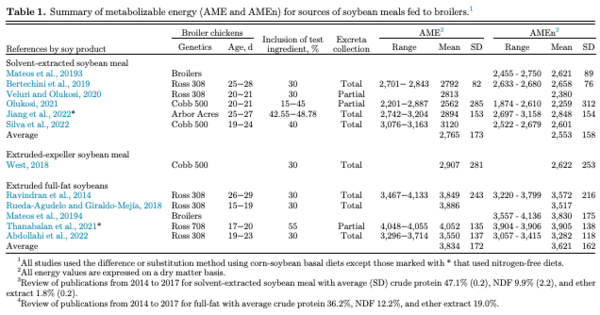
In broilers, energy utilization can be expressed as the apparent metabolizable energy (AME), among other methods (Veluri and Olukosi, 2020; Abdollahi et al., 2021). Metabolizable energy (ME) is defined as the difference between the gross dietary energy (GE) of the consumed feed and the GE expelled in the excreta (feces, urine, and gases), which is not corrected for endogenous loses and is consequently defined as AME (Hill and Anderson, 1958; Abdollahi et al., 2021; Khalil et al., 2021). The ME value of an ingredient can be affected by species (Olukosi et al., 2017), broiler genetics, age, growth rate (Adeola et al., 2018; Bertechini et al., 2019; Khalil et al., 2021), and feed intake (Sibbald, 1975, 1976; Mateos et al., 2019). Some of the variability observed in soybean products in studies published in the past 10 yr is summarized in Table 1.
In addition, the AME calculation does not account for the heat generated by various nutrients, which can cause variability in calculated values depending on the feedstuff composition and environmental conditions of the experiment (Barzegar et al., 2020). Once determined, the AME is often corrected to zero nitrogen (N) retention, and the resultant estimate is referred to as the N-corrected AME (AMEn)(Beckman et al., 2024). The assumption for zero N retention is that protein oxidation retained as body tissue in fast-growing broilers will yield uric acid with a GE per gram of N. However, the N correction penalizes the energy value of all feed ingredients, especially those providing more protein, so it is important to report both values (Mateos et al., 2019; Wu et al., 2020; Abdollahi et al., 2021). The optimum value to use in feed formulation is debated (Abdollahi et al., 2021).
There are 3 methods to determine AME: direct, difference or substitution, and regression (Wu et al., 2020; Abdollahi et al., 2021). The direct method is mainly used to determine the AME of cereal grains and only 1 ingredient is used in the test diet. This has issues with poorly palatable ingredients and potential nutrient imbalance when fed for several days. The substitution method is frequently used for protein sources with a basal reference diet and assay diets where the test ingredient replaces a portion of the basal diet. This method allows the evaluation of multiple ingredients under similar conditions (Wu et al., 2020). The regression method requires several inclusion levels of the test ingredient, and consequently, more treatments, limiting the evaluation of multiple ingredients under similar conditions. Within each method, the excreta collection can be total or partial (Abdollahi et al., 2021). The partial excreta collection uses an indigestible marker to estimate a digestibility coefficient based on a ratio of marker presence in the diet and excreta. Total collection takes more time and errors in recording excreta or feed intake can affect accuracy. The results of the partial collection analysis are influenced by the accuracy of laboratory analyses to recover the indigestible marker (Roza et al., 2018).
Table 1. Summary of metabolizable energy (AME and AMEn) for sources of soybean meals fed to broilers.1
Thus, the objective of this experiment was to evaluate the AME and AMEn of HO-FF soybeans and to compare them with other soybean sources, including SESBM, NO-FF, and NO-EE soybeans. These data will allow more accurate inclusion of HO-FF soybeans in feed formulation for broilers.

MATERIALS AND METHODS

All procedures involving the broilers were approved by the North Carolina State University Institutional Animal Care and Use Committee (Approved Protocol # 21-145).

Preparation of Experimental Diets

Near isogenic lines of conventional normal oleic soybean (< 25% oleic acid, > 7% linolenic—USDA NC-Roy) and a nongenetically modified HO soybean (> 75% oleic acid, < 2% linolenic-USDA N16-1286 BC4 NIL) cultivars were bred and harvested by the U.S. Department of Agriculture, Agriculture Research Service, Soybean and Nitrogen Fixation Research Unit, ARS (SNFRU, Raleigh, NC). Foreign materials were removed from the soybeans by using the Eclipse 324 seed and grain cleaner (Seedburo, Equipment Company, Des Plaines, IL).
All extruded products were processed under similar conditions. Extrusion was done in a commercial feed mill, Mule City Feeds (Benson, NC), by a single screw dry extruder (InstaPro 2000 R, Iowa) to produce FFSB. The whole soybeans were extruded at a die temperature of 155°C (highest temperature) of 20 s. To produce the extruded expeller soybean, after extrusion, the soybean was mechanically pressed in the expelling press (expeller model, Model 2000, InstaPro). Particle size was uniformized by roller-mill (Model C128889, RMS, Sea, SD) to obtain a geometric mean of 915 to 950 mm to match the particle size observed in the SE-SBM. The 50:50 roller gap setting was used for HO-FF and NO-FF, while the 50:25 roller gap was used for NO-EE soybeans.
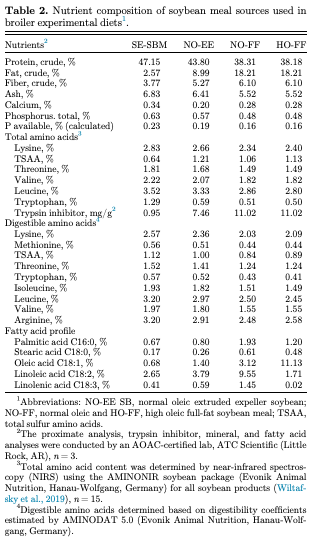
A total of 4 soybean meals with differing fat content (FFSB vs. SE-SBM) and fatty acid profiles (HO vs. NO) were included in the basal diet to produce the following experimental diets: SE-SBM, NO-EE, NO-FF, and HOFF soybeans. Three samples of all soybean meal sources were analyzed for proximate composition, fatty acid profile, and trypsin inhibitor activity by wet chemistry at a commercial laboratory (ATC Scientific, Little Rock, AR). Additionally, near-infrared spectroscopy (NIRS) was used to estimate proximate composition, total AA content, and trypsin inhibitors. The AMINONIR soybean package (Evonik Animal Nutrition, Hanau-Wolfgang, Germany) was used for all soybean products (Wiltafsky et al., 2019). These calibration curves have been evaluated globally in the feed industry and recently by Hack et al. (2023). Fifteen replicate samples of each soybean meal were scanned for NIRS values, and the average value was used for feed formulation. The digestible AAs were determined based on digestibility coefficients estimated by AMINODAT 5.0 (Evonik Animal Nutrition, Hanau-Wolfgang, Germany).
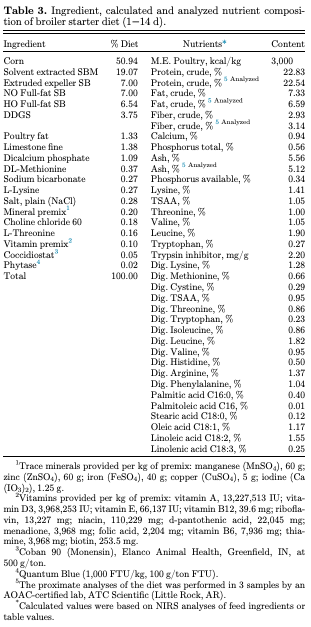
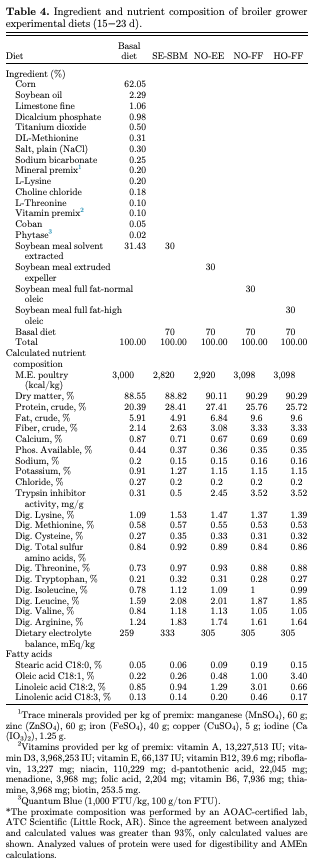
The FFSB had higher trypsin inhibitor activity (TIA) than the NO-EE and SE-SBM due to differences in the processing methods (Table 2). However, when adding them to test diets, the TIA only reached 3.52 mg/g (Table 4). This TIA is below the 4 mg/g recommended as the maximum level for broilers (Clarke and Wiseman, 2007). Consequently, this factor should not play in the present evaluation. The nutrient composition of the SBM sources evaluated is shown in Table 2. A starter diet (1−14 d) was formulated (Concept 5.0 software, Creative Formulation Concepts, LLC., Annapolis, MD) to meet or exceed nutrient requirements for broilers (Ross-708), and its composition is presented in Table 3. The formulation for starter feed was based on digestible AA, including all 4 sources of SBM evaluated in the grower phase. Corn was ground to 700 to 800 mm, and this diet was pelleted at 85°C and crumbled.
A basal or reference grower diet (Table 3) was formulated using corn and SE-SBM (Table 4). The basal diet was formulated to meet or exceed Ross-708 broiler recommendations (Aviagen, 2019). Phytate in soybeans can restrict mineral bioavailability, so a phytase enzyme was added to the experimental diets targeting 1,000 FTU/kg. Titanium dioxide was added at 5 g/kg as an inert marker in each diet. The test or assay diets contained 70% basal diet and 30% of the 4 sources of SBM evaluated. The calculated nutrient composition for these diets is shown in Table 4 as a reference.
Table 2. Nutrient composition of soybean meal sources used in broiler experimental diets1 .
Table 3. Ingredient, calculated and analyzed nutrient composition of broiler starter diet (1−14 d).
Table 4. Ingredient and nutrient composition of broiler grower experimental diets (15−23 d).

Chicken Husbandry

A total of 240 Ross-708 d-old broiler chicks were used in this experiment. Chickens were feather-sexed, weighed, tagged, and randomly assigned to Alternative Design battery cages. Brooder battery cages (88 £ 32 £ 24 cm3 ) were electrically heated, and the room temperature was maintained at 32°C to 28°C, 28° C to 24°C, and 24°C to 21°C during the first, second, and third week, respectively, using a temperature stepdown program to maintain bird comfort. A 23 h light and 1 h darkness cycle was used the first week, and 16 h light and 8 h darkness for the following 2 wk. Mortality was recorded daily.
Each treatment group had 8 replicate cages with 6 chickens per cage. All chicks were fed a starter diet (Table 3) for the first 14 d of acclimation. Subsequently, the basal and assay diets (Table 4) were fed from 15 to 23 d. After 6 d of adaptation, excreta samples were collected. Feed and water were provided ad libitum for the entire experimental period. Broiler BWs were recorded at 1, 14, 19, and 23 d.

Sample Collection

After a fasting period of 5 h, excreta samples were collected for 72 h, twice daily. Feathers and feed particles were removed immediately during collection. Excreta samples per cage were weighed and homogenized before storing them, freezing at 20°C in sterilized and labeled plastic bags.

Chemical Analysis

Feed and excreta samples were ground to pass through a 0.5 mm screen using a coffee grinder and analyzed for dry matter (DM), CP, N, GE, and titanium dioxide. The DM of feed and excreta samples was obtained by drying in a forced draft oven using NFTA Method 2.1.4, AOAC Official Method 935.29 & 945.15 (1990). Ground feed and excreta samples were analyzed for N by Fisons NA2000 Carbon Nitrogen Analyzer using AOAC 968.06 (1969) methods and for GE using a calorimetric bomb (Parr Model 6200). Titanium dioxide concentration was measured in triplicate in feed and excreta samples using an ultraviolet spectrophotometer following methods described by Myers et al. (2004).

Calculations

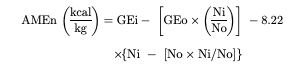
The AMEn values were determined for every dietary treatment as per the following equation (Kong and Adeola, 2014):
Influence of extruded soybean meal with varying fat and oleic acid content on nitrogen-corrected apparent metabolizable energy in broilers - Image 1
where GEi and GEo are GE values (kcal/kg) in diet and excreta; Ni and No are N values (g/kg DM) in diet (intake) and excreta (output). An N correction factor of 8,220 kcal/kg (8.22) of retained N was used to calculate MEn. This is based on estimating the energy needed when 1 kg of tissue N is catabolized (Hill and Anderson, 1958).

Statistical Analysis

Data were analyzed using JMP Pro 15 software (SAS Institute, Inc., Cary, NC). The cage served as the experimental unit. Before statistical analyses, the distribution platform of JMP was used to verify normality. Any outliers, determined as 3 times the root mean square error (RMSE) plus or minus the mean of the response, were removed from the statistical analysis. Data were analyzed in a completely randomized design using ANOVA, while mean separation was done using Tukey’s test at the significance level of P < 0.05.
The agreement between results obtained with the partial and total excreta collection was evaluated by t test, correlation coefficient, and Bland-Altman plot methodologies described by van Stralen et al. (2012). In the Bland-Altman plot method, the differences between the results obtained by the 2 methods (partial and total excreta collection) are plotted against the average of the results of both methods. This is because the “truth” ME value is unknown in this case. The limits of agreement are estimated with 2 standard deviations of the mean of the differences between both methods to estimate a confidence interval of 95%. Agreement between the 2 methods is accepted when all values are within the confidence interval (van Stralen et al., 2012). Additionally, dividing the AME and AMEn values obtained with the partial excreta collection by the respective values obtained with the total excreta collection is possible to obtain a percentage of agreement.

RESULTS

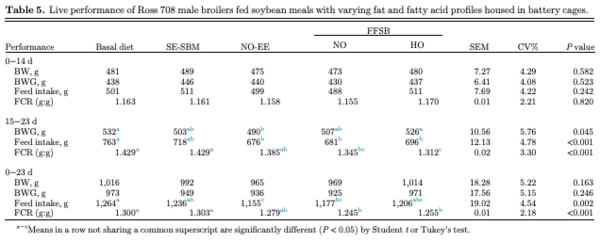
As expected, there were no significant effects (P > 0.05) among groups of chickens with the assigned treatments in BW, BWG, FI, or FCR during the first 14 d (Table 5). The reference and assay diets were fed from 15 to 23 d of age. In this period, the BWG of chickens fed the NO-EE test diet was lower than the observed in chickens fed the reference basal diet or the HO-FF test diet, and all other chickens fed test diets had intermediate BWG. The FI during the test period (15−23 d) was higher (P < 0.001) in chickens fed the reference basal diet than those fed NO-EE and both FFSB assay diets, and the FI of chickens fed the SE-SBM was intermediate. Chickens fed the FFSB assay diets had significantly better FCR values (P < 0.001) than broilers fed the basal and SE-SBM diets, and chickens fed the NO-EE assay diet had intermediate FCR. During this period (15 −23 d), the best FCR was observed in chickens fed the HO-FF assay diet.
There were no significant (P > 0.05) treatment effects in BW or BWG at the end of the whole experimental period (Table 5). Chickens fed the reference basal diet had higher total FI (P < 0.01) than broilers fed the NO FF and NO-EE assay diets. Chickens fed the FFSB assay diets had better FCR (P < 0.001) than those fed the basal and SE-SBM assay diets, while chickens fed the NO-EE assay diet had intermediate FCR during the whole experiment.
Table 5. Live performance of Ross 708 male broilers fed soybean meals with varying fat and fatty acid profiles housed in battery cages.

AME and AMEn Determination

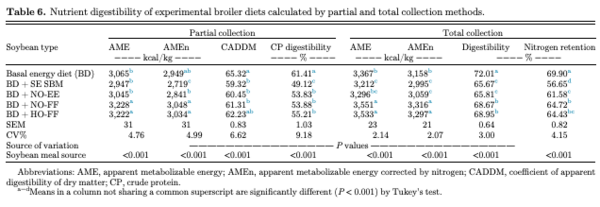
The AME and AMEn (kcal/kg) values were determined using partial and total excreta collection. The results of basal reference and assay diets are displayed in Table 6. On average, the AME and AMEn determined with partial excreta collection had 8.50% and 7.80% lower values (P < 0.001) than the total collection method. The correlation between both methods was 0.80. The Bland-Altman plot method (van Stralen et al., 2012) indicated an average difference between both methods of 305.08 § 19.97 and 261 § 20.58 kcal/kg for AME and AMEn, respectively. The standard deviations of the average differences between both methods were 121.46 and 125.16 kcal/kg. All AME and AMEn values obtained with both methods were within the 95% confidence interval, indicating good agreement between methods of analyses. The average percentage of agreement was 98% when dividing the energy value results determined with the partial excreta collection by results determined with the total excreta collection.
The AME and AMEn values of the HO-FF and NOFF assay diets were higher (P < 0.001) than the NO-EE and SE-SBM assay diets and the reference diet. The basal reference diet had similar AME and AMEn values to those observed in NO-EE diets, but SE-SBM had lower AMEn with both methods.
For the first method (partial collection), the apparent digestibility of DM (CADDM) and CP digestibility (%) were determined, and DM digestibility and N retention were calculated with the total collection method (Table 6). The highest CADDM values were found in the basal and HO-FF diets (P < 0.001) relative to the other treatment groups. The highest CP digestibility and N retention were observed in the reference diet and the lowest in the SE-SBM treatment groups (P < 0.001), with intermediate CP digestibility and N retention values in the other treatment groups.
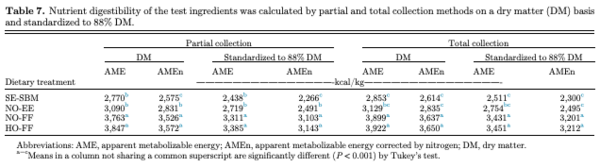
The AME and AMEn calculated for each SBM source with both methods in DM and standardized for 88% DM are presented in Table 7. The 88% DM is considered the most common value for feed formulation. Similar results were observed with both methods of excreta collection, and the agreement between both methods was 97.6% for AME and 98.3% for AMEn. The difference in kcal/kg between both methods was only 39 and 4 for AME and AMEn for the NO-EE and higher (136 and 111 kcal/kg) for NO-FF. On average, the difference was 83 and 58 kcal/kg for AME and AMEn. Both full-fat feed ingredients (NO-FF and HO-FF) had similar energy values and higher AME and AMEn values (P < 0.001) than SE-SBM and NO-EE.
Table 6. Nutrient digestibility of experimental broiler diets calculated by partial and total collection methods.
Table 7. Nutrient digestibility of the test ingredients was calculated by partial and total collection methods on a dry matter (DM) basis and standardized to 88% DM.

DISCUSSION

The AME and AMEn values determined in the present experiment for all 3 types of soybean sources (SESBM, NO-EE, and FFSB) are within 1 standard deviation above the mean observed in the literature (Table 1). In this experiment, the methodologies and age of the chickens were similar to those reported in the recent literature, summarized in Table 1. The substitution method was selected, and no correction was made to the dilution of titanium dioxide, minerals, vitamins, and other nutrients. Wu et al. (2020) theoretically discussed that this dilution could cause adverse effects on chicken performance and nutrient utilization. However, in the few studies listed in Table 1 that reported live performance or in the present experiment (Table 5), that negative effect has not been observed. In the present experiment, the BW of chickens fed test diets was similar to those fed the balanced basal reference diet. Chickens fed the test diets had FI similar to or lower than and FCR similar or better than those fed the reference diet (Table 5). No chicken live performance parameter indicated that these chickens had a nutrient deficiency affecting their growth, FI, or nutrient utilization. These results challenge the significance of the effects discussed by Wu et al. (2020), who recommended correcting minerals and vitamins in the test diets. However, in the substation method, all other nutrients will be unbalanced when a test ingredient is included (Table 4). The doubt remains about the effect of titanium oxide dilution on the AME determination, which was an additional reason to use partial and total excreta collection.
Efforts have been made to improve the precision of estimating energy values for poultry feed ingredients (Mateos et al., 2019; Wu et al., 2020). Despite recent developments in other energy systems for poultry, the AME and AMEn are still the most extensively used for describing feed ingredients’ available energy to use in feed formulation (Lopez and Leeson, 2008; Abdollahi et al., 2021). However, there is significant variability in the values published for each ingredient and even similar samples. The variability in estimating these ME values may be influenced by different factors. These factors include the methodology selected (Farrell et al., 1991; West, 2018; Olukosi, 2021), excreta collection method and inert marker used (Roza et al., 2018), age of the chickens (Lessire et al., 1982; Sibbald, 1982; Bertechini et al., 2019), the composition of reference diet (Veluri and Olukosi, 2020), time of adaptation to assay diets, and species and strain (Spratt and Leeson, 1987; Bourdillon et al., 1990).
Data from total and partial excreta collection generally deliver different values, and an agreement of more than 96% is considered acceptable (Roza et al., 2018; L. Adeola, personal communication, 2023). However, in a study conducted by Dourado et al. (2010), no significant difference was observed between the total and partial collection methods for energy determination of SBM. However, acid-insoluble ash was used as a digestibility marker in that experiment. The current experiment used titanium dioxide, and the total collection method had higher AME and AMEn values. Titanium dioxide is an approved feed additive by the US Food and Drug Administration (Titgemeyer et al., 2001) and is used as an inert marker in broiler diets for digestibility studies. Titanium meets all requirements as an inert marker; it has the same digestive transit speed as other dietary nutrients, is physiologically inactive, indigestible, nontoxic, easy to analyze, and homogenously mixed into the diet (Jagger et al., 1992; Titgemeyer et al., 2001). Titanium dioxide is preferred over the commonly used chromium oxide due to better reproducibility and homogeneity (Jagger et al., 1992). However, it has been proven in several experiments (Roza et al., 2018) that the titanium dioxide recovery rate is lower (82−85%) than acid-insoluble ash (95%). This could cause the values evaluated in all experiments using the partial method to be slightly lower than with the total collection method. The total collection method could be more accurate than the partial one.
In this experiment, 2 FFSB sources varying in fatty acid composition, NO-FF and HO-FF soybean meals, were processed under similar extrusion conditions. Even for similar soybean processing methods, there is no complete standardization of conditions of temperature, humidity, time, and pressure (Freitas et al., 2005). However, the AME and AMEn of these ingredients were similar in both collection methods. In the present experiment, 3,201 or 3,103 and 3,212 or 3,143 kcal/kg AMEn were observed for NO-FF and HO-FF when adjusted for 88% DM, which is very close (16−29 kcal/kg from the average) to other values previously reported in the literature for FFSB (Table 1). The lack of difference between soybean sources with different oleic acid indicates that the fatty acid profile does not impact the energy utilization (AME and AMEn) values obtained using these methodologies. The chicken live performance results during the short experimental period match the energy utilization values obtained.
There are very few recent studies evaluating EE-SB. The main difficulty for comparison is the difference in fat content among EE-SB products after the expeller process. West (2018) evaluated an EE-SB with 6.95% ether extract and 47.5% CP on a DM basis, while the NO-EE tested in the current project contained 43.80% CP and 8.99% ether extract. These 2.04% points of extra fat content could partially explain the additional 222 and 213 kcal/kg observed in AME and AMEn in the NO-EE evaluated in the present experiment. This result was the most significant difference in energy values compared to those observed in the literature.
For comparative purposes, ME values of ingredients and diets are usually corrected for N retention to transform all data to a base of N equilibrium. N retention changes with the age of the bird, type of bird, and potentially genetic strain; hence, a correction factor is essential to compare ME values for the same ingredient, which can signify the metabolic use or excretion of N compounds by the animal, through retention or excretion as uric acid (Liu et al., 2017). In the current study, a difference in AME and AMEn values of the different test ingredients can be attributed to N retention, as the CP level was different in the test diets (Table 4). The correction for N to obtain AMEn reduced the average energy value in these soy ingredients by 242 kcal/kg in the partial collection method and 267 kcal/kg in the total collection method. Abdollahi et al. (2021) have discussed in detail this issue of energy reduction when using AMEn for high protein feedstuffs and its implications for feed formulation and costs.
The maximum inclusion level of test ingredients is generally based on nutrient balance and palatability. Variability among ME values can occur due to a low inclusion level of test ingredients (Mateos and Sell, 1980). Still, high inclusion levels of test ingredients can also cause nutritional imbalances depending on the nutritional composition of the ingredients (Sibbald and Slinger, 1962). Variability in AME and AMEn due to the inclusion level of soybean products has been reported (West, 2018; Olukosi, 2021). However, the most common inclusion level recommended (Wu et al., 2020) for AME determination is 30%, as used in this experiment.
Lopez and Leeson (2008) stated that the AMEn values of SE-SBM were 7 to 12% less than AME when calculated using a corn-soybean diet. In the current study, reductions of 6.72 to 9.15% and 7.20 to 10.37% were observed from AME to AMEn values of test ingredients on a DM basis using partial and total collection methods, respectively. All these comparisons with the literature, between methods for all soybean sources, provide confidence that the data obtained for a new ingredient with no other reference to compare is accurate. To the best of our knowledge, this is the first data related to the energy utilization of HO-FF soybeans in broiler diets.

CONCLUSIONS

HO-FF soybean is a valuable feed ingredient that can be an alternative source of amino acids to conventional defatted soybean meals, such as EE-SB and SE-SBM. The AME and AMEn values for HO-FF and NO-FF soybeans in broilers were similar, but HO-FF soybean meal had 39% and 24% higher AME and AMEn than SE-SBM and NOEE, respectively. The percentage agreement between the AME and AMEn values determined with the partial and the total excreta collection methods was near 98%. Using HO soybean cultivars to produce full-fat soybean meals could create a potential value-added feed ingredient for the poultry and egg production industry. The HO-FF offers high available dietary energy while enhancing the oleic acid in poultry products, with potential economic benefits for the soybean and poultry industries.

ACKNOWLEDGMENTS

The authors would like to acknowledge Philip Lobo and the United Soybean Board-Animal Nutrition Working Group for providing their guidance and leadership.
Funding: The United Soybean Board supported this work [grant number 1930-362-0618], and the United States Department of Agriculture, Agricultural Research Service, Food Science & Market Quality and Handling Research Unit, Raleigh, NC, USA [CRIS project no. 6070-43440-013-00D].
Role of the Funding Source: The funding sponsor, the United Soybean Board, provided financial support to conduct this research in the study design, planning, and final review and edits of this manuscript.
Author Contributions: This work was the thesis research project of graduate student Muhammad Ali, who conducted the following tasks: collection of research data, summary and analysis of research data, generation of data tables, and preparation of the working draft of the manuscript. The following individuals assisted with the placement, weighing, feeding, processing, and laboratory analyses of samples: Muhammad Ali, Maria Camila Alfaro-Wisaquillo, Gustavo Adolfo QuintanaOspina, Danny Patino, Lina-Maria Penuela-Sierra, and ~ Thien Vu. Edgar Orlando Oviedo-Rondon was the graduate student advisor and broiler project lead. OviedoRondٕon did the broiler feed formulation, research planning, experimental design, supervision, and directed all lab analyses. Oviedo-Rondon was a coprincipal investigator on the United Soybean Board grant, assisting with soybean processing, preparation of experimental diets, and writing and submitting the final manuscript. The following individuals were responsible for soybean germplasm and cultivation, soybean production, harvest, and seed cleaning of all soybeans used to prepare all soybean meal sources: Rouf Mian. Michael Joseph was the coprincipal investigator on the United Soybean Board grant, the project leads for all soybean processing, the production of all soybean meal sources, and the final production of all experimental broiler diets. Ondulla Toomer was the lead principal investigator from the USDA on the United Soybean Board grant and led the procurement of funds, assisted with the collection of samples, and final manuscript edits.

DISCLOSURES

The authors declare the following financial interests/ personal relationships which may be considered as potential competing interests: Ondulla Toomer reports financial support was provided by United Soybean Board.
  
This article was originally published in 2024 Poultry Science 103:103408. https://doi.org/10.1016/j.psj.2023.103408. This is an Open Access article under the CC BY-NC-ND license (http://creativecommons.org/licenses/by-nc-nd/4.0/).

Abdollahi, M. R., Wiltafsky-Martin, M., & Ravindran, V. (2021). Application of apparent metabolizable energy versus nitrogen-corrected apparent metabolizable energy in poultry feed formulations: A continuing conundrum. Animals, 11, 2174.

Abdollahi, M. R., Wiltafsky-Martin, M., Zaefarian, F., & Ravindran, V. (2022). Influence of conditioning and expansion characteristics on the apparent metabolizable energy and standardized ileal amino acid digestibility of full-fat soybeans for broilers. Animals, 12, 1021.

Adeola, O., Anwar, M. N., Abdollahi, M., & Ravindran, V. (2018). Age-related energy values of meat and bone meal for broiler chickens. Poultry Science, 97, 2516–2524.

Ali, M., Joseph, M., Alfaro-Wisaquillo, M. C., Quintana-Ospina, G. A., Patiño, D., Peñuela-Sierra, L. M., Vu, T., Mian, R., Taliercio, E., Toomer, O., & Oviedo-Rondón, E. O. (2023). Standardized ileal amino acid digestibility of high-oleic full-fat soybean meal in broilers. Poultry Science, 102, 103152.

AOAC. (1990). Official methods of analysis of the Association of Official Analytical Chemists (15th ed.). AOAC.

AOAC. (1969). Official methods of analysis of the Association of Official Analytical Chemists. AOAC.

Aviagen. (2019). Ross nutrition specifications. https://en.aviagen.com/assets/Tech_Center/Ross_Broiler/RossBroilerNutritionSpecs2019-EN.pdf

Barzegar, S., Wu, S. B., Choct, M., & Swick, R. A. (2020). Factors affecting energy metabolism and evaluating net energy of poultry feed. Poultry Science, 99, 487–498.

Beckman, N. M., Otott, H. K., Blomme, A. K., Badger, P. A., Thompson, L. J., Lancaster, P. A., Zheng, Y., Amachawadi, R. G., Schrader, M. A., Stark, C. R., & Paulk, C. B. (2024). Nitrogen-corrected apparent metabolizable energy and apparent ileal digestibility of amino acids of thermally processed food waste for broilers. Journal of Applied Poultry Research, 33, 100379.

Bertechini, A. G., Kato, R. K., Freitas, L. F. V. B. D., Castro, R. T. D. C., & Mazzuco, H. (2019). Metabolizable energy values of soybean meals and soybean oil for broilers at different ages. Acta Scientiarum. Animal Sciences, 41, e44540.

Bourdillon, A., Carré, B., Leclercq, B., Lessire, M., Conan, L., Francesch, M., Fuentes, M., Wiseman, J., Huyghebaert, G., Janssen, W. M. M. A., & Rigoni, M. (1990). European reference method of in vivo determination of metabolisable energy in poultry: Reproducibility, effect of age, comparison with predicted values. British Poultry Science, 31, 567–576.

Clarke, E., & Wiseman, J. (2007). Effects of extrusion conditions on trypsin inhibitor activity of full-fat soybeans and subsequent effects on their nutritional value for young broilers. British Poultry Science, 48, 703–712.

de Coca-Sinova, A., Valencia, D. G., Jiménez-Moreno, E., Lázaro, R., & Mateos, G. G. (2008). Apparent ileal digestibility of energy, nitrogen, and amino acids of soybean meals of different origin in broilers. Poultry Science, 87, 2613–2623.

Dourado, L. R. B., Siqueira, J. C., Sakomura, N. K., Pinheiro, S. R. F., Marcato, S. M., Fernandes, J. B. K., & Silva, J. H. V. (2010). Poultry feed metabolizable energy determination using total or partial excreta collection methods. Revista Brasileira de Ciência Avícola, 12, 129–132.

Farrell, D. J., Thomson, E., du Preez, J. J., & Hayes, J. P. (1991). The estimation of endogenous excreta and the measurement of metabolisable energy in poultry feedstuffs using four feeding systems, four assay methods and four diets. British Poultry Science, 32, 483–499.

Freitas, E. R., Sakomura, N. K., Neme, R., dos Santos, A. L., & Fernandes, J. B. K. (2005). Effects of processing on full-fat soybean metabolizable energy determined by different methodologies and digestibility of amino acids for poultry. Revista Brasileira de Zootecnia, 34, 1938–1949.

Hack, A., Parsons, B., Utterback, P., Emmert, J., & Parsons, C. (2023). Toward a better understanding of antinutritional factors, reactive lysine, KOH protein solubility, and rooster amino acid digestibility in commercial soybean meals. Poultry Science, 102, 38.

Hill, F. W., & Anderson, D. L. (1958). Comparison of metabolizable energy and productive energy determinations with growing chicks. The Journal of Nutrition, 64, 587–603.

Jagger, S., Wiseman, J., Cole, D. J. A., & Craigon, J. (1992). Evaluation of inert markers for the determination of ileal and faecal apparent digestibility values in the pig. British Journal of Nutrition, 68, 729–739.

Jiang, Q., Wu, W., Wan, Y., Wei, Y., Kawamura, Y., Li, J., Guo, Y., Ban, Z., & Zhang, B. (2022). Energy values evaluation and improvement of soybean meal in broiler chickens through supplemental multienzyme. Poultry Science, 101, 101978.

Khalil, M. M., Abdollahi, M. R., Zaefarian, F., & Ravindran, V. (2021). Influence of feed form on the apparent metabolisable energy of feed ingredients for broiler chickens. Animal Feed Science and Technology, 271, 114754.

Knowlton, S. (2022). High-oleic soybean oil. In F. J. Flider (Ed.), High oleic oils (pp. 53–87). AOCS Press.

Kong, C., & Adeola, O. (2014). Evaluation of amino acid and energy utilization in feedstuff for swine and poultry diets. Asian-Australasian Journal of Animal Sciences, 27, 917–925.

Lessire, M., Leclercq, B., & Conan, L. (1982). Metabolisable energy value of fats in chicks and adult cockerels. Animal Feed Science and Technology, 7, 365–374.

Liu, W., Liu, G. H., Liao, R. B., Chang, Y. L., Huang, X. Y., Wu, Y. B., Yang, H. M., Yan, H. J., & Cai, H. Y. (2017). Apparent metabolizable and net energy values of corn and soybean meal for broiler breeding cocks. Poultry Science, 96, 135–143.

Loeffler, T., Shim, M. Y., Beckstead, R. B., Batal, A. B., & Pesti, G. M. (2013). Amino acid digestibility and metabolizable energy of genetically selected soybean products. Poultry Science, 92, 1790–1798.

Lopez, G., & Leeson, S. (2008). Assessment of the nitrogen correction factor in evaluating metabolizable energy of corn and soybean meal in diets for broilers. Poultry Science, 87, 298–306.

Mateos, G. G., Camara, L., Fondevila, G., & Lazaro, R. P. (2019). Critical review of the procedures used for estimation of the energy content of diets and ingredients in poultry. Journal of Applied Poultry Research, 28, 506–525.

Mateos, G. G., & Sell, J. L. (1980). True and apparent metabolizable energy value of fat for laying hens: Influence of level of use. Poultry Science, 59, 369–373.

Myers, W. D., Ludden, P. A., Nayigihugu, V., & Hess, B. W. (2004). Technical note: A procedure for the preparation and quantitative analysis of samples for titanium dioxide. Journal of Animal Science, 82, 179–183.

Olukosi, O. A. (2021). Investigation of the effects of substitution levels, assay methods and length of adaptation to experimental diets on determined metabolisable energy value of maize, barley and soya bean meal. British Poultry Science, 62, 278–284.

Olukosi, O. A., Adedokun, S. A., & Agboola, J. O. (2017). Species-dependent response to the influence of adaptation length during assay for metabolisable energy of cereal grains employing the difference method. Animal Feed Science and Technology, 231, 111–118.

Pacheco, W. J., Stark, C. R., Ferket, P. R., & Brake, J. (2013). Evaluation of soybean meal source and particle size on broiler performance, nutrient digestibility, and gizzard development. Poultry Science, 92, 2914–2922.

Parsons, C. M., Zhang, Y., & Araba, M. (2000). Nutritional evaluation of soybean meals varying in oligosaccharide content. Poultry Science, 79, 1127–1131.

Ravindran, V., Abdollahi, M., & Bootwalla, S. (2014). Nutrient analysis, apparent metabolisable energy and ileal amino acid digestibility of full-fat soybean for broilers. Animal Feed Science and Technology, 197, 233–240.

Roza, L. F., Tavernari, F. D. C., Surek, D., Sordi, C., Albino, L. F. T., Paiano, D., Boiago, M. M., Petrolli, T. G., & Junior, A. C. (2018). Metabolizable energy and amino acid digestibility of mash and pelleted diets for broilers determined under different methodologies. Animal Feed Science and Technology, 235, 1–7.

Rueda-Agudelo, S. L., & Giraldo-Mejía, A. M. (2018). Energía metabolizable del grano de soya integral en pollos de engorde. Revista de Veterinaria y Zootecnia (On Line), 12, 84–104.

Sibbald, I. R. (1975). The effect of level of feed intake on metabolizable energy values measured with adult roosters. Poultry Science, 54, 1990–1997.

Sibbald, I. R. (1976). A bioassay for true metabolizable energy in feedingstuffs. Poultry Science, 55, 303–308.

Sibbald, I. R. (1982). Measurement of bioavailable energy in poultry feedingstuffs: A review. Canadian Journal of Animal Science, 62, 983–1048.

Sibbald, I. R., & Slinger, S. J. (1962). Factors affecting the metabolizable energy content of poultry feeds: 10. A study of the effect of level of dietary inclusion on the metabolizable energy values of several high-protein feedingstuffs. Poultry Science, 41, 1282–1289.

Silva, D. L., Dalolio, F. S., Teixeira, L. V., Sens, R. F., Albino, L. F. T., & Rostagno, H. S. (2022). Impact of the supplementation of exogenous protease and carbohydrase on the metabolizable energy and standardized ileal amino acid digestibility of soybean meals in two Brazilian regions. Brazilian Journal of Poultry Science, 24, 4.

Slaughter, J., Peckman, T., Burdick, K., Callahan, Z., & Wiegand, B. (2019). Evaluating dietary inclusion of high-oleic soybean meal and oil on broiler performance and lipid quality. Meat and Muscle Biology, 3, 126.

Spratt, R. S., & Leeson, S. (1987). Determination of metabolizable energy of various diets using leghorn, dwarf, and regular broiler breeder hens. Poultry Science, 66, 314–317.

Thanabalan, A., Mohammadigheisar, M., & Kiarie, E. G. (2021). Amino acids and energy digestibility in extruded or roasted full-fat soybean fed to broiler chickens without or with multienzyme supplement containing protease, phytase, and fiber-degrading enzymes. Poultry Science, 100, 101511.

Titgemeyer, E. C., Armendariz, C. K., Bindel, D. J., Greenwood, R. H., & Löest, C. A. (2001). Evaluation of titanium dioxide as a digestibility marker for cattle. Journal of Animal Science, 79, 1059–1063.

Valencia, D. G., Serrano, M. P., Lazaro, R., Jiménez-Moreno, E., & Mateos, G. G. (2009). Influence of micronization (fine grinding) of soya bean meal and full-fat soya bean on the ileal digestibility of amino acids for broilers. Animal Feed Science and Technology, 150, 238–248.

Van Stralen, K. J., Dekker, F. W., Zoccali, C., & Jager, K. J. (2012). Measuring agreement, more complicated than it seems. Nephron Clinical Practice, 120, c162–c167.

Veluri, S., & Olukosi, O. A. (2020). Metabolizable energy of soybean meal and canola meal as influenced by the reference diet used and assay method. Animals, 10, 1–10.

West, S. (2018). Optimizing methods to determine metabolizable energy values of feed ingredients for broilers [Master’s thesis, University of Arkansas].

Wiltafsky, M., Reimann, I., Fickler, J., & Rademacher-Heilshorn, M. (2019). Method for the determination of processing influences on the nutritional value of feedstuff raw materials (European Patent No. EP3361248B1). Evonik Patent Association, c/o Evonik Industries AG, IP Management.

Wu, S. B., Choct, M., & Pesti, G. (2020). Historical flaws in bioassays used to generate metabolizable energy values for poultry feed formulation: A critical review. Poultry Science, 99, 385–406.


Related topics:
Authors:
Michael Joseph
Edgar O. Oviedo-Rondón
Maria Camila Alfaro Wisaquillo
Lina María Peñuela
Danny Patiño Prado
Show more
Recommend
Comment
Share
Profile picture
Would you like to discuss another topic? Create a new post to engage with experts in the community.
Featured users in Poultry Industry
Lieske van Eck
Lieske van Eck
United States
Shivaram Rao
Shivaram Rao
PhD Director Principal de Nutrición y Servicios Técnicos de Pilgrim’s Pride Corporation
United States
Carolina Hall
Carolina Hall
United States