Competitive exclusion improves the performance of broilers vaccinated against coccidiosis
Published: August 11, 2026
Source : A. LEARY 1, V. PAIN 2, E. CHEVAUX 3, F. BARBE 3, M. CASTEX 3, E. ALTINBAS 3 and
A. SACY 3 / 1 Lallemand Animal Nutrition, Maroochydore, Australia; 2 SOCSA, L’Union, France; 3 Lallemand Animal Nutrition, Blagnac, France.
Summary
Using vaccination to reduce the risk of coccidiosis, a major threat to poultry production, is becoming increasingly common in Australia and around the world. However, the vaccine itself has been reported to potentially have a negative effect on bird performance as it requires repeated cycling of coccidia within the bird to develop immunity. The current study investigates the impact of high levels of coccidiosis vaccines on bird performance and also the ability of using early, avian-specific microbiota development through a competitive exclusion product, to alleviate this negative impact on performance.
I. INTRODUCTION
Rapid development of an appropriate microbiota within a chicken gut is critical for its ongoing gut health and immunity (Meijerink et al., 2020). In natural circumstances the hen would pass her microbiota onto the chick, but in commercial conditions where eggs are set and hatched in a sterile hatchery this transfer is not possible and microbiota development is often from sources such as the environment (Dame-Korevaar et al., 2020). Development of a microbiota influenced by the environment rather than an avian-specific bacteria source has been shown to have detrimental effects on bird development and can result in colonisation of pathogenic bacteria (Meijerink et al., 2020). Application of a competitive exclusion product derived from a healthy adult hen has been shown to alleviate some of the risks (Meijerink et al., 2020).
Coccidiosis remains the major threat to the poultry industry in Australia and around the world (Mesa-Pineda et al., 2021). Added to this a recent concern of Eimeria isolates becoming resistant to anticoccidial drugs along with the societal demand for less antibiotic use have led to the development of alternative solutions, like live coccidiosis vaccines (Yu et al., 2023). Vaccination stimulates immunity to prevent coccidiosis, but several studies have reported the negative impact on zootechnical performances (Gautier et al., 2020; Repérant et al., 2022). In this context, in a pilot study, we have investigated a new way to mitigate the negative impact of a coccidiosis vaccine on performances using the early application of a competitive exclusion (CE) product.
II. METHOD
One hundred and fifty day-old, mixed sex ROSS 308 broilers were randomly allocated to 3 treatments: negative control (NC), vaccine group (VG) and vaccine group with a microbial solution (AviGuard® + Optiwall® - Lallemand SAS, CE). Each group consisted of 3 floorpens of 15 chicks, except the NC with 4 replicates. Starter crumbles diet without anticoccidials were formulated and offered throughout the trial from 1 to 33 days.
Birds were vaccinated with EVALON® (HIPRA) at 5x the recommended application rate to get an accurate count of oocysts in droppings (Mathis et al., 2018). The vaccination was performed immediately after the allocation of the birds to their respective pens by individual gavage and to prior feed access. The CE group was also administered by gavage with the vaccine. The NC group received 1 ml of mineral water.
Chicks were individually weighted at d1, d5, d10, d25 and d33. Oocysts were counted in faeces at d10 & d25, as a proposed marker of vaccinal oocysts recycling (Repérante et al., 2022). Eimeria gut lesions were evaluated according to Johnson & Reid (1970) scales. Treatment group comparison was performed using a non-parametric Kruskal-Wallis test (SPSS Statistics 27.0, IBM). Pairwise comparison was established as an indication of the dietary effect even if a trend was depicted.
III. RESULTS
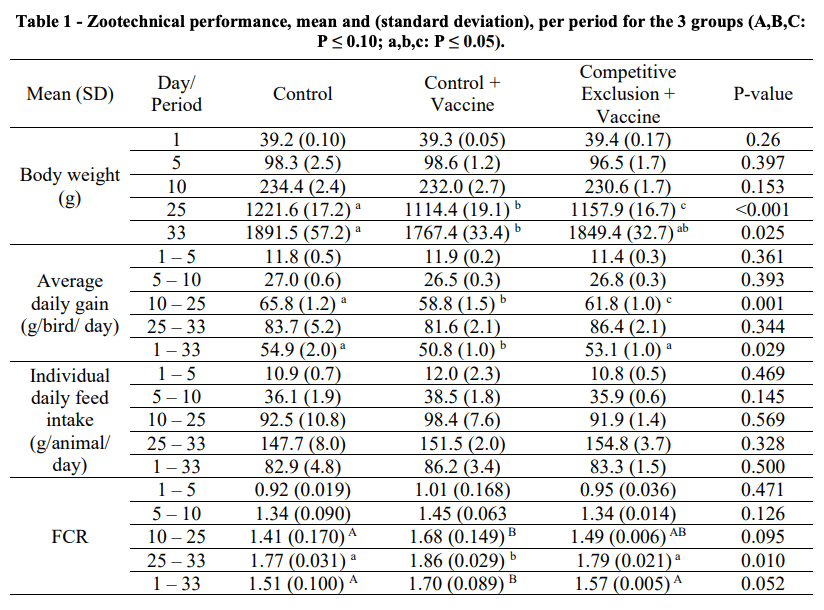
Detailed results are presented in Table 1. The vaccine induced a significant reduction in body weight (BW) at d33 of age (-6.6%), and even from d25 (-8.8%). The average daily gain (ADG) from d1 to d33 was also significantly altered (-7.5%). Feed intake was not influenced by any treatment. Consequently, the feed conversion ratio (FCR) was negatively impacted (+12.3%). Results indicated that CE vaccinated birds at d25 had significantly better performances (BW, ADG, FCR) than VG birds. Non-significant differences were found between non vaccinated birds and vaccinated birds inoculated with the competitive exclusion product except at d25 where CE birds’ performances were intermediate between NC and VG group.
Oocyst shedding was identical between both vaccinated groups on d10 and d25, suggesting that a normal cycling of the vaccine oocysts had occurred. The average oocysts per gram of faeces (OPG) was 2,617 OPG at d10 and 767 OPG at d25. No oocysts were found in the NC. Coccidiosis-induced lesions were only score 1 at d5 and scores 1 and 2 at d33. No statistical difference between groups was depicted at d5 (P = 0.312) and at d33 (P = 0.603). Despite the low number of lesions at both time points, CE vaccinated birds was the group having the smallest number of lesions scored 1 at d5 and no lesions scored 2 at d33.

IV. DISCUSSION
The CE tested in this study contributed to alleviating vaccination side effects. CE is based on a well-established concept aiming at reinforcing the immune status of the birds, especially through a faster mature and balanced microbiota establishment (Meijerink et al., 2020; DameKorevaar et al., 2020, Methner and Rösler, 2020).
Associating a live vaccine and CE has already been tested for Salmonella (Braukmann et al., 2016; Methner et al., 2017) with positive effect of the CE. Use of CE early in chick life shapes the gut microbiota, thus creating a favourable physiological environment for beneficial bacteria and reducing the possibility of opportunistic bacteria to develop. Another explanation is linked to the modulation of inflammation in the gut, which would minimize nutrients diversion towards an inflammatory response, to the benefit of performance. Here, in the context of cocci vaccine, this study presents an interesting strategy to compensate the previously reported negative effects of live cocci vaccines on performance. The OPG remained at the same level in both vaccinated groups, indicating that the CE did not alter the mode of action of the live vaccine while negating some of the vaccines impact on bird performance measured by weight gain and FCR.
From these results, it can be concluded that the CE is compatible with coccidiosis vaccines and could be a viable solution to alleviate the negative effect of coccidiosis vaccine on broiler performances.
Presented at the 35th Annual Australian Poultry Science Symposium 2024. For information on the latest and future editions, click here.
- Braukmann M, Barrow PA, Berndt A & Methner U (2016). Research in Veterinary Science 107: 34–41.
- Dame-Korevaar A, Kers JG, Van der Goot J, Velkers FC, Ceccarelli D, Mevius DJ, Stegeman A & Fischer EAJ (2020). Frontiers in Microbiology 11: 566619.
- Gautier AE, Latorre JD, Matsler PL & Rochell SJ (2020). Frontiers in Veterinary Science 6: 468.
- Johnson J & Reid WM (1970). Experimental Parasitology 28: 30–36.
- Mathis GF, Newman LJ, Fitz-Coy S, Lumpkins B, Charette R & Fuller L (2018). Journal of Applied Poultry Research 27: 33–37.
- Meijerink N, Kers JG, Velkers FC, van Haarlem DA, Lamot DM, de Oliveira JE, Smidt H, Stegeman JA, Rutten VPMG & Jansen CA (2020). Frontiers in Veterinary Science 7: 584561.
- Mesa-Pineda C, Navarro-Ruiz JL, Lopez-Osorio S, Chaparro-Gutierrez JJ & Gomez-Osorio LM (2021). Frontiers in Veterinary Science 8: 787653.
- Methner U, Berndt A & Locke M (2017). Vaccine 35: 6076–6082.
- Methner U & Rosler U (2020). BMC Veterinary Research 16: 143.
- Repérant J, Thomas-Henaff M, Benoit C, Raybaud C, Yazid C, Le Bihannic P & Techer C (2022). 14th Poultry and Foie Gras Palmipede Research Days.
- Yu Y, Huang W, Wang Q, Dong H, Zhao Q, Zhu S, Huang B & Han H (2023) International Journal of Parasitology: Drugs and Drug Resistance 21: 81-90.
Content from the event:

Related topics:
Authors:

Lallemand
Recommend
Comment
Share

Would you like to discuss another topic? Create a new post to engage with experts in the community.














Featured users in Poultry Industry

Dr. Algis Martínez  Cargill
DVM, Diplomado ACPV - Poultry Veterinarian North America Cargill
United States
United States