INTRODUCTION
Artificial insemination (AI) is the manual transfer of semen into the female’s vagina. Basically it is a two-step procedure, first, collecting semen from the male and second, inseminating the semen into the female [1]. Artificial insemination was first practiced in America during the 1920s and then used widely in Australia with the introduction of laying cages during late 1950s. AI is the method of choice for the geneticist for maintaining the pedigreed mating. Broad breasted turkey was produced by genetic selection, which is physically incapable of natural mating so in such birds AI is the only way of mating. AI is done to minimize the size of male flock in guinea fowl as in guinea fowl one male is used for two-three female.
Some of the advantages of artificial insemination in the poultry are:
1. Increased mating ratio: Normally one cockerel can mated to six to ten hens. With artificial insemination, this ratio could be increased fourfold.
2. Older males having outstanding performance can be used for several generations. Whereas under natural mating, their useful life is limited.
3. Valuable male birds having the leg injury can still be used for artificial insemination.
4. Elimination of preferential mating: When there is poor fertility caused by preferential mating, it can be eliminated.
5. Successful cross breeding: Although cross breeding is very successful under natural conditions, but sometimes there is a kind of colour discrimination as some hens will not mate with a male of a different colour unless they have been reared together. In such condition, AI helps in successful cross breeding.
MALE REPRODUCTIVE SYSTEM
Unlike most mammals, the testes of the rooster function at the normal body temperature of close to 41°C as testes are deep within the body cavity close to the kidneys. Prior to maturity, they are small being only 1–2 g each. Similar to the situation with the ovary in the hen, there size increases dramatically at around 18 weeks, and mature testes are weighing around 15–20 g [2]. Sperm production and testicular size are directly correlated, and the latter to some extent is positively correlated with body size. Daily sperm production is about 100 million per gram of testes weight, which is fairly constant regardless of mating or collection frequency. The ‘average’ males in the flock are likely the most effective in maintaining fertility. Males can produce semen as early as 12 weeks of age, depending upon body size and lighting programme. However, sperm from such roosters is rarely viable and effective maturity does not develop until birds are around a minimum of 18 weeks of age [2]. In turkeys, the volume averages ~0.35–0.5 mL, with a spermatozoon concentration of 6 to 8 billion/mL, where as in chickens, volume is 2–3 times that of turkeys, but the concentration is about one-half. Chicken and turkey semen begin to lose fertilizing ability when stored > 1 h. Liquid cold (4°C) storage of turkey and chicken semen can be used to transport semen and maintain spermatozoa viability for ~6–12 h.
SEMEN COLLECTION
Collection involves restraining of male by holding, breast down, usually on a table or the knee of the collector, who is usually sitting. The bird is held by another operator or alternatively held in some type of mechanical leg clamp. The abdomen is then firmly massaged with one hand while the other hand is drawn across the back and over the tail feathers. The phallus will enlarge after 3–6 such massages depending upon variation between males, and at this time, the collector quickly places their hands around the cloaca. Cloaca is pressed from top and bottom using thumb and fore finger, which allows the vent to evert out [2]. The semen is then aspirated from the surface of the phallus directly into a sealed tube. At this time, semen should appear on the end of the phallus. The procedure of manipulating the cloacal region can be conducted a second time to produce a second stream of semen. Semen is collected 4–6 times in a week.
SEMEN COMPOSITION
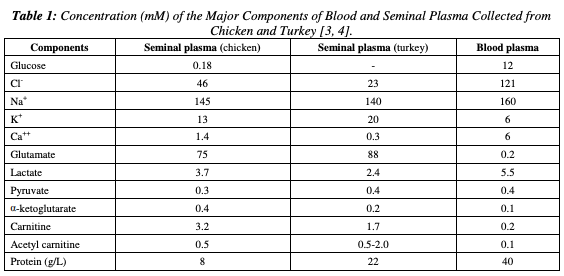
Glutamate concentration is very high in poultry semen, which is used as energy source. Composition of semen is given below in Table 1:
SEMEN EVALUATION
Semen should be routinely examined for concentration, motility and viability.
SPERM MOTILITY AND MOBILITY
Sperm motility can be progressive (forward and rapid) or nonprogressive (random movement or oscillations) movement. Generally, progressive motility is determined at ambient temperature using a microscope at low magnification (hanging-drop technique) or using a computer-assisted semen analysis system [5]. Motility evaluated by microscopy has been shown to have little correlation with fertility and simply reveals that the sperm are motile. Sperm mobility assay has gained popularity as a measure of an individual male’s ability to produce highly mobile sperm. Sperm mobility assay defines the ability of sperm to move progressively against a viscous medium at 41°C that are more likely to fertilize an ovum than males producing less mobile sperm [6]. Sperm mobility assay is a powerful tool for the selection of the most fecund males to be used in AI.
SPERM CONCENTRATION
If semen is to be diluted, it is best to have a known volume of semen diluent (a tissue culture like medium formulated to sustain sperm viability) at ambient temperature in the semen receptacle before collection begins. For routine AI of turkey hens, semen from 10–12 toms are pooled in a single receptacle, mixing the semen gently after each male is collected. Semen volume is determined and if the AI dose is based on numbers of sperm (generally 250–350 million sperm per dose) sperm concentration is determined. Methods for determination of semen concentration are:
1. Direct method: Hemocytometer is the direct method for estimation of spermatozoa concentration.
2. Indirect methods: includes:
Packed cell volume: PCV is also referred to as a spermatocrit. Determining sperm concentration using PCVs is nearly identical to that of determining blood hematocrit values [5]. Semen aspirated into microhematocrit tubes are centrifuged in a hematocrit centrifuge until the sperm are tightly packed (10 min); the percentage of packed sperm cells relative to the original semen volume in the microtube is determined. Sperm concentration is derived using a conversion factor or standard curve previously derived by comparing and graphically plotting spermatozoa concentration of serially diluted samples from hemocytometer counts to corresponding spermatocrit readings.
Optical density (OD; photometry): The optical density (OD) is determined using a photometer. The OD of highly diluted semen is directly proportional to the concentration of spermatozoa, thus providing an indirect estimate of the spermatozoa concentration. Like the PCV method, sperm concentration is derived using a conversion factor or previously derived standard curve by comparing and graphically plotting.
Sperm viability: The number of dead and abnormal spermatozoa in a sample should be less than 10% [2]. Sperm viability is determined by eosin-nigrosin stain followed by microscopic examination. Live viable spermatozoa remain white or colourless, on the black (nigrosin) background as their membrane is impermeable for the eosine; however, dead spermatozoa take up the eosin stain, and appear pink when viewed under the microscope at 80–100x magnification. Normal avian spermatozoa are ‘worm-like’ in appearance with a thin symmetrical shaped body culminating in a short (15–20% length) thin tail [2]. These normal spermatozoa are gently curved. Most abnormal spermatozoa are characterized by severe bending in the head, mid or tail region.
Semen dilution: Semen can be diluted so as to cover around 5–20 hens. The degree of dilution will depend upon the initial concentration of spermatozoa which itself varies among roosters and for individual roosters over time. Most diluents contain sodium glutamate, glucose, fructose and specialized buffers so as to maintain pH at around 7.0 and osmolarity around 400 milliosmole. The glutamate is especially important if semen is to be stored for more than 4–6 h. Poultry semen responds very poorly to cryopreservation in terms of fertility. Dose of semen is 100–200 million spermatozoa/insemination in 50 microliter volume [7]. Total volume of diluted semen (V) is calculated by:
V= undiluted volume (ml) x concentration of spermatozoa/ cells per insemination x 0.05 ml
So volume required to dilute semen will be: total volume of diluted semen – volume of ejaculate. There are various types of semen diluters that are commercially available. The semen may be diluted with a solution known as modified Ringer's solution. This modified Ringer's solution is very cheap and easily available. Composition of modified Ringer's solution is as follows:
- Sodium chloride 0.68 g
- Potassium chloride 0.173 g
- Calcium chloride 0.0 642 g
- Magnesium sulphate 0.025 g
- Sodium bicarbonate 0.025 g
- Distilled water 100 ml
ARTIFICIAL INSEMINATION
For insemination firstly female bird is restrained, then pressure is applied to the left side of the abdomen around the vent. This causes the cloaca to evert and the oviduct to protrude so that a syringe or plastic straw can be inserted ~1 inch (2.5 cm) into the oviduct and the appropriate amount of semen delivered. As the semen is expelled by the inseminator, pressure around the vent is released, which assists the hen in retaining spermatozoa in the vagina or the oviduct. Due to the high spermatozoa concentration of turkey semen, 0.025 ml (~2 billion spermatozoa) of undiluted pooled semen, inseminated at regular intervals of 10–14 days, yields optimal fertility.
In chickens, due to the lower spermatozoon concentration and shorter duration of fertility, 0.05 mL of undiluted pooled semen, at intervals of 7 days, is required. The hen’s squatting behaviour indicates receptivity and the time for the first insemination. For maximal fertility, inseminations may be started before the initial oviposition. Fertility tends to decrease later in the season; therefore, it may be justified to inseminate more frequently or use more cells per insemination dose. Interval between insemination and oviposition should be 8–15 h for maximum fertility [7].
REGULARITY OF INSEMINATION
Inseminations should be carried out on two consecutive days at the first week and then once each week thereafter while fertile eggs are required. As poultry semen has a very limited life, insemination of hens should be complete within one hour of semen collection. It is a good idea to carry out the operation at the same time each day, the best time being between 2.00 and 4.00 pm. The reason for this is that during the morning, most hens have an egg in the oviduct, thus obstructing the free passage of semen to the ovary. Another point in favour of inseminating the hens in the afternoon is that it is generally cooler and the hens are less likely to be affected by heat, particularly in late spring.
Observation has shown that eggs are fertile after the second day of insemination and can remain fertile for two weeks or more. If another male is to be used on the same hen in a breeding program, it is suggested that a period of three weeks elapse before the second male is used. If large numbers of male birds are to be used for artificial insemination, it is suggested that, prior to their use, a sample of the semen he examined under a microscope to check spermatozoa motility as them is a good correlation between spermatozoa movement and fertility.
CONCLUSION
Artificial insemination is a common practice in the poultry industry with the turkey industry in North America and Europe using it almost exclusively for the production of hatching eggs. The broiler industry has not adapted AI for several reasons: because of sheer numbers of broiler breeders that need to be inseminated weekly, the labour cost would be very significantly; the initial investment in special housing for the males; an efficient, cost effective means of actually performing the inseminations (housing and catching the hens) would need to be developed; and finally, the concern that after a few generations of breeding broilers by AI, the behaviours associated with natural mating may be less dominant.
The benefits of AI for broilers would include the following: the male:female ratio would be increased from 1:10 for natural mating to 1:25 with AI; with fewer males needed, there would be greater selection pressure on the male traits of economic importance and subsequently greater genetic advancement per generation. It may happen that sometime in the future, research addressing poultry sperm biology and the cellular and molecular basis of oviductal spermatozoa transport, selection, and storage will lead to the following innovations in poultry AI technology: insemination intervals increased to 10–14 days (versus 7-day) with fewer sperm per insemination; in vitro sperm storage for 24–36 h at ambient temperature with minimal loss of sperm viability; and, the possibility of transgenic progeny following the insemination of sperm carrying transgenes.
This article was published in Research & Reviews: Journal of Veterinary Science and Technology. ISSN: 2319–3441(online), ISSN: 2349-3690(print). Volume 5, Issue 1. www.stmjournals.com.