Efficacy of different ionophore-nicarbazin combination products in coccidiosis challenge model
This study investigated the efficacy of different ionophore-nicarbazin combination products using 400 male, day old, Ross 308 birds divided into wired floor battery cages (5 birds each) in 8 groups: 1) Uninfected Untreated Control (UUC); 2) Infected Untreated Control (IUC); 3) Monensin 50 ppm + nicarbazin 50 ppm; 4) Salinomycin 50 ppm + nicarbazin 50 ppm (SAL+NIC); 5) Narasin 50 ppm + nicarbazin 50 ppm (NAR+NIC); 6) Maduramicin 3.75 ppm + nicarbazin 40 ppm (MAD+NIC); 7) Semduramicin 15 ppm + nicarbazin 40 ppm (SEM+NIC low) and 8) Semduramicin 18 ppm + nicarbazin 48 ppm (SEM+NIC high), with 10 replicates per treatment. Birds were individually weighed at day 14 and provided with feed supplemented according to the allocation above. At d16 all birds, except for the UUC group, were individually gavaged with 1 ml of a mixed coccidia inoculum containing 130 000 Eimeria acervulina, 22 000 E. maxima and 8 000 E. tenella sporulated oocysts, all of them, from a recent field isolate originating from the Netherlands. All remaining feed was weighed at day 23. Half of the birds from each group were individually weighed, sacrificed and lesion scored at day 22, and the remaining birds followed the same protocol at day 23. Oocyst shedding (OPG), intestinal mean lesion scores for the three major Eimeria spp. used for the challenge and total mean lesion score (TMLS) as a sum of the above, body weight (BW), average daily weight gain (DWG), daily feed intake (DFI) and feed conversion ratio (FCR) were recorded and compared between treatments.
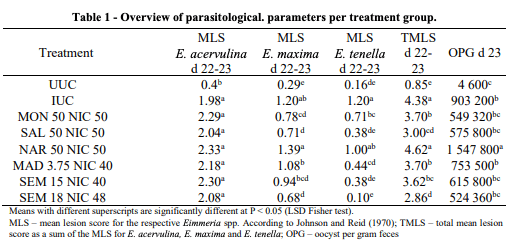
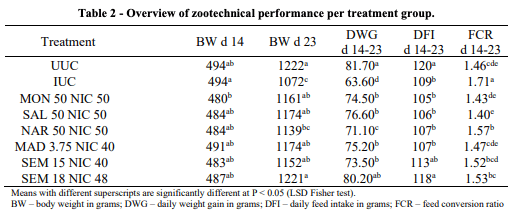
All treatments provided an improvement of DWG compared to IUC. Highest improvement was recorded in the SEM+NIC high group, which was the only group not differing from UUC (P > 0.05), completely alleviating the effect of the challenge. According to Chapman (1980) this indicates sensitivity for the respective treatment. All other treatments were significantly different (P < 0.05) to both UUC and IUC indicating partial resistance (reduced sensitivity). However, none of the treatments demonstrated complete resistance. The least effect was recorded in the NAR+NIC treatment, where DWG was significantly lower than all other combination treatments (P < 0.05). Feed intake was impaired in all treatments, except for both SEM+NIC low and high groups where it was not different from the UUC (P > 0.05). All treatments improved FCR compared to IUC (P < 0.05), with highest improvement in the SAL+NIC group. Lesion scores in all treatments except NAR+NIC were significantly reduced compared to IUC (P < 0.05). The highest reduction of TMLS was recorded in SEM+NIC high which was significantly lower than all other treatments (P < 0.05), except for SAL+NIC. None of the treatments significantly reduced E. acervulina lesions compared to IUC (P > 0.05). E. maxima lesions were significantly reduced (P < 0.05) in SEM+NIC high, SAL+NIC and MON+NIC compared to IUC and only NAR+NIC did not significantly reduce the lesions of E. tenella in comparison to IUC. None of the ionophore-nicarbazin combination treatments reduced oocyst shedding in comparison to IUC (P > 0.05).
I. INTRODUCTION
II. METHOD
III. RESULTS
IV. DISCUSSION
Blake, D. P., Knox, J., Dehaeck, B., Huntington, B., Rathinam, T., Ravipati, V., Ayoade, S., Gilbert, W., Adebambo, A. O., Jatau, I. D., Raman, M., Parker, D., Rushton, J., & Tomley, F. M. (2020). Veterinary Research, 51, 115.
Conway, D., & McKenzie, M. (2007). Poultry Coccidiosis: Diagnostic and Testing Procedures (3rd ed., pp. 49–53). Blackwell Publishing Professional.
Chapman, D. (1980). Avian Pathology, 9, 67–76.
Chapman, D., & Rathinam, T. (2022). International Journal for Parasitology: Drugs and Drug Resistance, 18, 32–42.
Johnson, J., & Reid, M. (1970). Experimental Parasitology, 28, 30–36.
Noack, S., Chapman, H. D., & Selzer, P. M. (2019). Parasitology Research, 118, 2009–2026.
Stanev, V., Terblance, E., Costello, C., & Gomez, L. (2021). Proceedings of the 2021 AVPA Virtual Scientific Meeting, 48–52.














United States