I. INTRODUCTION
It is widely known that Met is not only an essential amino acid but also the first limiting amino acid for broilers fed corn-soy diets and plays an important regulatory role in many physiological processes (Estevez et al., 2020). To meet the nutritional needs of Met, synthetic sources such as DL-Met and OH-Met are routinely added in broiler diets. LPS is a cell wall component of Gramnegative bacteria and is released in increased amounts when the bacteria die, or its cell wall is broken down. LPS stimulates the production of pro-inflammatory agents such as TNF-α, IL-1, IL6 by activating TLR4/MyD88/NFκB signaling pathway reaction to exacerbate inflammation (Cohen, 2002). Hence, LPS is widely used as an immune stress model. The present study was designed to determine the effects of Met sources and levels on growth performance and immune responses in chickens subjected to an LPS inflammatory challenge.
II. METHOD
A total of 792, one-d-old male Arbor Acre broilers were assigned randomly to 12 treatments with six replicate pens with 11 broilers in each pen. The birds were distributed in a factorial arrangement with two Met sources (DL-Met vs. OH-Met) × three TSAA levels (80%, 100%, and 120% of the breeding company recommendation) × two immunological states (LPS challenge or saline) factorial arrangement. The experiment was divided into two stages i.e., starter period: 0-14 days, and stress period: 15-21 days. At 15, 17, 19 and 21 days of age, broilers were intraperitoneally injected with LPS at a level of one mg/kg of body weight or an equal amount of sterile saline solution. Three hours post LPS injection on 21 d, one broiler close to the average body weight was selected from each replicate, shocked to stun and killed. The blood was collected to harvest serum by centrifugation at 3000 rpm for 10 min at 4℃ and stored at -20°C for subsequent analysis. The body cavity was quickly excised to collect and weigh spleen, liver, and thymus. Tissue samples from the spleen were collected in RNA-free centrifuge tube, snap frozen in liquid nitrogen and stored at -80°C for mRNA analysis.
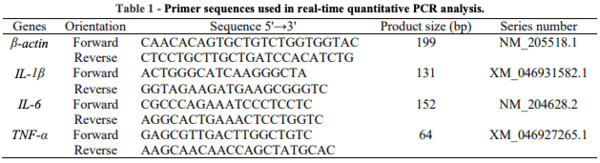
Total RNA was isolated using a Trizol reagent (TaKaRa Bio Inc., Kyoto, Japan) and reverse transcribed into cDNA using the PrimeScript RT reagent (RR047A, Takara Bio Inc., Kyoto, Japan) according to the manufacturer’s guidelines. The concentration and purity of RNA were determined using a NanoDrop 2000 spectrophotometer (Thermo Scientific, Massachusetts, America). SybrGreen based quantitative PCR was performed with a quantitative real-time PCR master mix (RR420A, Takara Bio Inc., Kyoto, Japan) in a 7500 real-time PCR system (Applied Biosystems LLC., Massachusetts, America). β-actin was used as a housekeeping gene and the relative gene expression level was calculated by the 2-∆∆Ct method. The primers used for quantifying selected genes are listed in Table 1. All serum samples were thawed and homogenized before analysis. The contents of serum serum-amyloid-A, OT, α1-AGP, and IgA were determined by enzyme-linked immunosorbent assay (ELISA) according to the manufacturer’s instructions (Shanghai Enzymelinked Biotechnology Co., Ltd., Shanghai, China).
The statistical differences were determined by three-way ANOVA in a 2 × 3 × 2 factorial arrangement with Duncan’s test for multiple comparisons. And one-way ANOVA and Duncan’s multiple comparisons were used when a significant interaction was observed. A value of P < 0.05 was considered significant. 0.05 < P < 0.10 was viewed as a trend.
III. RESULTS
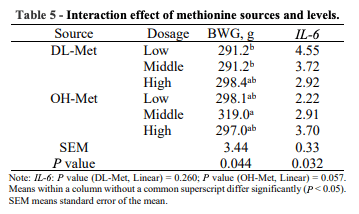
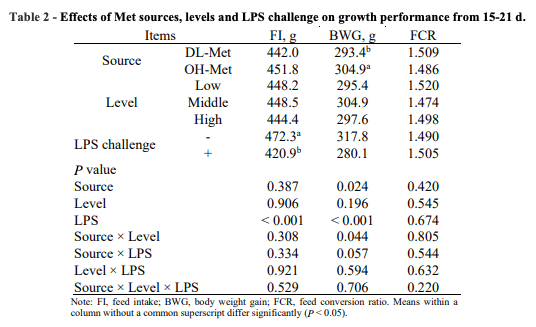
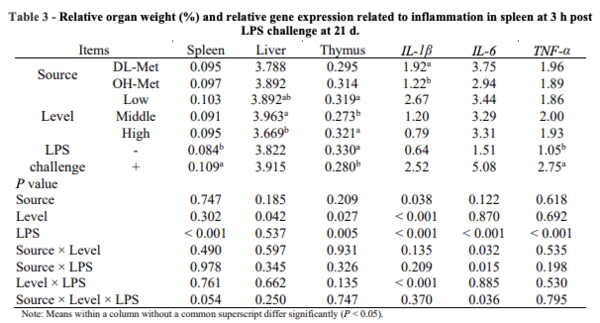
Performance data are presented in Table 2. During the challenge period (15-21 days), LPS challenge reduced FI of chickens (P < 0.01), while there was no significant change in FCR (P > 0.05). The interaction between Met sources and levels was significant on BWG during the challenge (P < 0.05, Table 5). At middle TSAA level, BWG was significantly higher in chickens fed the OH-Met diet. Moreover, there was a trend of interaction between the Met sources and LPS challenge on BWG (P = 0.057). The results of relative weight of immune organs are shown in Table 3. The broilers in the LPS-challenged group exhibited an increased relative spleen weight (P < 0.01) and a decreased relative thymus weight (P < 0.01). In addition, the broilers in the low- and high-TSAA groups exhibited an increased relative thymus weight (P < 0.05). Middle TSAA group also significantly increased relative liver weight (P < 0.05).
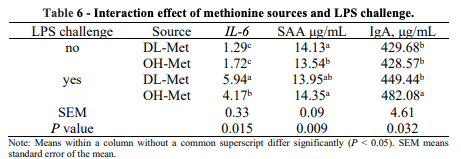
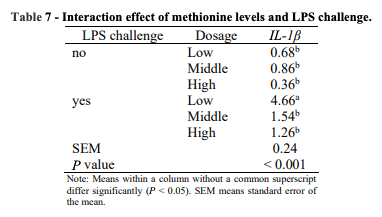
Splenic gene expression data for the broilers are also shown in Table 3. Dietary supplementation with OH-Met significantly reduced the mRNA expressions of IL-1β (P < 0.05). The broilers in the LPS-challenged group exhibited increased mRNA expression of TNF-α (P < 0.01). There was a significant interaction between Met sources and levels for IL-6 expression (P = 0.032, Table 5). The DL-Met levels did not affect the gene expression of IL-6, but the IL-6 expression has a tendency of linear increase with increasing level of OH-Met (P = 0.057). There was a significant interaction between Met sources and LPS challenge for IL-6 expression (P = 0.015, Table 6). The Met source did not affect the expression of IL-6 under normal conditions. Nonetheless, under LPS challenge, broilers fed OH-Met diet exhibited lower IL-6 expression. The IL-1β expression was influenced by the interaction between Met levels and LPS challenge (P < 0.01, Table 7). The Met level did not affect the expression of IL-1β under normal conditions. However, broilers fed low-TSAA level showed higher IL-1β expression with LPS challenge. We also observed interaction among Met sources, levels and LPS challenge for the expression of IL-6 (P < 0.05). The IL-6 expression was upregulated by LPS challenge, regardless of Met level in DLMet group while IL-6 expression was increased with LPS challenge at high-TSAA level in OHMet group.
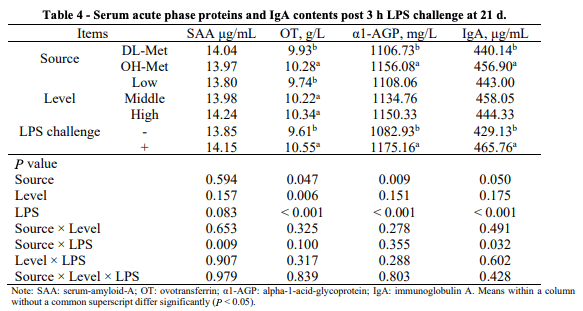
The results of serum acute phase proteins and IgA contents are shown in Table 4. We observed significant main effects of LPS, Met sources and levels on serum OT which was increased by LPS challenge, Met source and level (P < 0.05). α1-AGP and IgA were increased by Met sources and LPS challenge (P < 0.05). In addition, there was a significant interaction effect of Met sources and LPS on serum-amyloid-A and IgA (P < 0.05).
IV. DISCUSSION
Our study demonstrated that LPS challenge decreased FI and BWG, whereas there was no effect on the FCR of broilers from 15-21 days of age, which was consistent with the results of previous study (Yang et al., 2019) and indicated that LPS challenge was successfully induced. Importantly, our findings suggested that OH-Met supported better BWG compared with DL-Met during stress period. The spleen is a secondary lymphoid organ and plays a crucial role in immune response. The LPS-induced immune response increased the production of proinflammatory cytokines (IL-1β and IL-6 and TNF-α) in the spleen, and in turn, led to compensatory splenomegaly (Yang et al., 2008; Pozo et al., 2009), which is consistent with our study findings, further validated by an increase in relative spleen weight in broiler chickens post LPS challenge. Also, we observed a significant Met level effect on liver weight. Combined with the findings on serum acute phase proteins which were increased with OH-Met, it can be postulated that LPS challenge triggered the demand for cysteine to produce acute phase proteins. In this context, OH-Met would respond more efficiently due to its better transsulfuration (Martin-Venegas et al., 2006). We further tested the expression of inflammatory cytokines in spleen and found that LPS challenge stimulated the expression of inflammatory cytokines. In addition, OH-Met downregulated the expression of IL-1β, and the mRNA expression of IL-6 was reduced in OH-Met-fed broiler chickens when challenged with LPS, which suggested that OH-Met was able to exert advantageous effects on homeostatic mechanisms associated with the splenic immune response. In conclusion, OH-Met ameliorated the inflammatory damage caused by LPS challenge and improved the BWG during the challenge condition.
ACKNOWLEDGEMENTS: This work has been sponsored by Adisseo France S.A.S.
Presented at the 35th Annual Australian Poultry Science Symposium 2024. For information on the latest and future editions, click here.