Explore

Advertise on Engormix

Broiler chickens offered reduced crude protein diets based on sorghum outperform their wheat-based diet counterparts

Published: August 13, 2026
Source : M.Z. WANG 1, S.P. MACELLINE 1, M. TOGHYANI 1, P.H. SELLE 1 and S.Y. LIU 1 / 1 Poultry Research Foundation within The University of Sydney, Camden 2570 NSW, Australia.
Summary

The study compared growth performance in straight-run broiler chickens offered standard (205 g/kg) or reduced (175g/kg) crude protein diets based on wheat or sorghum from 14 to 35 days post-hatch. Treatment interactions (P < 0.001) were observed for crude protein concentrations and grain type for weight gain and FCR. Reducing crude protein in sorghum-based diets did not influence weight gain and FCR; in contrast, weight gain and FCR were compromised in broilers offered wheat-based diets. This outcome was consistent with previous studies where wheat-based diets were inferior to maize-based diets following crude protein reductions. 

I. INTRODUCTION

Wheat and sorghum are the most common feed grains for chicken-meat production in Australia. In two direct comparisons birds offered maize-based diets were better able to accommodate dietary crude protein (CP) reductions than wheat-based diets (Chrystal et al., 2021; Greenhalgh et al., 2022). One underlying reason for this difference appears to be the higher protein contents of wheat than maize and, similarly, wheat (n = 27) contained higher protein levels (115.5 versus 101.9 g/kg CP) than sorghum (n = 17) in one Australian survey (Bryden et al., 2009). The higher wheat protein content results in elevated non-bound (synthetic, crystalline) amino acid inclusions to meet dietary amino acids specifications. This may exacerbate post-enteral imbalances between protein-bound and non-bound amino acids. Relative to wheat, sorghum and maize are similar in respect of lower CP contents, slower starch digestion rates, and lower soluble NSP contents (Liu et al., 2015). The objective of this study was to determine the impact of dietary CP concentrations and grain type on growth performance and relative fat-pad weights in straight-run broiler chickens. The hypothesis is that reduced-CP sorghum-based diets will maintain better broiler growth performance than wheat-based diets.

II. MATERIALS AND METHODS

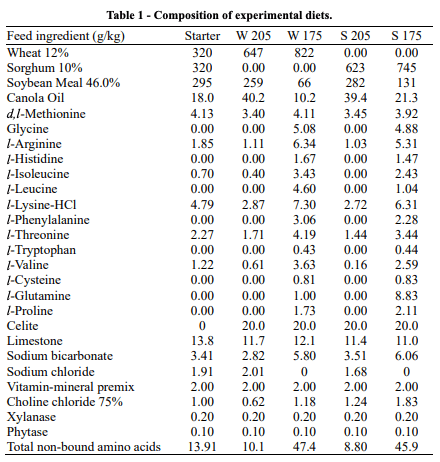
A common starter diet was offered to birds to 14 days post-hatch. 288 mixed-sex Ross 308 broiler birds were weighed, tagged, and allocated to four dietary treatments with 12 replicates of 6 birds per cage at 14 days post-hatch. The experimental design was a 2×2 factorial array of treatments, incorporating two concentrations of dietary CP (205 vs 175 g/kg) and two feed grains (wheat vs sorghum). The experimental diets were offered to the birds from 14 to 35 days post-hatch. The composition of the experimental diets is shown in Table 1. A total of 14 nonbound amino acids were incorporated into the 175 g/kg CP diets in order to match their amino acid concentrations in the 205 g/kg CP diets. Both wheat and sorghum were mediumly ground (4.0 mm hammer-mill screen) prior to being blended into the complete diets which were steampelleted through a Palmer PP330 pellet press (Palmer Milling Engineering, Griffith, NSW, Australia) at a conditioning temperature of 80°C with a conditioner residence time of 14 seconds and were then cooled. All experimental diets contained both phytate- and NSPdegrading enzymes. At the end of the study the gender of birds was identified, and a two-way analysis of covariance (ANCOVA) was employed to determine the impact of dietary treatments in which the percentage of male birds in each caged replicate was used as the covariant.
Table 1 - Composition of experimental diets.

III. RESULTS

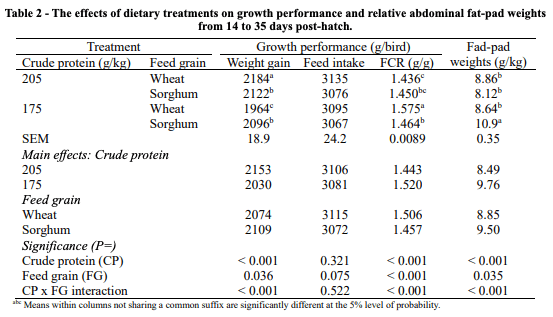
The effects of dietary crude protein concentration and grain type on broiler growth performance and relative fat-pad weights are presented in Table 2. A treatment interaction (P < 0.001) between CP level and grain type was observed for weight gain because there was a 10.1% decline in weight gain (1964 versus 2184 g/bird) in birds offered wheat-based diets but sorghum supported statistically similar weight gains. A similar interaction (P < 0.001) was observed for FCR, which was compromised by 9.68% (1.575 versus 1.436) in birds offered wheat-based diets as opposed to a numerical increase of 0.97% (1.464 versus 1.450) with sorghum-based diets. A third interaction (P < 0.001) was observed relative fat-pad weights as in reduced-CP diets, sorghum-based diets generated 26.0% (10.90 versus 8.65 g/kg) heavier abdominal fat-pads than wheat. There were not any significant treatment effects for feed intakes.

IV. DISCUSSION

Birds across all treatments outperformed 2022 Ross 308 performance objectives by 18.7% (2092 versus 1763 g/bird) in weight gain, by 15.3% (3093 versus 2682 g/bird) in feed intake and by 2.63% (1.481 versus 1.521) in FCR. Wheat supported faster weight gain than sorghum by 2.92% (2184 versus 2122 g/bird) and improved FCR by 0.96% (1.436 versus 1.450) in 205 g/kg CP diets; in contrast, sorghum supported 6.72% (2096 versus 1964 g/bird) faster gains and an improvement in FCR of 7.05% (1.464 versus 1.575) in 175 g/kg CP diets. This turnaround demonstrates that sorghum is a more suitable feed grain than wheat in the context of reduced-CP diets; thus, the hypothesis was established. 
Table 2 - The effects of dietary treatments on growth performance and relative abdominal fat-pad weights from 14 to 35 days post-hatch.
The shortfalls of reduced-CP, wheat-based broiler diets were given consideration in Selle et al. (2022a). The digestion-rate constant of wheat starch (0.036/minute) is more rapid than both sorghum (0.018/minute) and maize (0.017/minute) under in vitro conditions (Giuberti et al., 2012). Similar patterns have been reported in broiler chickens (Selle et al., 2021), where the value for wheat starch (0.117) was again more rapid than sorghum (0.075) and maize (0.086). Slowly digestible starch is seen as an advantage in broiler diets (Herwig et al., 2019) and may spare amino acids from catabolism in the gut mucosa (Enting et al., 2005). Moreover, the digestion of slowly digestible starch and absorption of glucose may be better aligned with protein digestion and amino acid absorption, resulting in a more harmonious provision of glucose and amino acids at sites of protein synthesis to drive efficient growth (Liu and Selle, 2017). Curiously, the difference in relative fat-pad weights, where sorghum generated greater fat deposition, may stem from the difference in starch digestion rates. It seems likely that the gradual digestion of sorghum starch results in more glucose being converted to glycogen and then fat via de novo lipogenesis, whereas glucose from rapidly digested wheat starch is directly oxidised more readily (Selle et al., 2022b). Additional factors inherent in wheat that may be contributing to its lack of suitability in reduced-CP diets may include soluble non-starch polysaccharides, amylase trypsin inhibitors and gluten (Selle et al., 2022a). Also, any impacts of starch on growth performance in reduced-CP diets would be amplified by the greater increase in wheat inclusions (647 to 822 g/kg – 27%) than sorghum (from 623 to 745 g/kg – 20%) pursuant to dietary CP reductions.
Usually, a reduced-CP, wheat-based diet will contain more non-bound amino acids than equivalent diets based on sorghum or maize because of wheat’s higher protein content. However, this was not the case in the present study where the sorghum- and wheat-based diets contained 45.9 and 47.4 g/kg non-bound amino acids, respectively. These high total inclusion levels are effectively identical and the inclusions of individual non-bound amino acids are similar with the exception of glutamine. Glutamine was added at 8.83 g/kg to the reduced-CP sorghum diet as opposed to 1.00 g/kg in the wheat-based diet; wheat typically contains more glutamic acid than sorghum (Bryden et al., 2009). This difference in glutamine supplementation to reduced-CP diets is probably important. This is because 10 g/kg non-bound glutamine inclusions in adequate protein diets generated an average 7.36% (range: 3.07 to 10.6%) increase in weight gain across seven studies as reviewed by Selle et al. (2024). For example, significant responses of 9.33% (Soltan, 2009) and 10.6% (Moghaddam and Alizadeh-Ghamsari, 2013) were recorded in two of these studies. Given that diets in the seven studies contained adequate protein levels, glutamine concentrations would have been notionally sufficient; nevertheless, positive weight gain responses were consistently reported. The positive impacts of glutamine probably involved the effects of this amino acid on both protein turnover and acid-base balance.
The interchangeable amino acids, glutamine and glutamate, are vital metabolites as they play a central role in cell metabolism and function (Newsholme et al., 2003). The positive relationship between intramuscular glutamine concentrations and protein synthesis in chickens, indicates that intracellular glutamine is involved in promoting protein synthesis (Watford and Wu, 2005). Earlier, Wu and Thompson (1990) investigated the effects of glutamine on protein turnover in isolated avian skeletal muscle tissue and concluded that glutamine appeared to have an overall anabolic effect. Amino acid metabolism and acid-base homeostasis are inextricably related (Patience, 1990). In a recent broiler study, it was shown that glutamine and asparagine had positive impacts on acid-base balance (Ibrahim et al., 2023).
Finally, sorghum-based diets exhibited promise following the dietary CP reduction of 30.0 g/kg by attenuating declines in weight gain and feed conversion efficiency compared to wheat-based diets. The additional glutamine in the sorghum-based diets may have been a factor in this comparison and glutamine merits further investigation.
   
Presented at the 35th Annual Australian Poultry Science Symposium 2024. For information on the latest and future editions, click here.

Bryden, W. L., Li, X., Ravindran, G., Hew, L., & Ravindran, V. (2009). RIRDC Publication No. 09/071. Rural Industries Research and Development Corporation, Canberra, ACT, Australia.

Chrystal, P. V., Greenhalgh, S., McInerney, B. V., McQuade, L. R., Akter, Y., de Paula Dorigam, J. C., Selle, P. H., & Liu, S. Y. (2021). Animal Feed Science and Technology, 275, 114867.

Enting, H., Pos, J., Weurding, R. E., & Veldman, A. (2005). Proceedings of the Australian Poultry Science Symposium, 17, 17–20.

Giuberti, G., Gallo, A., Cerioli, C., & Masoero, F. (2012). Animal Feed Science and Technology, 174, 163–173.

Greenhalgh, S., Lemme, A., Dorigam, J. C. P., Chrystal, P. V., Macelline, S. P., Liu, S. Y., & Selle, P. H. (2022). Poultry Science, 101, 102131.

Herwig, E., Abbott, D., Schwean-Lardner, K. V., & Classen, H. L. (2019). Poultry Science, 98, 3676–3684.

Ibrahim, A., Kenéz, Á., Rodehutscord, M., & Siegert, W. (2023). British Journal of Nutrition, 20, 1–13.

Liu, S. Y., Cadogan, D. J., Péron, A., Truong, H. H., & Selle, P. H. (2015). Animal Production Science, 55, 1255–1263.

Liu, S. Y., & Selle, P. H. (2017). Animal Production Science, 57, 2250–2256.

Moghaddam, H. N., & Alizadeh-Ghamsari, A. H. (2013). Journal of Applied Animal Research, 41, 1–7.

Newsholme, P., Procopio, J., Lima, M. M. R., Pithon-Curi, T. C., & Curi, R. (2003). Cell Biochemistry and Function, 21, 1–9.

Patience, J. F. (1990). Journal of Animal Science, 68, 398–408.

Selle, P. H., Moss, A. F., Khoddami, A., Chrystal, P. V., & Liu, S. Y. (2021). Animal Nutrition, 7, 450–459.

Selle, P. H., Macelline, S. P., Greenhalgh, S., Chrystal, P. V., & Liu, S. Y. (2022). Animal Nutrition, 11, 181–189.

Selle, P. H., Macelline, S. P., Chrystal, P. V., & Liu, S. Y. (2022). Proceedings of the Australian Poultry Science Symposium, 33, 22–25.

Selle, P. H., Macelline, S. P., Toghyani, M., & Liu, S. Y. (2024). Animal Nutrition (submitted for publication).

Soltan, M. A. (2009). International Journal of Poultry Science, 8, 60–68.

Watford, M., & Wu, G. (2005). Comparative Biochemistry and Physiology Part B: Biochemistry and Molecular Biology, 140, 607–614.

Wu, G., & Thompson, J. R. (1990). Biochemical Journal, 265, 593–598.

Content from the event:
Related topics:
Authors:
Shemil Macelline
Mehdi Toghyani
Dr. Peter Selle
Dr Sonia Yun Liu
Mengzhu Wang
Show more
Recommend
Comment
Share
Profile picture
Would you like to discuss another topic? Create a new post to engage with experts in the community.
Featured users in Poultry Industry
Padma Pillai
Padma Pillai
United States
Kendra Waldbusser
Kendra Waldbusser
United States
Karo Mikaelian
Karo Mikaelian
United States