I. INTRODUCTION
The mineralisation of calciferous eggshells is an extremely physiologically demanding process, having immense calcium requirements. As a result, laying hens have highly efficient, closely managed calcium homeostatic mechanisms involving a complex series of feedback loops primarily regulated by parathyroid hormone, calcitonin, and calcitriol (de Matos, 2008; Sinclair-Black et al., 2023). Calcitriol is the bioactive form of vitamin D, which increases calcium absorption from the small intestine (Chandra et al., 1990) and calcium reabsorption from the kidneys and bone (Schenck et al., 2012) during periods of hypocalcaemia.
A reduction in eggshell quality and breaking strength is frequently observed in older laying hens (Roland, 1979; Roberts et al., 2013). It is a current aim of the global egg industry to extend the production cycle of laying hens to 100 weeks to gain both financial and sustainability benefits (Dunn, 2013; Bain et al., 2016). However, for an extended production cycle to be adopted commercially, eggshell quality and laying rate must be maintained during the late stages of production (Molnár et al., 2016). One strategy being investigated to improve eggshell quality in older hens is the nutritional management of vitamin D. Calcitriol glycoside, an herbal form of vitamin D3, is in development as an alternate source of vitamin D for poultry. By supplementing vitamin D in the bioactive form, the hydroxylation reactions required to activate vitamin D3 and 25(OH)D3 are bypassed, potentially improving calcium utilisation in older hens.
A feed additive that contains calcitriol glycoside, ursolic acid and oleanolic acid has recently been released in the market. The product is said to improve eggshell quality and performance, particularly in laying hens over 50 woa although there has yet to be published data supporting this. Therefore, this study aimed to quantify the effect of activated vitamin D3 supplementation on eggshell quality and performance in laying hens from 60-80 woa.
II. METHOD
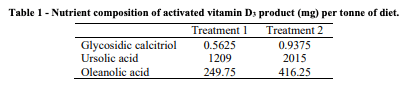
A total of 240 Hy-Line Brown layer hens, 55 woa, were purchased from a commercial laying farm and housed in the high-rise layer facility at The University of Sydney’s Camden Campus. Each bird was kept in an individual cage (25 × 25 × 50 cm) with access to a common feeder trough and an individual nipple drinker. All hens were fed the control diet, ad libitum, for a 5- week acclimation period. At 60 woa each bird was weighed and randomly allocated to one of three dietary treatment groups (Control, Treatment 1, and Treatment 2) consisting of 80 hens each. Each group was further subdivided into 8 replicates comprised of 10 hens (24 replicates total). The Control diet was formulated based on wheat, soybean meal and canola meal (AME 2750 kcal/kg and digestible Lysine 0.69%) and contained 3 MIU of vitamin D3/kg. Treatment 1 consisted of a control diet plus 75 g of activated vitamin D3 product/ton, while Treatment 2 consisted of the control diet plus 125 g of activated vitamin D3 product/ ton (Table 1). All diets were fed ad libitum. From 60-80 woa, egg production (EP), egg weight (EW) and feed intake (FI) were measured weekly, and egg mass (EM) and feed conversion ratio (FCR) were calculated. At 66, 68, 76 and 80 woa, 2 eggs from each replicate were randomly selected for quality testing, including Haugh unit (HU), yolk colour, eggshell breaking strength, eggshell thickness, and relative eggshell weight (%). Finally, at 80 woa each bird was re-weighed. Data was analysed using a one-way ANOVA for the three dietary treatments (Control, Treatment 1, and Treatment 2) when hens were 66, 68, 76 or 80 woa).
III. RESULTS
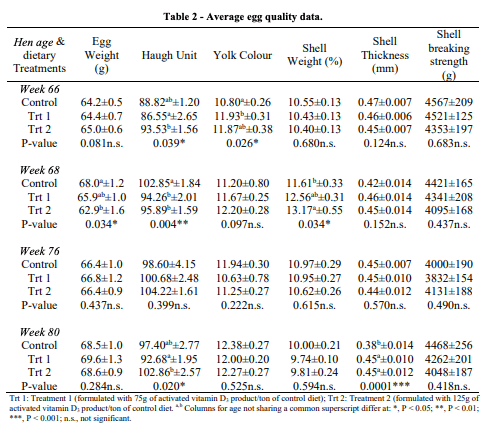
The effects of the dietary treatments on egg quality at 66, 68, 76 and 80 hen woa are presented in Table 2. Egg weight was not different due to dietary treatments at weeks 66 (P = 0.65), 72 (P = 0.96) and 80 (P = 0.72). At 68 woa, Treatment 2 had a lower EW than the control group (P = 0.02), but Treatment 1 EW was similar to control (P = 0.50) or Treatment 2 (P = 0.26).
At 66 (P = 0.18), 72 (P = 0.61) and 80 woa (P = 0.60), eggshell weight did not differ due to dietary treatments. However, at 68 woa, Treatment 2 generated a higher shell weight than the control (P = 0.02), but the shell weight of Treatment 1 was like the control (P = 0.25) and Treatment 2 (P = 0.55). Shell thickness did not differ at 66 (P = 0.12), 68 (P = 0.13) and 72 woa (P = 0.54). Nevertheless, at 80 woa, both Treatment 1 (P < 0.001) and Treatment 2 (P < 0.001) had higher shell thicknesses than the control. Shell breaking strength was not different between dietary treatments at 66 (P = 0.68), 68 (P = 0.44), 72 (P = 0.49) or 80 woa (P = 0.42).
IV. DISCUSSION
The supplementation of increasing concentrations of different sources of vitamin D in the diets of older laying hens has previously demonstrated inconsistent effects on eggshell quality. Some studies indicate that increasing dietary vitamin D in older hens improves shell quality (Plaimast et al., 2015; Wen et al., 2019; Jing et al., 2022), while other studies suggest that there are no effects (Mattila et al., 2004; Li et al., 2023). In this study, the supplementation of 125 µg of activated vitamin D3 /ton of diet produced higher eggshell weight than the control diet when hens were 68 woa and had been on the supplemented diet for 18 weeks. However, 75 g of activated vitamin D3 / ton supplementation did not affect eggshell weight.
This contradicts the results of Wen et al. (2019), which suggest that increasing vitamin D3 supplementation does not affect eggshell weight. In the activated vitamin D3 supplemented treatments, shell thickness was maintained relatively consistently throughout the trial, but had dropped notably in the control birds at 80 woa. Concurrently, supplementation of both concentrations of activated vitamin D3 increased eggshell thickness compared to the control diet, indicating that activated vitamin D3 may prevent the reduction in shell thickness frequently observed as hens age. Similarly, Jing et al. (2022) observed an increase in shell thickness when Roman Grey hens, 60 woa, were supplemented with 125 µg vitamin D3 or 125 µg 25(OH)D3 /kg diet compared to the control of 62.5 µg/kg of vitamin D3. Unlike Jing et al. (2022), an increase in eggshell-breaking strength in the vitamin D treatments compared to the control was not found in this study. This concurs with the findings of Li et al. (2023), where supplementation of 69 and 125 µg/kg of 25(OH)D3 did not affect eggshell breaking in hens at 70 woa. However, it should be noted that Li et al. (2023) found no significant differences in shell weight and shell thickness with increasing 25(OH)D3 supplementation in contrast to this study. Additionally, the improvement observed in eggshell thickness at week 4 of supplementation by Jing et al. (2022) preceded the increased shell-breaking strength observed at week 8. Therefore, activated vitamin D3 supplementation may improve eggshell-breaking strength after increases in shell thickness.
While no direct improvement in eggshell breaking strength was observed, significant improvements in relative shell weight and thickness indicate that supplementing activated vitamin D3 in older laying hens may benefit eggshell quality. As calcitriol also plays a vital role in regulating bone mineralization, further investigations into the effects of activated vitamin D3 supplementation on bone strength in older laying hens is underway. Additionally, increased vitamin D3 concentrations in the diets of laying hens have previously been found also to increase the vitamin D3 concentrations in eggs (Mattila et al., 2003; Plaimast et al., 2015). Therefore, it should be determined if similar effects in eggs occur due to the supplementation of activated vitamin D3 in laying hens.
Presented at the 35th Annual Australian Poultry Science Symposium 2024. For information on the latest and future editions, click here.