I. INTRODUCTION
Resilience is defined as the ability to successfully cope and thrive when faced with environmental disturbance, adversity, and stress. Across an animal’s lifetime, they will be exposed to many stressors that require the individual to adapt and maintain internal homeostasis against external variability. For a laying hen, these stressors could include pathogens, vaccinations, extreme temperature variations, transfer from pullet to layer housing, and conspecific aggression as some examples. The challenges hens face could be greater in loosehoused systems such as free-range, where both the likelihood, and magnitude of daily fluctuations are often higher than more controlled indoor-only housing. In the face of these environmental fluctuations, regulation of daily biological rhythms such as feeding, drinking, activity, and resting to maintain the same functional outcomes of growth and egg production would be indicative of a resilient individual (Bedere et al., 2022; Berghof et al., 2019). Along the same lines, the ability of an individual to cope with compounded stressors is going to affect susceptibility to and recovery from, disease and infection. Thus, high resilience capacity of the individual birds in a flock is desirable for healthier individuals, optimised welfare, and efficiency of production.
It is well understood across laying hens (and other types of production animals) that there is variation among individuals within a flock. Birds of the same genetic history can vary in their physiological responses to stressors, personality traits (e.g., fear and boldness), and coping styles (Campbell et al., 2016; Cockrem, 2013). There is also a growing body of literature on the impacts of rearing environments on hens’ subsequent physical health, gut microbiome, and behaviour, including propensity to develop undesirable behaviours such as feather pecking and floor egg laying (Bari et al., 2021; Campbell et al., 2019; Janczak and Riber, 2018). Early life conditions, including the incubation period, the hatching process, and pullet rearing period can all result in different outcomes depending on what the bird was exposed to. For example, high decibel noise during incubation can negatively affect neurotransmitter noradrenaline levels and impair spatial behaviour abilities in day-old chicks (Sanyal et al., 2013). Increased environmental complexity during rearing can improve spatial locomotion and navigation abilities of pullets (Rentsch et al., 2023). Commercial hatchery processing conditions versus quieter hatching without transport and delayed vaccination resulted in greater stress reactivity in pullets, increased feather damage, and reduced egg production (Hedlund et al., 2019; Hedlund and Jensen, 2022). It is also well established across many animal species that greater complexity during development will enhance neurological development (Campbell and Lee, 2021). Consequently, there is increasing interest in how environmental modifications, particularly in early life, can modulate and improve adaptive capacity and resilience of individual birds. Experiments with environmental enrichment as a means to enhance functional capacity of individuals are providing evidence of the benefits of developmental complexity (Colditz et al., 2023).
II. ENVIRONMENTAL ENRICHMENT TO ENHANCE ADAPTIVE CAPACITY
Globally, there is a small collection of studies that have been conducted over the past few years investigating the effects of environmental enrichment in enhancing adaptive capacity of hens. More projects around the topic are currently in progress as researchers seek to understand the best strategies for optimising the functioning of individual birds to cope with environmental disturbances which ultimately significantly improves their welfare and production efficiency. Further details of select trials to date are presented here.
The first study to highlight the impact of enrichment on adaptive capacity by Campbell et al. (2021) was conducted in Australia on free-range laying hens within an experimental housing system. This study aimed to understand how varying types of environmental enrichment during the entire pullet rearing period may affect the behaviour, adaptability, and welfare of laying hens at different stages across the production cycle. Hy-Line Brown day-old chicks were housed in an indoor floor-litter based rearing system. Pens with no additional objects served as a ‘control’ treatment. Two enrichment treatment groups were then also provided with either varying novel objects that were regularly changed throughout rearing as a ‘novelty’ treatment, or H-shaped perching structures that were fixed in place but had both openframe and opaque sides to increase the complexity of the spatial environment (‘structural’ treatment). Within the larger experiment, different assessments were made on samples of the 1400 birds throughout their life cycle with some tests applied to specifically assess whether the enrichments affected the adaptability of the birds.
As stated earlier, individual chickens can differ in their personalities which dictate how they may react to environmental stimuli. They are also known to vary significantly in individual range use patterns. These ranging preferences may be related to personality differences. In this rearing enrichment experiment, it was predicted that the greater environmental complexity relative to control conditions would modulate personality by reducing fear, as well as increasing adaptive capacity (Campbell et al., 2021). A sample of birds were individually tested with a series of behavioural tests at 9 to 11 weeks and the same birds again at 20 to 21 weeks. These behavioural assessments included initial responses to a novel arena, adaptation across time to the novel arena with food present, an open field test, novel maze arena training to access food and finally maze completion testing. Additionally, individual range use was measured from 27 to 31 weeks using radio-frequency identification technology that detected movement in and out of pop-holes by individually tagged hens (Campbell et al., 2021). The results showed that the enrichment treatments reduced the latency to first step in some of the tests which is indicative of reduced fear in a new environment. When 16 correlations were assessed between behavioural test parameters across time, 11 were significant for control birds and only six to seven were significant for the enriched treatments. Furthermore, correlations between test parameters and subsequent range use were significant for only the control birds (Campbell et al., 2021, Table 1). These study results indicate enrichment during rearing may reduce fear and increase adaptation. Fewer correlations among test parameters including with range use in the enriched hens suggest they developed a more plastic personality type that was flexible to their variable surroundings. A more plastic response strategy could have fitness benefits for hens, particularly free-range birds that encounter drastic environmental change across life stages.
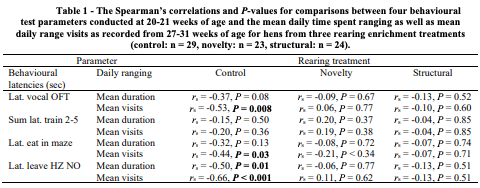
The behavioural test parameters were selected to be predictors of range use based on previous studies. These parameters included the latencies (lat) to vocalise in an open field test (OFT), the summed latency for training to reach food in an arena across the first day of training sessions, the latency to eat in a maze test, and the latency to leave the holding zone with a novel object present (HZ NO) in the maze test. Table adapted from Campbell et al. (2021) with further details on the behavioural tests in that paper. Significant P-values are indicated in bold.
Within the same rearing enrichment experiment, the adult free-range hens were exposed to a stressor at 44 weeks of age where the range area they had been accessing for several months was reduced by 80% for 11 days (Bari et al., 2020). Changes in ranging behaviour and albumen corticosterone concentrations were evaluated. Across all hens, ranging time decreased and the average number of range visits increased when the available area was reduced, but there was a lower increase in visit numbers for the structural treatment hens suggesting they were able to better adapt to the environmental change. The corticosterone concentrations also varied across treatments although the results were less clear to interpret. Both the control and novelty treatment hens’ eggs showed increases immediately following the range shrinkage which decreased across the range shrinkage period. In contrast, the albumen corticosterone concentration in structural hens’ eggs decreased immediately following the range shrinkage and then increased slightly toward the end of the range shrinkage period (Bari et al., 2020). These findings highlight the longer-term impacts of rearing environments and how they can modulate hens’ responses to stressors they encounter across their lifetime.
Expanding our focus internationally, a collection of three studies conducted in Sweden investigated the impacts of rearing complexity on stress responses and adaptability in Bovans Robust white layers. In the first study, similar to the previous research with free-range hens, further support was found for early environmental enrichment improving adaptive plasticity (Campderrich et al., 2019). In a two-factorial design, small groups of one-day-old chicks were housed in either simple floor litter pens, or complex pens that included perches, a dark brooder, and wooden blocks. They were then also exposed to an acute 6-h cold stress treatment or not at two days of age. Across five days at four weeks of age, the four different treatment groups (enriched/non-enriched + acute stress/no acute stress) were exposed to intermittent and unpredictable stressors. These implemented stressors included, for example, changing the room temperature, changing out the bedding, random noise playback, and lighting schedule modifications. Varying immunological parameters were assessed to measure the birds’ immunocompetence. Results showed the enriched environment was able to mitigate the negative effects of the cold stress treatment. Similarly, the birds from the enriched rearing had improved physiological responses to the intermittent imposed stressors. This improvement may have been facilitated by increased resting behaviour observed in the enriched birds enabling greater recovery (Campderrich et al., 2019). This research contributes further evidence to the beneficial effects of early complexity and the ability to modulate a bird’s phenotypes based on their rearing conditions.
In the second study, the effects of rearing environmental choice were assessed in small bird groups with the prediction that enrichment may have beneficial impacts through the mechanisms of allowing resource choice (i.e., increasing ‘agency’) in the young birds (Nazar et al., 2022). Treatments were rearing from day one with only a single litter type and a single perch, versus four different litter and perch types. Similar immunocompetence tests were performed at three weeks of age as well as behavioural tests of tonic immobility, novelty, and human-reward motivation conflict. Across all the measures, there was evidence that the rearing with environmental choice improved immunological parameters and indicators of fear and adaptability, although not every parameter showed statistical differences (Nazar et al., 2022). This study again supports that rearing complexity can alter the phenotype of the chick and enhance their coping with what they encounter in their environment.
In a third study by the same research group, Skånberg et al. (2023) built upon the previous findings to assess how both environmental choice, and environmental change affected chick adaptability. Different litter and perch types were provided simultaneously to chicks (static choice) or were swapped around multiple times each week (choice and change), and these treatments were compared with a single choice swapped out multiple times each week (change, no choice), and a no choice static rearing environment deemed to represent standard rearing conditions. When the chicks were four to five weeks old, behavioural tests were conducted including a novel arena test and a social detour test. The test results indicated that greater environmental change had impacts on reducing fear and greater environmental choice, increased exploration, and improved spatial skills. However, combining both change and choice did not have an additive effect on improving the chicks’ behavioural adaptability. This indicated these environmental parameters both have positive impacts, but through different mechanisms (Skånberg et al., 2023).
As a final illustration of enrichment impacts, a study in Canada used small groups of young adult ISA Brown hens in floor pens (Ross et al., 2019; Ross et al., 2020). Comparisons were made between housing in control littered floor pens or an enriched floor pen environment with a larger area, and more spatial complexity including perches and platforms as well as foraging opportunities. When the birds were assessed in behavioural tests of judgement bias, restraint, and startle reflexes, including physiological measurement of stress-induced hyperthermia, the enriched hens fared better. Housing in a preferred enriched environment reduced both the behavioural and physiological responses to imposed stressors, including a more rapid return to prestress physiological levels which is indicative of improved resilience (Ross et al., 2020). These stress test measures did not covary with judgement bias assessments indicating different mechanisms of enrichment impact on affective states (Ross et al., 2019; Ross et al., 2020).
III. DISCUSSION AND CONCLUSIONS
The collection of studies detailed here illustrate the effects of early rearing complexity through different environmental enrichment strategies to beneficially modulate the phenotype of the bird. These modulations increase the bird’s resilience and adaptability when faced with environmental stressors and will ultimately improve their welfare. To date, there is some evidence of beneficial rearing effects still being present later in life, and enrichment can also still be beneficial when applied in young adults rather than the early rearing period. However, there is a need for more work to capture how this improved resilience may play out across the entire flock cycle. The studies described in this paper have reported significant beneficial effects on varying single-point measures that included behavioural as well as physiological assessments. However, not every measure showed significant impacts. This highlights the importance of multiple measurements to assess treatment impacts as the exact mechanism via which these improvements are happening is still under investigation. While single time point trait assessments are indicative of a modulated phenotype, there is a need for more continuous flock cycle assessments looking at fluctuations across time to wholly capture the longer-term resilience of the bird. For example, body weight variation in an individual bird across time may function as a heritable indicator of the bird’s resilience capacity (Berghof et al., 2019). Furthermore, egg production traits (weekly deviations of an individual from the average) across a flock cycle may be indicative of individual resilience enabling selective breeding of more adaptive animals (Bedere et al., 2022). The holistic functioning of an individual organism across its lifetime and the ability to maintain functional performance in the face of environmental disturbances is a resilience individual that will better cope with challenges it may face (Colditz et al., 2023). Enhancing adaptive capacity through environmental complexity will provide the tools an individual bird needs to better perform throughout its life.