Effects of Perching on Poultry Welfare and Production: A Review
Perching is one of the essential natural behaviors for avian species. Providing an optimal perching design (e.g., shape, dimension, and materials) for commercial poultry production is critical for maintaining bird health, welfare, and production efficiency. This review paper summarized poultry perching studies and discussed the relationship between perch design, bird welfare, and production efficiency. Providing perches at an early stage may ensure optimum use during adulthood, reduce perching accidents, and lower the risk of floor eggs in cage-free (CF) hen houses. Therefore, a perch space of 15 cm per bird is recommended for the CF hen house. Similarly, rectangular perches are preferred to circular perches as the rectangular perch provides hens with an excellent tendon-locking mechanism to prevent slipping. In addition, perches with softer materials such as polyurethane and rubber coverings are recommended to increase the contact surface on the chicken’s toes. Perching behavior (PB) promotes a musculocutaneous system and reduces the incidences of footpad dermatitis and lesions. Generally, providing perching may reduce aggression and stress in birds and improve welfare and production efficiency. In the case of broilers, it is found that the broiler perches less during the latter stage of their lives because they are comparatively heavier and exhibit a more inactive lifestyle. Studies have investigated the effect of the surface temperature of the perch on broilers’ welfare. Perches with lower temperatures help improve performance and welfare by relieving heat stress and leg issues. Overall, PB is required to improve bird health and welfare.
Keywords: poultry production; animal housing system; perching behavior; perch design; animal health and welfare
1. Introduction
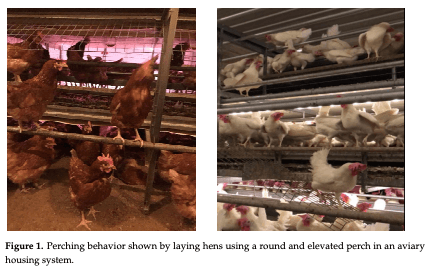
2. Early Perching Behaviors in Chickens
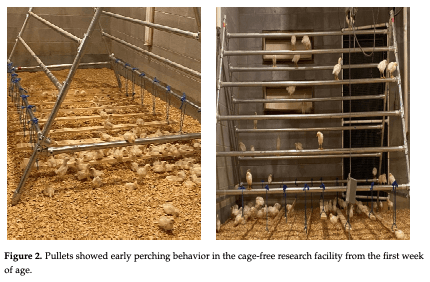
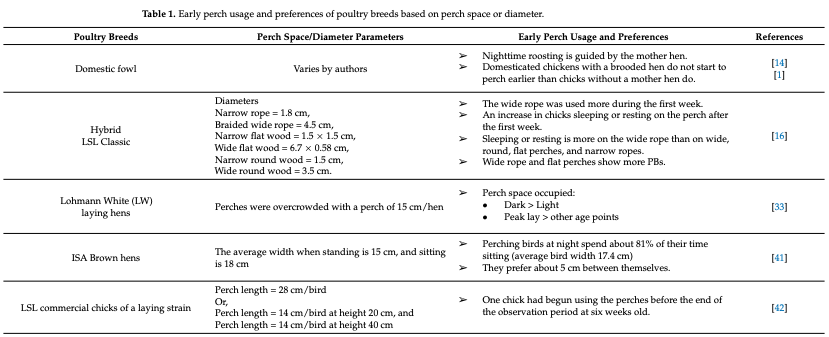

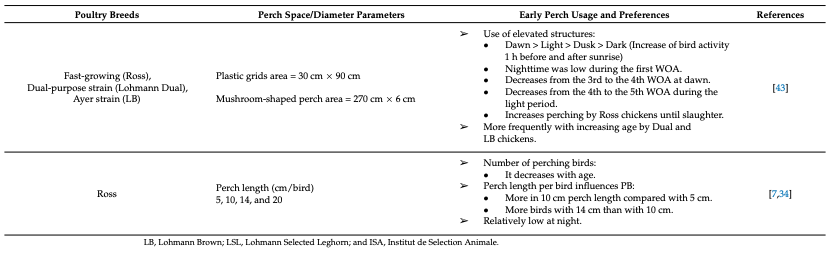
3. Perching Preferences
3.1. Guidelines on Perch Uses
3.2. Perch Dimension
3.3. Perching Duration
3.4. Strain Preferences
4. Perch Design: Structure and Materials
4.1. Perch Design Considerations
4.2. Perch Height
4.3. Perch Shape and Diameter
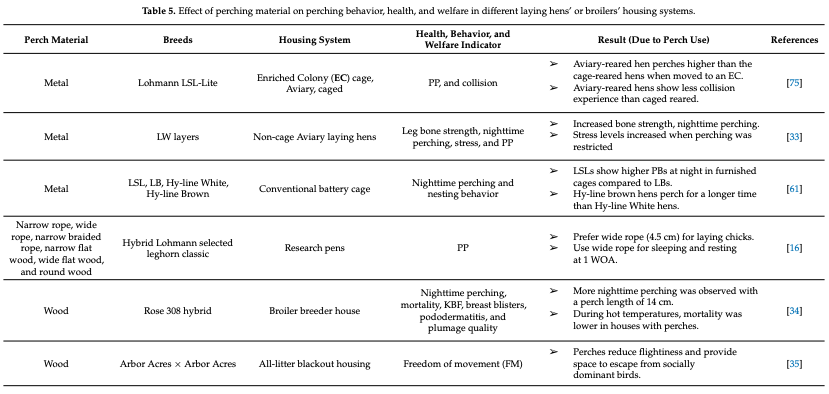
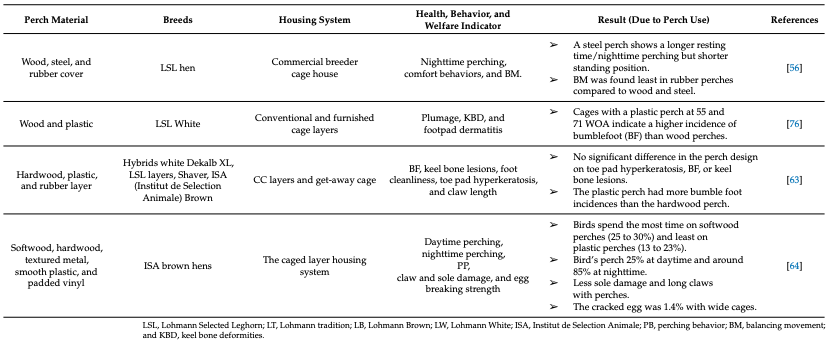
4.4. Perch Materials
5. Poultry Perching: Well-Being and Production
5.1. Musculoskeletal System
5.2. Production Basis
5.3. Welfare and Behavioral Basis
6. Discussions
7. Conclusions
- Wood-Gush, D.; Duncan, I. Some Behavioural Observations on Domestic Fowl in the Wild. Appl. Anim. Ethol.1976, 2, 255–260.
- Newberry, R.C.; Estevez, I.; Keeling, L.J. Group Size and Perching Behaviour in Young Domestic Fowl. Appl. Anim. Behav. Sci.2001, 73, 117–129.
- Quinn, T.H.; Baumel, J.J. The Digital Tendon Locking Mechanism of the Avian Foot (Aves). Zoomorphology1990, 109, 281–293.
- Trbojevic Vukicevic, T.; Galić, S.; Horvatek Tomić, D.; Kužir, S. The Morphological Characteristics of the Passive Flexor Mechanism of Birds with Different Digit Layout. Vet. Arh.2018, 88, 125–138.
- Olsson, I.A.S.; Keeling, L.J. Night-Time Roosting in Laying Hens and the Effect of Thwarting Access to Perches. Appl. Anim. Behav. Sci.2000, 68, 243–256.
- Schrader, L.; Müller, B. Night-Time Roosting in the Domestic Fowl: The Height Matters. Appl. Anim. Behav. Sci.2009, 121, 179–183.
- Gebhardt-Henrich, S.G.; Toscano, M.J.; Würbel, H. Use of Aerial Perches and Perches on Aviary Tiers by Broiler Breeders. Appl. Anim. Behav. Sci.2018, 203, 24–33.
- McLean, J.; Mathews, K.; Solomon, W.; Brayton, P.; Bayne, N. Effect of Ammonia on Nasal Resistance in Atopic and Nonatopic Subjects. Ann. Otol. Rhinol. Laryngol.1979, 88, 228–234.
- Cordiner, L.; Savory, C. Use of Perches and Nestboxes by Laying Hens in Relation to Social Status, Based on Examination of Consistency of Ranking Orders and Frequency of Interaction. Appl. Anim. Behav. Sci.2001, 71, 305–317.
- Weatherhead, P.J.; Hoysak, D.J. Dominance Structuring of a Red-Winged Blackbird Roost. Auk1984, 101, 551–555.
- EU Council Directive 1999/74/EC of 19 July 1999 Laying down Minimum Standards for the Protection of Laying Hens. Available online: https://www.legislation.gov.uk/eudr/1999/74/contents (accessed on 30 September 2022).
- McBride, G.; Parer, I.; Foenander, F. The Social Organization and Behaviour of the Feral Domestic Fowl. Anim. Behav. Monogr.1969, 2, 125–181.
- Heikkilä, M.; Wichman, A.; Gunnarsson, S.; Valros, A. Development of Perching Behaviour in Chicks Reared in Enriched Environment. Appl. Anim. Behav. Sci.2006, 99, 145–156.
- Riber, A.B.; Wichman, A.; Braastad, B.O.; Forkman, B. Effects of Broody Hens on Perch Use, Ground Pecking, Feather Pecking and Cannibalism in Domestic Fowl (Gallus gallus domesticus). Appl. Anim. Behav. Sci.2007, 106, 39–51.
- Janczak, A.M.; Riber, A.B. Review of Rearing-Related Factors Affecting the Welfare of Laying Hens. Poult. Sci.2015, 94, 1454–1469.
- Skanberg, L.; Nielsen, C.B.K.; Keeling, L.J. Litter and Perch Type Matter Already from the Start: Exploring Preferences and Perch Balance in Laying Hen Chicks. Poult. Sci.2021, 100, 431–440.
- Nielsen, B.L. Breast Blisters in Groups of Slow-Growing Broilers in Relation to Strain and the Availability and Use of Perches. Br. Poult. Sci.2004, 45, 306–315.
- Bizeray, D.; Estevez, I.; Leterrier, C.; Faure, J. Effects of Increasing Environmental Complexity on the Physical Activity of Broiler Chickens. Appl. Anim. Behav. Sci.2002, 79, 27–41.
- Norring, M.; Kaukonen, E.; Valros, A. The Use of Perches and Platforms by Broiler Chickens. Appl. Anim. Behav. Sci.2016, 184, 91–96.
- LeVan, N.F.; Estevez, I.; Stricklin, W.R. Use of Horizontal and Angled Perches by Broiler Chickens. Appl. Anim. Behav. Sci.2000, 65, 349–365.
- Kiyma, Z.; Küçükyılmaz, K.; Orojpour, A. Effects of Perch Availability on Performance, Carcass Characteristics, and Footpad Lesions in Broilers. Arch. Anim. Breed.2016, 59, 19–25.
- Rodriguez-Aurrekoetxea, A.; Leone, E.H.; Estevez, I. Effects of Panels and Perches on the Behaviour of Commercial Slow-Growing Free-Range Meat Chickens. Appl. Anim. Behav. Sci.2015, 165, 103–111.
- Malchow, J.; Puppe, B.; Berk, J.; Schrader, L. Effects of Elevated Grids on Growing Male Chickens Differing in Growth Performance. Front. Vet. Sci.2019, 6, 203.
- Watson, M. The Mechanism of Perching in Birds. J. Anat. Physiol.1869, 3, 379.
- Roderick, W.R.; Chin, D.D.; Cutkosky, M.R.; Lentink, D. Birds Land Reliably on Complex Surfaces by Adapting Their Foot-Surface Interactions upon Contact. eLife2019, 8, e46415.
- Zhu, Y.; He, X.; Zhang, P.; Guo, G.; Zhang, X. Perching and Grasping Mechanism Inspired by a Bird's Claw. Machines2022, 10, 656.
- Bist, R.B.; Chai, L.; Yang, X.; Subedi, S.; Guo, Y. Air Quality in Cage-Free Houses during Pullets Production. In 2022 ASABE Annual International Meeting; Houston, TX, USA, 17–20 July 2022; American Society of Agricultural and Biological Engineers: St. Joseph, MI, USA, 2022; p. 1.
- Gunnarsson, S.; Yngvesson, J.; Keeling, L.J.; Forkman, B. Rearing without Early Access to Perches Impairs the Spatial Skills of Laying Hens. Appl. Anim. Behav. Sci.2000, 67, 217–228.
- Wechsler, B.; Huber-Eicher, B. The Effect of Foraging Material and Perch Height on Feather Pecking and Feather Damage in Laying Hens. Appl. Anim. Behav. Sci.1998, 58, 131–141.
- Hester, P.; Enneking, S.; Haley, B.; Cheng, H.W.; Einstein, M.; Rubin, D. The Effect of Perch Availability during Pullet Rearing and Egg Laying on Musculoskeletal Health of Caged White Leghorn Hens. Poult. Sci.2013, 92, 1972–1980.
- Zhao, J.; Jiao, H.; Jiang, Y.; Song, Z.; Wang, X.; Lin, H. Cool Perches Improve the Growth Performance and Welfare Status of Broiler Chickens Reared at Different Stocking Densities and High Temperatures. Poult. Sci.2013, 92, 1962–1971.
- EFSA Panel on Animal Health and Animal Welfare (AHAW). Scientific Opinion on Welfare Aspects of the Use of Perches for Laying Hens. EFSA J.2015, 13, 4131.
- Campbell, D.; Makagon, M.; Swanson, J.; Siegford, J. Perch Use by Laying Hens in a Commercial Aviary. Poult. Sci.2016, 95, 1736–1742.
- Gebhardt-Henrich, S.; Toscano, M.J.; Würbel, H. Perch Use by Broiler Breeders and Its Implication on Health and Production. Poult. Sci.2017, 96, 3539–3549.
- Brake, J. Influence of Presence of Perches during Rearing on Incidence of Floor Laying in Broiler Breeders. Poult. Sci.1987, 66, 1587–1589.
- Vasdal, G.; Gebhardt-Henrich, S.; Tahamtani, F.; Kittelsen, K. Effect of Perch Access on Perching, Health and Production Outcomes in Commercial Broiler Breeder Flocks. Poult. Sci.2022, 101, 102160.
- Rutten, M.; Leterrier, C.; Constantin, P.; Reiter, K.; Bessei, W. Bone Development and Activity in Chickens in Response to Reduced Weight-Load on Legs. Anim. Res.2002, 51, 327–336.
- Bokkers, E.A.; Koene, P. Behaviour of Fast- and Slow-Growing Broilers to 12 Weeks of Age and the Physical Consequences. Appl. Anim. Behav. Sci.2003, 81, 59–72.
- Oester, H.; Wiedmer, H. Evaluation of Elevated Surfaces and Perches for Broilers. Anim. Sci. Pap. Rep.2005, 23, 231–240.
- Weeks, C.; Danbury, T.; Davies, H.; Hunt, P.; Kestin, S. The Behaviour of Broiler Chickens and Its Modification by Lameness. Appl. Anim. Behav. Sci.2000, 67, 111–125.
- Savory, C.; Percival, D.; Yuill, I. Influence of Perch Space Allowance on Perching Behaviour of Laying Hens. Comp. Biochem. Physiol.2002, 12, 435–437.
- Wichman, A.; Heikkilä, M.; Valros, A.; Forkman, B.; Keeling, L.J. Perching Behaviour in Chickens and Its Relation to Spatial Ability. Appl. Anim. Behav. Sci.2007, 105, 165–179.
- Malchow, J.; Berk, J.; Puppe, B.; Schrader, L. Perches or Grids? What Do Rearing Chickens Differing in Growth Performance Prefer for Roosting? Poult. Sci.2019, 98, 29–38.
- Oliveira, J.L.; Xin, H.; Chai, L.; Millman, S.T. Effects of Litter Floor Access and Inclusion of Experienced Hens in Aviary Housing on Floor Eggs, Litter Condition, Air Quality, and Hen Welfare. Poult. Sci.2019, 98, 1664–1677.
- Bist, R.B.; Subedi, S.; Chai, L.; Yang, X. Ammonia Emissions, Impacts, and Mitigation Strategies for Poultry Production: A Critical Review. J. Environ. Manag.2023, 328, 116919.
- Appleby, M. What Causes Crowding? Effects of Space, Facilities and Group Size on Behaviour, with Particular Reference to Furnished Cages for Hens. Anim. Welf.2004, 13, 313–320.
- UEP. UEP Ref Auditor Guidelines 2016. Available online: https://www.emsllc.org/ISO_DOC/Assessments_Audits/UEP/UEP_Ref_Auditor_Guidelines_2016.pdf (accessed on 13 April 2022).
- Struelens, E.; Tuyttens, F. Effects of Perch Design on Behaviour and Health of Laying Hens. Anim. Welf.2009, 18, 533–538.
- Wilkins, L.; McKinstry, J.; Avery, N.; Knowles, T.; Brown, S.; Tarlton, J.; Nicol, C. Influence of Housing System and Design on Bone Strength and Keel Bone Fractures in Laying Hens. Vet. Rec.2011, 169, 414.
- Scott, G.; Hughes, B.; Lambe, N.; Waddington, D. Ability of Laying Hens to Jump between Perches: Individual Variation and the Effects of Perch Separation and Motivation on Behaviour. Br. Poult. Sci.1999, 40, 177–184.
- Scott, G.; Lambe, N.; Hitchcock, D. Ability of Laying Hens to Negotiate Horizontal Perches at Different Heights, Separated by Different Angles. Br. Poult. Sci.1997, 38, 48–54.
- Moinard, C.; Statham, P.; Haskell, M.; McCorquodale, C.; Jones, R.; Green, P. Accuracy of Laying Hens in Jumping Upwards and Downwards between Perches in Different Light Environments. Appl. Anim. Behav. Sci.2004, 85, 77–92.
- Tauson, R. Management and Housing Systems for Layers—Effects on Welfare and Production. World's Poult. Sci. J.2005, 61, 477–490.
- Struelens, E.; Van Poucke, E.; Duchateau, L.; Ödberg, F.; Sonck, B.; Tuyttens, F.A. Effect of Cross-Wise Perch Designs on Perch Use in Laying Hens. Br. Poult. Sci.2008, 49, 402–408.
- Faure, J.M.; Jones, R.B. Effects of Sex, Strain and Type of Perch on Perching Behaviour in the Domestic Fowl. Appl. Anim. Ethol.1982, 8, 281–293.
- Pickel, T.; Scholz, B.; Schrader, L. Perch Material and Diameter Affects Particular Perching Behaviours in Laying Hens. Appl. Anim. Behav. Sci.2010, 127, 37–42.
- Pickel, T.; Schrader, L.; Scholz, B. Pressure Load on Keel Bone and Foot Pads in Perching Laying Hens in Relation to Perch Design. Poult. Sci.2011, 90, 715–724.
- Duncan, E.; Appleby, M.; Hughes, B. Effect of Perches in Laying Cages on Welfare and Production of Hens. Br. Poult. Sci.1992, 33, 25–35.
- Sandilands, V.; Moinard, C.; Sparks, N. Providing Laying Hens with Perches: Fulfilling Behavioural Needs but Causing Injury? Br. Poult. Sci.2009, 50, 395–406.
- Scholz, B.; Kjaer, J.; Schrader, L. Analysis of Landing Behaviour of Three Layer Lines on Different Perch Designs. Br. Poult. Sci.2014, 55, 419–426.
- Wall, H.; Tauson, R. Perch Arrangements in Small-Group Furnished Cages for Laying Hens. J. Appl. Poult. Res.2007, 16, 322–330.
- Cook, N.; Schaefer, A.; Korver, D.; Haley, D.; Feddes, J.; Church, J. Minimally-Invasive Assessments of the Behavioural and Physiological Effects of Enriched Colony Cages on Laying Hens. Open Agric. J.2011, 5, 10–18.
- Tauson, R.; Abrahamsson, P. Foot and Keel Bone Disorders in Laying Hens: Effects of Artificial Perch Material and Hybrid. Acta Agric. Scand. A-Anim. Sci.1996, 46, 239–246.
- Appleby, M.; Smith, S.; Hughes, B. Individual Perching Behaviour of Laying Hens and Its Effects in Cages. Br. Poult. Sci.1992, 33, 227–238.
- Brendler, C.; Kipper, S.; Schrader, L. Vigilance and Roosting Behaviour of Laying Hens on Different Perch Heights. Appl. Anim. Behav. Sci.2014, 157, 93–99.
- Subedi, S.; Bist, R.; Yang, X.; Chai, L. Tracking Pecking Behaviors and Damages of Cage-Free Laying Hens with Machine Vision Technologies. Comput. Electron. Agric.2023, 204, 107545.
- Potzsch, C.; Lewis, K.; Nicol, C.; Green, L. A Cross-Sectional Study of the Prevalence of Vent Pecking in Laying Hens in Alternative Systems and Its Associations with Feather Pecking, Management and Disease. Appl. Anim. Behav. Sci.2001, 74, 259–272.
- Liu, K.; Xin, H.; Shepherd, T.; Zhao, Y. Perch-Shape Preference and Perching Behaviors of Young Laying Hens. Appl. Anim. Behav. Sci.2018, 203, 34–41.
- Bailie, C.L.; Baxter, M.; O'Connell, N.E. Exploring Perch Provision Options for Commercial Broiler Chickens. Appl. Anim. Behav. Sci.2018, 200, 114–122.
- Chen, D.; Bao, J.; Meng, F.; Wei, C. Choice of Perch Characteristics by Laying Hens in Cages with Different Group Size and Perching Behaviours. Appl. Anim. Behav. Sci.2014, 150, 37–43.
- Yan, F.; Hester, P.; Cheng, H. The Effect of Perch Access during Pullet Rearing and Egg Laying on Physiological Measures of Stress in White Leghorns at 71 Weeks of Age. Poult. Sci.2014, 93, 1318–1326.
- Kappeli, S.; Gebhardt-Henrich, S.; Fröhlich, E.; Pfulg, A.; Schäublin, H.; Stoffel, M.H. Effects of Housing, Perches, Genetics, and 25-Hydroxycholecalciferol on Keel Bone Deformities in Laying Hens. Poult. Sci.2011, 90, 1637–1644.
- Hester, P. The Effect of Perches Installed in Cages on Laying Hens. World's Poult. Sci. J.2014, 70, 247–264.
- Scott, G.; MacAngus, G. The Ability of Laying Hens to Negotiate Perches of Different Materials with Clean or Dirty Surfaces. Anim. Welf.2004, 13, 361–365.
- Pullin, A.N.; Temple, S.M.; Bennett, D.C.; Rufener, C.B.; Blatchford, R.A.; Makagon, M.M. Pullet Rearing Affects Collisions and Perch Use in Enriched Colony Cage Layer Housing. Animals2020, 10, 1269.
- Valkonen, E.; Valaja, J.; Venäläinen, E. The Effects of Dietary Energy and Perch Design on the Performance and Condition of Laying Hens Kept in Furnished Cages. Anim. Sci. Pap. Rep. 2005, 23, 103–110.
- Leyendecker, M.; Hamann, H.; Hartung, J.; Kamphues, J.; Neumann, U.; Sürie, C.; Distl, O. Keeping Laying Hens in Furnished Cages and an Aviary Housing System Enhances Their Bone Stability. Br. Poult. Sci. 2005, 46, 536–544.
- Jiang, S.; Hester, P.; Hu, J.; Yan, F.; Dennis, R.; Cheng, H. Effect of Perches on Liver Health of Hens. Poult. Sci. 2014, 93, 1618–1622.
- Gunnarsson, S. Effect of Rearing Factors on the Prevalence of Floor Eggs, Cloacal Cannibalism and Feather Pecking in Commercial Flocks of Loose Housed Laying Hens. Br. Poult. Sci. 1999, 40, 12–18.
- Donaldson, C.J.; O’Connell, N.E. The Influence of Access to Aerial Perches on Fearfulness, Social Behaviour and Production Parameters in Free-Range Laying Hens. Appl. Anim. Behav. Sci. 2012, 142, 51–60.
- Hughes, B.; Appleby, M. Increase in Bone Strength of Spent Laying Hens Housed in Modified Cages with Perches. Vet. Rec. 1989, 124, 483–484.
- Abrahamsson, P.; Tauson, R.; Appleby, M. Behaviour, Health and Integument of Four Hybrids of Laying Hens in Modified and Conventional Cages. Br. Poult. Sci. 1996, 37, 521–540.
- Turkyilmaz, M.K.; Nazligul, A.; Fidan, E.D.; Karaarslan, S.; Mehmet, K.; Kilimci, F.S. The Effect of Perch Cooling and Perch Height on Some Bone Strength Parameters in Broilers Reared in Summer. Harran Üniv. Vet. Fak. Derg. 2020, 9, 133–138.
- Fleming, R.; Whitehead, C.; Alvey, D.; Gregory, N.; Wilkins, L. Bone Structure and Breaking Strength in Laying Hens Housed in Different Husbandry Systems. Br. Poult. Sci. 1994, 35, 651–662.
- Enneking, S.; Cheng, H.; Jefferson-Moore, K.; Einstein, M.; Rubin, D.; Hester, P. Early Access to Perches in Caged White Leghorn Pullets. Poult. Sci. 2012, 91, 2114–2120.
- Tauson, R. Effects of a Perch in Conventional Cages for Laying Hens. Acta Agric. Scand. 1984, 34, 193–209.
- Fleming, R.; McCormack, H.; McTeir, L.; Whitehead, C. Relationships between Genetic, Environmental and Nutritional Factors Influencing Osteoporosis in Laying Hens. Br. Poult. Sci. 2006, 47, 742–755.
- Hughes, B.; Elson, H. The Use of Perches by Broilers in Floor Pens. Br. Poult. Sci. 1977, 18, 715–722.
- Appleby, M.; Duncan, I.; McRae, H.E. Perching and Floor Laying by Domestic Hens: Experimental Results and Their Commercial Application. Br. Poult. Sci. 1988, 29, 351–357.
- Hu, J.; Cheng, H.W. Warm Perches: A Novel Approach for Reducing Cold Stress Effect on Production, Plasma Hormones, and Immunity in Laying Hens. Poult. Sci. 2021, 100, 101294.
- King, N.; Robinson, D. The Use of the Scanning Electron Microscope for Comparing the Structure of Weak and Strong Egg Shells. J. Microsc. 1972, 95, 437–443.
- Board, R.; Tranter, H. The Microbiology of Eggs. In Egg Science and Technology; CRC Press: Boca Raton, FL, USA, 1995; pp. 81–104.
- Fidan, E.; Kaya, M.; Nazligul, A.; Türkyilmaz, M. The Effects of Perch Cooling on Behavior, Welfare Criteria, Performance, and Litter Quality of Broilers Reared at High Temperatures with Different Litter Thicknesses. Braz. J. Poult. Sci. 2020, 22.
- Ventura, B.; Siewerdt, F.; Estevez, I. Effects of Barrier Perches and Density on Broiler Leg Health, Fear, and Performance. Poult. Sci. 2010, 89, 1574–1583.
- Brake, J.; Keeley, T.; Jones, R. Effect of Age and Presence of Perches during Rearing on Tonic Immobility Fear Reactions of Broiler Breeder Pullets. Poult. Sci. 1994, 73, 1470–1474.
- Keeling, L. A Comparison of Two Basic Characteristics of a Perch for Laying Hens. In Proceedings of the 31th International Congress of the ISAE, Prague, Czech Republic, 13–16 August 1997; pp. 13–16.
- Siegel, P.; Gross, W. General Principles of Stress and Well-Being. Livest. Handl. Transp. 2000, 27, 42.
- Campo, J.; Gil, M.; Davila, S.; Munoz, I. Influence of Perches and Footpad Dermatitis on Tonic Immobility and Heterophil to Lymphocyte Ratio of Chickens. Poult. Sci. 2005, 84, 1004–1009.
- Stratmann, A.; Fröhlich, E.K.; Harlander-Matauschek, A.; Schrader, L.; Toscano, M.J.; Würbel, H.; Gebhardt-Henrich, S.G. Soft Perches in an Aviary System Reduce Incidence of Keel Bone Damage in Laying Hens. PLoS ONE 2015, 10, e0122568.
- Ali, A.; Campbell, D.; Karcher, D.; Siegford, J. Nighttime Roosting Substrate Type and Height among 4 Strains of Laying Hens in an Aviary System. Poult. Sci. 2019, 98, 1935–1946.
- Brendler, C.; Schrader, L. Perch Use by Laying Hens in Aviary Systems. Appl. Anim. Behav. Sci. 2016, 182, 9–14.
- Estevez, I.; Tablante, N.; Pettit-Riley, R.; Carr, L. Use of Cool Perches by Broiler Chickens. Poult. Sci. 2002, 81, 62–69.
- Giersberg, M.F.; Spindler, B.; Kemper, N. Linear Space Requirements and Perch Use of Conventional Layer Hybrids and Dual-Purpose Hens in an Aviary System. Front. Vet. Sci. 2019, 6, 231.
- Heerkens, J.; Delezie, E.; Rodenburg, T.B.; Kempen, I.; Zoons, J.; Ampe, B.; Tuyttens, F. Risk Factors Associated with Keel Bone and Foot Pad Disorders in Laying Hens Housed in Aviary Systems. Poult. Sci. 2016, 95, 482–488.
- Hongchao, J.; Jiang, Y.; Song, Z.; Zhao, J.; Wang, X.; Lin, H. Effect of Perch Type and Stocking Density on the Behaviour and Growth of Broilers. Anim. Prod. Sci. 2013, 54, 930–941.
- Pettit-Riley, R.; Estevez, I. Effects of Density on Perching Behavior of Broiler Chickens. Appl. Anim. Behav. Sci. 2001, 71, 127–140.
- Rufener, C.; Rentsch, A.K.; Stratmann, A.; Toscano, M.J. Perch Positioning Affects Both Laying Hen Locomotion and Forces Experienced at the Keel. Animals 2020, 10, 1223.
- Struelens, E.; Tuyttens, F.; Duchateau, L.; Leroy, T.; Cox, M.; Vranken, E.; Buyse, J.; Zoons, J.; Berckmans, D.; Ödberg, F. Perching Behaviour and Perch Height Preference of Laying Hens in Furnished Cages Varying in Height. Br. Poult. Sci. 2008, 49, 381–389.
- Heerkens, J.L.T.; Delezie, E.; Ampe, B.; Rodenburg, T.B.; Tuyttens, F.A.M. Ramps and Hybrid Effects on Keel Bone and Foot Pad Disorders in Modified Aviaries for Laying Hens. Poult. Sci. 2016, 95, 2479–2488.
- Stratmann, A.; Fröhlich, E.K.F.; Gebhardt-Henrich, S.G.; Harlander-Matauschek, A.; Würbel, H.; Toscano, M.J. Modification of Aviary Design Reduces Incidence of Falls, Collisions and Keel Bone Damage in Laying Hens. Appl. Anim. Behav. Sci. 2015, 165, 112–123.
- Vasdal, G.; Gebhardt-Henrich, S.G.; Kittelsen, K.E.; Tahamtani, F.M. Commercial Broiler Breeder Pullet Hens Use Perches but Show No Preference for Perch Type or Height. Appl. Anim. Behav. Sci. 2022, 249, 105608.























United States