Balancing Poultry House Moisture Levels - Part I
Published: March 23, 2026
Source : Michael Czarick / Extension Engineer - UGA Poultry Science
When it comes to setting minimum ventilation fan runtimes during cold weather it is important to keep in mind that one of the primary objectives of minimum ventilation is to manage house moisture levels. Too much fan runtime will not only result in excessive moisture removal from a house, leading to dry, dusty conditions which can lead to bird respiratory issues, but it will also result in high heating costs. Conversely, if the minimum ventilation fans are not operated enough, too little moisture will be removed from the house, litter will cake over, ammonia levels will rise, and bird performance, health, and welfare can suffer.
Quite simply, we remove moisture from a house by exchanging the moist air from within a house with drier air from outside a house. But what about when the relative humidity is higher outside than inside? Though it may be hard to believe, the fact is that during cold weather, the air outside a poultry house is always drier than the air inside a poultry house. To understand why, it helps to understand the difference between relative and absolute humidity.
Relative humidity is the most commonly used term to indicate how much moisture is in the air. In reality, it should be called "relative to temperature humidity" because it is a measure of how full of moisture the air is relative to the current air temperature. So if the relative humidity is 50% and the air temperature is 40°F, we know the air is half full of moisture at the current air temperature of 40°F. We don't know how much moisture is actually in the air. We only know that it is half full.
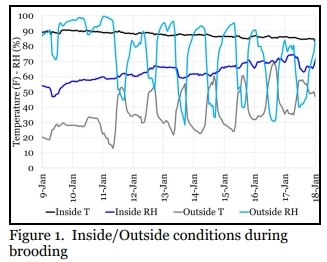
What makes talking about relative humidity tricky is that the moisture-holding ability of air is not constant; it changes with air temperature. In fact, for every 20°F we increase the air temperature, its moisture-holding ability roughly doubles. So, if in the morning it is 40°F outside and the relative humidity is 50% and during the afternoon the air temperature increases 20°F to 60°F the air is now capable of holding roughly twice the amount of moisture it did in the morning, and as a result, the relative humidity will be cut in half to approximately 25%. This is why over the course of the day, as outside temperature increases, the relative humidity decreases, and as the outside temperature decreases, relative humidity increases (Figure 1).
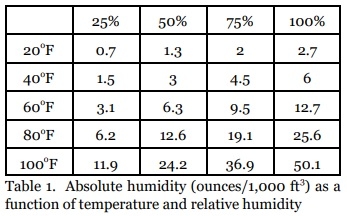
Unlike relative humidity, absolute humidity is a measure of precisely how much moisture there is in a given volume of air, i.e., ounces of water per 1,000 ft3 of air. Table 1 shows the absolute humidity of air at different air temperatures and relative humidities. From Table 1, it can be seen that the maximum amount of moisture 1,000 ft3 of 40°F air can hold is around 6 ounces. If the temperature of the air is increased to 60°F, the maximum moisture-holding capacity of 1,000 ft3 of air increases to 12.7 ounces. Another 20°F increase, to 80°F air, 25.6 ounces, roughly doubling again.
The key point when removing moisture from a poultry house is to keep in mind that just because the relative humidity may be higher outside than inside, that doesn't necessarily mean that there is more moisture in the air outside than inside. What matters is the absolute humidity of the inside/outside air. The fact is that during cold weather, the outside air will always contain less moisture than the air inside because cold air simply is incapable of holding very much moisture compared to the warm air inside a poultry house.
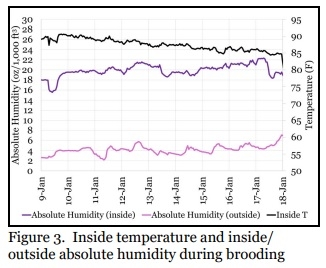
The difference between relative and absolute humidity when it comes to removing moisture from a poultry house can be seen in the data collected from a commercial broiler house where chicks were placed the second week of January. During the first ten days of the flock, outside temperatures ranged between 25°F and $35°F at night and between 50°F and 70°F during the day. Outside relative humidity ranged between a low of 35% during the day and highs around 90% at night. Figure 2 shows the inside and outside absolute humidity during the same ten days.
What should not be particularly surprising is that since house temperature and relative humidity were relatively constant during the brooding period, the inside absolute humidity was relatively consistent (18 - 22 ounces/1,000 ft3. But what may seem odd at first is that despite relatively wide variations in outside temperature and relative humidity, the outside absolute humidity varied little (between 3 and 5 ounces per 1,000 ft3 over the first ten days of the flock. This is because the amount of moisture in the air outside a poultry house really doesn't change much from day to night or from day to day for that matter unless a weather front moves through, bringing with it more or less moisture. Yes, the relative humidity will change as the outside air temperature changes (temperature increases, relative humidity falls, temperature decreases, the relative humidity will rise), but the actual amount of moisture in the air will tend to remain relatively consistent.
When you examine the graph of absolute humidity, the moisture removal process becomes a little more clear. During the time shown, air outside the poultry house contained approximately 4 ounces of water per 1,000 ft3 while the air inside the house contained approximately 20 ounces/1,000 ft3. Whenever the minimum ventilation fans exchanged 1,000 ft3 of inside air for 1,000 ft3 of outside air, 16 ounces of water were removed from the poultry house. So when a 36" fan operated for a minute, roughly 10,000 ft3 of air would have been exchanged, resulting in the removal of 160 ounces or 1.25 gallons of water from the house ((20 ounces - 4 ounces) X 10 (thousand cubic feet)).
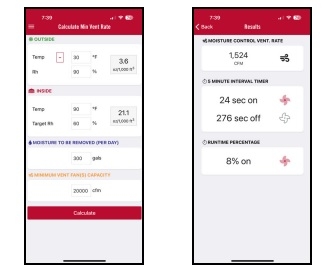
One way to gain a better understanding of the concept of absolute humidity and how it affects house moisture removal is to experiment with the Minimum Ventilation Calculator in the Poultry441 app. Input inside/outside conditions, the amount of water the birds are drinking, and the fan capacity to be used for minimum ventilation and the app will not only calculate the inside/outside absolute humidity but also how much the minimum ventilation fans have to operate to remove the moisture the birds are adding to the house that day.
This article was originally published in Poultry Housing Tips, Volume 37, Number 1, 2025. University of Georgia, College of Agricultural and Environmental Sciences Cooperative Extension (https://www.poultryventilation.com/).
Related topics:
Authors:


Recommend
Comment
Share

Would you like to discuss another topic? Create a new post to engage with experts in the community.














Featured users in Poultry Industry