Explore

Advertise on Engormix

Acid binding capacity of poultry feed ingredients and diets

Published: August 18, 2026
Source : L.S. DAVID 1, M.R. ABDOLLAHI 1, P.H. SELLE 2, C.L. WALK 3 and V. RAVINDRAN 1 / 1 Monogastric Research Centre, School of Agriculture and Environment, Massey University, Palmerston North 4442, New Zealand; 2 Poultry Research Foundation, University of Sydney, Camden, NSW 2570, Australia; 3 DSM Nutritional Products, Kaiseraugst, Switzerland.
Summary

The objective of the present work is to determine the acid binding capacity (ABC) of feed ingredients (inorganic, animal, and plant sources) and diets (layer mash and pelleted broiler diets) used in poultry nutrition. The measurements were made at three pH points (4, 3 and 2) to examine the best pH point for the ABC estimation which was a secondary objective of the study. The results showed that the limestone and oyster shell had the highest ABC at all pH points. The ABC of limestone was variable depending on the source. The ABC of 10 limestone samples ranged from 8,261-13,459 mEq/kg at pH 4; 9,836-15,566 mEq/kg at pH 3 and 16,010- 22,393 mEq/kg at pH 2. Next to inorganic sources, animal-based ingredients had higher ABC with an average of 632 1,122 and 2,449 mEq/kg, at pH 4, 3 and 2, respectively. Among the plant-based sources, cereals had the lowest ABC (960 mEq/kg at pH 2) compared to the plantprotein sources (1,590 mEq/kg at pH 2) and cereal-by products (1,216 mEq/kg at pH 2). Layer mash had a higher ABC (5,846 mEq/kg at pH 2) when compared to broiler diets (1,275-1,446 mEq/kg at pH 2). In conclusion, limestone was the most consequential ingredient in terms of increasing ABC. The variability in ABC among different limestone sources may have implications for nutrient utilisation and absorption. The most suitable pH point was pH 2, as the readings were more stable at this pH and it is more relevant to the pH in the foregut of poultry. 

I. INTRODUCTION

Acid binding capacity (ABC) of an ingredient, through its effect on gastric pH, plays an important role in the digestion and absorption of nutrients in poultry. The ABC is defined as the resistance of a feed ingredient to the pH reduction by gastric acid. Limestone, the major Ca source in poultry diets, has a high ABC (Lawlor et al., 2005), which can increase the digesta pH and, influence the solubility and digestibility of nutrients, including minerals. The average pH in the segments of proventriculus and gizzard ranges from 0.5 to 4.8 (Ravindran, 2013; Lee et al., 2018). For optimum digestion, a low pH must be maintained in the gizzard. Therefore, the inherent buffering capacity of the ingredients must be considered for the effective use of ingredients, especially of the mineral sources, in feed formulations. Lawlor et al. (2005) examined the ABC of some feed ingredients used in pig feeds. Similar studies for ingredients and diets used for poultry feeding are scant. The objective of present study was to determine the ABC of feed ingredients and diets used in poultry nutrition. A secondary objective was to examine the influence of pH (4.0, 3.0 and 2.0) on the measurement of ABC.

II. MATERIALS AND METHODS

Ingredients and poultry diets were obtained from various commercial sources in New Zealand and Australia. All samples were ground to pass through a 0.5 mm screen using a laboratory rotor mill and were stored in air-tight plastic containers at 4˚C until analysis. The samples examined were mineral sources (limestone, oyster shell, dicalcium phosphate and monocalcium phosphate), cereals and by-products (barley, maize, sorghum, triticale, wheat, and wheat bran), plant-protein sources (canola meal, peas, soybean meal, sunflower meal), animal protein sources (fish meal, meat and bone meal [MBM], meat meal and blood meal) and diets (layer mash and broiler starter, grower and finisher diets). A modified procedure of Lawlor et al. (2005) was used to determine the ABC. Instead of measuring at two pH points (3.0 and 4.0), the present work used three pH points (4.0, 3.0 and 2.0). All pH measurements were made using a laboratory pH meter which was calibrated using certified pH of 4.0 and 7.0 buffer solutions. A 0.5 g sample of ingredient or diet was suspended in 50 mL of deionised water and continuously stirred with a magnetic stirrer at 37° C for one hour. However, for the ingredients having extremely high buffering capacity namely, limestone, oyster shell and layer mash, a sample amount of 0.1 g was used which was determined based on preliminary experiments. Titrations were performed by addition of 0.1N hydrochloric acid in variable increments (0.1 to 45 mL depending on the ingredient type and the stage of titration). Initial pH and all further readings taken during the titration were recorded after equilibration for three minutes. The ABC was calculated as the amount of hydrochloric acid in milliequivalents (mEq) required to lower the pH of 1 kg of sample to respective pH point. Calculated ABC values of each sample were means of 3 replicates.

III. RESULTS AND DISCUSSION

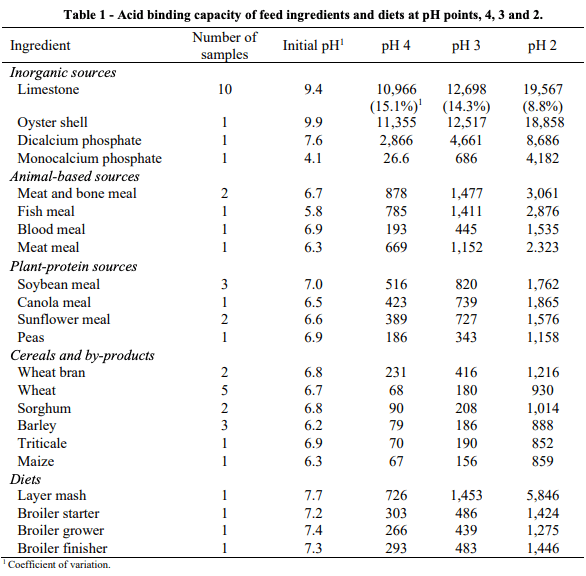
Table 1 summarises the initial pH and average ABC of test ingredients and diets. Limestone and oyster shell had extremely high ABC at all pH points. The ABC of limestone was highly variable among the different sources. The ABC of the 10 samples ranged from 8,261-13,459 mEq/kg at pH 4; 9,836-15,567 mEq/kg at pH 3; and 16,010-22,394 mEq/kg at pH 2 with standard deviations of 1,657, 1,812 and 1,723, respectively. Among the animal protein sources, MBM (878-3,061 mEq/kg) had higher ABC followed by fish meal (785-2,876 mEq/kg) at all pH points. Among the plant-based sources, ABC of cereals were very low with an average of 101, 223 and 960 mEq/kg, respectively, at pH 4, 3 and 2. The ABC of cereal by-product (wheat bran) was higher than that of cereals (231-1,216 mEq/kg). Among the plant protein sources, soybean meal had the highest ABC while peas had the lowest ABC. Among the diets, layer mash had higher ABC when compared to broiler diets. 
Most of the current estimates are in general agreement with those of Lawlor et al. (2005). The current work shows that the inorganic mineral sources (except for monocalcium phosphate) had higher ABC when compared to other categories, which is in agreement with previous results (Lawlor et al., 2005; Gilani et al., 2013; Lu et al., 2016). The average ABC of 13 limestone samples has been reported as 12,932 and 15,044 mEq/kg at pH 4 and 3, respectively, by Lawlor et al. (2005), which is 16% higher than the current estimates. In contrast to the current work, Lawlor et al. (2005) reported a relatively higher ABC for fish meal (738-1,457 mEq/kg) when compared to MBM (595-920 mEq/kg) which could be due to the difference in the chemical composition among various sources. For instance, the calcium concentration of MBM samples may vary from 71 to 118 g/kg (Anwar et al., 2016), which might have an influence on the ABC of different MBM samples. The former study also reported slightly higher values for cereals and plant protein sources which again may reflect differences in nutrient composition within ingredients depending on the source. Higher ABC of layer mash when compared to broiler diets was as expected because of the high inclusion of limestone in layer mash to meet the high calcium demand for egg production.
Among the pH points examined, pH 2 is most applicable to poultry nutrition when compared to pH 3 and 4. According to Duke (1986), the pH of proventriculus and gizzard is around 2. The readings were also more stable at pH 2 compared to the other pH points because determining the amount of hydrochloric acid required to increase the pH to 4 and 3 was found to be demanding. This was particularly an issue for the high-ABC materials (limestone, oyster shell and layer mash).
Table 1 - Acid binding capacity of feed ingredients and diets at pH points, 4, 3 and 2.
Other than pH, factors that may influence the ABC of ingredients are temperature of the solution, type of processing (pelleting, extrusion) and particle size. According to Gilani et al. (2013), increasing temperature from 21 to 41˚ C reduced the pH and ABC for selected inorganic (calcium carbonate, oyster shell, dicalcium phosphate and monocalcium phosphate) and plant-based (wheat, rice bran, soybean meal) feed ingredients. It must be noted that a temperature of 37˚ C was used in the current work. The ABC of ingredients is affected by their particle size as the particle size greatly influence their solubility.
The extraordinarily high ABC of limestone has implications for digesta pH along the gastrointestinal tract. This is reflected in increased digesta pH in the crop (5.32 vs. 4.89; P < 0.05) and ileum (7.39 vs. 6.62; P < 0.01) pursuant to the addition of 40 g/kg limestone to broiler diets in Shafey et al. (1991). The digestion of protein and absorption of amino acids are paramount to the growth performance of poultry. Intestinal uptakes of amino acids principally take place as constituents of di- and tripeptides (oligopeptides) via the peptide transporter, PepT-1, rather than as monomeric entities. Interestingly, there are indications (Kennedy et al. 2002) that intestinal mucosal surface pH values of less than 6.1 to 6.8 would advantage the functionality of PepT-1 (Steel et al., 1997). Therefore, it is relevant that increasing limestone inclusions from 3.0 to 18.7 g/kg in maize-soy broiler diets depressed average apparent ileal digestibility coefficients of 17 amino acids by 7.95% (0.78 vs 0.72) as reported by Amerah et al. (2014). However, in the same study, increasing limestone inclusions did not significantly influence pH of ileal digesta. This suggests that the ABC of limestone was not influencing digesta pH along the digestive tract and other factors stemming from limestone and/or calcium were influential. Accordingly, considerable attention is now being paid to the calcium content, particle size and solubility of limestone used in poultry diets (Gilani et al., 2022). Moreover, the use of phytase may also impact the ABC. Phytase matrix values (1000 FTU/kg) for calcium and phosphorous of 2.09 and 1.97 g/kg, respectively, are often applied to the formulation of broiler diets (Moss et al., 2022). Given the high ABC of limestone, dicalcium phosphate and monocalcium phosphate reported herein, the corresponding reductions in their dietary inclusions would translate to tangible depressions in dietary ABC, which should be to the advantage of broiler growth performance.
In conclusion, determining the ABC at pH 2 is most suitable for poultry ingredients when compared to pH 3 and 4, because (i) it represents the gastric pH on birds and (ii) the readings during the titration process were more stable at pH 2. Limestone was the most influential ingredient in terms of ABC of poultry diets. Substantial variability in the ABC of the 10 limestone samples determined in the current work is noteworthy and this may cause differences in the digestion and utilisation of nutrients and on bird performance. This is a research topic that has not been previously explored and future studies are warranted.
   
Presented at the 35th Annual Australian Poultry Science Symposium 2024. For information on the latest and future editions, click here.

Amerah, A. M., Plumstead, P. W., Barnard, L. P., & Kumar, A. (2014). Poultry Science, 93, 906–915.

Anwar, M. N., Ravindran, V., Morel, P. C. H., Ravindran, G., & Cowieson, A. J. (2016). Poultry Science, 95, 70–76.

Duke, G. E. (1986). In P. D. Sturkie (Ed.), Avian Physiology (pp. 289–302). Springer-Verlag, New York.

Gilani, A., Kermanshahi, H., Golian, A., Gholizadeh, M., & Mohammadpour, A. A. (2013). Iranian Journal of Applied Animal Science, 3, 687–694.

Gilani, S., Mereu, A., Li, W., Plumstead, P. W., Angel, R., Wilks, G., & Dersjant-Li, Y. (2022). Journal of Applied Animal Nutrition, 10, 19–30.

Kennedy, D. J., Leibach, F. H., Ganapathy, V., & Thwaites, D. T. (2002). Pflügers Archiv – European Journal of Physiology, 445, 139–146.

Lawlor, P. G., Lynch, P. B., Caffrey, P. J., O’Reilly, J. J., & O’Connell, M. K. (2005). Irish Veterinary Journal, 58, 447–452.

Lee, S. A., Dunne, J., Febery, E., Brearley, C. A., Mottram, T., & Bedford, M. R. (2018). British Poultry Science, 59, 568–578.

Lu, N., Arnaut, P., & Lindemann, M. D. (2016). Journal of Animal Science, 94, 121 (Abstract).

Moss, A. F., Ghane, A., Dersjant-Li, Y., Dao, T. H., Suleman, M., Morgan, N., & Crowley, T. M. (2022). Proceedings of the Australian Poultry Science Symposium, 33, 85–88.

Ravindran, V. (2013). Journal of Applied Poultry Research, 22, 628–636.

Shafey, T. M., McDonald, M. W., & Dingle, J. G. (1991). British Poultry Science, 32, 185–194.

Steel, A., Nussberger, S., Romero, M. F., Boron, W. F., Boyd, C. A., & Hediger, M. A. (1997). Journal of Physiology, 498, 563–569.


Content from the event:
Related topics:
Authors:
Reza Abdollahi
Dr. Peter Selle
Velmurugu Ravindran
Recommend
Comment
Share
Profile picture
Would you like to discuss another topic? Create a new post to engage with experts in the community.
Featured users in Poultry Industry
Fernanda Lima de Souza Castro
Gerente de serviços técnicos
United States
Shivaram Rao
Shivaram Rao
PhD Director Principal de Nutrición y Servicios Técnicos de Pilgrim’s Pride Corporation
United States
Karo Mikaelian
Karo Mikaelian
United States