Features of the extended laying cycle of hy-line brown hens reared under different lighting and feeding regimens
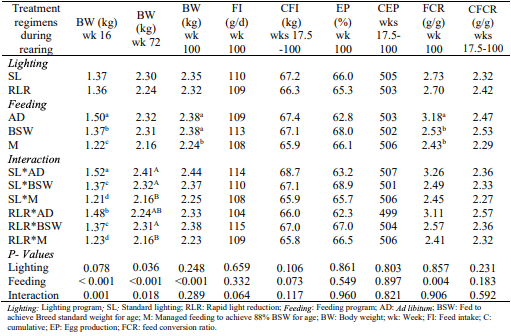
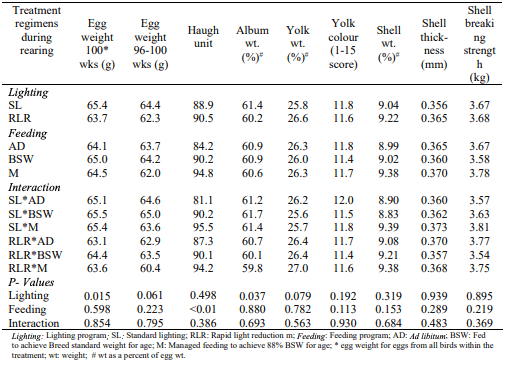
The impact of two lighting and three feeding programs during rearing on hen egg-production characteristics across an extended laying cycle was evaluated. Hy-Line Brown chicks were housed in floor pens from day old under two lighting programs i.e. standard lighting (SL) of 10h light (L) /d from 7 weeks of age (WOA) or, rapid light reduction (RLR) of 9h L/d from 4 WOA. Feed was provided ad libitum until 4 WOA, when three feeding regimens i.e. ad libitum (ad lib), feeding to Hy-Line Brown breed standard weight (BSW), and feeding to 88% BSW (Managed) for age were introduced into each lighting program and continued to 16 WOA. Pullets were then transferred to individual cages in a cage layer facility with ad libitum feeding and gradual increase in lighting to 16 h L/d at 33 WOA. The feed intake (FI), egg production (EP), egg weight (EW), feed conversion ratio (FCR) and body weight (BW) of each hen was followed through until they were 100 WOA. An interim BW at 72 WOA is also reported. Between 96-100 WOA internal egg characteristics of Haugh unit (HU), relative albumen weight and yolk colour and, shell quality including relative shell weight, shell thickness and breaking strength, were assessed on 12 focal birds/rearing treatment. Lighting and feeding during rearing interacted to impact BW at 16 WOA i.e. pullets of SL and ad lib feeding were heaviest and Managed feeding with both SL and RLR were lightest (P = 0.001). When 100 WOA, birds that had been fed ad lib during rearing had similar BW to hens fed to BSW in rearing, both being heavier than birds from Managed feeding during rearing (P < 0.001). Hens from the former two treatments also consumed more feed (P = 0.073) across the laying phase. During their 100th WOA hen EP ranged 62-69%, which was not affected by the rearing treatment. Overall hens from all rearing regimens had produced 500 eggs by 100 WOA but, at 100 WOA hens reared under SL produced heavier eggs compared to rearing with RLR (P=0.015). Hens that had been fed to BSW and Managed feeding during rearing had lower FCR during their 100th WOA (P= 0.004), and numerically lower cumulative FCR throughout the laying phase. Eggs produced across 96-100 WOA by focal hens from Managed feeding during rearing had the highest HU (P = 0.002) and, ad lib feeding the lowest HU. Relative albumen weight was highest in eggs from hens reared under SL compared to RLR (P = 0.037), whereas the feeding regimens during rearing had no effect on relative albumen weight. There were no differences in relative shell weight, shell thickness nor shell breaking strength. Managing FI during rearing generated smaller hens with lower FCR but similar EP and eggs of higher HU compared to the larger sized hen that was achieved by ad lib feeding throughout rearing.
I. INTRODUCTION
II. MATERIALS AND METHODS
III. RESULTS AND DISCUSSION
- Arango, J.A.; Settar, P.; Saxena, S.; Arthur, J.; O’Sullivan, N. (2007). Available at: http://internationalpoultryexposition.com/ipsf/docs/evalForm.pdf
- Hy-Line International. (2018). Available at: https://www.hyline.com/filesimages/Hy-Line-Products/HyLine-Product-PDFs/Brown/BRN%20COM%20ENG.pdf
- Muir, W.I.; Akter, Y.; Bruerton, K.; Groves, P.J. (2022). Poultry Science, 101, 102041.
- Muir, W.I.; Akter, Y.; Bruerton, K.; Groves, P.J. (2023a). Poultry Science, 102, 102338.
- Muir, W.I.; Akter, Y.; Bruerton, K.; Groves, P.J. (2023b). Proceedings of the Australian Poultry Science Symposium, 34, 201–204.
- Parkinson, G.B.; Firooz, F.R.; Cransberg, P. (2008). Proceedings of 2008 Poultry Information Exchange, pp. 17–21.
- Roberts, J.R. (2004). Journal of Poultry Science, 41, 161–177.
- Santiago-Anadón, H.L.; Latorre-Acevedo, J.R. (2004). The Journal of Agriculture of the University of Puerto Rico, 88, 135–144.



















United States
United States