INTRODUCTION
In the United States, approximately 240 million commercial broiler eggs are set in incubators every week with an average hatchability of 80.3% (National Agricultural Statistics Service, 2022). In 2007, it was estimated that an improvement of 1% would increase returns to more than $25 million for the hatcheries and further increase profits to the broiler production chain (Schaal and Gherian, 2007). The egg management at the hatchery such as storage conditions, incubation temperatures, humidity, and turning frequency is fundamental to reaching top hatchability (Vick et al., 1993; Reis et al., 1997; Lourens et al., 2005; Elibol and Brake, 2006). However, regardless of how well the egg is handled in the hatchery, eggshell quality is critical to have a better chance of hatching. The eggshell regulates gas and vapor diffusion, serves as a barrier for pathogens for the survival of the developing embryo and is used as an indicator for hatchability through parameters such as specific gravity, vapor water conductance, weight, thickness, porosity, breaking strength, elastic modulus, static and dynamic stiffness, among others (McDaniel et al., 1979; Pebbles and Brake, 1987; King’ori, 2011; Liao et al., 2013). Furthering our understanding of the importance of eggshell quality parameters on hatchability could generate new opportunities for research via nutrition and breeder management (Emery et al., 1984; Wilson, 1997; Ketta and Tu! mov!a, 2018).
Translucency is an eggshell quality parameter that has been primarily studied for table eggs from laying hens where its effects on bacterial penetration, eggshell structure, shell membranes, thickness, and strength have been demonstrated (Chousalkar et al., 2010; Wang et al., 2017). However, there is not much data published related to its impact on hatchability and chick quality in broiler eggs. Shell translucency is described as a mottled appearance with lighted-colored spots of different sizes easy to observe when candling eggs (Holst et al., 1932; Baker and Curtiss, 1957). Its generation is suggested to be caused by moisture accumulation in the shell and an uneven drying after the egg is laid, leaving opaque and translucent areas (Talbot and Tyler, 1974). Factors including hen’s nutrition (Leach and Gross, 1983; Bouvarel, Nys and Lescoat, 2011; Gautron et al., 2021), breed/strain (Zhang et al., 2021; Baker and Curtiss, 1957), health, and environmental conditions (Cheng and Ning, 2023) can increase the eggshell’s translucency primarily by altering and disrupting the ultrastructure and inner membrane of the eggshell.
The color of the eggshell is a physical parameter mainly attributed to the pigments protoporphyrin, biliverdin, and its zinc chelate which are synthesized in the shell gland of the oviduct and mainly deposited over the egg toward the conclusion of eggshell formation (Wang et al., 2007). The presence or absence of a specific dye is determined by the hen’s genetics and the dye intensity may increase or decrease under different conditions due to stress, age of the hen, the health status of the flock, and environmental factors (Odabasi et al., 2007 ¸ ; Liu and Cheng, 2010). However, several authors continue to doubt that color alone could serve as a reliable indicator of eggshell quality and hatchability (Ingram et al., 2008). The aim of this project is to describe the possible effects of eggshell translucency and color lightness (dark and light) on eggshell thickness, hatchability, and chick weight.
MATERIALS AND METHODS
The protocol of this experiment was previously approved by the Auburn University Institutional Animal Care and Use Committee (Reference number: 2021- 3985). A total of 4,320 eggs from Ross 708 breeder hens between 50 and 55 wk of age from a commercial hatchery were used for this study. Eggs were collected over 4 consecutive days from different flocks each day (1,080 eggs per d). Prior to collection, eggs were stored for 4 to 6 d in a constant environment (temperature 15°C and 70% relative humidity) in a storage room of a commercial broiler hatchery.
Translucency Score, Coloration Lightness, Thickness, and Initial Weight
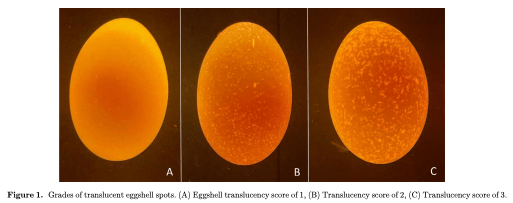
Each day, with the use of an egg-candling box, a total of 1,080 eggs were divided into 3 groups according to their translucency scores (1 = low, 2 = medium, 3 = high), using a 3-point subjective scoring system that takes into consideration the amount, size, and coverage of spot patterns or mottling areas in the eggshell (Figure 1). After scoring, eggshell coloration lightness (L* value) was evaluated using an electronic colorimeter (Nix Color Sensor Pro 2) sorting the eggs as light or dark and the evaluated eggs were placed in a total of twelve 90-egg-incubator-trays. Eggshell thickness was determined using a noninvasive ultrasound gauge (eggshell thickness gauge by egg tester). For initial egg weight, eggs were weighed before incubation as an average of the eggs per tray. The experimental unit of this study was the 2 trays of 90 eggs each. The study used a factorial treatment design (3 eggshell translucency levels and 2 eggshell colors), each treatment was repeated 4 times in a complete block randomized design where each day of collection was the source of variation to conform the blocks which was considered the random factor for the statistical analysis.
Incubation
Eggs were set in 4 identical single-stage incubators (Nature Form, model NMC 1080) with a capacity of 1,080 eggs at Auburn University Miller Research Farm in Auburn, AL. Relative humidity and temperature were maintained constant during incubation (37.7°C and 55% relative humidity) and eggs were turned every hour.
Hatchability, Transfer Egg Weight, Weight Loss Percent, Infertile, Cracked, Exploders, Contaminated, Unhatched + Culls Percent, and Chick Weight
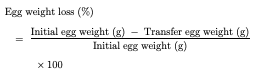
After 18 d of incubation, all eggs were candled to identify and remove eggs that appeared to be infertile or with dead embryos, cracked to confirm infertility and embryonic mortality (early, mid, and late) by visual examination, and finally counted for calculating the egg loss along with the cracked, contaminated and exploder eggs. The fertile eggs placed in trays were weighted for the calculation of egg weight at transfer. Egg weight loss was estimated as follows:
Eggs were then transferred to hatching baskets and placed back into the same incubators at the same temperature and relative humidity. Hatchability was calculated based on the number of eggs hatched from the total of eggs set. Hatched chicks were weighed as an average of chicks per basket. Eggs that failed to hatch at d 21 were opened to visually confirm the embryonic mortality and chicks that hatched but were weak and near death were culled and counted to calculate the percentage of unhatched + culls based on the total amount of eggs set. Hatch of fertile was calculated based on the number of chicks hatched from the total of fertile eggs transferred to the hatcher.
Statistical Analysis
Data regarding the effect of translucency and eggshell color in initial egg weight, transfer egg weight, water loss percent, hatchability percent, unhatched + culls percent, eggshell thickness, and chick weight were analyzed using the GLIMMIX procedure of SAS (V 9.4) and Tukey’s HSD test was performed to separate means. A significant difference was considered when P ≤ 0.05.
RESULTS AND DISCUSSION
Results regarding the translucency are summarized in Table 1. All the parameters analyzed were affected by translucency score except for initial egg weight, egg weight loss, and unhatched + culls percent (P > 0.05). This agrees with Baker and Curtiss (1957) and Wang et al. (2017) who did not observe any correlation between initial egg weight and translucency on table eggs when stored at room temperature.
Regarding the transfer egg weight (P = 0.0358) obtained on d 18 of incubation, results show a lower egg weight in high translucent eggs (T score 3) compared to less translucent eggs (T score 1). Research has suggested that loss of weight during incubation could be attributed to water vapor exchange that can be influenced by eggshell porosity (Sousa de Araujo et al., 2017) and thickness (Roque and Soares, 1994). However, no differences in porosity have been reported regarding translucency in laying eggs (Talbot and Tyler, 1974; Wang et al., 2017). According to Roque and Soares (1994), thinner eggshells can lose more weight during incubation, which is contrary to our observations. We found that eggs with thicker eggshells, but high translucency may lose more weight during incubation than eggs with thin eggshells. One crucial component that allows gaseous exchange throughout the shell is the inner membrane (Kayar et al., 1981). Translucent eggs have been reported to have thinner inner membranes that are more easily breakable (Wang et al., 2017) which negatively affects the flow of gases through the shell. It is suggested that even though the eggshell of those eggs is thicker, their translucency renders them more sensitive to lose weight during incubation due to a lower quality of their inner membrane.
Eggs with a translucency score of 1 had a 6.91% higher hatchability of eggs set (P = 0.0127) and greater chick weight (P = 0.0385) in comparison to eggs with a translucency score of 3. Higher hatchability can be influenced by fewer bacterial infection occurrences (Barbour et al., 1984) and a better quality of the eggshell and inner membrane which may impact moisture regulation and gas exchange (Roque and Soares, 1994). In 2010, Chousalkar and others observed that eggs with high translucency had an increased pathogenic bacteria penetration, linking the integrity of the inner and outer eggshell membranes, and the consequential shell ultrastructure, to bacterial permeability. Wang et al. (2017) found that the inner membrane of high translucent eggshells was significantly thinner and had lower failure stress values, which indicates reduced toughness and elasticity. They concluded that high translucent eggs had membranes that are more easily disrupted and offered less projection to the egg content.
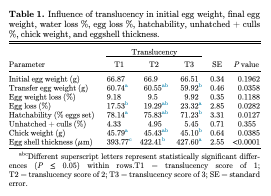
Results of this study also suggest that translucency impacts the percentage of egg loss (P = 0.0282) due to infertility and embryonic death during the first 18 d, showing a 5.79% higher egg loss in highly translucent eggs (T score 3) than low translucent eggs (T score 1). Potential causes of embryonic death in translucent eggs could be related to poor resistance to water loss and altered respiration rate of the embryo during incubation as well as high susceptibility to bacterial contamination as mentioned above. We also hypothesize that translucency may even be related to the nutritional and immunological quality of the yolk or to a nutritional shortfall in the hen that could potentially affect fertility. However, further studies are required to confirm this.
Regarding eggshell thickness, it was shown that highly translucent eggshells (T score 3) had greater thickness (P < 0.0001). Similar results were reported by Talbot and Tyler (1974) and Wang et al. (2017), these last authors suggest that the effect of translucency on thickness varies between hens’ lines, finding the same relationship between thickness and translucency only in brown-egg dwarf layers but not in White Leghorn lines. It is thought that size, shape, and orientation of the calcite crystals of the eggshell are responsible for its ultrastructure, breaking strength, and thickness (Nys et al., 2004). According to Liao et al. (2013), the length of the mammillary layer and the size of the mammillary cones are positively correlated with eggshell thickness. Chousalkar et al. (2010) observed that translucent eggshells have changes primarily in their mammillary layer and cones. It is suggested that the increased thickness of the highly translucent eggs is caused predominantly by alterations in its ultrastructure.
Several authors have correlated a greater eggshell thickness with better hatchability and higher egg strength (Zhang et al., 2005; Ketta and Tu! mov!a, 2018). However, in this study, it was observed that when eggs were classified by translucency, the thinner eggshells had the highest hatchability. The differences could be attributed to potentially better uniform shell thickness over the entirety of the egg which causes a greater strength of the eggs as suggested by Yan et al. (2014). These authors found that eggs with thin and uniform shells are stronger than those with thick yet fewer uniform shells. It is suggested that translucency also may affect the strength of the eggshell due to modifications in its ultrastructure (Van Toledo et al., 1982; Chousalkar et al., 2010), and weaknesses in its inner membrane (Wang et al., 2017), which make translucent eggs more susceptible to microcracking even though they have a thicker eggshell. These characteristics could affect water and vapor exchange during incubation, increase bacterial penetration, and therefore affect hatchability.
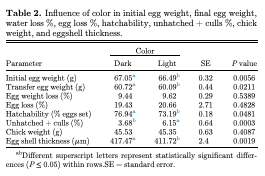
Regarding eggshell coloration lightness, darker eggshells had an average L* value of 80.7 while dark eggshells had an average L* value of 76.0, on a scale of 0 to 100 (data not shown). Results suggest that L* value was significantly correlated with initial egg weight (P = 0.0056), transfer egg weight (P = 0.0211), hatchability of eggs set (P = 0.0481), unhatched eggs + culls (P = 0.0003) and shell thickness (P = 0.0019). However, chick weight (P = 0.4087) and egg weight loss (P = 0.5389) were not affected by eggshell L* value (Table 2).
In this study, darker eggshells showed heavier initial egg weight (P = 0.0056), these results do not agree with Joseph et al. (1999) and Shafey et al. (2005), in which the authors did not find any relationship between eggshell coloration and initial egg weight when comparing different broiler breeds and ages (32-, 36-, and 42-wk old). The discrepancy between their findings and ours could be attributed to the fact that these authors chose eggs of a similar size and chickens with similar body weights for their study while we randomly selected eggs from hens between 50 and 55 wk of age, which could have increased the variability in the egg weight in our study.
Regarding hatchability, dark-colored eggs had »3.75% higher hatchability (P = 0.0481), which agrees with Baylan et al. who in 2017 also found a higher hatchability on darker eggshells from broiler breeder hens as well as Kumar in 2018 who studied hatchability on brown line breeders. Darker eggshells on broiler breeders have been related to a higher maternal antibody content in the yolks (Baylan et al., 2017), lower bacteria development on the shell surface (Ishikawa et al., 2010) and higher specific gravity (Joseph et al., 1999). All these factors may explain why there is a greater hatchability in dark-colored eggs. On the other hand, Shafey et al. (2005) suggested that the impact of the color intensity in hatchability depends on the bird’s age, where young birds (32 wk) had better hatchability in lighter-colored eggs while old birds (41 wk) had better hatchability in dark-colored eggs. The age of the hen is an important factor in eggshell color and its interaction with other shell quality parameters (Ingram et al., 2008). This could support the idea that eggshell color is only a stronger predictor of hatchability in older flocks, whereas hatchability is higher in young flocks regardless of shell color.
Dark-colored eggs also had a thicker eggshell in this study (P = 0.0019). The pigmentation of the eggshell and the calcification process are interrelated, with a significant deposit of pigment causing an increase in calcium deposition in the eggshell (Lang and Wells, 1987; Samiullah and Roberts, 2013), which may explain why darker-colored eggs are thicker. Some authors suggest that thicker eggs have more chances of success during incubation process (Narushin and Romanov, 2002; Liao et al., 2013) as a result of their greater resistance to physical harm and ability to withstand excessive water loss during incubation (McDaniel et al., 1979; Ketta and Tu! mov!a, 2018). However, thickness does not affect chick weight (Yamak et al., 2015). This also agrees with our observation that dark-colored eggs were thicker and had higher hatchability with no influence on chick weight (P > 0.05). In contrast, other authors (Malik et al., 2015) suggest that there is no relationship between thickness and hatchability. Such discrepancy could be attributed to the flock breed and age they used (Cobb, 64-wk old) which was about 10 to 14 wk older than the flock used in our study. At that late age, hatchability percentage is at its lowest point in the entire cycle and could even be independent of shell quality measurements.
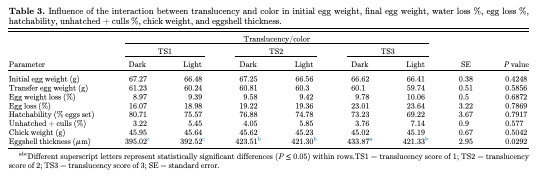
An interaction between color and translucency was observed only for eggshell thickness (P = 0.0292) (Table 3), where eggs classified as light-colored and with translucency score of 1 had a thinner eggshell compared to those that were dark and had a translucency score of 3. This interaction is consistent with the effect of translucency and color on thickness when evaluated independently. Thickness has been considered a very important determinant of eggshell quality. Our study suggests that thickness can be best estimated by considering the translucency and color of the eggshell.
In conclusion, low translucent eggs (score of 1) had the best effects on hatchability and chick weight whereas high translucent eggs (score of 3) had the thickest eggshells. Regarding the impact of color lightness, greater values of thickness and hatchability were found on dark-colored eggs. The interaction of both translucency and color lightness only impacted shell thickness. These results suggest that eggshell translucency and coloration lightness can be good noninvasive indicators of eggshell thickness, hatchability, and chick weight in breeder flocks.
DISCLOSURES
The authors declare no conflicts of interest associated with this manuscript.