Can a saponin-aluminosilicate blend promote resilience to coccidiosis in broilers?
Published: July 14, 2026
Source : M. BRINK 1, B. BRUNEEL 1, M. SINCLAIR 1, F. ATIENZA 1, J. VAN SOEST 1, C. FRITZLEN 2 and M.E. PERSIA 2 / 1 Orffa Additives B.V., Breda, The Netherlands; 2 School of Animal Sciences, Virginia Tech, United States.
Summary
In broilers, coccidiosis leads to reduced growth and feed efficiency and it is often a predisposing factor to secondary diseases such as necrotic enteritis. Coccidiosis is commonly controlled with conventional control strategies such as prophylactic anticoccidial drugs and the use of vaccines. However, these strategies cannot fully prevent Eimeria infection and performance losses still occur due to subclinical coccidiosis. Natural solutions, such as saponins derived from the Quillaja saponaria Molina tree and aluminosilicates can bring added value to coccidiosis management strategies by reducing disease pressure and improving intestinal health.
I. INTRODUCTION
Coccidiosis is one of the main disease challenges affecting broiler production worldwide. This disease has a significant economic impact on the poultry industry and the global cost of coccidiosis in chickens linked to prevention, treatment, and performance losses is estimated at US$13 billion or US$0.20 per bird (Blake et al., 2020). Coccidiosis is caused by protozoan parasites of the genus Eimeria. Seven different Eimeria species are known to affect chickens, each with a different pathogenicity and targeting a specific location in the intestinal tract. In order to replicate, these parasites invade the intestinal cells of the host, which results in tissue damage, impaired nutrient digestion and absorption, and compromised well-being and growth performance in broilers (MesaPineda et al., 2021). Furthermore, coccidiosis is also a predisposing factor to secondary diseases such as necrotic enteritis induced by Clostridium perfringens (Lee et al., 2011).
Current prevention and control of coccidiosis is mainly based on the use of anticoccidials and live vaccines. The extensive prophylactic use of anticoccidials has resulted in resistant Eimeria strains and loss of efficacy (Abbas et al., 2011). Vaccines, on the other hand, have a high relative cost and, if managed incorrectly, can predispose the animals to subclinical coccidiosis and necrotic enteritis. In broilers, vaccines often do not lead to a timely build-up of immunity (Mesa-Pineda et al., 2021).
With these drawbacks, broiler producers are looking for new tools to add to their global coccidiosis management strategy. Natural feed additives, such as saponin-rich plant extracts, are among the promising approaches used to control coccidiosis in broilers. Saponins are found in many plant species and are known to be antimicrobial, to inhibit mould, and to protect plants from insect attack (Francis et al., 2002). As a result, saponin extracts from plants such as the Quillaja saponaria Molina tree have a wide range of applications in livestock production and can be used as antibacterial, antiviral, and antiparasitic agents, as well as adjuvants (Fleck et al., 2019). The antiparasitic effect of saponins may be linked to their detergent action: the hydrophobic part of the saponin can integrate into the membrane of protozoa to form complexes with sterols, resulting in pore formation and cell lysis (Augustin et al., 2011; Fleck et al., 2019). Aluminosilicates are clay minerals which are also widely used as feed additives to improve growth performance and health of animals, mainly due to their ability to adsorb heavy metals, ammonia, mycotoxins and toxins, thereby protecting the integrity of the intestinal tract (Damato et al., 2022).
The objective of this study was to investigate the effect of a blend of Quillaja saponaria extract (a source of triterpenoid saponins) and aluminosilicate on oocyst excretion, intestinal lesions and productive performance in broilers raised on used litter seeded with coccidia oocysts.
II. METHODS
One-day-old male Ross 708 broilers were obtained from a commercial hatchery (Elizabethtown, PA, USA) and, after sorting for health, 1152 chicks were assigned to 48 floor pens (24 broilers per pen). The trial consisted of four treatments that were randomly assigned to the pens, each with 12 replicates: a positive control with no anticoccidials and reared on clean pine shaving litter (PC); a negative control with no anticoccidials added to the diet and reared on used pine shaving litter (NC); a negative control with 60 mg/kg of an anticoccidial (salinomycin: Bio-Cox® 60g, Huvepharma Inc.) added to the diet and reared on used pine shaving litter (NC + sal); a negative control with a saponin-aluminosilicate blend (Excential Sapphire Q, Orffa Additives B.V.) providing 30 mg/kg of Quillaja saponaria extract in the diet and reared on used pine shaving litter (NC + sap-al).
The used litter containing Eimeria oocysts was generated as follows: In 48 separate floor pens, a total of 1200 one-day-old male Cobb chicks from a female broiler breeder line were housed (25 birds per pen) on clean pine shavings and received a 10x dose of a coccidiosis vaccine (Coccivac® B52, Merck Animal Health) via the feed for the first two days. The vaccine consisted of the following strains: E. acervulina, E. maxima, E. maxima MFP, E. mivati, and E. tenella. The birds were reared until 18 days of age to allow for at least three cycles of coccidiosis oocyst shedding into the litter. The used litter was then collected, mixed, and redistributed into the experimental pens. The broilers had free access to feed and water during the whole experimental period and were fed in three phases that is, starter (0 to 16 days), grower (16 to 29 days) and finisher (29 to 42 days). The diets were maize and soybean meal-based and were fed in a crumble form during the starter period and pellet form during the grower and finisher periods.
Mortalities were recorded daily. At 0, 17, 28, and 42 days of age (at the end of each feeding phase), body weight (BW) and average daily feed intake (ADFI) were determined to calculate the body weight gain (BWG) and feed conversion ratio (FCRm) (after correcting for mortalities) for the time periods 0 to 16, 0 to 29, and 0 to 42 days. At 16 days of age, three birds per pen were euthanised for macroscopic intestinal lesion evaluation using the methods described by Conway and McKenzie (2008) and Johnson and Reid (1970). On days 11 to 13, 17 to 19, and 22 to 24, fresh excreta samples were collected and pooled from each pen to determine the number of oocysts shed per gram of excreta. Oocysts were stored and processed as outlined by Long et al. (1970) and counted using procedures described by Dalloul et al. (2003), with the modification of correcting for total grams of excreta collected.
Broiler performance, intestinal lesion scoring, and oocyst shedding were analysed as oneway ANOVA using JMP Pro 16 (SAS Institute Inc., Cary, NC) with the significance level set at 0.05. Blocking within the house was used as a random variable within the model. Results were expressed as least square means (lsmeans) and the standard error of those means (SEM). If global ANOVA was significant, significant differences between lsmeans were determined using Fishers least significant difference test.
III. RESULTS
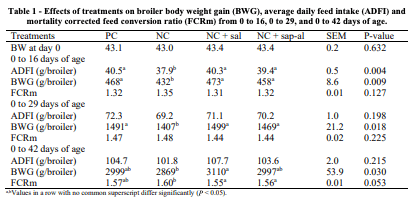
From 0 to 16 days, the NC + sal and NC + sap-al treatments had higher ADFI (P = 0.004) and BWG (P = 0.009) compared to NC and similar performance to PC (P > 0.05) (Table 1). From 0 to 29 days, there were no differences in ADFI (P = 0.198) among the treatments, but BWG was higher for the PC, NC + sal, and NC + sap-al treatments compared to the NC treatment group (P = 0.018). For the overall period from 0 to 42 days, NC + sal had a higher BWG compared to NC, with the PC and NC + sap-al treatments being intermediate but not significantly different from the NC and NC + sal treatments. For FCRm from 0 to 42 days the NC + sal and NC + sap-al treatments tended to improve the overall FCRm compared to the NC treatment (P = 0.053).
No differences in lesion scores were noted among treatments in the duodenum (P = 0.509), jejunum (P = 0.101) and ileum (P = 0.579) (Table 2).
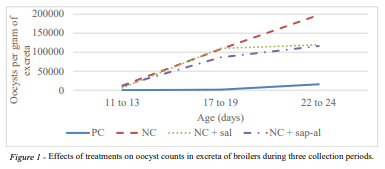
From 11 to 13 days, the lowest oocyst shedding was observed for PC and the highest shedding for NC and NC + sap-al treatments, with the NC + sal treatment being intermediate (P < 0.001) (Figure 1). No significant differences in oocyst shedding were found between the treatments from 17 to 19 days (P = 0.209), although the PC group showed numerically the lowest oocyst counts on these days. From 22 to 24 days, a trend was observed for oocyst counts (P = 0.063). The NC + sal and NC + sap-al treatments tended to reduce the number of excreted oocysts compared to the NC treatment. The PC treatment showed numerically the lowest oocyst excretion on these days.

IV. DISCUSSION
In the current study, the coccidia challenge was confirmed by lower oocyst counts for the PC and higher oocyst counts for the NC between 11 to 13 days. No significant differences in oocyst counts were observed between treatments for the collection periods 17 to 19 days and 22 to 24 days, possibly due to large variation within treatments. However, for the collection period between 22 to 24 days, oocyst excretion was reduced by 39.7% and 41.3% compared to negative control, when salinomycin or the saponin-aluminosilicate blend was fed, respectively, indicating a direct anticoccidial effect of these additives. Saponins are amphiphilic molecules and are natural detergents because they contain a fat-soluble nucleus or sapogenin and water-soluble carbohydrate side chains (Francis et al., 2002; Augustin et al., 2011). The reduction in oocyst excretion seen for broilers fed the saponin-aluminosilicate blend was likely the result of the affinity for and ability of the sapogenin portion of the saponins to form complexes with cholesterol in the protozoal cell membrane. This would have affected the integrity of the parasite membrane by leading to pore formation and cell lysis and preventing the parasites from infecting intestinal cells and replicating (Augustin et al., 2011; Fleck et al., 2019). The saponin-aluminosilicate blend was able to improve the growth of coccidiosis-challenged broilers to a similar level as the unchallenged control and broilers fed salinomycin, an anticoccidial drug. A coccidiosis challenge generally occurs concurrently with necrotic enteritis which is caused by toxins produced by Clostridium perfringens (Lee et al., 2011). One beneficial effect of aluminosilicates is their ability to bind enterotoxins in the intestinal tract of animals (Damato et al., 2022). In this study, the improved performance seen for the NC + sap-al treatment compared to the NC treatment group may also have been due to the aluminosilicate which adsorbed toxins produced by opportunistic pathogens in the coccidiosischallenged broilers, reducing intestinal damage and thereby improving growth.
The results of the current study indicate that the saponin-aluminosilicate blend can promote the resilience in broilers to coccidiosis. This blend can be implemented to further reduce the negative effect of subclinical coccidiosis on growth and feed efficiency in broilers and reduce the costs associated with these performance losses. If the societal demand for antibiotic-free animal products keeps increasing, this natural blend can provide a viable alternative for anticoccidial treatment in broilers.
Presented at the 35th Annual Australian Poultry Science Symposium 2024. For information on the latest and future editions, click here.
- Abbas RZ, Iqbal Z, Blake D, Khan MN & Saleemi MK (2011). World's Poultry Science Journal 67: 337–350.
- Augustin JM, Kuzina V, Andersen SB & Bak S (2011). Phytochemistry 72: 435–457.
- Blake DP, Knox J, Dehaeck B, Huntington B, Rathinam T, Ravipati V, Ayoade S, Gilbert W, Adebambo AO, Jatau ID, Raman M, Parker D, Rushton J & Tomley FM (2020). Veterinary Research 51: 115.
- Conway DP & McKenzie ME (2008). In: Poultry Coccidiosis: Diagnostic and Testing Procedures, 3rd Edition (Eds. D.P. Conway, M.E. McKenzie).
- Dalloul RA, Lillehoj HS, Shellem TA & Doerr JA (2003). Poultry Science 82: 62–66.
- Damato A, Vianello F, Novelli E, Balzan S, Gianesella M, Giaretta E & Gabai G (2022). Frontiers in Veterinary Science 9: 889612.
- Fleck JD, Betti AH, da Silva FP, Troian EA, Olivaro C, Ferreira F & Verza SG (2019). Molecules 24: 171.
- Francis G, Kerem Z, Makkar HPS & Becker K (2002). British Journal of Nutrition 88: 587–605.
- Johnson J & Reid WM (1970). Experimental Parasitology 28: 30–36.
- Lee KW, Lillehoj HS, Jeong W, Jeong HY & An DJ (2011). Poultry Science 90: 1381–1390.
- Long PL (1970). Zeitschrift für Parasitenkunde 35: 1–6.
- Mesa-Pineda C, Navarro-Ruiz JL, López-Osorio S, Chaparro-Gutiérrez JJ & Gómez-Osorio LM (2021). Frontiers in Veterinary Science 8: 787653.
Content from the event:

Related topics:
Authors:




Recommend
Comment
Share

Would you like to discuss another topic? Create a new post to engage with experts in the community.












Featured users in Poultry Industry

Dr. Algis Martínez  Cargill
DVM, Diplomado ACPV - Poultry Veterinarian North America Cargill
United States
United States