Efficacy evaluation of novel organic iron complexes in laying hens: effects on laying performance, egg iron content and blood biochemical parameters
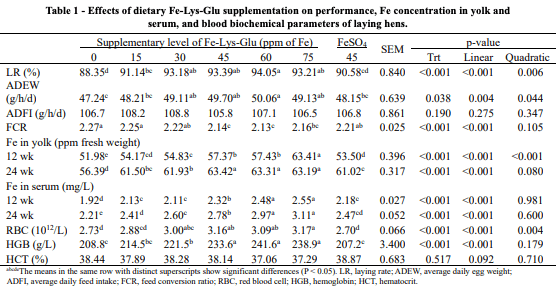
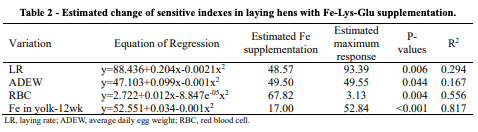
A study was conducted to determine the optimal dose of novel iron (Fe) amino acid complexes (Fe-Lys-Glu) by measuring laying performance, egg Fe concentrations, and blood biochemical parameters in laying hens. A total of 1260 18-wk-old Beijing White laying hens were randomly divided into 7 groups with 12 replicates of 15 birds each. After a 2-wk acclimation to the basal diet, hens were fed diets supplemented with 0 (basal negative control - NC - with innate 75.1 ppm Fe), 15, 30, 45, 60, and 75 ppm Fe as Fe-Lys-Glu or 45 ppm Fe from FeSO4 (positive control, PC) for 24 wks. Results showed that compared with the NC and PC, dietary supplementation with 30 to 75 ppm Fe from Fe-Lys-Glu significantly (linear and quadratic, P < 0.05) increased the laying rate and average daily egg weight; hens administered 45 to 75 ppm Fe as Fe-Lys-Glu showed a remarkable (linear, P < 0.05) decrease in FCR. The Fe concentrations in egg yolk and serum were elevated by increasing Fe-Lys-Glu levels, and the highest Fe content was found in 75 ppm Fe group. In addition, hens fed 45 ppm Fe from FeLys-Glu had (linear and quadratic, P < 0.05) higher yolk Fe contents than PC. The red blood cell count (RBC) and haemoglobin content (linear and quadratic, P < 0.05) increased in the groups fed with 30 to 75 ppm Fe as Fe-Lys-Glu in comparison with NC and PC groups. In conclusion, supplementation Fe-Lys-Glu in laying hens could substitute for FeSO4 and the optimal level of Fe-Lys-Glu is 45 ppm Fe in layers diets based on the quadratic regression analysis of performance.
I. INTRODUCTION
II. MATERIALS AND METHODS
a) Laying performance
b) Iron content in egg yolk and blood biochemical parameters
c) Statistical Analysis
III. RESULTS
IV. DISCUSSION
Abbaspour, N., Hurrell, R., & Kelishadi, R. (2014). Journal of Research in Medical Sciences, 19, 164–174.
Baker, R. D., & Greer, F. R. (2010). Pediatrics, 126, 1040–1050.
Bess, F., Vieira, S. L., Favero, A., Cruz, R. A., & Nascimento, P. C. (2012). Animal Feed Science and Technology, 178, 67–73.
Drygalski, A. V., & Adamson, J. W. (2013). Journal of Parenteral and Enteral Nutrition, 37, 599–606.
Egeli, A. K., Framstad, T., & Grønningen, D. (1998). Acta Veterinaria Scandinavica, 39, 77–87.
Kwiecien, M., Samolinska, W., & Bujanowicz-Haras, B. (2015). Journal of Animal Physiology and Animal Nutrition, 99, 1184–1196.
Li, Y., Yang, W., Dong, D., Jiang, S., Yang, Z., & Wang, Y. (2018). Animal Nutrition, 4, 197–202.
Ma, X. Y., Liu, S. B., Lu, L., Li, S. F., Xie, J. J., Zhang, L. Y., Zhang, J. H., & Luo, X. G. (2014). Poultry Science, 93, 556–563.
Revy, P. S., Jondreville, C., Dourmad, J. Y., & Nys, Y. (2004). Animal Feed Science and Technology, 116, 93–112.
Sarlak, S., Tabeidian, S. A., Toghyani, M., Shahraki, A. D. F., Goli, M., & Habibian, M. (2021). Biological Trace Element Research, 199, 1986–1999.
Trivedi, R., & Barve, K. (2021). International Journal of Pharmaceutics, 601, 120590.
Wang, J., & Pantopoulos, K. (2011). Biochemical Journal, 434, 365–381.
Xie, C., Elwan, H. A. M., Elnesr, S. S., Dong, X. Y., & Zou, X. T. (2019). Poultry Science, 98, 7101–7109.
Zhang, L. Y., Lu, L., Zhang, L. Y., & Luo, X. G. (2016). Journal of Animal Science, 94, 2378–2396.
Zhou, L., Zhao, B., Zhang, L., Wang, S., Dong, D., Lv, H., & Shang, P. (2018). International Journal of Molecular Sciences, 19, 1545.














United States