Explore

Advertise on Engormix

Solar Powered Thermoelectric Air Conditioning for Temperature Control in Poultry Incubators
Published: September 29, 2026
Source : Kumar Reddy Cheepati 1 and Nezah Balal 2* / 1 Department of Electrical and Electronics Engineering, KSRM College of Engineering, Kadapa 516005, India; 2 Department of Electrical and Electronics Engineering, Ariel University, Ariel 40700, Israel.
1. Introduction
Thermoelectric modules convert heat energy into electrical energy and vice versa. The temperature difference between the hot and cold junctions creates a potential difference, which generates electrical energy [1]. The generated electrical energy, in turn, creates a temperature difference between the two junctions, where the cold junction becomes colder, and the hot junction becomes hotter [2]. These modules are primarily used for cooling and heating applications. The Peltier effect explains the phenomenon of temperature difference when an electrical supply is applied, while the Thomson effect describes the direction of the current. The Seebeck effect explains the generation of electricity by maintaining hot and cold junctions using conductors or semiconductors [3].
Thermoelectric modules offer an attractive solution for heating and cooling applica tions because they can simultaneously produce both effects when supplied with direct current (DC) [1–4]. Additionally, they can generate electricity through the Seebeck ef fect [1–4]. The poultry industry faces numerous challenges related to egg hatching, chicken growth, and reproduction [5–7]. Inadequate air conditioning is one of the primary issues in poultry farms. Chicken egg hatching requires warm temperatures of approximately 40 ◦C and humidity levels between 50–70%, while chicken growth and reproduction necessitate cooler temperatures, ranging from 10–24 ◦C [5,8]. Traditionally, fluorescent or incandescent lamps are used for egg hatching, providing sufficient light and heat at different stages of the hatching process [9–13]. However, these lamps consume significant amounts of electrical energy and are prone to frequent failures, making them less reliable [14–18].
Research on off-grid solar-powered thermoelectric air conditioning systems for poultry farms has been growing, addressing the critical need for sustainable temperature control solutions [5]. Studies emphasize the importance of maintaining optimal temperatures for poultry health and productivity, highlighting the limitations of conventional cooling methods and the potential of solar-powered thermoelectric systems to offer reliable off-grid solutions [19]. Recent advancements focus on enhancing system efficiency, durability, and cost-effectiveness through innovative approaches such as improved heat exchanger de signs, advanced materials for thermoelectric modules, and the integration of smart control technologies [20]. Case studies and field trials demonstrate promising results, indicating the feasibility and benefits of deploying such systems in real-world poultry farming envi ronments. However, challenges remain, including cost barriers, technical limitations, and scalability issues, necessitating further research to address these constraints and unlock the full potential of solar-powered thermoelectric air conditioning for sustainable poultry farming practices [21].
For these reasons, a heat-ejecting fan connects the Peltier module’s hot junction to the egg-hatching unit, and hot water is supplied below the egg trays to create humidity. This mechanism consumes less energy and reduces the time required to reach the desired warm temperatures (approximately 40 ◦C) and humidity levels (50% to 70%) [22]. Furthermore, this method can facilitate faster egg hatching, usually within 21 days [23]. Existing air cooling systems for chicken-growing and reproduction farms typically use refrigeration gas-based air conditioners or electric fan-based air coolers [24–26]. These systems are expensive and consume substantial amounts of electrical energy. To address this issue, the cold side of the Peltier module is connected to the chicken-growing and reproduction unit, which requires temperatures ranging from 10–24 ◦C [27].
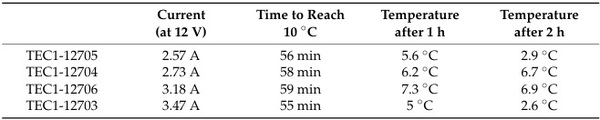
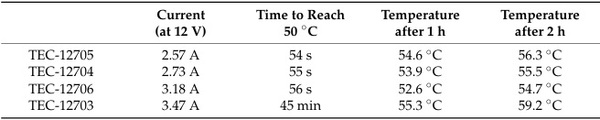
A single Peltier module serves both functions: warming up the egg-hatching unit and cooling down the chicken-growing and reproduction unit. This setup suits both hot and cold weather regions, as the cold and hot junctions can be reversed [28]. Various Peltier modules, also known as thermoelectric coolers (TECs), are available on the market, most of which are primarily used for cooling purposes [29–31]. In this research, hot air is ejected into the egg-hatching unit through an exhaust fan. TECs create a heat flux between two different types of devices and are specified by size, power consumption, and temperature range [29–31]. They are classified into single-stage, multi-stage, high temperature, thin-film, and high coefficient of performance (COP) types [32]. For this research, a high-COP TEC module is preferred, since it must perform both effective heating and cooling simultaneously. Tables 1 and 2 present the performance comparison of various high-COP TEC modules at the cold junction and hot junction sides, respectively, at a 30 ◦C room temperature.
Table 1. Comparison of various TEC modules (cold junction).
Solar Powered Thermoelectric Air Conditioning for Temperature Control in Poultry Incubators - Image 1
Continuous air conditioning is crucial for egg-hatching, chicken growth, and reproduc tion units [33–38]. However, frequent power cuts can disrupt the constant air conditioning supply, especially in remote locations. Solar energy offers a promising alternative solution: utilizing solar photovoltaic (PV) panels to provide a continuous power supply. Among the various types of solar PV panels available, monocrystalline solar panels are highly efficient and offer several advantages, such as reduced space requirements, durability, long lifespan, high-temperature tolerance, low-light performance, and high-power output. The only drawback is the higher cost of these panels compared to other types.
Table 2. Comparison of various TEC modules (hot junction).
Solar Powered Thermoelectric Air Conditioning for Temperature Control in Poultry Incubators - Image 2
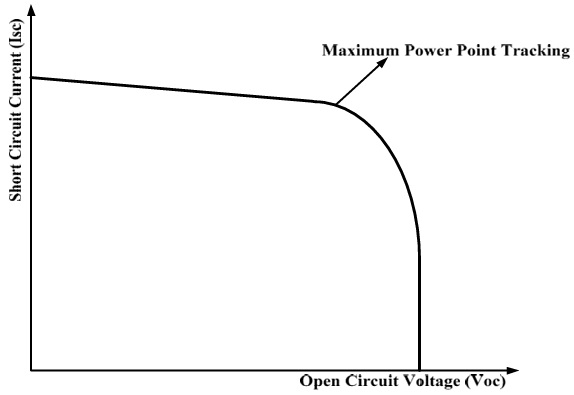
A solar charge controller is essential for safely charging a battery through a solar panel. It regulates the solar voltage to the required battery voltage level (usually 12 volts DC), regardless of the irradiation levels falling on the solar panel. Maximum Power Point Tracking (MPPT) charge controllers are widely used among the many available charge controllers. The use of MPPT charge controllers in the proposed research offers several benefits, including increased energy harvesting, high energy conversion efficiency, adaptability to environmental changes, and adequate battery charging management. The MPPT algorithm extracts the maximum electrical power from the solar panel under all environmental conditions, as illustrated in Figure 1.
Solar Powered Thermoelectric Air Conditioning for Temperature Control in Poultry Incubators - Image 3
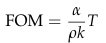
Figure 1. Maximum power tracking by the charge controller.
The proposed system utilizes a solar-powered thermoelectric module, TEC1-12703, with a solar panel, an MPPT charge controller, and battery power to provide continuous air conditioning. During the day, the battery stores electrical energy by charging with the solar panel via the MPPT charge controller. This stored energy is then released during nighttime or cloudy conditions, when solar irradiation is absent, ensuring the uninterrupted operation of the thermoelectric module. The choice of battery depends on various factors, such as voltage compatibility, capacity, chemistry, size, weight, cycling
High-accuracy temperature sensors, such as infrared (IR) thermocouple sensors, are placed on both the cold and hot junction sides of the Peltier module to monitor temperature variations, as poultry chickens are sensitive to thermal fluctuations. Maintaining temperatures and humidity within specific limits is crucial for egg hatching and chicken production [38–43]. A thermocouple-based controller is integrated with the TEC-12703 Peltier module to maintain a steady temperature.
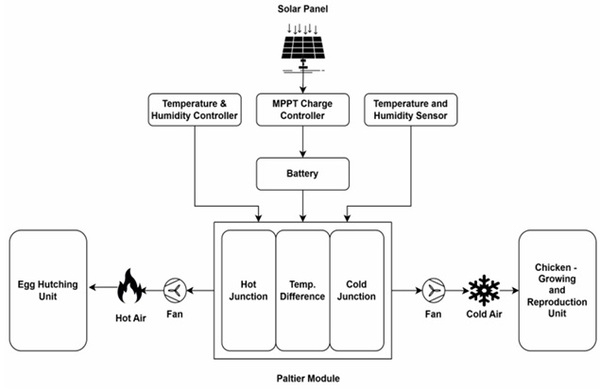
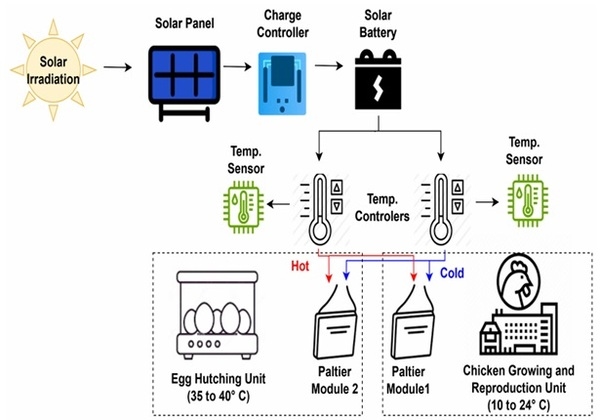
Figure 2 illustrates the proposed air conditioning method for egg-hatching, chicken growing, and reproduction units. Compared to existing poultry systems, the proposed system offers simultaneous cooling and heating effects using only two Peltier modules, two temperature controllers, and a solar panel with a battery equipped with an MPPT charge controller. This innovative approach is highly effective, economical, renewable, and energy efficient, setting it apart from previously reported air conditioning systems in the literature.
Solar Powered Thermoelectric Air Conditioning for Temperature Control in Poultry Incubators - Image 4
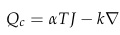
Figure2. Block diagram of the proposed system.
This paper is structured into five sections: introduction, system overview and components, mathematical modeling and design calculations, hardware results and analysis, and conclusions and future scope. Section 1 provides a comprehensive introduction to the topic, while Section 2 describes the block diagram of the proposed research and its various components. Section 3 delves into the mathematical modeling and design calculations, while Section 4 presents the hardware results and analysis. Finally, Section 5 summarizes the conclusions and discusses the future scope of this research.
2. System Overview and Components
tem Overview and Components Figure 2 presents a block diagram of the proposed research system. The hot junction of the Peltier module is connected to the egg-hatching unit, while the cold junction is connected to the chicken-growing and reproduction unit. The Peltier module requires a connected to the chicken-growing and reproduction unit. The Peltier module requires a DC power supply to operate, which is provided through a solar panel, an MPPT charge controller, and a battery. Two temperature sensors are connected at each junction to measure the temperatures over time, and a temperature controller is connected to both junctions to maintain the temperature within the desired ranges. Two exhaust fans are placed at the egg-hatching unit for air heating, while two cooling fans are located at the chicken-growing and reproduction unit.
The solar panel provides continuous electrical energy during the daytime, which is stored in a battery through the MPPT charge controller. The charge controller plays a crucial role in safely charging the battery, irrespective of variations in solar irradiation, by maintaining a constant output voltage required for battery charging. Temperature and humidity sensors and controllers are installed at both the egg-hatching and chicken growing units. Upon sensing the temperatures at both units, the controllers intelligently operate the Peltier modules to maintain the desired temperatures. Two brushless DC (BLDC) fans are mounted for hot air circulation at the egg-hatching unit, and two BLDC fans are placed for cool air circulation at the chicken-growing unit.
3. Mathematical Modelling and Design Calculations
To better understand the proposed system, the mathematical modeling of the ther moelectric module and the solar-powered thermoelectric module are performed sepa rately. This section presents the theoretical background and equations governing the system’s performance.
3.1. Mathematical Modelling of Thermoelectric Module
The performance of the Peltier module is measured by the figure of merit (FOM) [44], which is given by (1)
Solar Powered Thermoelectric Air Conditioning for Temperature Control in Poultry Incubators - Image 5

where T—absolute temperature;
α—Seebeck constant;
ρ—electrical resistivity;
k—thermal conductivity.
For an ideal latest third-generation Peltier module, the FOM is approximately equal to three [44–47]. As the FOM increases, the energy conversion efficiency of the Peltier module increases, whereas it decreases with increasing thermal conductivity [44–47].
The rate of thermal transfer per unit area (Qc) is given by (2):
Solar Powered Thermoelectric Air Conditioning for Temperature Control in Poultry Incubators - Image 6
where J is the electron density, k is the heat conductivity, and ∇ is the gradient. The heat diffusion equation at the steady state is given by (3):
Solar Powered Thermoelectric Air Conditioning for Temperature Control in Poultry Incubators - Image 7

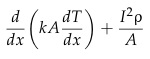
From (3), the first term represents heat conduction, the second term represents joule heating, and the third term represents the Thomson effect.
Assuming that α is not dependent on temperature, electrical or thermal contact resis tance, or heat loss, then (3) is reduced to (4):
Solar Powered Thermoelectric Air Conditioning for Temperature Control in Poultry Incubators - Image 8
A—cross-sectional area, I—the current flowing through the module. Equation (2), in the form of p-type and n-type semiconductors, is given by (5):
Solar Powered Thermoelectric Air Conditioning for Temperature Control in Poultry Incubators - Image 9

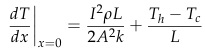
where n is the number of thermocouples, Qc is the rate of heat absorbed at the cold side, αp and αn are the Seebeck coefficients at the p and n sides, Tc is the temperature at the cool side, I is the current flowing through the module, A is the cross-sectional area, dT dx is the temperature gradient, and L is thermocouple length.
The temperature gradient, with two boundary conditions (dT dx x=0 ),is given by (6):
Solar Powered Thermoelectric Air Conditioning for Temperature Control in Poultry Incubators - Image 10
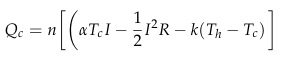
Substituting (6) in (5) yields (7):
Solar Powered Thermoelectric Air Conditioning for Temperature Control in Poultry Incubators - Image 11
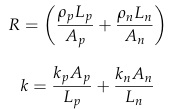
where
Lp—the length of the thermocouple on the p-side;
Ln—the length of the thermowell at the n-side;
AP—the thermocouple area of the cross-section on the p-side;
An—the thermocouple area of the cross-section on the n-side;
kp—the thermal conductivity at p-side of the thermocouple;
kn—the thermal conductivity at the n-sided thermocouple;
Th—the temperature at the hot side of the thermocouple;
n—the number of thermocouples.
Assuming that the p-type and n-type thermocouples are similar, (7) becomes (8):
Solar Powered Thermoelectric Air Conditioning for Temperature Control in Poultry Incubators - Image 12
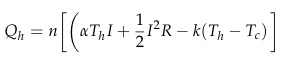
where α=αp−αn R—resistance.
Solar Powered Thermoelectric Air Conditioning for Temperature Control in Poultry Incubators - Image 13
The heat ejected at the hot junction (Qh) is given by(9):
Solar Powered Thermoelectric Air Conditioning for Temperature Control in Poultry Incubators - Image 14
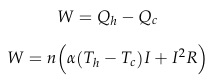
where R = ρL/A; k = kA/L. The work performed per unit time (W) across the module is given by (10).
Solar Powered Thermoelectric Air Conditioning for Temperature Control in Poultry Incubators - Image 15

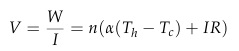
The voltage (V) across the module is given by (11):
Solar Powered Thermoelectric Air Conditioning for Temperature Control in Poultry Incubators - Image 16
The coefficient of performance (COP) is defined as the ratio of the cooling power (Qc) to the input electrical power (W) and is given by (12) [48–52].
Solar Powered Thermoelectric Air Conditioning for Temperature Control in Poultry Incubators - Image 17
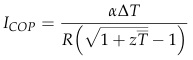
The current (ICOP) at which the maximum COP is achieved by differentiating (13) with respect to the current I and made equal to zero is given by (13):
Solar Powered Thermoelectric Air Conditioning for Temperature Control in Poultry Incubators - Image 18
The current (ICOP) is given by (14):
Solar Powered Thermoelectric Air Conditioning for Temperature Control in Poultry Incubators - Image 19
where ∆T = Th − Tc, z = α²/ρk is also known as the FOM, and T is the average temperature of Tc and Th.
The current (Impc) at which the maximum cooling power is achieved by differentiating (8) with respect to the current I, which is made equal to zero, is given by (15):
Solar Powered Thermoelectric Air Conditioning for Temperature Control in Poultry Incubators - Image 20
The current (Impc) is given by (16):
Solar Powered Thermoelectric Air Conditioning for Temperature Control in Poultry Incubators - Image 21
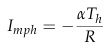
The current (Imph) at which the maximum heating power is achieved by differentiating (9) with respect to the current I, which is made equal to zero, is given by (17):
Solar Powered Thermoelectric Air Conditioning for Temperature Control in Poultry Incubators - Image 22
The current (Imph) is given by (18):
Solar Powered Thermoelectric Air Conditioning for Temperature Control in Poultry Incubators - Image 23

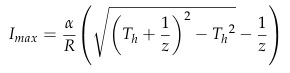
The maximum current (Imax) that generates the maximum possible temperature difference is given by (19):
Solar Powered Thermoelectric Air Conditioning for Temperature Control in Poultry Incubators - Image 24
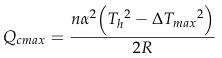
The maximum temperature difference (∆Tmax) is given by (20):
Solar Powered Thermoelectric Air Conditioning for Temperature Control in Poultry Incubators - Image 25
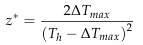
The maximum cooling power (Qcmax) is given by (21):
Solar Powered Thermoelectric Air Conditioning for Temperature Control in Poultry Incubators - Image 26
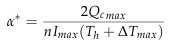
The maximum DC voltage (Vmax) is given by (22):
Vmax=nαTh
The material properties (α, ρ, k) in a Peltier module are inversely proportional to the maximum parameters (Imax, ∆Tmax, Qcmax, Vmax) [53–57]. The material properties play an important role in predicting the performance of the Peltier module. For the effective operation of the Peltier module, the inverse proportion between the material properties and maximum parameters must be eliminated by introducing the effective FOM (z∗), Seebeck coefficient (α∗), electrical resistivity (ρ∗), and thermal conductivity (k∗) [57–66].
The effective FOM (z∗) i sgiven by (23):
Solar Powered Thermoelectric Air Conditioning for Temperature Control in Poultry Incubators - Image 27
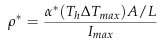
The effective Seebeck coefficient (α∗) is given by (24):
Solar Powered Thermoelectric Air Conditioning for Temperature Control in Poultry Incubators - Image 28
The effective electrical resistivity (ρ∗) is given by (25):
Solar Powered Thermoelectric Air Conditioning for Temperature Control in Poultry Incubators - Image 29
The effective thermal conductivity (k∗) is given by (26):
Solar Powered Thermoelectric Air Conditioning for Temperature Control in Poultry Incubators - Image 30
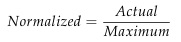
The performance of the Peltier module can be seen by deriving the normalized values. The formula for the normalized value is given by (27):
Solar Powered Thermoelectric Air Conditioning for Temperature Control in Poultry Incubators - Image 31

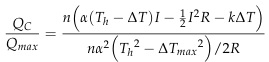
The normalized value for the cooling power is given by (28):
Solar Powered Thermoelectric Air Conditioning for Temperature Control in Poultry Incubators - Image 32
Formula (28), in terms of the normalized current and normalized temperature difference, is given by (29).
Solar Powered Thermoelectric Air Conditioning for Temperature Control in Poultry Incubators - Image 33

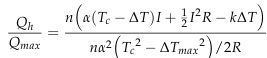
The normalized value for heating power is given by (30):
Solar Powered Thermoelectric Air Conditioning for Temperature Control in Poultry Incubators - Image 34

Formula (30), in terms of the normalized current and normalized temperature difference, is given by (31):
Solar Powered Thermoelectric Air Conditioning for Temperature Control in Poultry Incubators - Image 35

The normalized COP for cooling is given by (32):
Solar Powered Thermoelectric Air Conditioning for Temperature Control in Poultry Incubators - Image 36
The normalized COP for heating is given by (33):
Solar Powered Thermoelectric Air Conditioning for Temperature Control in Poultry Incubators - Image 37
3.2.Mathematical Modelling of Solar Thermoelectric Module
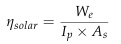
The efficiency of the solar panel (ηsolar) is given by (34):
Solar Powered Thermoelectric Air Conditioning for Temperature Control in Poultry Incubators - Image 38
where We is the electrical power in kilowatt (kW).
As—solar panel cross-sectional area (square meter);
Ip—solar irradiation (kW/square meter).
The Peltier module efficiency at the cold side (ηcold) is given by (35):
Solar Powered Thermoelectric Air Conditioning for Temperature Control in Poultry Incubators - Image 39
The Peltier module efficiency at the hot side (ηhot) is given by (36):
Solar Powered Thermoelectric Air Conditioning for Temperature Control in Poultry Incubators - Image 1
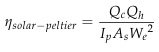
The overall efficiency of the solar thermoelectric Peltier module (ηsolar−peltier) is given by(37) and (38):
ηsolar−peltier=ηsolar × ηcold × ηhot
Solar Powered Thermoelectric Air Conditioning for Temperature Control in Poultry Incubators - Image 2
3.3. Design Calculations
The hardware components required to execute the proposed research are as follows:
(1) Monocrystalline solar panel; (2) MPPT solar charge controller; (3) Lead–acid tubular battery; (4) Two Peltier modules; (5) Two heat sinks; (6) Two temperature sensors; (7) Two temperature controllers; (8) Two exhaust and two cooling fans.
The TEC-12703 Peltier module is rated at 12 VDC and 3 amp. of current. Two Peltier modules are used to achieve maximum cooling and heating efficiency, consuming a total power of 72 W (3 A × 12 V × 2). The fans placed at the hot and cold junctions consume an additional 6.72 W (2 × 2.16 W + 2 × 1.2 W). During the daylight hours, the solar panel should be capable of delivering 80.64 W to power the Peltier modules and fans while also charging the battery. Assuming an average of 10 h of irradiation per day, the solar panel capacity is calculated as follows:
 Solar panel capacity = Peltier module power + Fan power = 72 W + 6.72 W = 79.72 W
To ensure continuous operation during periods without sunlight, the system must be designed to sustain a load of 80.64 W for 12 h. The energy required from the battery is calculated as follows:
Energy = Power × Time = 80.64 W × 12 h= 967.68 Wh
Considering inefficiencies and losses, an additional 20% of the energy is added, result ing in a total required energy of
Total required energy = 967.68 Wh × 1.2 ≈ 1161.21 Wh
Given an average of 4 peak sunlight hours per day, the required solar panel output is as follows:
Solar panel output = Total required energy ÷ Peak sunlight hours = 1161.21 Wh ÷ 4 h ≈ 290.30 W
Therefore, a solar panel with an approximate output of 290.30 W is needed to continu ously deliver 80.64 W of power, with battery support for 12 h without sunlight. The battery capacity is calculated as follows:
Battery capacity (Ah) = Total required energy (Wh) ÷ Battery voltage (V) = 1161.21 Wh ÷ 12 V ≈ 96.76 Ah
A 12 V,100Ahlead–acid battery is selected, considering a 20% safety margin for losses. Temperature control is achieved using XH-W1209 adjustable temperature controllers, one for each side of the egg-hatching and chicken-farming units.
The MPPT charge controller is sized based on the solar panel and battery specifications. For a 300 W solar panel with a typical voltage range of 17–18 V and a 12 V, 100 Ah battery, the following steps are used to determine the appropriate MPPT charge controller:
Calculate the current: I = P ÷ V = 300 W ÷ 17 V ≈ 17.64 A.
Apply a 25%oversizing factor: 17.64 A × 1.25 = 22.05 A.
Select an MPPT charge controller rated at least 30–40 A to accommodate the calculated current and oversizing factor.
Heat transfer calculations are required to increase the room size for the egg-hatching and the chicken-growing and reproduction units.
4. Hardware Results and Analysis
This section will initially explain the block diagram of the proposed research prototype, the steps in validating the hardware, and its analysis by comparing various existing egg hatching and chicken-growing and reproduction units.
4.1. Block Diagram of the Proposed Hardware
The complete hardware setup for the proposed egg-hatching, chicken-growing, and reproduction units is shown in Figure 3. From the design calculations, a 12-volt, 300-watt monocrystalline solar panel is placed under continuous solar irradiation, irrespective of day and night. Due to the variations in the solar irradiation levels, the solar panel output voltage also fluctuates. To avoid these fluctuations, an MPPT solar charge controller with a rating of 12 volts and 40 amp is connected to the output of the solar panel. The duty of the solar charge controller is to maintain a constant DC voltage for the safe charging of the solar battery. The output of the solar charge controller is connected to a solar battery with a rating of 12 volts and 100 Ah. This battery is capable of delivering the power required for the proposed setup continuously for 12 h even though no irradiation occurs. The output of the battery is connected to two temperature controllers of each 12-volt, 10amp rating. One temperature controller is connected to a sensor, and the output is connected to the hot side of Peltier module 1, i.e., at the egg-hatching unit. Another temperature controller is connected to the cold side of Peltier module 2, i.e., the chicken-growing and reproduction unit. Two fans on the hot side and two fans on the cold side of the Peltier modules are connected for uniform air circulation on the hot and cold sides, respectively. The egg-hatching unit requires 35 to 40 degrees centigrade of temperature. Hence, the on and off temperatures are set in the controller. Similarly, the temperature will be set for the controller placed at the chicken-growing and reproduction units. At the egg-hatching unit, two hot junctions are placed from two Peltier modules, but the temperature controller is connected to the hot side of Peltier module 1, and the other hot junction is controlled by the temperature controller placed in the chicken-growing and reproduction unit and vice versa. This kind of temperature control will optimize the overall performance and reduce costs.
Solar Powered Thermoelectric Air Conditioning for Temperature Control in Poultry Incubators - Image 3
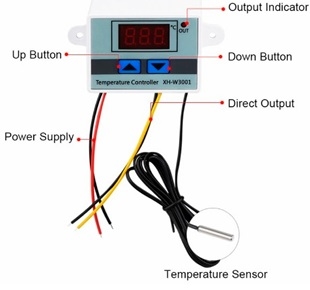
Figure 3. Hardware setup and connection diagram.
4.2. Steps in Validating the Proposed Hardware Setup
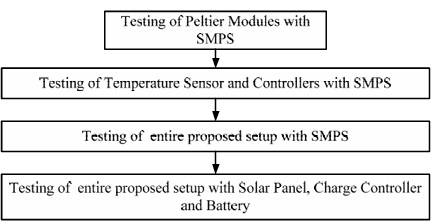
The steps for validating the proposed research idea are shown in Figure 4. Initially, the Peltier modules (TEC1-12703) were tested with a switched mode power supply (SMPS) for cooling and heat effects on each cold and hot junction. Next, the temperature sensors and controllers were tested for sensing and controlling the temperature, and the entire proposed setup was tested with the SMPS. After testing the entire proposed setup with the SMPS, the whole assembly was tested with a monocrystalline solar panel as an input to the Peltier modules through the lead–acid battery and MPPT charge controller.
Solar Powered Thermoelectric Air Conditioning for Temperature Control in Poultry Incubators - Image 4
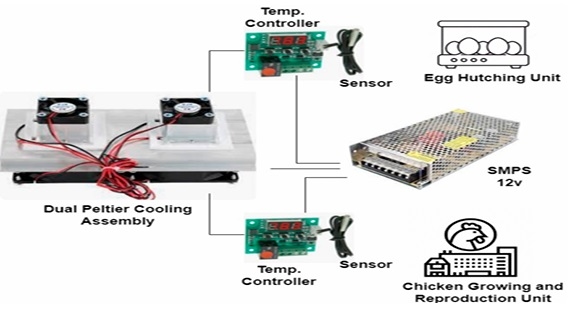
Figure 4. Steps in validating the proposed research.
4.2.1. Testing of Peltier Module 1 and 2
Each Peltier module consists of a TEC1-12703 Peltier plate, two heat sinks, and two fans on each side. TEC1-12703 demands a 12-volt DC supply, and it draws a maximum current of 3 amp. Initially, for the SMPS with a 12-volt DC rating, 10 amp was used as the power source. A temperature sensor is connected to a heat sink placed on the cold side. Table 1 shows that TEC1-12703 is the best Peltier module for cooling applications. Similarly, TEC-12703 was also tested on the hot side. Table 2 shows that TEC1-12703 is the best Peltier module even for heating applications.
4.2.2. Testing of Temperature Controllers
The connection diagram of the temperature controller is shown in Figure 5. To control the Peltier module, a 12-volt DC supply is connected to the temperature controller input terminals, and the output terminals are connected to the Peltier module. The input of the sensor is connected to the controller, and the sensor is placed on either the cold or hot side, based on the sensor requirements. The sensed temperature will be used to control the Peltier odule by setting the up and down temperatures. For the egg-hatching unit, the set temperatures were between 35 and 40ºC. The controller switches on the Peltier module when the temperatura falls below 35º C and switches it off when it exceeds 40ºC. Similarly, for the chicken-growing and reproduction unit, the temperature ranges between 10 and 24ºC. The controller switches on the Peltier module when the temperature exceeds 24 ◦C and switches it off when it falls below 10 ◦C.
Solar Powered Thermoelectric Air Conditioning for Temperature Control in Poultry Incubators - Image 5
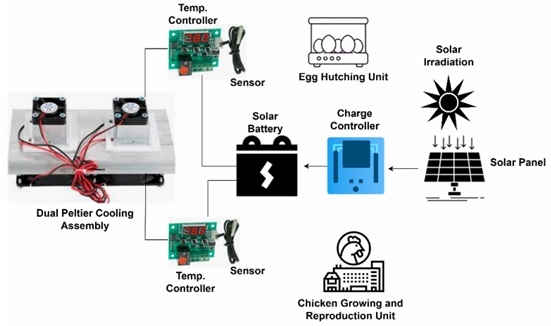
Figure 5. Temperature controller with sensor.
In the next step, the testing of the temperature controller with the Peltier module and SMPS is performed. The temperature controller is able to maintain the temperatures required for egg hatching, chicken growth, and reproduction by controlling the Peltier modules based on the sensed temperatures at the hot and cold sides.
4.2.3. Testing of the Whole Assembly with the SMPS
After testing the Peltier modules, the sensor, and the temperature controller separately using the SMPS, the whole setup was tested with the SMPS, as shown in Figure 6. The hot sides of the Peltier modules 1 and 2 are projected to the egg-hatching unit, and the cold sides are projected to the chicken-growing and reproduction unit. One sensor was placed in the egg-hatching unit, and one sensor was placed in the chicken-growing and reproduction unit. The whole assembly perfectly maintained the temperatures required for the egg-hatching and chicken-growing and reproduction units. For the uniform distribution of heat throughout the egg-hatching unit, two fans were used, and another two fans were used at the chicken-growing and reproduction unit for the uniform distribution of cool air.
Solar Powered Thermoelectric Air Conditioning for Temperature Control in Poultry Incubators - Image 6
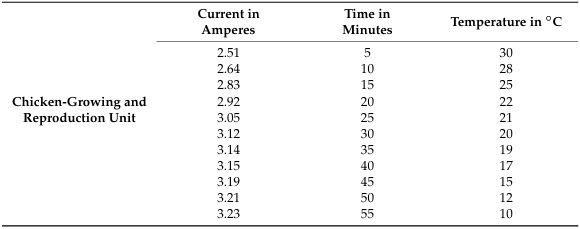
Figure 6. Testing of the whole assembly with the SMPS.
4.2.4. Testing of Whole Assembly with Solar Panel, Charge Controller, and Battery
To facilitate the proposed air conditioning system for egg hatching, a chicken-growing and reproduction unit for off-grid chicken farmers and zero electrical energy bills for existing chicken farmers, the proposed air conditioning system was fed with solar energy through a solar panel, an MPPT charge controller, and a battery, as shown in Figure 7. The proposed system is designed so that both the egg-hatching and chicken farms will run continuously, without any power interruption. This kind of air conditioning with solar energy is not mentioned anywhere in the literature, and it is novel in the current research.
Thetemperatures achieved with the proposed solar thermoelectric module with respect to time at the cold side are shown in Table 3. The ambient room temperature was 35 ◦C.
FromTables 3 and 4,itisevident that the proposedsolar thermoelectric module is capa ble of performing the cooling action for the chicken-growing and reproduction unit and the heating action for the egg-hatching unit. Additionally, the temperature controllers placed at both sides will maintain the temperatures required according to existing standards. The addition of temperature controllers will optimize the entire proposed setup by switching the solar thermoelectric module on and off in accordance with the set temperatures on both sides.
Solar Powered Thermoelectric Air Conditioning for Temperature Control in Poultry Incubators - Image 7
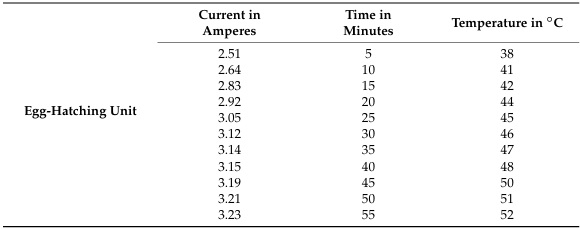
Figure 7. Proposed system with solar energy through charge controller and battery.
Table 3.Temperatures achieved at the cold side.
Solar Powered Thermoelectric Air Conditioning for Temperature Control in Poultry Incubators - Image 8
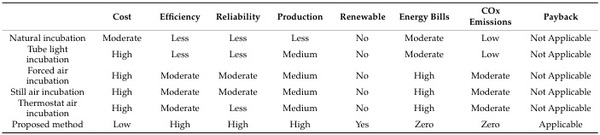
Table 4.Temperatures achieved at the hot side.
Solar Powered Thermoelectric Air Conditioning for Temperature Control in Poultry Incubators - Image 9
A comparison of the proposed air conditioning system for the egg-hatching unit with existing methods is given in Table 5.
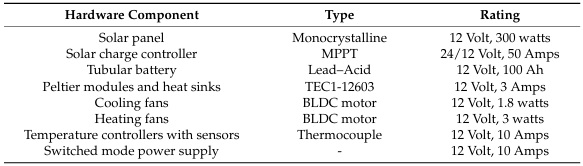
A list of hardware components used to implement the proposed research along with type, specifications, and parameters is given in Table 7.
Table 5. Comparison of air conditioning systems for the egg-hatching unit.
Solar Powered Thermoelectric Air Conditioning for Temperature Control in Poultry Incubators - Image 10
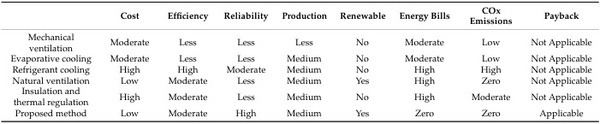
A comparison of the proposed air conditioning system for the chicken-growing and reproduction unit is given in Table 6.
Table 6. Comparison of air conditioning systems for the chicken-growing and reproduction unit.
Solar Powered Thermoelectric Air Conditioning for Temperature Control in Poultry Incubators - Image 11
Table 7. List of hardware components with type and rating.
Solar Powered Thermoelectric Air Conditioning for Temperature Control in Poultry Incubators - Image 12
5. Conclusions
The proposed solar-powered thermoelectric air conditioning system presents a novel, energy-efficient, and eco-friendly solution for poultry farmers. Compared to conventional cooling methods, this system significantly reduces energy costs, minimizes space requirements, operates quietly, and eliminates the need for harmful refrigerant gases. The improved energy efficiency and reduced CO2 emissions contribute to the overall sustainability of poultry farming operations.
The economic analysis revealed that the proposed system offers a relatively short payback period and substantial long-term cost savings for poultry farmers. Moreover, the optimal thermal management provided by the system can enhance animal welfare and increase productivity by improving egg-hatching rates and reducing poultry mortality. The modular design and adaptability of the proposed system make it easy to implement in existing poultry farms, offering a practical solution for farmers looking to upgrade their climate control systems.
The reliance on renewable solar energy makes it particularly suitable for remote locations with limited access to the electricity grid, expanding the potential adoption of this technology.
This research contributes to precision agriculture, renewable energy applications, and climate control in agricultural settings. The findings demonstrate the feasibility and benefits of integrating thermoelectric cooling with solar power in poultry farming, paving the way for further advancements in sustainable agricultural practices. However, some limitations and challenges should be considered, such as the potential for electromagnetic interference from solar panels and other components, the importance of proper grounding practices to avoid safety hazards and interference issues, and the impact of environmental conditions on the performance and reliability of the system.
Future research should focus on addressing these limitations while incorporating automatic egg turners, conducting detailed heat transfer calculations for optimal unit sizing, integrating humidity control mechanisms, and exploring the system’s scalability using high capacity Peltier modules. Additionally, long-term studies on the system’s performance, durability, and maintenance requirements in real-world poultry farming environments would provide valuable insights for further optimization and widespread adoption.
Although the proposed solar-powered thermoelectric air conditioning system may have a relatively high initial cost due to the hardware components, it offers significant long-term benefits. The system requires minimal maintenance, with only the tubular battery needing occasional distilled water and the solar panels requiring regular cleaning. The Peltier modules, cooling and heating fans, and temperature sensors are designed to be maintenance-free. Over time, the system provides substantial cost savings in electricity bills, making it an economically viable solution. Moreover, the improved thermal management is expected to enhance poultry health and egg production, further compensating for the initial investment. Despite the initial cost and maintenance considerations, the proposed system presents a sustainable and efficient solution for poultry farming.
In conclusion, the proposed self-powered thermoelectric module offers a sustainable, low-maintenance, and cost-effective solution for air conditioning in poultry farms. With its potential to revolutionize the poultry farming industry by providing an optimized air conditioning solution for small-scale and large commercial poultry farms, this technology represents a significant step towards more sustainable and efficient agricultural practices.
   
This article was originally published in Sustainability 2024, 16, 4832. https://doi.org/10.3390/su16114832. This is an Open Access article distributed under the terms and conditions of the Creative Commons Attribution (CC BY) license (https://creativecommons.org/licenses/by/4.0/).

1.Kaiprath, J.; Kishor Kumar, V.V. A review on solar photovoltaic-powered thermoelectric coolers, performance enhancements, and recent advances. Int. J. Air-Cond. Refrig. 2023, 31, 6. [CrossRef]

2. Soorej, T. Solar Thermo-Electric Cooler cum Warmer. 2016. Available online: https://www.researchgate.net/publication/355425 044_Solar_Thermo-Electric_Cooler_cum_Warmer (accessed on 5 May 2024).

3. Alam, N.; Ali, M.S.; Sajid, S.; Sharma, D.; Hasan, Z. Experimental investigation and analysis of cooling performance of solar thermoelectric refrigerator. Sol. Energy 2023, 263, 111892, ISSN 0038-092X. [CrossRef]

4. Islam, N.; Islam, R.; Rana, J.; Zaman, H.U. A Novel Design of A Dual-Powered Automatic Peltier Effect Cooler. In Proceedings of the 2020 IEEE Region 10 Symposium (TENSYMP), Dhaka, Bangladesh, 5–7 June 2020; pp. 287–290. [CrossRef]

5. Anarbaev, A.; Zakhidov, R.; Tursunov, O.; Kodirov, D.; Vakhidov, U.; Khaliknazarov, U.; Yusupov, Z.; Kushev, A. Using of evaporative cooling systems in poultry farms. IOP Conf. Ser. Earth Environ. Sci. 2020, 614, 012015. [CrossRef]

6. Shahzad, K.; Sultan, M.; Bilal, M.; Ashraf, H.; Farooq, M.; Miyazaki, T.; Sajjad, U.; Ali, I.; Hussain, M.I. Experiments on Energy-Efficient Evaporative Cooling Systems for Poultry Farm Application in Multan (Pakistan). Sustainability 2021, 13, 2836. [CrossRef]

7. Hoff, S.J. HVACTechniques for Modern Livestock and Poultry Production Systems; HVAC System; InTech: London, UK,2018. [CrossRef]

8. Feng, Q.; Wang, B.; Zhang, W.; Li, X. Development and Test of Spraying Robot for Anti-epidemic and Disinfection in Animal Housing. In Proceedings of the 2021 WRC Symposium on Advanced Robotics and Automation (WRC SARA), Beijing, China, 11 September 2021; pp. 24–29. [CrossRef]

9. Evstatiev, B.; Evstatieva, N. Conceptual Model of a System for Controlling the Process of Egg-Hatching in Incubators. In Proceedings of the 2022 IEEE 28th International Symposium for Design and Technology in Electronic Packaging (SIITME), Bucharest, Romania, 26–29 October 2022; pp. 17–22. [CrossRef]

10. Bari, M.A.; Hossain, M.J.; Khan, M.M. Development of Smart Egg Incubator. In Proceedings of the 2021 IEEE 12th Annual Ubiquitous Computing, Electronics & Mobile Communication Conference (UEMCON), New York, NY, USA, 1–4 December 2021; pp. 0527–0533. [CrossRef]

11. Jaichandran, R.; Shobana, R.; Tharick, K.M.; Raja, L.; Anandaram, H.; Vijaipriya, K. Automatic Hatching System by designing IoT-based Egg Incubator. In Proceedings of the 2022 3rd International Conference on Smart Electronics and Communication (ICOSEC), Trichy, India, 20–22 October 2022; pp. 501–506. [CrossRef]

12. Wickramasinghe, S.; Jayasinghe, J.; Senadeera, M. Compact battery-free UHF RFID tag for temperature measurement in poultry egg incubators. In Proceedings of the 2023 IEEE 17th International Conference on Industrial and Information Systems (ICIIS), Peradeniya, Sri Lanka, 25–26 August 2023; pp. 1–6. [CrossRef]

13. Herrera, S.; Lizano, D.; Díaz, N. Design approach of a trout egg sorting machine based on convolutional neural networks with water conditions monitoring. In Proceedings of the 2021 IEEE Sciences and Humanities International Research Conference (SHIRCON), Lima, Peru, 17–19 November 2021; pp. 1–4. [CrossRef]´

14. Duvanov, E.S.; Kudinov, Y.I.; Pashchenko, F.F.; Duvanova, V.S. Analysis of the Technological Process of Egg Incubation and Formulation of the Control Problem. In Proceedings of the 2021 3rd International Conference on Control Systems, Mathematical Modeling, Automation and Energy Efficiency (SUMMA), Lipetsk, Russia, 10–12 November 2021; pp. 769–773. [CrossRef]

15. Siby, J.; Tomy, A.; Shaji, A.; Chacko, R.; Sankar, V. Self Regulated Solar Powered IoT Based Egg Incubator. In Proceedings of the 2022 IEEE 19th India Council International Conference (INDICON), Kochi, India, 24–26 November 2022; pp. 1–6. [CrossRef]

16. Kumar,P.V.; Obulesu, Y.P. Solar Incubator for Hatching of Eggs using Different Controllers: A Critical Review. In Proceedings of the 2021 Innovations in Power and Advanced Computing Technologies (i-PACT), Kuala Lumpur, Malaysia, 27–29 November 2021; pp. 1–8. [CrossRef]

17. Amornsawatwattana, I.; Son-In, S.; Phanak, W. Analysis of Temperature Distribution from The Comparison Egg Incubator Shape by 3-D Finite Element Method. In Proceedings of the 2022 International Electrical Engineering Congress (iEECON), Khon Kaen, Thailand, 9–11 March 2022; pp. 1–4. [CrossRef]

18. Chitra, K.; Kalpana, T.; Hemalatha, M.; Vishnu, S.H.; Kishore, K.; Manoj, S. Automatic Egg Incubator Using IoT. In Proceedings of the 2023 International Conference on Computer Communication and Informatics (ICCCI), Coimbatore, India, 23–25 January 2023; pp. 1–5. [CrossRef]

19. Liang, Y.; Tabler, G.T.; Dridi, S. Sprinkler Technology Improves Broiler Production Sustainability: From Stress Alleviation to Water Usage Conservation: A Mini Review. Front. Vet. Sci. 2020, 7, 544814. [CrossRef] [PubMed]

20. Wilcox, C.H.; Sandilands, V.; Mayasari, N.; Asmara, I.Y.; Anang, A. A literature review of broiler chicken welfare, husbandry, and assessment. World’s Poult. Sci. J. 2023, 80, 3–32. [CrossRef]

21. Maaño,R.C.; Maaño, R.A.; De Castro, P.J.; Chavez, E.P.; De Castro, S.C.; Maligalig, C.D. SmartHatch: An Internet of Things–Based Temperature and Humidity Monitoring System for Poultry Egg Incubation and Hatchability. In Proceedings of the 2023 11th International Conference on Information and Communication Technology (ICoICT), Melaka, Malaysia, 23–24 August 2023; pp. 178–183. [CrossRef]

22. Kadirova, S.Y.; Okishelov, S.V.; Kolev, Z.D. Design of Electronic System for Control of Parameters in an Incubator. In Proceedings of the 2022 IEEE 28th International Symposium for Design and Technology in Electronic Packaging (SIITME), Bucharest, Romania, 26–29 October 2022; pp. 87–91. [CrossRef]

23. EPetkov; Kalushkov, T.; Shipkovenski, G.; Radoeva, R.; Valcheva, D. Fault Tolerance Smart Incubator with IoT Control and Alerts. In Proceedings of the 2022 International Symposium on Multidisciplinary Studies and Innovative Technologies (ISMSIT), Ankara, Turkey, 20–22 October 2022; pp. 929–933. [CrossRef]

24.Setiawan, B.; Mandayatma, E.; Widjarnako; Isrofi, A.; Audiana, V.U. Hybrid Solar Heat Accumulator Control for Egg Hatcher Applying Power Hysteresis Method. In Proceedings of the 2022 International Conference on Electrical and Information Technology (IEIT), Malang, Indonesia, 15–16 September 2022; pp. 231–237. [CrossRef]

25. Junaidi, A.; Lasama, J.; Adhinata, F.D.; Iskandar, A.R. Image Classification for Egg Incubator using Transfer Learning of VGG16 and VGG19. In Proceedings of the 2021 IEEE International Conference on Communication, Networks and Satellite (COMNETSAT), Purwokerto, Indonesia, 17–18 July 2021; pp. 324–328. [CrossRef]

26. Duvanov, E.S.; Kudinov, Y.I.; Pashchenko, F.F. Features of Egg Incubation Process Control. In Proceedings of the 2022 4th International Conference on Control Systems, Mathematical Modeling, Automation and Energy Efficiency (SUMMA), Lipetsk, Russia, 9–11 November 2022; pp. 494–499. [CrossRef]

27. Masud, K.I.; Bhottacharjee, P.; Saeid, A.; Mostofa, M.G.; Rahman, M.O. Design and Development of an Efficient IoT-based Egg Incubation System. In Proceedings of the 2023 International Conference on Next-Generation Computing, IoT and Machine Learning (NCIM), Gazipur, Bangladesh, 16–17 June 2023; pp. 1–6. [CrossRef]

28. Musa, M.J.; Salihu, Y.O.; Yusuf, M.; Usman, Z.G. Improved XM-18 Controller using Petroleum Liquid Gas-Based Automatic Heating Alternative for Egg Incubation in Developing Countries. In Proceedings of the 2022 5th Information Technology for Education and Development (ITED), Abuja, Nigeria, 1–3 November 2022; pp. 1–4. [CrossRef]

29. Assad, M.E.H.; Al Shamsi, A.; Almheiri, M.; Alhefeiti, H.; Alshawab, M.; Al Shabi, M.; AlMallahi, M.N. Design of Incubator Powered by Geothermal Energy. In Proceedings of the 2022 Advances in Science and Engineering Technology International Conferences (ASET), Dubai, United Arab Emirates, 18 March 2022; pp. 1–4. [CrossRef]

30. AFajrian, H.; Hakim, R.J.; Millah, R.L.; Kamelia, L. Smart Incubation: A Smart System for Poultry Farm Based on IoT. In Proceedings of the 2023 9th International Conference on Wireless and Telematics (ICWT), Solo, Indonesia, 6–7 July 2023; pp. 1–5. [CrossRef]

31. Bhuiyan, M.R.; Wree, P. Animal Behavior for Chicken Identification and Monitoring the Health Condition Using Computer Vision: A Systematic Review. IEEE Access 2023, 11, 126601–126610. [CrossRef]

32. Zu, L.; Chu, X.; Wang, Q.; Ju, Y.; Zhang, M. Joint Feature Target Detection Algorithm of Beak State Based on YOLOv5. IEEE Access 2023, 11, 64458–64467. [CrossRef]

33. Aziz, N.S.N.A.; Daud, S.M.; Dziyauddin, R.A.; Adam, M.Z.; Azizan, A. A Review on Computer Vision Technology for Monitoring Poultry Farm—Application, Hardware, and Software. IEEE Access 2020, 9, 12431–12445. [CrossRef]

34. Alshahrani, H.; Alkahtani, H.K.; Mahmood, K.; Alymani, M.; Mohammed, G.P.; Abdelmageed, A.A.; Abdelbagi, S.; Drar, S. Chaotic Jaya Optimization Algorithm With Computer Vision-Based Soil Type Classification for Smart Farming. IEEE Access 2023, 11, 65849–65857. [CrossRef]

35. Oliveira, F.; Pereira, P.; Dantas, J.; Araujo, J.; Maciel, P. Dependability Evaluation of a Smart Poultry House: Addressing Availability Issues Through the Edge, Fog, and Cloud Computing. IEEE Trans. Ind. Inform. 2023, 20, 1304–1312. [CrossRef]

36. Koech, A.K.; Makatia, F.; Chebet, V. Smart Chicken Farming; Case Study in North Rift Kenya. In Proceedings of the 2023 IEEE Conference on AgriFood Electronics (CAFE), Torino, Italy, 30 October 2023; pp. 80–84. [CrossRef]

37. Susanty, A.; Sutrimo, W.H.W.M.; Saptadi, S. Measuring the Sustainability Broiler Chicken Supply Chain Using Rapid Appraisal for Poultry Method: A Comparison between One Tier and Two-Tier Contract Farming System. In Proceedings of the 2021 IEEE 8th International Conference on Industrial Engineering and Applications (ICIEA), Chengdu, China, 23–26 April 2021; pp. 226–230. [CrossRef]

38. Yang, J.; Gao, J.; Li, Y.; Zhou, A.; Qu, C.; Zhao, K.; Wei, L.; Zhang, L.; Liu, Z.; Jiang, N.; et al. A smart chicken farming platform for chicken behavior identification and feed residual estimation. In Proceedings of the 2023 IEEE International Conference on Bioinformatics and Biomedicine (BIBM), Istanbul, Turkiye, 5–8 December 2023; pp. 1627–1634. [CrossRef]

39. Sriharee, G.; Khongban, P.; Wongpipan, K. Toward IoT and Data Analytics for the Chicken Welfare using RFID Technology. In Proceedings of the 2022 19th International Conference on Electrical Engineering/Electronics, Computer, Telecommunications and Information Technology (ECTI-CON), Prachuap Khiri Khan, Thailand, 24–27 May 2022; pp. 1–4. [CrossRef]

40. Yan, S. Integrated Design of Automated Cage Chicken Control Based on Electromechanical Control System. In Proceedings of the 2023 International Conference on Electronics and Devices, Computational Science (ICEDCS), Marseille, France, 22–24 September 2023; pp. 584–590. [CrossRef]

41. Sun, E.; Xiao, Z.; Yuan, F.; Wang, Z.; Ma, G.; Liu, J. Method of Classified Counting of Mixed Breeding Chickens Based on YOLOV5. In Proceedings of the 2023 42nd Chinese Control Conference (CCC), Tianjin, China, 24–26 July 2023; pp. 7644–7649. [CrossRef]

42. Ghosh, S.; Mitra, I.; Chakraborty, A.; Chakraborty, R.; Das, R.; Nandy, P. Fostering Sustainable Poultry Farming: Chicken Disease Classification through Ensemble Techniques and Local Attention-Based Fused Descriptor Definition. In Proceedings of the 2023 Second International Conference On Smart Technologies For Smart Nation (SmartTechCon), Singapore, Singapore, 8–19 August 2023; pp. 351–355. [CrossRef]

43. Guráš, R.; Mahdal, M. Use of Peltier Modules for Liquid Cooling. In Proceedings of the 2021 22nd International Carpathian Control Conference (ICCC), Velké Karlovice, Czech Republic, 31 May–1 June 2021; pp. 1–4. [CrossRef]

44. Lee, H. Thermoelectrics: Design and Materials; John Wiley & Sons: Hoboken, NJ, USA, 2023.

45. Loganathan, U. Derivation and Analysis of Dynamic Model of Peltier Module using Small Signal Approach for Heat Pump Application. In Proceedings of the 2023 IEEE IAS Global Conference on Renewable Energy and Hydrogen Technologies (GlobConHT), Male, Maldives, 11–12 March 2023; pp. 1–6. [CrossRef]

46. Kasarov, R. A new method for testing Peltier modules. In Proceedings of the 2022 8th International Conference on Energy Efficiency and Agricultural Engineering (EE&AE), Ruse, Bulgaria, 30 June–2 July 2022; pp. 1–4. [CrossRef]

47. Patil, A.S.; Patil, M.D.; Vasekar, S.G.; Dinde, M.H.; Kulkarni, R. Design and Analysis of Solar Based Thermoelectric Cooling System. In Proceedings of the 2021 9th International Conference on Smart Grid and Clean Energy Technologies (ICSGCE), Sarawak, Malaysia, 15–17 October 2021; pp. 78–83. [CrossRef]

48. Almodfer, R.; Zayed, M.E.; Elaziz, M.A.; Aboelmaaref, M.M.; Mudhsh, M.; Elsheikh, A.H. Modeling of a solar-powered thermoelectric air-conditioning system using a random vector functional link network integrated with jellyfish search algorithm. Case Stud. Therm. Eng. 2022, 31, 101797, ISSN 2214-157X. [CrossRef]

49. Shanmugapriya, P.; Bengeri, P.M.; Krishnamachari, D.; Kumar, S. Automatic Switching of Hybrid Peltier Module for Electronic Application. In Proceedings of the 2022 1st International Conference on Computational Science and Technology (ICCST), Chennai, India, 9–10 November 2022; pp. 142–146. [CrossRef]

50. Ivanov, K.; Belovski, I.; Aleksandrov, A. Research and Analysis of the Electromotive Voltage Generated by Seebeck and Peltier Modules. In Proceedings of the 2021 12th National Conference with International Participation (ELECTRONICA), Sofia, Bulgaria, 27–28 May 2021; pp. 1–4. [CrossRef]

51. Jridi, A.; Chrouta, J.; KHaterchi, H.; Messaoud, R.B.; Zaafouri, A. Optimization of a Peltier influence cooling system for photovoltaic cells. In Proceedings of the 2022 IEEE International Conference on Electrical Sciences and Technologies in Maghreb (CISTEM), Tunis, Tunisia, 26–28 October 2022; pp. 1–6. [CrossRef]

52. Belovski, I.; Ivanov, K.; Aleksandrov, A.; Aleksandrova, I. Regression Model of a Thermoelectric Generator based on Peltier Modules. In Proceedings of the 2021 17th Conference on Electrical Machines, Drives and Power Systems (ELMA), Sofia, Bulgaria, 1–4 July 2021; pp. 1–5. [CrossRef]

53. Pyt, P.; Jankowski-Mihułowicz, P.; W˛eglarski, M. Beacons powered by peltier modules, using heat loss from industrial objects. In Proceedings of the 2021 Selected Issues of Electrical Engineering and Electronics (WZEE), Rzeszow, Poland, 13–15 September 2021; pp. 1–5. [CrossRef]

54. Ivanov, K.; Belovski, I.; Aleksandrov, A. Peltier Module-Based Thermoregulator for Liquid Bidirectional Temperature Control. In Proceedings of the 2023 18th Conference on Electrical Machines, Drives and Power Systems (ELMA), Varna, Bulgaria, 29 June–1 July 2023; pp. 1–4. [CrossRef]

55. Muhammad, T.; Putra, D.S.; Sardi, J. Portable Thermal Electricity Generator Using the Seebeck Effect of Peltier as an Alternative Energy. In Proceedings of the 2023 International Conference on Advanced Mechatronics, Intelligent Manufacture and Industrial Automation (ICAMIMIA), Surabaya, Indonesia, 14–15 November 2023; pp. 1–5. [CrossRef]

56. Kalimuthu, M.; Subashini, R.; AlRasheeth, U.M.; Sabaeshwaran, M. Peltier Based Temperature Controlled Smart Mini Refrigerator. In Proceedings of the 2021 International Conference on Advancements in Electrical, Electronics, Communication, Computing and Automation (ICAECA), Coimbatore, India, 18 January 2021; pp. 1–5. [CrossRef]

57. Iftikhar, E.; Bhatti, B.H.; Mehboob, F.; Muzaffar, A.; Tariq, M.H.; Cheema, T.A. Performance Enhancement of a Peltier Device as a Cooling Source. In Proceedings of the 2023 International Conference on Energy, Power, Environment, Control, and Computing (ICEPECC), Gujrat, Pakistan, 11 August 2023; pp. 1–4. [CrossRef]

58. Dhanasekar, R.; Vijayaraja, L.; RS, M.R.; Kesavan, R. Implementation of PV based solar water cooler with enhanced chiller performance using Peltier module. In Proceedings of the 2022 International Conference on Computer, Power and Communications (ICCPC), Chennai, India, 14–16 December 2022; pp. 518–522. [CrossRef]

59. Nimmagadda, L.A.; Mahmud, R.; Sinha, S. Materials and Devices for On-Chip and Off-Chip Peltier Cooling: A Review. IEEE Trans. Compon. Packag. Manuf. Technol. 2021, 11, 1267–1281. [CrossRef]

60. Yilmaz, U.; Cavus, T.F.; Islamoglu, Y. Bidirectional Modeling of Thermoelectric Module Using MATLAB/Simulink for Circuit Simulations. IEEE Access 2022, 10, 82680–82696. [CrossRef]

61. Ding, L.; Song, R.; Zhao, S.; Wang, J.; Mantooth, H.A. Active Peltier Effect Heat Sink for Power Semiconductor Device Thermal Stability Enhancement. IEEE Trans. Power Electron. 2023, 38, 11507–11520. [CrossRef]

62. Okamoto, Y.; Nguyen, T.-V.; Okada, H.; Ichiki, M. Thermal Flow Sensor with a Bidirectional Thermal Reference. J. Microelectromechanical Syst. 2022, 31, 830–839. [CrossRef]

63. Wang, N.; Zhang, J.-N.; Liu, Z.-Y.; Ding, C.; Sui, G.-R.; Jia, H.-Z.; Gao, X.-M. An Enhanced Thermoelectric Collaborative Cooling System with Thermoelectric Generator Serving as a Supplementary Power Source. IEEE Trans. Electron Devices 2021, 68, 1847–1854. [CrossRef]

64. Jeevadason, A.W.; Padmini, S.; Bharatiraja, C. Enhancing Freshwater Productivity of Twin Wedge Solar Still by Temperature Control through Thermoelectric Sensors and Modules. IEEE Sensors J. 2022, 22, 9095–9103. [CrossRef]

65. Wang, N.; Liu, Z.X.; Ding, C.; Zhang, J.-N.; Sui, G.-R.; Jia, H.-Z.; Gao, X.-M. High Efficiency Thermoelectric Temperature Control System with Improved Proportional Integral Differential Algorithm Using Energy Feedback Technique. IEEE Trans. Ind. Electron. 2021, 69, 5225–5234. [CrossRef]

66. Ahmed, R.; Zeeshan; Mehmood, M.U.; Mannan, A.; Lee, J.Y.; Lim, S.H.; Chun, W. Design and Performance Analysis of Powering a Wireless Earphone by a Thermoelectric Generator. IEEE Access 2021, 9, 54457–54465. [CrossRef]


Related topics:
Authors:
Nezah Balal
Recommend
Comment
Share
Profile picture
Would you like to discuss another topic? Create a new post to engage with experts in the community.
Featured users in Poultry Industry
Vivek Kuttappan
Vivek Kuttappan
Research Scientist
United States
Shivaram Rao
Shivaram Rao
PhD Director Principal de Nutrición y Servicios Técnicos de Pilgrim’s Pride Corporation
United States
Kim Litteken
Kim Litteken
Marketing and Customer Service Manager
United States