Home
Search
Explore
Publish
Explore

Advertise on Engormix
Home
Publish
Search

Effect of grower dietary energy level on feed intake and performance of modern broiler chickens

Published: October 20, 2026
Source : Abdol Hossain Ataei 1*, Mohammad Mehdi Moheghi 2, Yaser Fazel 3 / 1 Ege University, Feeds and Animal Nutrition, Izmir/ Bornova, Turkey; 2 Herat University, Department of Animal Sciences, Herat, Afghanistan; 3 Kabul University, Faculty of Veterinary Sciences, Kabul, Afghanistan.
Introduction
The relationship adjustment of feed intake, according to the dietary energy content of broiler chicks is an old-time theory, while modern broiler chicks due to intense genetic selection for growth rate and increased appetite (Polyphagia) and/or limited gut capacity need to be reviewed at different age. In fact, the main factor in increasing the growth rate of broilers is feed consumption (Abdollahi et al., 2018) and appetite (Applegate, 2012). Also, it has been clear that growth in both broilers and laying hens in response to intensive genetic selection, will change according to specifications of market demands, and will continue (Classen, 2017). Accordingly, over time, intense selection has led to the production of modern broilers, which have faced significant growth rates and significant changes in body compositions (Paxton et al., 2010), a surprising capacity to eat (Mahagna and Nir, 1996), a relatively short retention time for feeding, high digestibility and absorption capacity (Mitchel and Smith, 1991) compared to laying hens. Today, broilers reach approximately 70 times their primary body weight at 42 days. Modern broilers will not reach their growth potential unless they consume their own nutrients daily. In addition, besides adjusting a suitable diet, maintaining maximum feed intake is the most important factor that affects the growth rate and efficiency of nutrient utilization (Ferket and Gernat, 2006). The theory of the ability of broilers to regulate feed intake to receive the required energy is an almost common theory; But it has been found that modern broilers, due to strong genetic choices for growth and increased appetite, can not precisely regulate their energy consumption by changing the level of feed intake and will receive more energy if consumed diets high in energy. The result is energy stores in the form of fat.
Even newer evidence suggests that modern strains of laying hens are unable to exactly or reliably change feed intake in response to dietary energy levels (Classen, 2017).
As broilers are growing, their ability to adjust diets with low nutrient densities increases (Leeson and Summers, 2009). Maiorka et al. (2008) showed that the regulation of feed intake with dietary energy levels was correlated with the age of the birds. Adult birds are more able to digest and absorb fat and therefore may have a better feed intake adjustment according to these factors, while young chickens are not yet able to adjust their feed intake according to dietary energy levels. However, a large number of new reports indicate that chickens, regardless of dietary energy levels, consumed feed to the extent of physical satiety and were not able to adjust feed intake to receive a certain amount of energy (Pym, 2005; Heger et al., 2014). Also, with the annual increasing rate of genetic ability, the existing standards for growth rate are rapidly becoming obsolete (Leeson and Summers, 2009); and since very little work has been done over the years to determine nutritional requirements of poultry, the requirements expressed in the NRC (1994) are often limited to information from older publications (Leeson, 2006) that need to be revised; or, as birds age, metabolizable energy (ME) of feeds increases, but for poultry diets, the same amounts of energy from the feed are used for all birds in the age group (Plavnik et al., 2000). Therefore, to maximize this potential for nutritionists it is necessary to revise and methods in which these fast-growing breeds are fed. Unless there will change in the feed composition of broilers in the future (McKay, 2009). Because the amount of food consumed in broilers is very closely correlated with the intensity of growth rate and they consume the feed, regardless of dietary energy levels. At this stage, the chicks are dynamically growing; therefore, this experiment was conducted to investigate the effect of different levels of ME (2800, 2900, 3000, and 3100 kcal/kg ME) on feed intake and performance of modern broilers during the growing period (11 to 24 d).
Materials and Methods
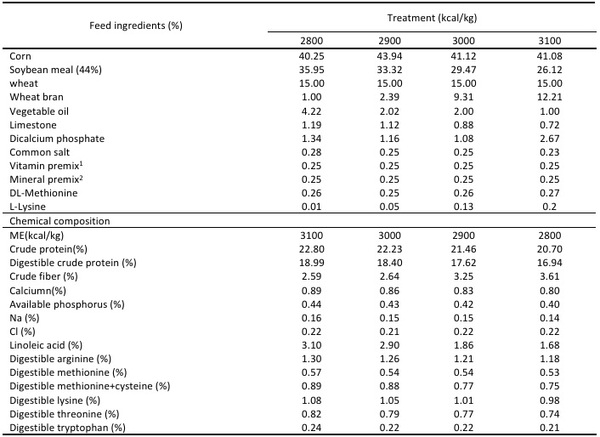
In this study, 160 one-day-old Ross 308 broiler chicks (mixed-sex) have been used in a completely randomized design with 4 treatments and 4 replicates with 10 chickens per replication at 16 pens (1 m2) on the litter floor. Experimental diets were prepared in the form of mash, and birds were on ad libitum feeding throughout the experimental period. Experimental diets were formulated according to the Ross 308 guideline (Aviagen 2014) using UFFDA (Pesti et al., 1992) software to be equal in terms of energy to nutrient ratio at the same periods (nutrients were considered based on their digestibility). Chicks were fed from 11 to 24 days of age with dietary treatments including 4 grower diets with 2800, 2900, 3000, and 3100 kcal/kg ME and with constant energy to nutrient ratios (Table 1). All chicks were fed the recommended Ross diet during starter (1- 10 d) and finisher (25- 42 d) periods. At the end of each period and the whole period, growth performance and carcass characteristics were measured.
Birds were weighed weekly and for each bird, the amount of feed consumption was calculated as bird day and the feed conversion ratio for each experimental pen was calculated by dividing the amount of feed intake by body weight gain in every period. At the end of the period (42 d), after 6 hours of fasting, 3 chickens were randomly selected from each replicate and slaughtered to determine the carcass characteristics. Carcass weight was measured after separation of the viscera and carcass efficiency was obtained by dividing the weight of empty carcass to live body weight, also collect the liver, heart, gizzard, spleen, pancreases, abdominal fat and total edible carcass and relative weight of each organ were calculated as follows:
Relative weight= (organ weight/carcass weight) ×100 (El-katcha et al., 2016).
All data were analyzed using the General Linear Model procedure (GLM) of the Statistical Analysis System (SAS 2002) in a completely randomized design with a significance level of 5% to compare the means based on Duncan's multiple range tests.
Results
Feed Intake
The results of this experiment showed that different levels of ME (with constant energy to nutrient ratios) had no significant effect (P> 0.05) on average of the daily feed intake at 11 to 24 days of age; chickens consumed the same amount of feed from the diets with the lowest energy level (2800 kcal/kg ME ( and the highest energy level or control group (3100 kcal/kg) (Table 2). In addition, feed intake in the finisher period (25 to 42 d) when all treatments used a standard diet with an energy level of 3200 kcal/kg ME was not affected by different dietary energy levels during the growing period. Although the feed intake of chickens fed lower energy diets was numerically lower, this difference was not significant (P> 0.05) (Table 2), Also in the whole period (1 to 42 d), feed intake was not affected by different dietary energy levels during the growing period (P> 0.05).
Body Weight Gain
The average daily weight gain of broiler chickens during the growth period (11-24 d) was significantly affected (P< 0.05) by dietary energy levels (with constant energy to nutrient ratios) so that the average daily weight gain in the lowest dietary energy level had the lowest weight gain (Table 2). However, the average daily weight gain of the groups in the finisher periods (25-42 d) and whole periods (1-42 d) was not affected by different dietary energy levels in the growth period (P> 0.05).
Table 1. Feed ingredients and composition of experimental diets in grower period (11-24 days)
Effect of grower dietary energy level on feed intake and performance of modern broiler chickens - Image 1
1-Supplied vitamins per kilogram of diet: A, 12000 IU; D3, 5000 IU; E, 80 IU; B1, 3 mg; B2, 8.6 mg; B6, 5.4 mg; B12, 0.017 mg; Cloride Choline, 1700 mg. 2- Supplied minerals per kilogram of diet: Mn, 120 mg; Fe, 20 mg; Zn, 100 mg; Cu, 16 mg; I, 1.25 mg; Se, 0.30 mg.
Table 2. Effect of different levels of energy on average feed intake (g/bird/day), body weight gain (g/bird/day) and feed conversion ratio of broiler chickens from 11-24 days of age.
Effect of grower dietary energy level on feed intake and performance of modern broiler chickens - Image 2
Means within same column with different letters differ significantly (P< 0.05) 1-All chicks during the starter period (1- 10 d) and the finisher period (25-42 d) were fed by standard diets (24% protein and 3000 kcal/kg ME) and (20% protein and 3200 kcal/kg, respectively).
Feed Conversion Ratio
The results in Table 2 show that the effect of different dietary energy levels on feed conversion ratio at the age of 11 to 24 days has a significant effect (P< 0.05), so that the groups fed with the lowest dietary energy level had the highest feed conversion ratio. The conversion ratio during the finisher period (25 to 42 d) was also significantly affected (P< 0.05) by the dietary energy level in the growing period and the groups that were fed the lowest of energy diets in the growing period showed a better conversion ratio, while during whole period (1 to 42 d) there was no significant (P> 0.05).
Carcass Characteristics
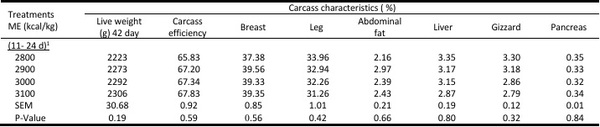
The results inTable 3 show that different dietary energy levels (2800, 2900, 3000, and 3100 kcal/kg ME) at 11 to 24 d of age had no significant effect on the performance of carcass yield at the end of the period (42 d) (P> 0.05).
Discussion
Feed Intake
In agreement with the results of the current study on feed intake, it was reported that dietary energy levels had no significant effect (P> 0.05) on feed intake of broilers at 11 to 24 days (Maiorka et al., 2008), 11 to 22 days (Abudabos et al., 2014) and 14 to 35 days (Chrystal et al., 2020), however in these studies, the energy to protein ratios was not constant.Lou et al. (2003) and Leeson et al. (1996) reported that feed intake before 25 days of age was not affected by dietary energy concentration. In contrast, Heger et al. (2014) showed that feed intake increased in all periods, including the growth period (11-24 d) by decreasing the density of ME in the diet. Also, opposite to the results of the present study, some authors reported that the dietary energy level affects the feed intake of broilers during the growing period (Mousavi et al., 2013; Kim et al., 2012). Kamran et al. (2008), in a similar finding with these authors, attributed the increase in feed intake to the ability of chickens to meet their caloric needs from low energy diets.
In the present study, feed intake in the growth periods and the whole period was not affected (P> 0.05) by the dietary energy level, which in line Mousavi et al. (2013) observed that the feed intake of Cobb broilers in terms of energy was significantly affected at 11 to 22 days of age, but in the finisher period (23-40 d) and the whole period (1-40 d), feed intake was not affected by the dietary energy level. In another study, it was reported that feed intake of broilers at 21 to 42 days of age or the whole period (1 to 42 d) was not affected by dietary energy (Azizi et al., 2011). Also, Tooci et al. (2009) who used diluted diets during 11-28 days of age and standard diets in the starter and finisher period, observed that feed intake was not significantly different from the control treatment (P> 0.05).
Body Weight Gain
The average daily weight gain during the grower period was affected by dietary energy level, that chicken fed on higher dietary ME level, average daily weight gain increased at the grower period (P< 0.05). This is in agreement with several studies (Maiorka et al., 2008; Abudabos et al., 2014; Kamran et al., 2008). Zhang et al. (2010) also observed a significant effect of dietary energy factors on weight gain in local chickens at 1 to 4 weeks of age. Chrystal et al. (2020) reported that a reduction of 100 kcal/kg of ME has no effect on the performance of Ross broilers in 14 to 35 days of age. Also, the current results study showed that the average daily weight gain of the groups during the finisher periods (25-42 d) and the whole period (1-42 d) was not affected (P> 0.05) by dietary energy level at growth period treatments. It was reported in line that the rate of weight gain during the dietary restriction period (6-12 d) with diluted energy diets decreased, but due to compensatory growth in the post-restriction period, there was no significant difference (P> 0.05) in the final body weight gain among of groups in the whole period (42 d) (Yussefi Kelaricolaii et al., 2001). Abouelezz et al. (2019) also reported that at the end of the period (42 d) the weight gain of broilers was not affected by dietary energy levels. Lou et al. (2003) showed that the effect of dietary energy on body weight gain of broiler chickens from 1 to 26 and 1 to 42 days of age (whole period) is in a linear relationship. The reason for these differences may be due in part to the difference of ME in amino acid ratios in the experimental treatments (Mousavi et al., 2013).
Feed Conversion Ratio
In the current experiment, the effect of different dietary energy levels on feed conversion ratio during 11 24 days of age were significant (P< 0.05). In agreement with the results of experimental data performed on Cobb broilers by Mousavi et al. (2013), it was shownthat dilution of dietary energy during the growth period (11 22 d) by 10% there was a significantdifference in conversion ratio (P< 0.05). Similar findings were also reported by Tooci et al. (2009) at 11 to 28 days of age and Maiorka et al. (2008) at 14 to 21 days of age in broilers. The results were also in accordance with those of Jackson et al. (1982) who reported that feed efficiency increased with increasing levels of dietary protein or energy. Probably one of the reasons for improving the feed efficiency is their higher digestibility due to higher carbohydrate content and fewer raw fibers than low dietary energy levels. In contrast, it was reported that the dietary energy level had no significant effect (P> 0.05) on a feed conversion ratio of broiler chickens at 11-24 days (Heger et al., 2014), 11 to 22 days (Abudabos et al., 2014) and 14 to 35 days of ages (Chrystal et al., 2020). The findings of this study were in close agreement with those of Lou et al. (2003) who found that the use of three energies levels 2800, 3000, and 3200 kcal/kg ME with a constant ratio of energy to protein up to 26 days of age, has no significant effect (P> 0.05) on the feed conversion ratio at the end of the period (49 d). In another study by Rezaei and Hajati (2010), it was stated that energy dilution up to 40% had a significant effect on feed conversion ratio at the 16 to 20 days of age and in restricted groups, with fed low energy density FCR was
Table 3. Effect of different levels of metabolic energy of grower diets on carcass characteristics of broiler chickens at the age of 42 days.
Effect of grower dietary energy level on feed intake and performance of modern broiler chickens - Image 3
Means within same column with different letters differ significantly (P< 0.05) 1-All chicks during the starter period (1- 10 d) and the finisher period (25- 42 d) were fed by standard diets (24% protein and 3000 kcal/kg ME) and (20% protein and 3200 kcal/kg ME, respectively).
higher, but in the whole experimental period (16 up to 44 d) there was no significant effect (P> 0.05). While Mousavi et al. (2013) reported that the dietary energy level was the effect on FCR of Cobb broilers in the growth period (11-22 d) and also the whole period (1-40 d).
Carcass Characteristics
The observations of the present study showed that the energy level of the diet during the growth period did not significant difference (P> 0.05) on the performance of different carcass components at the end of the period (42 d). Others have reported similar responses in broiler chickens fed different dietary energy levels (Heger et al., 2014; Hosseini-Vashan et al., 2010; Marcu et al., 2012; Abudabos et al., 2014; Mousavi et al., 2013; Abouelezz et al., 2019). Inline, Rezaei and Hajati (2016) and Kamran et al. (2008) showed that diluting dietary energy at 11 to 26 days of age in broilers was not an influence on carcass yield, carcass meat production, thighs, abdominal fat, liver, heart, and gizzard. In another study, Kamran et al. (2008) while obtaining similar results of this experiment reported that results may be due to the constant ratio of energy to protein in all dietary treatments (Kim et al., 2012). Opposite of these statements, some authors have concluded that changes in the energy content of the diet can affect the performance of broilers and carcass quality (Marcu et al., 2013). These inconsistency reports can be due to differences in diet type and feed form (Abdollahi et al., 2013), genotype/strain, environmental impact, broilers density and number of birds used (Mbajiorgu et al., 2011). However, there are differences in the effect of dietary energy level on carcass characteristics and quality. Generally, as long as the standard ratio of energy to dietary protein is maintained, there is no change in carcass fat percentage, that is, carcass fat increases when only dietary energy content increases (Bartov et al., 1974; Skinner et al., 1992).
Conclusion
During the growing period, modern broiler chicks consume feed regardless of the energy level of the diet and continue up to physical satiety. Grower dietary energy levels do not affect the average daily feed intake but affect the body weight gain and feed conversion ratio at 11 to 24 days of age. However, at the whole periods (1-42 d) feed intake, weight gain, feed conversion ratio, final live weight, and relative carcass yield do not affect by different dietary energy levels during the growing period.
    
This article was originally published in Poultry Studies, 19(1), 1-6. https://doi.org/10.34233/jpr.1111291. This is an Open Access article distributed under a Creative Commons Attribution License.

Abdollahi, M. R., Zaefarian, F., Ravindran, V. (2018). Feed intake response of broilers: Impact of feed processing. Animal Feed Science and Technology, 237, 154-165.

Abdollahi, M. R., Ravindran, V., Svihus, B. (2013). Pelleting of broiler diets: An overview with emphasis on pellet quality and nutritional value. Animal feed science and technology, 179(1-4), 1-23.

Abouelezz, K. F. M., Wang, Y., Wang, W., Lin, X., Li, L., Gou, Z., Jiang, S. (2019). Impacts of graded levels of metabolizable energy on growth performance and carcass characteristics of slow-growing yellow-feathered male chickens. Animals, 9(7), 461.

Abudabos, A. M., Saleh, F., Lemme, A., Zakaria, H. A. (2014). The relationship between guanidino acetic acid and metabolisable energy level of diets on performance of broiler chickens. Italian Journal of Animal Science, 13(3), 3269.

Applegate, T. J. (2012). Factors affecting feed intake What do we know. In Proceeding of the Arkansas. Nutrition Conference. The Poultry Federation; Rogers, Arkansas, USA.

Aviagen, T. (2014). Ross 308 Broiler Nutrition Specifications. Aviagen Group, Huntsville.

Azizi, B., Sadeghi, G., Karimi, A., Abed, F. (2011). Effects of dietary energy and protein dilution and time of feed replacement from starter to grower on broiler chickens performance. Journal of Central European Agriculture, 12(1), 44-52.

Bartov, I., Bornstein, S., Lipstein, B. (1974). Effect of calorie to protein ratio on the degree of fatness in broilers fed on practical diets. British Poultry Science, 15(1), 107-117.

Chrystal, P. V., Moss, A. F., Khoddami, A., Naranjo, V. D., Selle, P. H., Liu, S. Y. (2020). Effects of reduced crude protein levels, dietary electrolyte balance, and energy density on the performance of broiler chickens offered maize-based diets with evaluations of starch, protein, and amino acid metabolism. Poultry Science, 99(3), 1421-1431.

Classen, H. L. (2017). Diet energy and feed intake in chickens. Animal Feed Science and Technology, 233, 13 21.5.

El-katcha, M. I., Soltan, M. A., Sharaf, M. M., Hasen, A. (2016). Growth performance, immune response, blood serum parameters, nutrient digestibility and carcass traits of broiler chicken as affected by dietary supplementation of garlic extract (Allicin). Alexandria Journal of Veterinary Sciences, 49(2), 50-64. DOI: 10.5455/ajvs.219261

Ferket, P. R., & Gernat, A. G. (2006). Factors that affect feed intake of meat birds: A review. International Journal of Poultry Science 5(10), 905-911.

Heger, J., Zelenka, J., Machander, V., de la Cruz, C., Lešták, M., Hampel, D. (2014). Effects of guanidinoacetic acid supplementation to broiler diets with varying energy content. Acta Universitatis Agriculturae et Silviculturae Mendelianae Brunensis, 62(3), 477-485.

Hosseini-Vashan, S. J., Jafari-Sayadi, A. R., Golian, A., Motaghinia, G., Namvari, M., Hamedi, M. (2010). Comparison of growth performance and carcass characteristics of broiler chickens fed diets with various energy and constant energy to protein ratio. Journal of Animal and Veterinary Advances, 9(20), 2565-2570.

Jackson, S., Summers, J. D., Leeson, S. (1982). Effect of dietary protein and energy on broiler performance and production costs. Poultry Science, 61(11), 2232-2240.

Kim, J. S., Kwon, J. T., Kim, J. H., Oh, S. T., Lee, B. K., Zheng, L., Kang, C. W. (2012). Growth performance and carcass characteristics of two different broiler strains by different levels of metabolizable energy. Korean Journal of Poultry Science, 39(3), 195-205. (In Korean with an abstract in English). Available from: http://dx.doi.org/10.5536/KJPS.2012.39.3.195

Kamran, Z., Sarwar, M., Nisa, M., Nadeem, M. A., Mahmood, S., Babar, M. E., Ahmed, S. (2008). Effect of low-protein diets having constant energy-to-protein ratio on performance and carcass characteristics of broiler chickens from one to thirty-five days of age. Poultry Science, 87(3), 468-474

Leeson, S., Summers, J. D. (2009). Commercial poultry nutrition. Nottingham University Press.

Leeson, S. (2006). Defining and predicting changes in nutrient requirements of poultry. In The XII European Poultry Conference.

Leeson, S., Caston, L., Summers, J. D. (1996). Broiler response to diet energy. Poultry Science, 75(4), 529-535

Lou, S. M., Golian, A., Shahroudi, F. E., Mahallati, M. N., & Kermanshahi, H. (2003). Effect of Energy Level and Time of Feed Replacement from Starter to Finisher Diets of Broilers Weighted Less than Two kg. Journal of Science and Technology of Agriculture and Natural Resources. (In Persian with an abstract in English). URL: http://jcpp.iut.ac.ir/article-1-451-en.html

Mahagna, M., Nir, I. (1996). Comparative development of digestive organs, intestinal disaccharidases and some blood metabolites in broiler and layer‐type chicks after hatching. British Poultry Science, 37(2), 359-371.

Maiorka, A., Dahlke, F., Santin, E., Bruno, L. D. G., Macari, M. (2008). Energy and oil levels in broiler starter diets. Ciência Rural, 38(4), 1099-1104.

Marcu, A., Vacaru-Opriş, I., Dumitrescu, G., Marcu, A., Ciochină, L. P., Nicula, M., Kelciov, B. (2013). Effect of diets with different energy and protein levels on breast muscle characteristics at broiler chickens. Scientific Papers Animal Science and Biotechnologies, 46(1), 333-340

Marcu, A., Vacaru-Opriş, I., Marcu, A., Nicula, M., Dronca, D., Kelciov, B. (2012). Effect of different levels of dietary protein and energy on the growth and slaughter performance at ‘’Hybro PN+” broiler chickens. Scientific Papers Animal Science and Biotechnologies, 45(2), 424-431.

Mbajiorgu, C. A., Ng'Ambi, J. W., Norris, D. D. (2011). Voluntary feed intake and nutrient composition in chickens. Asian Journal of Animal and Veterinary Advances, 6(1), 20-28.

Mckay, J. C. (2009). The genetics of modern commercial poultry. In Poultry Science Symposium Series (p. 1).

Mousavi, S. N., Afsar, A., Lotfollahian, H. (2013). Effects of guanidinoacetic acid supplementation to broiler diets with varying energy contents. Journal of Applied Poultry Research, 22(1), 47-54.

NRC. (1994). National Research Council. 1994. Nutrient Requirements of Poultry: Ninth Revised Edition, Washington, DC: The National Academies Press. https://doi.org/10.17226/2114

Paxton, H., Anthony, N. B., Corr, S. A., Hutchinson, J. R. (2010). The effects of selective breeding on the architectural properties of the pelvic limb in broiler chickens: a comparative study across modern and ancestral populations. Journal of Anatomy, 217(2), 153-166.

Pesti, G. M., Miller, B. R., Hargrave, J. (1992). User-Friendly Feed Formulation, Done Again (UFFDA). University of Georgia

Plavnik, I., Makovsky, B., Sklan, D. (2000). Effect of age of turkeys on the metabolisable energy of different foodstuffs. British poultry science, 41(5), 615-616.

Pym, R. A. E. (2005). Genetic aspects of food intake and food utilization efficiency for growth in chickens. In Proceedings of the 17th Australian Poultry Science Symposium, Sydney, New South Wales, Australia, 7-9 February 2005 (pp. 153 162). Poultry Research Foundation.

Rezaei, M., Hajati, H. (2016). Effect of diet dilution at early age on performance, carcass characteristics and blood parameters of broiler chicks. Italian Journal of Animal Science.

Skinner, J. T., Waldroup, A. L., Waldroup, P. W. (1992). Effects of dietary nutrient density on performance and carcass quality of broilers 42 to 49 days of age. Journal of Applied Poultry Research, 1(4), 367-372.

SAS (2002). Statistical Analysis System (SAS) Institute SAS/STAT User’s Guide. Version 8, 6th Edition, SAS Institute, Cary, 112

Tooci, S., Shivazad, M., Eila, N., Zarei, A. (2009). Effect of dietary dilution of energy and nutrients during different growing periods on compensatory growth of Ross broilers. African Journal of Biotechnology, 8(22)

Yussefi Kelaricolaii, K., Rezaei, M., Kamyab, A. (2001). Performance of broiler chickens during and following feed restriction at an early age. British poultry science, 42, S111-S111.

Zhang, X., Han, W., Su, Y., Li, G., Lu, J. (2010). Effects of dietary metabolizable energy (ME) and crude protein (CP) concentrations on daily gain of suqin silky chickens aged from 0 to 12 weeks. Acta Agriculturae Universitatis Jiangxiensis, 32(2), 199-2


Related topics:
Authors:
Abolghasem Golian
Recommend
Comment
Share
Profile picture
Would you like to discuss another topic? Create a new post to engage with experts in the community.
Featured users in Poultry Industry
Dr. Algis Martínez
Dr. Algis Martínez
DVM, Diplomado ACPV - Poultry Veterinarian North America Cargill
United States
Shivaram Rao
Shivaram Rao
PhD Director Principal de Nutrición y Servicios Técnicos de Pilgrim’s Pride Corporation
United States
Carolina Hall
Carolina Hall
United States