Live-Attenuated Oral Vaccines to Reduce Campylobacter Colonization in Poultry
The control of Campylobacter in poultry at the pre-harvest level is critical to reducing foodborne infections with Campylobacter since the consumption of contaminated poultry is the most frequent cause of human campylobacteriosis. Although poultry vaccination is suggested as useful intervention measures, no Campylobacter vaccines are currently available. To develop live-attenuated oral Campylobacter vaccines, in this study, we evaluated the efficacy of pre-colonization by oxidative stress defense mutants, including knockout mutants of ahpC, katA, and sodB, in preventing Campylobacter jejuni from colonizing poultry. Interestingly, when chickens were pre-colonized with ∆ahpC and ∆katA mutants, rather than the ∆sodB mutant, the level of C. jejuni colonization was significantly reduced within 35 days. Further studies demonstrated when chickens were pre-colonized with the ∆ahpC mutant by oral challenge with a high dose (ca., 5 × 10⁸ CFU/bird) and a low dose (ca., 5 × 10⁶ CFU/bird), it twice reduced the level of C. jejuni by 3.9 log10CFU/g feces and 3 log10CFU/g feces after 42 days, respectively, compared to the untreated control. Due to a colonization defect, the ∆ahpC mutant was removed from chickens within 42 days. After excretion from the host, moreover, the ∆ahpC mutant cannot survive in aerobic environments because of compromised aerotolerance. Our findings suggest that the ahpC mutant has a great potential for on-farm application to control C. jejuni at the pre-harvest level.
Keywords: Campylobacter; live-attenuated oral vaccines; poultry; food safety
1. Introduction
2. Materials and Methods
2.1. Bacterial Strains and Culture Conditions
2.2. Evaluation of Efficacy in Preventing Campylobacter Colonization by Pre-Colonization with Oxidative Stress Defense Mutants
3. Results
3.1. Prevention of C. jejuni Colonization by Pre-Colonization with Oxidative Stress Defense Mutants
3.2. C. jejuni Reduction by Challenge with the ∆ahpC Mutant A High Dose
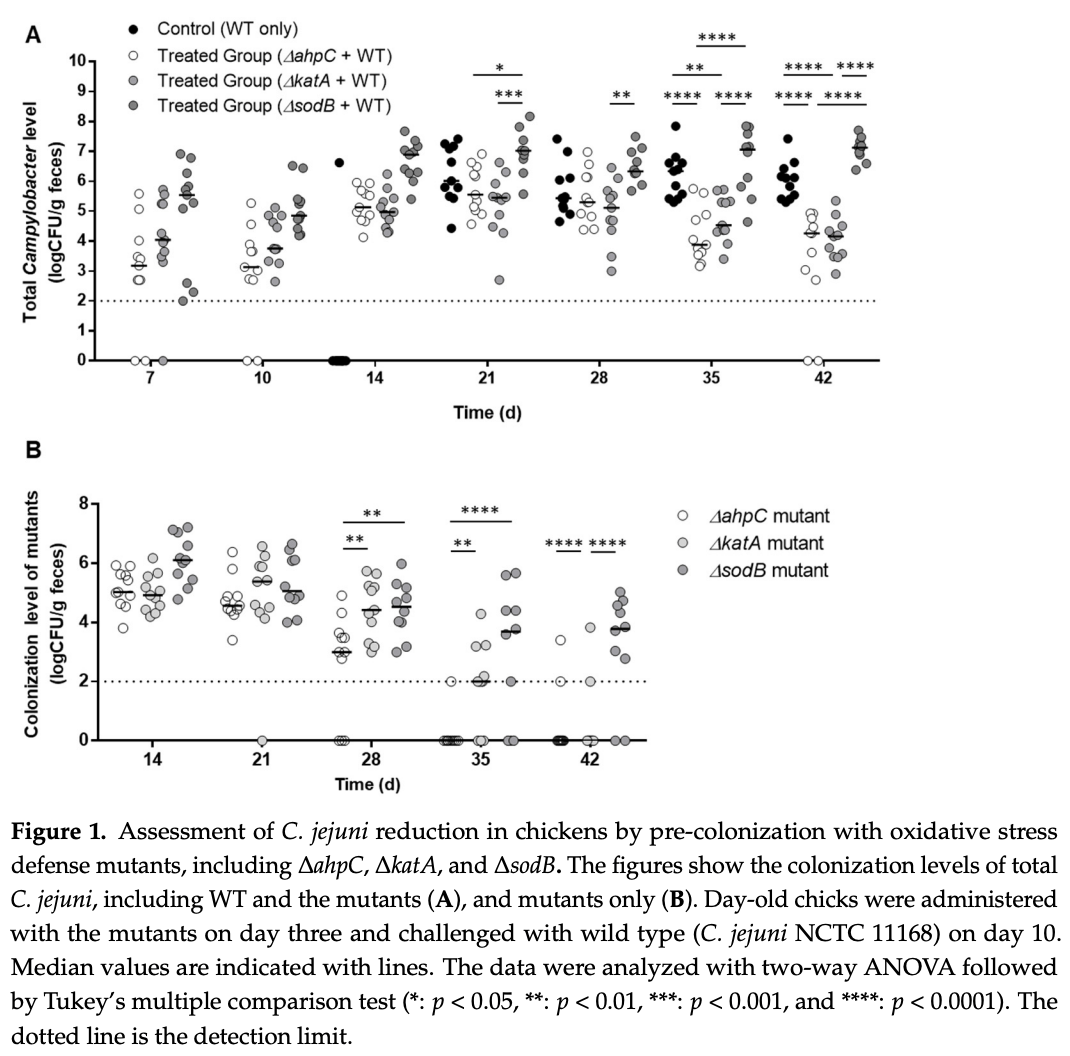

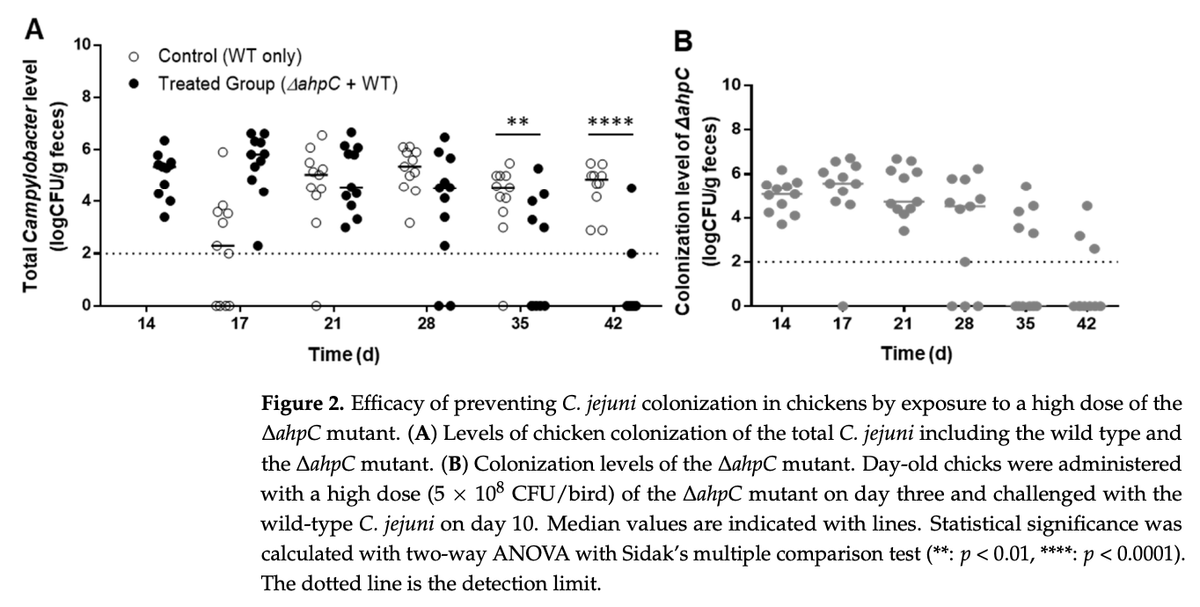
3.3. C. jejuni Reduction by Challenge with the ∆ahpC Mutant A Low Dose
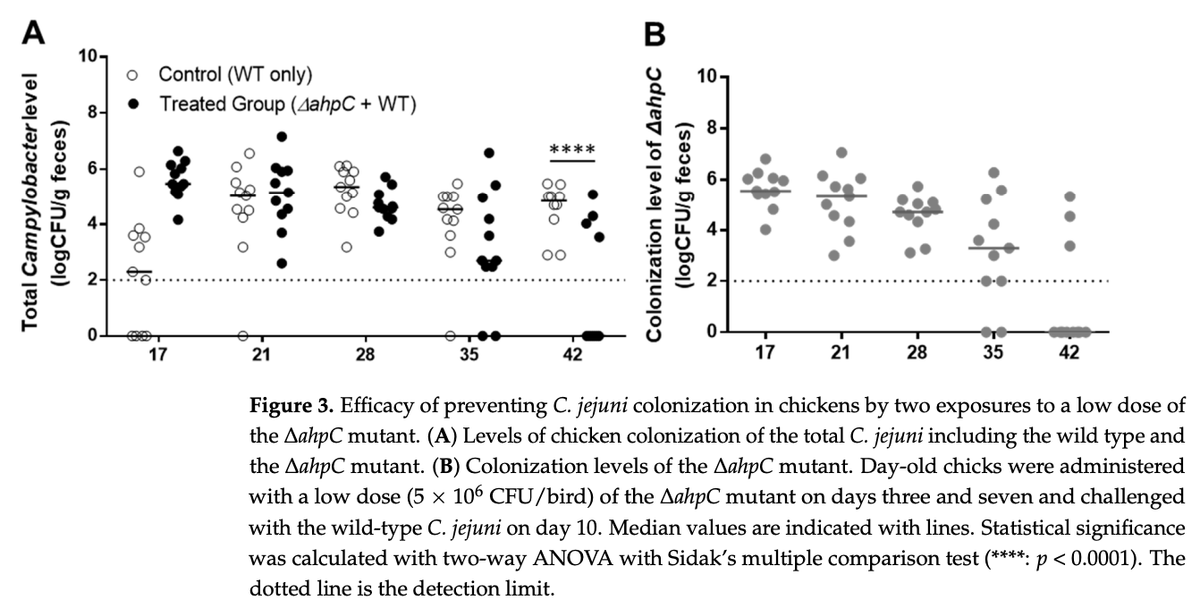
3.4. Increase in Chicken Body Weight after Pre-Colonization with the ∆ahpc Mutant
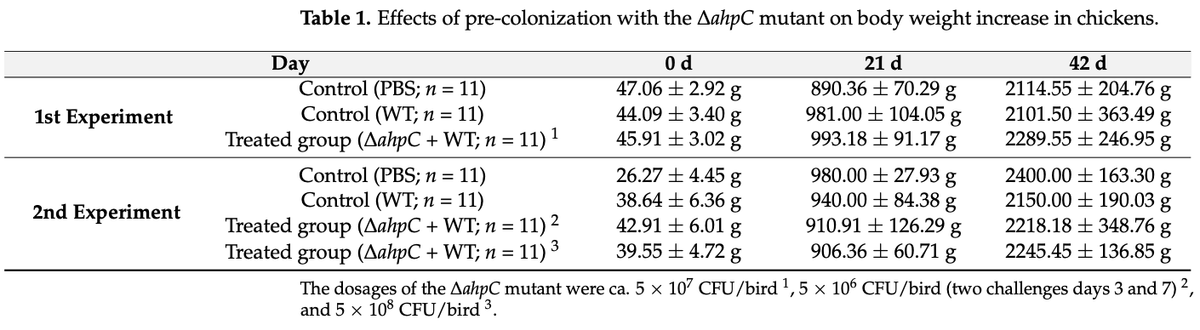
4. Discussion
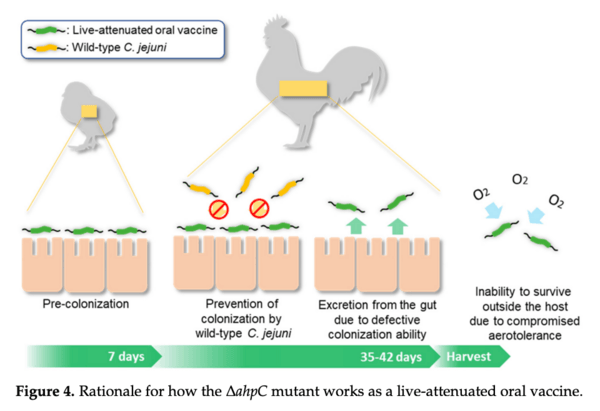
5. Conclusions
6. Patents
Kirk, M. D., Pires, S. M., Black, R. E., Caipo, M., Crump, J. A., Devleesschauwer, B., Dopfer, D., Fazil, A., Fischer-Walker, C. L., Hald, T., et al. (2015). World Health Organization estimates of the global and regional disease burden of 22 foodborne bacterial, protozoal, and viral diseases, 2010: A data synthesis. PLoS Medicine, 12, e1001921.
Poropatich, K. O., Walker, C. L., & Black, R. E. (2010). Quantifying the association between Campylobacter infection and Guillain-Barré syndrome: A systematic review. Journal of Health, Population and Nutrition, 28, 545–552.
Heimesaat, M. M., Backert, S., Alter, T., & Bereswill, S. (2021). Human campylobacteriosis—a serious infectious threat in a One Health perspective. Current Topics in Microbiology and Immunology, 431, 1–23.
Jeon, B., Muraoka, W. T., & Zhang, Q. (2010). Advances in Campylobacter biology and implications for biotechnological applications. Microbial Biotechnology, 3, 242–258.
Davis, L., & DiRita, V. (2008). Growth and laboratory maintenance of Campylobacter jejuni. Current Protocols in Microbiology, 8, 8A.1.1–8A.1.7.
Rasschaert, G., De Zutter, L., Herman, L., & Heyndrickx, M. (2020). Campylobacter contamination of broilers: The role of transport and slaughterhouse. International Journal of Food Microbiology, 322, 108564.
Nauta, M. J., Johannessen, G., Laureano Adame, L., Williams, N., & Rosenquist, H. (2016). The effect of reducing numbers of Campylobacter in broiler intestines on human health risk. Microbial Risk Analysis, 2–3, 68–77.
Rosenquist, H., Nielsen, N. L., Sommer, H. M., Norrung, B., & Christensen, B. B. (2003). Quantitative risk assessment of human campylobacteriosis associated with thermophilic Campylobacter species in chickens. International Journal of Food Microbiology, 83, 87–103.
Lin, I. Y., Van, T. T., & Smooker, P. M. (2015). Live-attenuated bacterial vectors: Tools for vaccine and therapeutic agent delivery. Vaccines, 3, 940–972.
Krieg, N. R., & Hoffman, P. S. (1986). Microaerophily and oxygen toxicity. Annual Review of Microbiology, 40, 107–130.
Taylor, A. J., & Kelly, D. J. (2019). The function, biogenesis and regulation of the electron transport chains in Campylobacter jejuni: New insights into the bioenergetics of a major food-borne pathogen. Advances in Microbial Physiology, 74, 239–329.
Imlay, J. A. (2008). Cellular defenses against superoxide and hydrogen peroxide. Annual Review of Biochemistry, 77, 755–776.
Parkhill, J., Wren, B., Mungall, K., Ketley, J., Churcher, C., Basham, D., Chillingworth, T., Davies, R., Feltwell, T., & Holroyd, S. (2000). The genome sequence of the food-borne pathogen Campylobacter jejuni reveals hypervariable sequences. Nature, 403, 665–668.
Hébrard, M., Viala, J. P. M., Méresse, S., Barras, F., & Aussel, L. (2009). Redundant hydrogen peroxide scavengers contribute to Salmonella virulence and oxidative stress resistance. Journal of Bacteriology, 191, 4605–4614.
Oh, E., McMullen, L., & Jeon, B. (2015). Impact of oxidative stress defense on bacterial survival and morphological change in Campylobacter jejuni under aerobic conditions. Frontiers in Microbiology, 6, 295.
Baillon, M. L., van Vliet, A. H., Ketley, J. M., Constantinidou, C., & Penn, C. W. (1999). An iron-regulated alkyl hydroperoxide reductase (AhpC) confers aerotolerance and oxidative stress resistance to the microaerophilic pathogen Campylobacter jejuni. Journal of Bacteriology, 181, 4798–4804.
Atack, J. M., & Kelly, D. J. (2009). Oxidative stress in Campylobacter jejuni: Responses, resistance and regulation. Future Microbiology, 4, 677–690.
Day, W. A., Jr., Sajecki, J. L., Pitts, T. M., & Joens, L. A. (2000). Role of catalase in Campylobacter jejuni intracellular survival. Infection and Immunity, 68, 6337–6345.
Purdy, D., Cawthraw, S., Dickinson, J. H., Newell, D. G., & Park, S. F. (1999). Generation of a superoxide dismutase (SOD)-deficient mutant of Campylobacter coli: Evidence for the significance of SOD in Campylobacter survival and colonization. Applied and Environmental Microbiology, 65, 2540–2546.
Hermans, D., Van Deun, K., Martel, A., Van Immerseel, F., Messens, W., Heyndrickx, M., Haesebrouck, F., & Pasmans, F. (2011). Colonization factors of Campylobacter jejuni in the chicken gut. Veterinary Research, 42, 82.
Palyada, K., Sun, Y.-Q., Flint, A., Butcher, J., Naikare, H., & Stintzi, A. (2009). Characterization of the oxidative stress stimulon and PerR regulon of Campylobacter jejuni. BMC Genomics, 10, 481.
Hwang, S., Ryu, S., & Jeon, B. (2013). Roles of the superoxide dismutase SodB and the catalase KatA in the antibiotic resistance of Campylobacter jejuni. Journal of Antibiotics, 66, 351–353.
Oh, E., & Jeon, B. (2014). Role of alkyl hydroperoxide reductase (AhpC) in the biofilm formation of Campylobacter jejuni. PLoS ONE, 9, e87312.
Walker, R. I. (2005). Considerations for development of whole cell bacterial vaccines to prevent diarrheal diseases in children in developing countries. Vaccine, 23, 3369–3385.
Okamura, M., Tominaga, A., Ueda, M., Ohshima, R., Kobayashi, M., Tsukada, M., Yokoyama, E., Takehara, K., Deguchi, K., Honda, T., et al. (2012). Irrelevance between the induction of anti-Campylobacter humoral response by a bacterin and the lack of protection against homologous challenge in Japanese Jidori chickens. Journal of Veterinary Medical Science, 74, 75–78.
Rice, B. E., Rollins, D. M., Mallinson, E. T., Carr, L., & Joseph, S. W. (1997). Campylobacter jejuni in broiler chickens: Colonization and humoral immunity following oral vaccination and experimental infection. Vaccine, 15, 1922–1932.
Sizemore, D. R., Warner, B., Lawrence, J., Jones, A., & Killeen, K. P. (2006). Live, attenuated Salmonella typhimurium vectoring Campylobacter antigens. Vaccine, 24, 3793–3803.
Layton, S. L., Morgan, M. J., Cole, K., Kwon, Y. M., Donoghue, D. J., Hargis, B. M., & Pumford, N. R. (2011). Evaluation of Salmonella-vectored Campylobacter peptide epitopes for reduction of Campylobacter jejuni in broiler chickens. Clinical and Vaccine Immunology, 18, 449–454.
Buckley, A. M., Wang, J., Hudson, D. L., Grant, A. J., Jones, M. A., Maskell, D. J., & Stevens, M. P. (2010). Evaluation of live-attenuated Salmonella vaccines expressing Campylobacter antigens for control of C. jejuni in poultry. Vaccine, 28, 1094–1105.
Alemka, A., Nothaft, H., Zheng, J., & Szymanski, C. M. (2013). N-glycosylation of Campylobacter jejuni surface proteins promotes bacterial fitness. Infection and Immunity, 81, 1674–1682.
van Sorge, N. M., Bleumink, N. M., van Vliet, S. J., Saeland, E., van der Pol, W. L., van Kooyk, Y., & van Putten, J. P. (2009). N-glycosylated proteins and distinct lipooligosaccharide glycoforms of Campylobacter jejuni target the human C-type lectin receptor MGL. Cellular Microbiology, 11, 1768–1781.
Nothaft, H., Davis, B., Lock, Y. Y., Perez-Munoz, M. E., Vinogradov, E., Walter, J., Coros, C., & Szymanski, C. M. (2016). Engineering the Campylobacter jejuni N-glycan to create an effective chicken vaccine. Scientific Reports, 6, 26511.
Battersby, T., Whyte, P., & Bolton, D. J. (2016). The pattern of Campylobacter contamination on broiler farms: External and internal sources. Journal of Applied Microbiology, 120, 1108–1118.
Sahin, O., Luo, N., Huang, S., & Zhang, Q. (2003). Effect of Campylobacter-specific maternal antibodies on Campylobacter jejuni colonization in young chickens. Applied and Environmental Microbiology, 69, 5372–5379.
Sahin, O., Zhang, Q., Meitzler, J. C., Harr, B. S., Morishita, T. Y., & Mohan, R. (2001). Prevalence, antigenic specificity, and bactericidal activity of poultry anti-Campylobacter maternal antibodies. Applied and Environmental Microbiology, 67, 3951–3957.
Mortada, M., Cosby, D. E., Akerele, G., Ramadan, N., Oxford, J., Shanmugasundaram, R., Ng, T. T., & Selvaraj, R. K. (2021). Characterizing the immune response of chickens to Campylobacter jejuni (strain A74C). PLoS ONE, 16, e0247080.
Connerton, P. L., Richards, P. J., Lafontaine, G. M., O’Kane, P. M., Ghaffar, N., Cummings, N. J., Smith, D. L., Fish, N. M., & Connerton, I. F. (2018). The effect of the timing of exposure to Campylobacter jejuni on the gut microbiome and inflammatory responses of broiler chickens. Microbiome, 6, 88.
Smith, C. K., Abuoun, M., Cawthraw, S. A., Humphrey, T. J., Rothwell, L., Kaiser, P., Barrow, P. A., & Jones, M. A. (2008). Campylobacter colonization of the chicken induces a proinflammatory response in mucosal tissues. FEMS Immunology and Medical Microbiology, 54, 114–121.
Lacharme-Lora, L., Chaloner, G., Gilroy, R., Humphrey, S., Gibbs, K., Jopson, S., Wright, E., Reid, W., Ketley, J., Humphrey, T., et al. (2017). B lymphocytes play a limited role in clearance of Campylobacter jejuni from the chicken intestinal tract. Scientific Reports, 7, 45090.
Meunier, M., Guyard-Nicodème, M., Dory, D., & Chemaly, M. (2016). Control strategies against Campylobacter at the poultry production level: Biosecurity measures, feed additives and vaccination. Journal of Applied Microbiology, 120, 1139–1173.
Hendrixson, D. R., Akerley, B. J., & DiRita, V. J. (2001). Transposon mutagenesis of Campylobacter jejuni identifies a bipartite energy taxis system required for motility. Molecular Microbiology, 40, 214–224.
















Norel Animal Nutrition

LIPTOSA


United States