I. INTRODUCTION
Necrotic enteritis (NE), caused by toxins produced by the bacterium Clostridium perfringens, is a major enteric disease in commercial poultry with associated annual economic losses estimated at $6 billion worldwide (Wade and Keyburn, 2015). In broiler production, much of these costs are attributed to subclinical NE resulting in reduced performance associated with compromised integrity of the gut, higher mortality rates, and greater costs for disease treatment and prevention of subsequent infections (Van Immerseel et al., 2004; Timbermont et al., 2011; Emami et al., 2019; 2020; 2021). As C. perfringens is naturally occurring in the gastrointestinal tract of poultry, the development of NE requires predisposing factors with Eimeria sp. challenge being the most commonly employed in research models. C. perfringens is a Gram-positive, spore-forming, opportunistic pathogen and is generally classified into 7 groups (A, B, C, D, E, F, and G) based on the production status of toxins: α, β, ε, ι, and NetB (Rood et al., 2018). In poultry, C. perfringens types A and G producing alpha toxin (CPA) and necrotic enteritis B-like Toxin (NetB) are most commonly associated with NE in broiler chickens (Rood et al., 2018; Emami and Dalloul, 2021). Such toxins bind to tight junction protein complexes of the intestinal epithelial layer, modulating permeability and allowing for pore formation (Saitoh et al., 2015). These complexes are dynamic barriers that can respond to external stimuli, including nutrients, commensal bacteria, and pathogens/antigens present in the intestinal lumen (Emami et al., 2019; 2020). Therefore, the intestinal environment plays a critical role in maintaining the integrity of tight junction proteins and the structural damage caused by C. perfringens toxins compromise overall gut integrity. As a result, nutrient absorption is reduced and gut permeability increases, allowing traffic of macromolecules between the intestinal lumen and sub-epithelium (leaky gut) potentially leading to inflammatory responses and necrosis associated with toxin production (Awad et al., 2017; Ducatelle et al., 2018; Husta et al., 2023). Consequently, these reactions can trigger various signaling cascades initiating and/or activating immune response pathways that induce the production of cytokines and other immune-related factors including interferon (IFN) γ, interleukin (IL) 1β, IL10, IL12B, tumor necrosis factor (TNF) α, and annexin (ANXA) 1.
Traditionally, antimicrobial growth promoters (AGPs) were used as prophylactics to help mitigate enteric diseases such as NE. However, NE has become a larger problem for the poultry industry after the ban of AGPs in the European Union in 2006 followed by the implementation of the US Food and Drug Administration (FDA) Veterinary Feed Directive (VFD) in 2017 restricting the use of prophylactic AGPs in the United States. As a result, the industry use of therapeutic levels of AGPs has become less common with more poultry producers implementing no antibiotics ever (NAE) and antibiotic free (ABF) production schemes (Gaucher et al., 2017; Smith, 2019). AGPs such as virginiamycin, bacitracin methylene disalicylate (BMD), and lincomycin can promote poultry health and productivity by reducing pathogens, flock mortality, improving litter quality, and enhancing performance (Cervantes, 2015; Hofacre et al., 2018). Yet, consumer demands for drug-free production and legislative restrictions on AGPs have prompted an intense investment in developing effective alternative strategies mostly via nutritional interventions to mitigate the adverse effects of NE on broiler health (Calik et al., 2019; Emami et al., 2021; Blue et al., 2023). In this context, probiotics, synbiotics, phytogenics, and other industrial by-products such as yeast (e.g. betaglucans) and algal derivatives are currently used in poultry production to mitigate the adverse effects of NE and other enteric challenges.
In summary, NE continues to be a leading complex enteric disease with a vast array of consequences, including compromised intestinal integrity and immune competence leading to significant economic losses. During pathogen (e.g. C. perfringens) invasion, a cascade of signaling events in the intestine leads to the secretion of various cytokines and other immunity factors that directly influence the integrity and function of the intestinal barrier, nutrient uptake, and epithelial cell energy metabolism (Emami et al., 2020). As a result, by altering the stability of the intestinal tract, NE is able to negatively impact production parameters and further predispose birds to stressors. With the removal of AGPs, maintaining homeostasis in performance and gut barrier integrity is critical for gut immune development, function and overall health. Achieving this goal requires a deep understanding of the changes that occur in tight junction proteins and gut immune responses during NE in broilers. Therefore, research should continue to investigate how targeted nutrition can help birds effectively prevent NEinduced damage, ultimately improving nutrient absorption, performance, and cell energy utilization and metabolism. Several groups across the globe continue to investigate and develop targeted non-drug dietary means with the collective goals of lessening the devastating impact of enteric diseases. Recently, our group has been investigating various such alternatives in controlled NE model studies employing Eimeria challenge as predisposing factor followed by C. perfringens introduction, and assessing their effectiveness on performance, pathology, and gut immunity and integrity of broiler chickens.
II. METHODS
Two challenge models were used in a series of studies assessing the effectiveness of dietary supplements on the broilers’ responses during subclinical NE. In all studies, a basal diet (negative control) and an AGP diet (positive control) groups were included for comparative purposes. All studies were conducted according to the guidelines of the Institutional Animal Care and Use Committees.
The first study evaluated the effects of a saponin-based product on broilers' performance and carcass composition during an induced NE challenge. A total of 1,200 dayof-hatch male chicks were randomly assigned to four dietary treatments (10 pens/treatment; 30 birds/pen): treatment 1 (NC), a non-medicated corn–soybean basal diet; treatment 2 (PC), NC + 50 g/MT BMD; and treatments 3 (CQ15) and 4 (CQ30) consisting of NC + 15 and 30 g/MT of the test product Clarity Q, respectively. On the day (d) of placement, birds were challenged by a 10X dose of coccidia vaccine to induce NE. On d 8, 14, 28, and 42, performance parameters were measured. On d 8, three birds/pen were necropsied for NE lesions. On d 8 and d 14, jejunum samples from one bird/pen were collected for measuring mRNA abundance of tight junction proteins and nutrient transporter genes using qPCR. Data were subjected to a one-way ANOVA (JMP Pro, 16) except for lesion scores where a chi-square test was used. Fisher’s LSD test compared separated means when statistical differences were noted and considered significant at P ≤ 0.05.
In the second study, the NE model involved co-infection with Eimeria maxima and C. perfringens to assess whether an algal sulfate polysaccharide could mitigate the adverse effects of NE in broilers. A total of 600 d-old Ross 708 male chicks were randomly assigned to one of four treatment groups: the NC group (negative control, fed a corn-soybean meal diet); PC group (positive control, fed NC + 15 ppm Avilamycin and 125 ppm Amprolium); AGS (fed NC + algal product at 0.1% of the diet); and AGH (fed NC + algal product at 0.2% of the diet). On d 14, all birds were orally gavaged with 2,000 E. maxima sporulated oocysts, followed by one dose of approximately 1×10⁸ CFU of C. perfringens on d 19. Performance parameters were measured on d 14, 21, 28, and 42. On d 21 the small intestines of four birds/pen were examined for necrotic lesions. On d 14, 21, and 42 jejunum samples (from one bird/pen) were collected to measure mRNA abundance of tight junction proteins. Data were analyzed using JMP and significance between treatments identified by LSD at P ≤ 0.05.
In a similar setup, the third study evaluated the effects of phytogenic blends on performance, intestinal lesion scores, and mRNA abundance of tight junction proteins and immune response genes. It also consisted of 600 d-old Ross 708 male broilers allocated to one of four treatment groups (6 replicate floor pens, 25 birds/pen) including NC and PC as per the previous studies in addition to two phytogenic additive groups PHY1 (Alterna®) and PHY2 (Alterna® + Synbiotec®). PHY1 group was fed NC + Alterna at 0.4 kg/MT during the starter and grower phases and 0.3 kg/MT during the finisher phase. PHY2 was fed NC + Alterna® and Synbiotec® at an inclusion rate of 0.4 and 0.5 kg/MT, respectively, during the starter and grower phases, 0.3 and 0.25 kg/MT during the finisher phase. Performance parameters were measured on d 14, 21, 28, and 42. On d 21 the small intestines of four birds/pen were examined for lesions. On d 14, 21, and 42, jejunal samples were collected to assess mRNA abundance of IL1β, IL10, and IL12B, IFNγ, TNFα, and ANXA1. Data were analyzed using ANOVA and significance (P ≤ 0.05) was determined by the LSD test.
III. RESULTS AND DISCUSSION
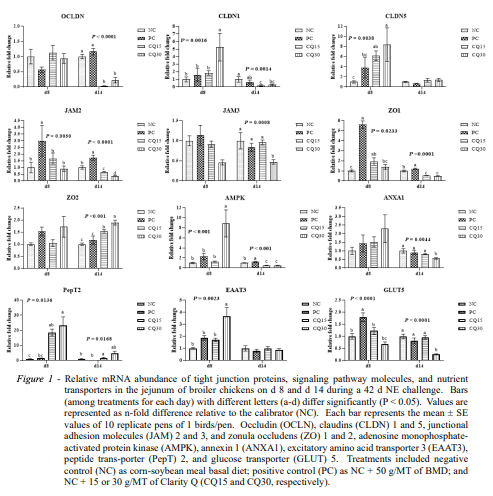
In evaluating a saponin-based product, the results revealed differential responses of broilers. Compared to PC and NC, CQ15 had slightly higher average daily gain (ADG) on d 8 (P > 0.05), and exhibited numerically lower NE lesions in the duodenum compared to all other treatments (Blue et al., 2023). Also at the peak of infection on d 8, mRNA abundance of CLDN1, CLDN5, AMPK, PepT2, and EAAT3 were significantly greater in CQ30 (P < 0.05) compared to both PC and NC. On d 14, considered as the recovery time in this particular model, mRNA abundance (Figure 1) of ZO2 and PepT2 was significantly lower in PC when compared to all treatments, while that of ANXA1, JAM3, and GLUT5 was comparable to CQ15. Additionally, OCLDN, CLDN1, JAM2, and ZO1 showed lower abundance in CQ15 and CQ30 compared to NC and PC. Under this subclinical NE challenge model when broilers were supplemented with Clarity Q, the data showed a numerical reduction in duodenal lesion scores on d 8 (CQ15) and a slightly improved FCR (CQ30) during the overall grow-out period. The results also showed a positive modulation in mRNA abundance of several tight junction proteins and nutrient transporter genes. Overall, adding this lant-based product to broiler diets exhibited a potential to alleviate some of the adverse effects caused by this enteric disease. These were best manifested by improving performance, reducing intestinal lesions, and positively modulating the mRNA abundance of various tight junction proteins and key nutrient transporters during peak NE infection. As such, dietary supplementation of Clarity Q can potentially assist birds during an enteric disease challenge warranting further investigations under this as well as other disease/stress conditions.
Under a different NE challenge model, a sulfate polysaccharide extracted from marine algae could mitigate the adverse effects of NE in broilers. In this study, PC, AGS, and AGH had significantly lower mortality, ADFI, and FCR, and greater ADG compared to NC. Additionally, PC, AGS, and AGH significantly reduced NE lesions compared to the NC group on d 21. There were no significant differences in mRNA abundance of CLDN1, CLDN3, ZO2, and OCLDN on d 21 (peak infection) among all treatments. However, on d 42 (market age), AGS and AGH showed greater mRNA abundance of CLDN1, ZO1, and ZO2 (P < 0.05) compared to NC and PC groups. Collectively, the enhancements in performance, reduction in lesion scores, and increased post-infection expression of tight junction protein mRNA demonstrate the potential of this marine algae-derived dietary supplement as an effective alternative to AGPs. This approach has the potential to alleviate the negative impacts of disease in the context of this NE model, yet further investigations into its mode of action under various enteric challenges are warranted.
In the third study, supplementation of phytogenic blends resulted in interesting findings. During the challenge period of d 14-21, PHY2 and PC had a significantly lower mortality percentage compared to NC; the same trend was seen on d 0-21 and d 0-28. ADG was significantly greater in PC, PHY1, and PHY2 compared to NC during d 0-14, 21-28, and 0-28. Also, FCR was significantly lower in PHY1, PHY2, and PC compared to NC during d 14-21, 21-28, and 0-28 but not during 0-42 as the NC birds seemed to have compensated for growth during the last two weeks. On d 21, PHY1, PHY2 and PC significantly reduced NE lesion severity (P = 0.0002) compared to NC. As for qPCR results, mRNA abundance of CLDN1 was significantly greater in PHY2 compared to all other treatments on d 14, while that of OCLN was significantly greater in PC on d 21. mRNA abundance of TNFα, IL10, and ANXA1 was significantly lower in PHY2 compared to all treatments on d 21. Meanwhile, on d 42, PHY1 and PHY2 showed greater mRNA abundance of IFNγ, TNFα, IL10, ANXA1, and IL12B. Based on these results, the combination of Alterna® and Synbiotec® in the diet of broiler chickens has the potential to improve performance, reduce pathology, and have a positive effect on tight junction proteins similarly to an AGP and a coccidiostat. Further, during peak infection (d 21), a decrease in various inflammatory cytokines could enhance tolerance against infection, while the release of anti-inflammatory mediators can resolve inflammation and restore homeostasis. Taken together, these findings further demonstrated the usefulness of phytogenic blends in this NE model with their potential to diminish the intrusion of pathogens and enhance broilers' ability to counteract the adverse effects of NE.
In summary, necrotic enteritis is a costly enteric disease for the global poultry industry and requires continued research in order to meet the increasing demand of poultry products as the industry moves away from the use of AGPs. As these products continue to fall out of use in the animal industry, it is essential to identify intervention strategies that mitigate poultry health problems, including NE and associated enteric challenges. Several factors including Eimeria infection, environmental stressors, and feed ingredients can alter the intestinal tract structure and function in poultry in predisposing birds to NE. The outcomes of such factors can be harmful to varying degrees or at times beneficial, and delineating their impacts is critical to tailor effective mitigation under field conditions. To develop practical and efficient applications, continued research into the mechanisms of the broiler’s immune response to NE and its predisposing factors will be crucial.
Presented at the 35th Annual Australian Poultry Science Symposium 2024. For information on the latest and future editions, click here.