Introduction
Salmonella is a Gram-negative, facultative anaerobe ubiquitous in the gastrointestinal tract of several animal species, including poultry (Antunes et al., 2016). Several serovars of S. enterica pose a risk to human health, potentially resulting in gastroenteritis and death in rare cases when infection occurs (Antunes et al., 2016). Although biosecurity is important for commercial poultry operations, Salmonella can be introduced or freely move between barns or farms through vectors such as insects and rodents or introduced from wild birds and waterfowl (Wang et al., 2023). Additionally, Salmonella can reside, at least briefly (Hargis et al., 2001) in poultry litter and feces, so its prevalence in the environment makes it difficult to control (Wang et al., 2023). While the ceca of commercial poultry are known to be the primary site of colonization and proliferation (Hargis et al., 2001), the crop has been shown to be more frequently contaminated at processing (approximately 3.5-fold) and more likely to rupture during evisceration (86-fold) during commercial processing (Hargis et al., 1995). Antemortem disinfection of the crop during the pre-slaughter feed withdrawal could theoretically reduce the contribution of crop leakage on carcasses and subsequent Salmonella contamination during processing.
Chlorhexidine (CHX) salts are antimicrobial disinfectants that are widely used, notably in dental products and as an antiseptic agent in medicine or surgery (Lim and Kam, 2008; Poppolo Deus and Ouanou nou, 2022). Similarly, cetylpyridinium chloride (CPC) is a disinfectant also considered non-toxic in small quantities and has been used in human mouthwash (Sreenivasan et al., 2013) and for disinfection within poultry processing plants. These molecules were evaluated alone, or in combinations, for ability to disinfect contaminated feed slurries in an established in vitro crop model (Barnhart et al., 1999).
The CHX molecule is a positively charged biguanide that is capable of attaching to negatively charged surfaces in the mouth and causing a long-lasting antimicrobial effect (Barrett-Bee et al., 1994; Lim and Kam, 2008). This is referred to as a “pin cushion” effect as the bound CHX molecule can in turn bind and penetrate bacterial cell walls which can last for hours (Lim and Kam, 2008; Thangavelu et al., 2020). Though CHX is the active ingredient in many commercial products, CHX is frequently combined as a gluconate, digluconate, or diacetate salts to improve solubility (Lim and Kam, 2008; Thangavelu et al., 2020). Importantly, CHX salts are reasonably safe when ingested by humans at low concentrations (Barrett-Bee et al., 1994; Lim and Kam, 2008). Ac cording to findings from Lim and Kam (2008), CHX is generally bacte riostatic at concentrations < 0.05 % and is bactericidal at higher concentrations. Previous experiments evaluating CHX for in vitro crop assays have been conducted and have demonstrated CHX to be inef fective (0.002 % and 0.02 % concentration used) to moderately effective (0.2 % concentration used) at inhibiting Salmonella growth (Barnhart et al., 1999). Therefore, we hypothesized that different CHX salts at the same or increased concentrations could be useful for antemortem disinfection of the upper gastrointestinal tract of chickens alone or combined with another disinfectant. Similarly to CHX, the CPC molecule is positively charged and binds and disrupts negative phospholipid bilayer of bacterial cells (Sreenivasan et al., 2013). The goal of this study was to investigate different CHX salts and CPC individually and in combination to compare ST CFU reductions between treatments and test for possible synergistic combinations that would increase their antimi crobial properties.
Materials and methods
Chemicals used
Cetylpyridinium chloride monohydrate (Cat. No. C0732, Sigma- Aldrich, St. Louis, MO), a commercially available product containing chlorhexidine gluconate (Cat. No. 501027, VETone, Boise, ID), chlor hexidine gluconate (Cat. No. CH126, Spectrum Chemical, New Bruns wick, NJ), or chlorhexidine digluconate (Cat. No. C9394, Sigma-Aldrich, St. Louis, MO) were diluted to respective assay treatment concentrations using sterile saline to conduct assays. Each treatment chemical was diluted to the final concentrations of 0.1 %, 0.2 %, 1 %, 1.8 % or 2 % CHX gluconate, CHX digluconate or CPC, respectively, in sterile saline. Treatments were drop plated onto XLT-4 agar plates with antibiotics novobiocin sodium salt (Cat. No. N1628, Sigma-Aldrich, St. Louis, MO) and nalidixic acid sodium (Cat. No. N4382, Sigma-Aldrich, St. Louis, MO) salt at 25 µg/mL and 20 µg/mL respectively.
Crop assays
For in vitro evaluation simulating the presence of organic matter within the crop of preslaughter broilers, we used an established in vitro crop assay (Barnhart et al., 1999). Briefly, we used 2.5 g of mash chicken feed added 16 x 125 mm borosilicate tubes and pasteurized at 60◦C for 16 h to eliminate Salmonellae and most unwanted bacteria prior to the assay. Each replicate tube was inoculated with 105 CFUs/mL of ST. Each tube contained 9 mL treatment and 1 mL Salmonella Typhimurium (ST) challenge for a total of 10 mL vehicle (saline). Each tube containing chemical treatment, feed, and ST was incubated statically for 2 h at 37◦C. To simulate movement in the crop, tubes were briefly pulse vor texed just prior to incubation and again at 30 min incubation. After 2 h of incubation, each replicate tube was serially diluted and drop-plated to quantify CFUs. Two crop assay experiments were conducted with N =3 replicates per treatment for experiment 1, N =5 replicates per treatment for experiment 2, N =104 replicates for the entire study.
Statistics
All statistical analysis was performed using JMP Pro 17 software. Bacteria recovery from crop assays reported in Log10 CFU/mL and compared by ANOVA. Significantly different means were further partitioned using Tukey’s multiple range test at p < 0.05, indicating statistical significance.
Results and discussion
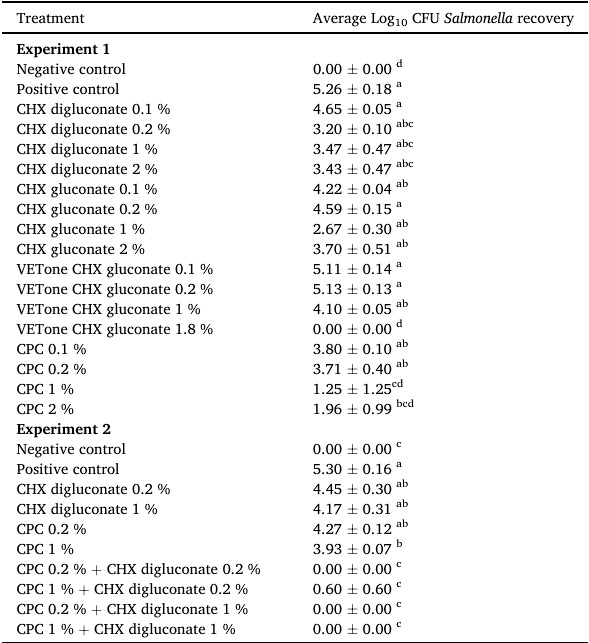
CHX salts were tested at and above concentrations indicated to be moderately effective at reducing Salmonella recovery by Barnhart et al. (1999) to determine if an increased concentration would be more effective. CPC was used at these same concentrations to act as a direct comparison to the CHX salt treatments. Table 1summarizes the average recovery of Log10 ST after 2 h of incubation at 37◦C in the respective treatment in in vitro crop experiments 1 and 2. Although many of the treatments caused numerical reduction of 1 Log10 CFUs or greater of ST recovery, the treatments containing 1.8 % the VETone CHX gluconate, 1 % CPC or 2 % CPC are reported to have caused significant reduction in recovery when compared to the positive control. For the treatment containing 1.8 % VETone CHX gluconate, there was no detectible ST recovery. CHX +CPC combinations were further evaluated, and we determined that although bacterial recovery was eliminated when used at 0.2 %, bactericidal effects diminished markedly at 0.1 % CHX +0.1 % CPC (3.29 Log10 CFU/mL recovered at this concentration, data not shown).
Table 1
Log10 CFU recovery of ST in in vitro crop assays treated with saline, CHX (chlorhexidine) digluconate, CHX gluconate, commercial CHX gluconate and CPC (cetylpyridinium chloride) at 0.1 %, 0.2 %, 1 %, 1.8 % and 2 % concen tration after 2 h incubation at 37◦C.
Data expressed as mean ±SE. Data were analyzed by ANOVA, further separated by post hoc Tukey HSD range test. N =3 replicates for experiment 1 and n =5 replicates for experiment 2. a-d Values within the same column and experiment that do not share a common letter differ significantly (p < 0.05). N =3 replicates for experiment 1 and n =5 replicates for experiment 2.
It’s important to note that with the serial dilution and drop plate method, the limit of detection is 500 CFUs/mL, or about 2.7 Log. Therefore, it is possible that some undetectable ST remained in the treatment tubes. However, this is still a meaningful reduction as ST causes illness at relatively high doses at 10 10 6–10 8 CFUs (Antunes et al., 2016). To be implemented as a crop treatment intervention prior to slaughter, effective concentrations may be too high to be safely administered to poultry as ST elimination occurred at 0.2 % CHX + 0.2 % CPC. Literature shows that CHX at this concentration is utilized in mouthwash that is used briefly (30 s) in the mouth, but not intended to be ingested (Poppolo Deus and Ouanounou, 2022). As such, administration at an efficacious dose, product safety, regulations, and voluntary consumption by poultry remain potential pitfalls for future implementation. However, as synergistic effects between CPC and CHX have been demonstrated here, it’s possible that additional ingredients can strengthen their antibacterial effects and decrease the dosage needed to be effective. This is exemplified by the treatment containing 1.8 % VETone CHX gluconate in experiment 1, which at a lower concentration than the treatments containing 2 % CHX gluconate and 2 % CHX digluconate, completely inhibited ST recovery. Therefore, we can reasonably conclude that additional ingredients have an impact on ef f icacy. These avenues should be explored, as the CHX + CPC combination is promising, either for use as an antemortem crop treatment or for other antibacterial purposes.
Disclosures
The authors declare that they have no known competing financial interests or personal relationships that could have appeared to influence the work reported in this paper.