I. INTRODUCTION
In the last century, human ingenuity led to the identification and then exploitation of antimicrobial agents. Their use has had huge impacts by helping in the control of bacterial diseases, improving health, and enhancing productivity in agriculture. Unfortunately, this monumental success has eroded over time, with exposure of the microbiome to antimicrobials having selected for survivors that are inherently resistant or that have developed or acquired mechanisms to circumvent the activities of the antimicrobials. This antimicrobial resistance (AMR) continues to increase, and has become a serious, long-term concern for human and animal health worldwide [World Health Organisation 2019]. For example, in 2019, almost one million human deaths globally were attributed to the occurrence of AMR in just six bacterial species: Escherichia coli, Staphylococcus aureus, Klebsiella pneumoniae, Streptococcus pneumoniae, Acinetobacter baumannii, and Pseudomonas aeruginosa (Antimicrobial Resistance 2022). In the absence of a concerted global effort to curb the development and spread of AMR, and to develop new antimicrobials and alternative means to control infections, these figures are predicted to increase to more than 10 million deaths/year by 2050, with a cumulative economic impact of 100 trillion USD (O'Neill 2016).
Unfortunately, the development pipeline for new antimicrobials in human medicine is stagnating, due to high development costs and the extended timelines required to get new drugs to market. Worryingly, 15 of the 18 largest pharmaceutical companies in the world have discontinued their research and development programs on antimicrobials over the last three decades (Dutescu and Hillier 2021, Gotham, Moja et al. 2021). Consequently, it is more important than ever to minimise the emergence and spread of AMR, and to conserve our arsenal of medically important antimicrobials – through appropriate use of antimicrobials in human and animal health, and antimicrobial stewardship. To achieve this, it is essential to adopt a “One Health” approach that considers and balances human, animal and environmental health needs.
The use of antimicrobials to support animal and plant health and productivity has generated, and selected for, antimicrobial resistant organisms that pose significant potential risks to human health, and that may limit therapeutic options for the treatment of human disease (World Health Organisation 2019). These may include resistant zoonotic pathogens that can spread directly to humans, or resistant commensal or environmental organisms from which antimicrobial resistance genes may spread to pathogens. These considerations mean that surveillance programs for AMR are essential for identifying emerging AMR in the veterinary and food production industries, since their transmission to humans through the food chain would pose significant risks. Of particular concern is the identification of bacteria that are resistant to critically important antimicrobials (CIAs), including extended-spectrum cephalosporins (ESCs), fluoroquinolones (FQs) and carbapenems, which are considered to be the highest priority antimicrobials for therapeutic use in humans. This threat of resistance moving through the food chain has led to the use of CIAs being restricted to human therapeutic purposes in many countries (Tang, Caffrey et al. 2017).
Increasing levels of resistance to CIAs in isolates from food production animals, including indicator organisms such as E. coli, have been identified globally. For example, a 2022 French study reported the detection of colistin-resistant E. coli in 16.5% of veal calves (n=170) (Um, Dupouy et al. 2022), and the Danish Integrated Antimicrobial Resistance Monitoring and Research Programme (DANMAP) reported a 16% prevalence of FQ-resistant E. coli in broiler chickens (DANMAP 2020). Similarly, national monitoring data from the USA revealed 3.5% of pigs carried FQ-resistant E. coli (FDA, 2022). In contrast, data from the Australian livestock sector has shown more favourable results when it comes to the CIAresistant colonisation of food producing animals (Abraham, Groves et al. 2014, Abraham, Jordan et al. 2015, Al-Habsi, Jordan et al. 2018, Kidsley, Abraham et al. 2018, Sodagari, Mohammed et al. 2019, Barlow, McMillan et al. 2022). Several factors have influenced this situation, including Australia’s isolated geographic location, long-term regulatory constraints on the use of CIAs in food animals (Australian Strategic and Technical Advisory Group on Antimicrobial Resistance (ASTAG) 2018), and strict border control and quarantine programs, which have reduced the impact of AMR against CIAs in Australia (Turner 2011). The Australian livestock industry has a strong focus on vaccination and animal welfare programs, including a regulatory focus on eliminating chemical residues from animal products, so in some areas the impact of bacterial diseases is minimised. In the commercial layer industry, hens producing eggs for human consumption are completely spared exposure to antimicrobials that might otherwise result in accumulation of residues in eggs.
Eggs produced by commercial layer hens and chicken meat are two of the most frequently consumed animal products around the world. In Australia, the demand for eggs and chicken meat has been increasing steadily for the past decade, with on average each person consuming 246 eggs (Australian Egg Industry 2022) and 50 kg of chicken meat per year (The Australian Chicken Meat Federation 2023). Unfortunately, poor food handling and/or hygiene practices in some domestic and commercial establishments has led to outbreaks of foodborne illness associated with poultry products. Typically, infection is with zoonotic foodborne pathogens such as Salmonella and Campylobacter, and with non-pathogenic commensal bacteria, such as Enterococci and E. coli. (Chousalkar and Gole 2016). Where these organisms show AMR, then human treatment is made more difficult, and resistance traits may be spread to other potential pathogens, increasing the risk to human health via the food chain (de Mesquita Souza Saraiva, Lim et al. 2022).
II. SURVEILLANCE OF ANTIMICROBIAL RESISTANCE
The cornerstone of national and international efforts to address AMR is antimicrobial stewardship – programs and activities designed to halt the emergence and spread of resistance in animal and human populations (Food and Agriculture Organisation of the United Nations , World Organisation for Animal Health 2022, World Health Organization 2023a,b). Surveillance for AMR can help to identify emerging AMR and provide valuable feedback on how to ensure stewardship programs are effective. Surveillance for AMR in food producing animals and food is a well-established activity and the World Health Organisation has longstanding recommendations for performing ‘integrated AMR surveillance’ as part of the multifaceted management and control of AMR (World Health Organization 2019, 2023a, b). Surveillance of antimicrobial resistance is necessary to; i) Assess trends in and sources of AMR, ii) Detect the emergence of new AMR mechanisms, iii) Support risk analysis, iv) Provide a basis for policy, v) Evaluate and inform antimicrobial use, and vi) Assess efficacy of interventions (World Organisation for Animal Health 2022).
Countries such as the USA, Canada and Denmark have been proactive and at the forefront of AMR surveillance in livestock and food. A core component is the collection and analysis of data relating to the AMR profile of indicator bacteria (such as E. coli and Enterococci) and foodborne zoonotic pathogens such as Salmonella and Campylobacter from both livestock and food products. All these bacterial species may reside in the gastrointestinal tract of healthy animals and birds, although occasionally they may cause disease in these hosts. Australia does not have a formal AMR surveillance program in livestock yet; however, it has undertaken AMR surveys in livestock, including poultry. Some of the key findings from these surveys on indicator and zoonotic bacteria from Australian poultry are described below.
a) Escherichia coli
Escherichia coli is used as one of the key indicator organisms for AMR detection in animals, food and humans. This is due to its commensal nature and abundance in the intestines of warmblooded animals (Aarestrup, Bager et al. 1998). Acquired antimicrobial resistance is common among E. coli, and mobile AMR determinants (transposons, plasmids and integrons carrying genes encoding AMR) are readily acquired and shared within E. coli and closely related commensal and pathogenic Gram-negative bacterial species (particularly in the gut) (Mukerji, O'Dea et al. 2017). As such, antimicrobial resistance among E. coli may be used as a marker to reflect overall resistance in animals (European Food Safety Authority, 2012).
Studies have indicated that resistance to CIAs among E. coli from Australian livestock is relatively low compared to other countries (Abraham, Groves et al. 2014, Barlow, McMillan et al. 2015, Mukerji, O'Dea et al. 2017, Barlow, McMillan et al. 2022), with a 2020 Australian survey of healthy commercial laying hens supported this status (Australian Eggs 2021). In this study, E. coli isolates (n=296) from the faeces of healthy commercial laying hens were collected from 62 farms; 53% of the isolates were found to be susceptible to all antimicrobials tested, whilst all isolates were susceptible to the CIAs cefoxitin, ceftiofur, ceftriaxone, chloramphenicol and colistin. Relatively low frequencies of resistance were observed to amoxicillin-clavulanate (9.1%), ampicillin (16.2%), ciprofloxacin (2.7%), florfenicol (2.4%), gentamicin (1.0%), streptomycin (4.7%), tetracycline (37.8%) and trimethoprim/sulfamethoxazole (9.5%). Multi-drug resistance (MDR) was observed in 21 isolates (7.0%), with one isolate exhibiting resistance to four antimicrobial classes. This study confirmed that E. coli isolated from layer hens in Australia have low rates of AMR, and that strict control on antimicrobial usage – through regulation and voluntary measures – is likely to be contributing to this encouraging result.
Rates of AMR among isolates from Australian commercial meat chickens are also generally low in comparison to the situation in other countries (ACMF 2018). Using a robotic antimicrobial susceptibility platform (RASP) in a large-scale survey conducted in 2022, 56.8% of recovered E. coli isolates were susceptible to all antimicrobials tested, and no clinical resistance to third generation cephalosporins was detected (Australian Chicken Meat Federation 2022). Resistance to the fluoroquinolone (FQ) ciprofloxacin was detected in 96 isolates (3.25%), with 32 isolates (1.2%) showing clinical resistance. MDR was only present in 2.92% of E. coli isolates. Since FQs are not approved for use in the Australian commercial chicken meat industry, these isolates were investigated further. Sequencing identified mutations related to quinolone resistance in 25/32 clinically resistant isolates. E. coli belonging to sequence type (ST) ST354 (n=16) and ST773 (n=7) were the dominant FQ-resistant E. coli clones, and these clones are globally disseminated in different host species (Australian Chicken Meat Federation 2022). Considering the global prevalence of these FQ-resistant strains, and the fact that FQs are not used in the Australian chicken meat industry, it is likely that the strains have been introduced through an external source. This warrants further investigation into the potential origins of these resistant microorganisms, and the introduction of resistant indicator commensal bacteria into the Australian poultry sector.
b) Enterococcus sp.
Enterococci are commonly present bacteria in the gastrointestinal microbiota of mammals and birds, and generally act as harmless commensals. Nevertheless, certain Enterococci can act as opportunistic pathogens, leading to invasive infections of varying severity in both humans and animals (Byappanahalli, Nevers et al. 2012). In Europe, use of avoparcin (a glycopeptide antimicrobial similar to vancomycin) as a growth promoter in animal feed was implicated in an increase in vancomycin-resistant Enterococcus faecium (VRE) colonization in livestock (Bager, Madsen et al. 1997). At this time it was thought that a transfer of resistant strains to humans was occurring from livestock; however, while subsequent studies have identified some genetic similarities between Enterococci from human and livestock sources, and have explored the potential for zoonotic transmission, concrete evidence supporting this transmission has been limited. Rather, it is thought that the routine use of vancomycin in the public health system is responsible for the elevated prevalence of VRE in hospitals. Consistent with this, a 2016 study performed on Enterococci from Australian meat chickens found clinical resistance to a number of different antimicrobials, but it did not identify any resistance to vancomycin (O'Dea, Sahibzada et al. 2019). Moreover, E. faecium from meat chickens were found to be genetically distinct from hospital-adapted strains. Another survey across the Australian egg industry conducted in 2020 similarly revealed an absence of VRE among Enterococcus isolates (E. faecium, n=80; Enterococcus faecalis, n=135) (Australian Eggs 2021). In this study, 31.3% of E. faecium and 39.3% of E. faecalis isolates displayed phenotypic susceptibility to all antimicrobials tested. Only one E. faecium and three E. faecalis isolates displayed an MDR phenotype. All tested E. faecium isolates from egg laying birds were susceptible to benzylpenicillin, chloramphenicol, daptomycin, gentamicin, linezolid, teicoplanin, vancomycin, and virginiamycin. Resistance was detected against ampicillin (5.1%), erythromycin (22.5%), and tetracycline (58.8%). Importantly, none of the resistant isolates belonged to the major STs associated with sepsis in humans in Australia in 2015-2017 (O'Dea, Sahibzada et al. 2019, Lee, Jordan et al. 2021) . The E. faecalis isolates showed resistance to tetracycline (57%), ampicillin (1.5%), chloramphenicol (1.5%), erythromycin (11.9%), linezolid (0.7%) and streptomycin (1.5%), but none demonstrated resistance to benzylpenicillin, daptomycin, gentamicin, teicoplanin, vancomycin or virginiamycin.
The most recent Australian chicken meat AMR survey on Enterococci (E. faecium n=147, E. faecalis n=24) conducted in 2022 also confirmed the absence of VRE and linezolid resistant Enterococci from chicken meat birds (Australian Chicken Meat Federation 2022). More than half of the E. faecium (64.6%) isolates were susceptible to all antimicrobials tested. In a similar trend to the 2016 survey (O'Dea, Sahibzada et al. 2019), resistance levels to erythromycin (5.4%) and quinupristin-dalfopristin (6.1%) continued to decrease while very low levels of resistance to virginiamycin (2.7%) were detected. The most common resistance was to tetracycline (30.6%), but this figure was also lower than in the 2016 study (40.3%). Among the E. faecalis isolates (n=24), the prevalence of tetracycline resistance was 87.5%, and erythromycin resistance was 41.7%. However, the low the number of isolates examined makes it difficult to make broad conclusions from these data.
c) Salmonella enterica
Salmonella enterica is one of the key zoonotic pathogens causing gastrointestinal diseases in humans and animals (Gupta, Fontana et al. 2003, Lan, Reeves and Octavia 2009). The emergence of MDR S. enterica in livestock is a major threat to animal and human health (Gupta, Fontana et al. 2003), especially when it involves serovars able to cause severe human illness. Salmonella from livestock regularly enter the food chain due to post-processing contamination and subsequently pose a risk of human illness due to their zoonotic potential. As a result, any emergence or magnification of AMR, particularly against CIAs, in the source population of animals represents an elevated threat to human health. Consequently, surveillance for Salmonella is routinely performed to evaluate the public health risk from both an AMR and a food safety (zoonotic pathogen) perspective.
Recent studies have demonstrated that there are very low levels of AMR in Salmonella from Australian livestock, including an absence of resistance to CIAs. To date, no resistance to colistin or carbapenems in Salmonella from Australian pigs, sheep or cattle has been reported, with resistance to FQs and ESCs being rare (0–3%) (Abraham, Groves et al. 2014, Barlow, McMillan et al. 2015, Kidsley, Abraham et al. 2018). A 2021 Australia-wide study of the commercial egg layer industry found that all 307 S. enterica subspecies enterica isolates obtained were susceptible to amoxicillin-clavulanate, azithromycin, ceftiofur, ceftriaxone, ciprofloxacin, colistin, florfenicol, gentamicin, kanamycin, and trimethoprimsulfamethoxazole. Low levels of resistance to streptomycin (2.3%, n=7), sulfisoxazole (2.0%, n=6), chloramphenicol (1.3%, n=4), tetracycline (1.0%, n=3), ampicillin (2/307; 0.7%) and cefoxitin (2/307; 0.7%) were detected (Veltman, Jordan et al. 2021). Only two isolates were MDR, and no resistance to highest priority CIAs were detected. These extremely low levels of AMR reflect Australia's conservative antimicrobial registration policy in food-producing animals and low rates of antimicrobial use within the industry.
As with the results from the Australian layer bird study, Salmonella isolates from Australian meat chickens sampled in 2016 lacked resistance to most antimicrobials tested (Abraham, O'Dea et al. 2019, Australian Chicken Meat Federation 2022). The isolates (n=53) were susceptible to ceftiofur, chloramphenicol, ciprofloxacin, colistin, florfenicol, gentamicin and tetracycline. A few of the isolates exhibited resistance to streptomycin (1.9%), ampicillin (3.8%), or cefoxitin (11.3%). Of note, AMR was only detected among Salmonella sofia serovars. None of the Salmonella isolates exhibited an MDR phenotype. Whole genome sequencing did not identify any known resistance mechanisms for the Salmonella isolates that demonstrated resistance to cefoxitin. In a subsequent 2022 chicken meat survey, despite using the same sample size and bacterial isolation technique, only nine Salmonella isolates were recovered, and all were susceptible to all antimicrobials that were tested (Australian Chicken Meat Federation 2022).
d) Campylobacter sp.
Campylobacter infection is one of the leading causes of gastroenteritis in humans, often stemming from the consumption of inadequately cooked poultry. The two major species of concern are Campylobacter jejuni and Campylobacter coli, which have overtaken Salmonella as the key foodborne bacterial pathogens worldwide (European Food Safety, European Centre for Disease and Control 2022). While most cases of human illness resolve on their own, a small percentage of infections necessitate antimicrobial intervention, and a few patients may develop neurological complications. In instances where antimicrobials are required, antimicrobials such as FQs (ciprofloxacin) and macrolides (erythromycin) are recommended for treatment (RuizPalacios 2007, Luangtongkum, Jeon et al. 2009). In the past decade global rates of resistance to first line antimicrobials (tetracyclines) and CIAs (FQs and macrolides) have been on the increase among Campylobacter sp. This increasing resistance has contributed to heightened concerns around antimicrobial efficacy for Campylobacter infections, resulting in major public health concern worldwide (Ruiz-Palacios 2007, Luangtongkum, Jeon et al. 2009).
An Australian national survey of AMR in Campylobacter isolates from meat chickens sampled in 2016 identified low rates of AMR (Abraham, Sahibzada et al. 2020). The survey revealed that most C. jejuni (63%) and C. coli (86.5%) samples were susceptible to all antimicrobials tested. However, this study uniquely reported the emergence of FQ resistance among C. jejuni (14.8%) and C. coli (5.4%) in the absence of direct FQ use in the Australian industry (Abraham, Sahibzada et al. 2020). Genomic analysis revealed that FQ-resistant isolates belonged to globally disseminated clones which had been previously reported in humans and animals in other international studies. These included ST7323, ST2083, and ST2343 for C. jejuni and ST860 for C. coli. Various factors, including the low level of resistance to other antimicrobials, the absence of FQ use in the Australian chicken meat industry, the adoption of measures for preventing spread of contagion between flocks, and particularly the genomic identities of isolates, all point to the hypothesis that the most plausible source of these resistant microorganisms in Australian chickens is external, possibly originating from humans, pest species, or wild birds.
A follow up chicken meat survey conducted in 2022 (Australian Chicken Meat Federation 2022) reported similar result to the 2016 study (Abraham, Sahibzada et al. 2020, Australian Chicken Meat Federation 2022). The majority of Campylobacter sp. isolated in this study were susceptible to all antimicrobials tested (68.7% of C. jejuni and 88.9 % of C. coli). All isolates were susceptable to azithromycin, chloramphenicol, clindamycin, erythromycin, florfenicol and gentamicin, with no MDR detected. The most commonly detected antimicrobial resistance was to the FQ ciprofloxacin, (24.4% C. jejuni; 3.2% C. coli), nalidixic acid (21.7% C. jejuni; 4.8% C. coli) and tetracycline (18.3% C. jejuni; 1.6% C. coli). All isolates showing ciprofloxacin resistance had mutations known to confer resistance to quinolones. However, FQs are not used in the animal production industry in Australia, so the observed levels of resistance to ciprofloxacin (~25%) in C. jejuni are unexplained and concerning. This finding emphasizes the need for ongoing enhanced surveillance among indicator and zoonotic bacterial species: sampling along the food chain helps to understand the origin and dissemination of unusual forms of resistance, and it allows mitigation of risks of AMR to protect public health. Overall, the low AMR rates found in these zoonotic pathogens underscores the efficiency of Australia’s AMR stewardship in the Australian chicken meat industry.
III. AMR BIOSECURITY CHALLENGES FROM WILD BIRDS AND HUMANS: A ONE HEALTH CHALLENGE
In recent years, studies have demonstrated that wild birds sharing proximity to humans may act as potential reservoirs for the amplification and transmission of resistant bacteria (Mukerji, Stegger et al. 2019, Mukerji, Gunasekera et al. 2020, Mukerji, Sahibzada et al. 2023). In Australia, studies on silver gulls identified the carriage of CIA-resistant E. coli across urban locations in various States (Mukerji, Stegger et al. 2019). High levels of CIA-resistance to ESCs (21.7%), and FQs (23.8%) were observed in isolates from the gulls, with carbapenem and colistin resistance observed at lower frequencies. Genomic analysis of the CIA-resistant E. coli identified them as predominantly clinically significant extra-intestinal pathogenic E. coli (ExPEC) clones with significant overlap with human clinical isolates. This indicated the existence of a potential bi-directional transmission or an undetermined reservoir connecting both species. The proximity of gulls to humans, their foraging habits (including feeding on human leftovers), and access to human waste, wastewater, and livestock waste were recognized as key factors predisposing gulls to act as major carriers of CIA-resistant E. coli. These findings have been validated by other Australian reports (Dolejska, Masarikova et al. 2016, Mukerji, Gunasekera et al. 2020, Wyrsch, Nesporova et al. 2022, Mukerji, Sahibzada et al. 2023), indicating that wild urban birds are a mobile potential ecological reservoir for E. coli isolates that are resistant to last-line drugs, and as such they represent a significant biosecurity concern for livestock and poultry, as well as humans.
Recent AMR surveys addressing various food animal systems have demonstrated recurring evidence of human to animal transmission of AMR (HAT-AMR) or bird to animal transmission of AMR (BAT-AMR), which may or may not involve passage through the environment (Abraham, Jagoe et al. 2017, Sahibzada, Abraham et al. 2017, Abraham, Sahibzada et al. 2020). Examples include the detection of human derived methicillin resistant Staphylococcus aureus (MRSA) ST93 in Australian pigs and cattle attributed to reverse zoonosis, and the detection of FQ-resistant C. jejuni and C. coli in Australian poultry in the absence of direct antimicrobial use.
These related issues challenge our understanding about how AMR to CIAs enters, evolves, and persists in food animals, particularly where those drugs have little or no use in the production animal system under question. The biology of both HAT-AMR and BAT-AMR needs to be clarified further due to their potential to impact on animal health, public health and perceptions about the safety of animal food products. We are already aware of instances where human-derived bacteria that are resistant to CIAs have become established in food producing animals, and then caused disease amongst in-contact humans (Groves, O'Sullivan et al. 2014, Sahibzada, Abraham et al. 2017, Abraham, Sahibzada et al. 2020).
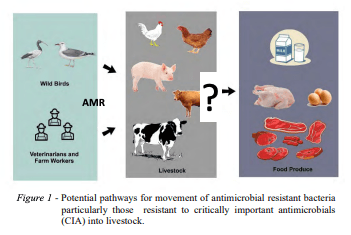
AMR is a complex, multifactorial issue and it is fortunate that the advancement in genomic sequencing technology has improved our understanding of multi-directional movement of resistance between isolates from humans, animals, wildlife and the environment as summarised in Figure 1. This potential for transmission highlights the need for better understanding of AMR from a One Health perspective. Management of these risks requires a broader understanding of the pathways and processes by which animals and products become infected (or contaminated) with isolates showing forms of AMR that would not normally be expected to be present (aberrant resistance).
IV. CONCLUSIONS
The results of the above Australian studies have demonstrated that the responsible use of antimicrobials has helped to ensure that levels of AMR to high and medium importance CIAs remain low in the Australia egg layer and chicken meat industries. This reflects the commendable way that Australia has adopted a One Health approach in tackling the problems of AMR, taking coordinated action across all sectors where antimicrobials are used in the country, as well as coordinating closely with global action. Future work on AMR in poultry in Australia should focus on understanding antimicrobial usage in the industries, identifying the pathways driving AMR, including possible alternative routes for AMR transmission into flocks, and devising measures that can be taken to reduce the presence of resistant bacteria. Apart from regulated exclusion of CIAs from most aspects of livestock production, vaccination against key bacterial pathogens and stringent biosecurity are likely to have contributed to the favourable AMR status of the Australian chicken meat and egg industries. Nevertheless, industry and government agencies need to proactively monitor AMR and promote antimicrobial stewardship to ensure the long-term protection of both animal and human health.
Presented at the 35th Annual Australian Poultry Science Symposium 2024. For information on the latest and future editions, click here.