Introduction
Increasing the efficiency of protein utilization is an important issue in livestock for production. Apart from the cost of protein (the input side), the issue is also driven to reduce nitrogen excretion (the output side) to limit the environmental impact of livestock production. The quantitatively most important role of dietary protein is to provide the amino acids for animal-derived products, such as meat, milk, and eggs. The similarities in the amino acids composition of these products is not surprising because, to some extent, they serve the same biological purpose. Meat originates from muscle, but milk is provided by the mother to the young to grow (muscle). Similarly, the amino acids in egg yolk and egg white are there to be used by the embryo to develop (muscle).
The amino acid composition of plant proteins can differ from what the animal needs, and the amino-group of amino acids that are not incorporated in animal protein will be removed and the carbon chain can be used for other purposes. Some of these amino-groups can be used to synthesize non-essential amino acids, but the remainder will be excreted by animal as ammonia (fish), urea (mammals), or uric acids (birds). At least 30% of the nitrogen of dietary protein will be excreted by the animal.
The nitrogen that is lost also represents an energy loss for the animal. The gross energy values for ammonia, urea, and uric acid are 91.5, 75.9, and 114.7 kcal/g N, respectively, and this energy loss is accounted for in the metabolizable energy value of the diet (van Milgen, 2021). While it does not require additional energy to make ammonia, it is often ignored that energy is required to synthesize urea and uric acid. Part of that energy is retained in the excretion product (and thus accounted for in the ME value), but part of it is lost as heat. The latter is part of the heat increment and thus part of the NE value of protein.
The urea “cycle” in mammals and birds
Hans Krebs (1900-1981) is well-known for the discovery of the so-called Krebs or TCA cycle to produce ATP from acetyl-Co. It is much less known that Krebs also contributed to the discovery of the urea and uric acid cycles. Consequently (and to look smart), if someone says “It is used in the Krebs cycle”, respond by saying “which Krebs cycle?”
Figure 1. The urea cycle: urea (the output) contains two nitrogen and one carbon atom, which are input by the metabolites with a yellow and brown background, respectively. Its costs 9.63 kcal/g N to synthesize urea, 56% of which is retained in the product and 44% is released as heat. Birds cannot synthesize carbamoyl phosphate, but they possess the other reactions of the urea cycle.
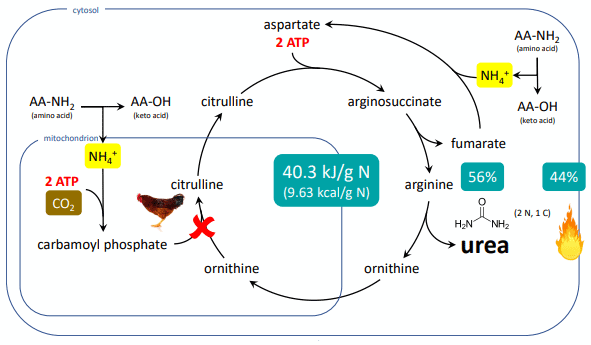
Urea is a relative molecule and contains two nitrogen and one carbon atom (Figure 1). One nitrogen and the carbon enter the cycle as carbamoyl-phosphate. The other nitrogen enters the cycle as aspartate the carbon of which leaves the cycle as fumarate (which can be used to resynthesize aspartate by accepting an amino group from another amino acid given in excess). Arginine is an intermediate metabolite in the urea cycle. Birds cannot synthesize arginine because they lack the enzyme to synthesize carbamoyl-phosphate. They therefore have a dietary requirement for arginine. Because muscle protein contains approximately equal quantities of lysine and arginine, the recommended level of arginine, relative to lysine, is around 100% in birds, while it is around 42% in pigs (because pigs can make arginine).
Although one can say that “birds not have a urea cycle”, this does not mean that they do not use certain elements of the urea cycle. They lack only one reaction (the enzyme to synthesize carbomoyl-phosphate) of the cycle, but they can use all other reactions including the synthesis of arginine from citrulline The word “citrulline” is derived from the Latin word for watermelon. From the experience I have with my backyard chickens (n=2), I can tell you that they love watermelon and its rind. Citrulline is also synthesized by when arginine is used to synthesize nitric oxide, a vasodilator, and this citrulline can be used to resynthesize arginine. It is thus not correct to say that birds “cannot synthesize arginine”, because they do (from citrulline), but they do not possess the complete urea cycle.
The uric acid “cycle” in mammals and birds
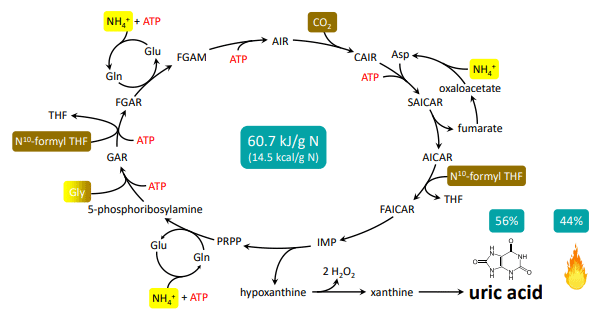
Birds and reptiles excrete nitrogen via the uric acid cycle, which is shown in Figure 2. Uric acid contains four nitrogen and five carbon atoms. Two nitrogen atoms enter the cycle as glutamine, one as aspartate (like in the urea cycle), and one nitrogen comes in from glycine. Glycine also provides two of the five carbon atoms, and the three remaining carbon atoms originate from CO2 and N10 -formyl-THF. The latter is a so-called one-carbon metabolite linked to tetrahydrofolate, derived from folic acid (vitamin B9).
Figure 2. The uric acid cycle: uric acid (the output) contains four nitrogen and five carbon atoms, which are input by the metabolites with a yellow and brown background, respectively. Its costs 14.5 kcal/g N to synthesize urea, 56% of which is retained in the product and 44% is released as heat. Mammals also use (part of) the uric acid cycle to synthesize purine (i.e., AMP and GMP) from IMP (inosine monophosphate).
Hydroxyxanthine is the output of the uric acid cycle, which can be metabolized further to uric acid. It costs 14.5 kcal/g N to synthesize uric acid, 56% of which is retained in uric acid and 44% is released as heat (van Milgen, 2021).
Although poultry nutritionists acknowledge that glycine is required for uric acid synthesis, the fact that two of the five carbons come from N10 -formyl-THF is frequently ignored. However, part of the energy retained in uric acid originates from N10 -formyl-THF. The metabolism of 1-carbon metabolites is receiving more attention (e.g., in cancer research). Methionine is an important 1- carbon carrier in methylation reactions (e.g., to methylate Arg and Lys in histones and in epigenetics). Although methionine is a 1-carbon carrier, it is not necessarily the dietary source of 1-carbon. One-carbon originates from the catabolism of betaine (and thus from choline), tryptophan, and histidine. It also originates from methionine when methionine is used for cysteine synthesis (e.g., for the synthesis of feathers). Serine and glycine are also involved in the synthesis of 1-carbon metabolites and constitute the main route of 1-carbon synthesis and metabolism.
Although mammals do not use the uric acid cycle to excrete excess nitrogen from protein, they use almost all of the uric acid cycle for other, critically essential processes. IMP (inosine monophosphate) is the precursor of the purines AMP and GMP, and thus for ATP and GTP. These purines are also the backbone of DNA and RNA. It is thus not too difficult to see the importance of the uric acid “cycle” for all organisms, and also illustrates the importance of glycine and 1- carbon metabolism. To synthesize IMP, PRPP (phosphoribosyl pyrophosphate) is required, which can be synthesized from glucose. Although the animal possesses mechanisms to efficiently “recycle” the purines and pyrimidines, they are also catabolized, resulting in excretion products uric acid and allantoin.
These examples show that both mammals and bird possess (almost) all of the reactions of the urea and uric acid cycle, but that small differences can result in important physiological differences in excreting nitrogen from excess dietary protein. As animal nutritionists, it is equally important to see and manage these differences as it is to see the commonalities.
Presented at the 2024 Animal Nutrition Conference of Canada. For information on the next edition, click here.