The use of more circular diets in pig production – consequences and challenges
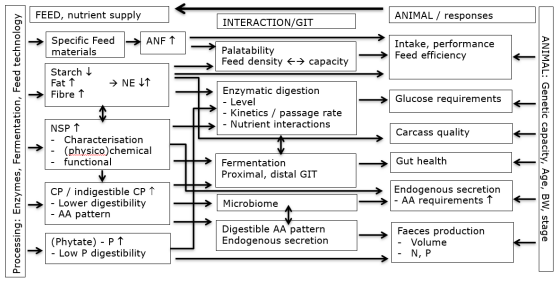
Production of foods for humans has a major impact on environmental emissions, climate change and land-use. To reduce the impact, and minimize feed-food competition, implementation of the concept of circularity of food production will become increasingly important. In circular food systems, crop land is primarily used for plant-based food production, while by-products from food processing and biofuels i.e. crop residues, co-products of the food industry, grass from marginal land and food waste will be used to formulate diets for production animals. These ingredients generally contain less starch and fat (energy), are variable in protein content and, when of plant origin, contain more fibre and phytate compared to conventional feed ingredients. Use of more circular diets in pig production will have consequences for nutrient composition of the diet and their consumption by pigs might reveal physiological limitations related to digestion and postabsorptive metabolism. The use of circular diets will also direct more efforts towards processing of by-products and complete diets to maximize their nutritional value and minimize the environmental imprint. The potential challenges and consequences in formulating and using circular diets will be discussed from a nutritional, physiological, nutrient efficiency, health and welfare perspective.
Keywords: pigs, circular food production, by-products, nutrient efficiency, health
Introduction
More circular feed ingredients in pig diets
Further processing of circular ingredients and diets
Conclusions
Acknowledgements
Adeola O, Cowieson A.J., 2011. Opportunities and challenges in using exogenous enzymes to improve nonruminant animal production. J. Anim. Sci. 89, 3189-3218.
Agyekum, A.K. and Nyachoti, C.M., 2017. Nutritional and metabolic consequences of feeding high-fiber diets to swine: a review. Engineering, 3, 716-725.
Aluthge, N.D., Van Sambeek, D.M., Carney-Hinkle, E.E., Li, Y.S., Fernando, S.C. and Burkey, T.E., 2019. The pig microbiota and the potential for harnessing the power of the microbiome to improve growth and health. J. Anim. Sci. 97, 3741-3757.
Aranda-Aguirre, E., Robles-Jimenez, L.E., Osorio-Avalos, J., Vargas-Bello-Pérez, E. and Gonzalez-Ronquillo, M., 2021. A systematic-review on the role of exogenous enzymes on the productive performance at weaning, growing and finishing in pigs. Veterinary and Anim. Sci. 14, p.100195.
Bach Knudsen, K.E., Hedemann, M.S. and Lærke, H.N., 2012. The role of carbohydrates in intestinal health of pigs. Anim. Feed Sci. and Techn. 173, 41-53.
Barko, P.C., McMichael, M.A., Swanson, K.S., Williams, D.A., 2018. The gastrointestinal microbiome: a review. J. Vet. Intern. Med. 32, 9-25.
Beaulieu, A.D., Williams, N.H., Patience, J.F., 2009. Response to dietary digestible energy concentration in growing pigs fed cereal grain-based diets. J. Anim. Sci. 87, 965–976.
Bikker, P. and Jansman, A.J.M., 2023. Composition and utilization of feed by monogastric animals in the context of circular food production systems. Animal, p.100892.
De Vries, S., Pustjens, A.M., Schols, H.A., Hendriks, W.H. Gerrits, W.J.J., 2012. Improving digestive utilization of fiber-rich feedstuffs in pigs and poultry by processing and enzyme technologies: A review. Anim. Feed Sci. And Techn. 178, 123-138.
Déru, V., Bouquet, A., Labussière, E., Ganier, P., Blanchet, B., Carillier‐Jacquin, C. and Gilbert, H., 2021. Genetics of digestive efficiency in growing pigs fed a conventional or a high‐fibre diet. J. Anim. Breeding and Genetics, 138, 246-258.
EU (2023). Agricultural market – EU balance sheets by sector: EU feed protein https://data.europa.eu/data/datasets/eu-feed-protein-balance-sheet?locale=en
Fassarella, M., Blaak, E.E., Penders, J., Nauta, A., Smidt, H. Zoetendal, E.G., 2021. Gut microbiome stability and resilience: elucidating the response to perturbations in order to modulate gut health. Gut 70, 595-605.
Fédération Européenne des Fabricants d’Aliments Composés (FEFAC), 2019. Resource Efficiency Champions: Co-products, an Essential Part of Animal Nutrition. FEFAC, Brussels, Belgium.
Gerber, P.J., Steinfeld, H., Henderson, B., Mottet, A., Opio, C., Dijkman, J., Falcucci, A., Tempio, G. 2013. Tackling climate change through livestock: A global assessment of emissions and mitigation opportunities. Food and Agriculture Organization of the United Nations (FAO), Rome, Italy.
Giner Santonja, G., Karlis, P., Stubdrup, K.R., Brinkmann, T., Roudier, S., 2019. Best Available Techniques (BAT) Reference Document for the Food, Drink and Milk Industries. Industrial Emissions Directive 2010/75/EU (Integrated Pollution Prevention and Control), EUR 29978 EN. Publications Office of the European Union, Luxembourg, Luxembourg. Doi: 10.2760/243911.
Lannuzel, C., Smith, A., Mary, A.L., Della Pia, E.A., Kabel, M.A. and de Vries, S., 2022. Improving fiber utilization from rapeseed and sunflower seed meals to substitute soybean meal in pig and chicken diets: A review. Anim. Feed Sci. and Techn. 285, p.115213.
Li, H., Yin, J., Tan, B., Chen, J., Zhang, H., Li, Z. and Ma, X., 2021. Physiological function and application of dietary fiber in pig nutrition: A review. Anim. Nutr., 7, 259-267.
OECD/FAO (2022). OECD-FAO Agricultural Outlook 2020-2029; OECD: Paris, France, 2020.
Pandey, S., Kim, E.S., Cho, J.H., Song, M., Doo, H., Kim, S., Keum, G.B., Kwak, J., Ryu, S., Choi, Y. and Kang, J., 2023. Swine gut microbiome associated with non-digestible carbohydrate utilization. Front Vet Sci. 2023; 10: 1231072. doi: 10.3389/fvets.2023.1231072
Parlasca, M.C. and Qaim, M., 2022. Meat consumption and sustainability. Annual Review of Resource Economics, 14, pp.17-41.
Poore, J., Nemecek, T., 2018. Reducing food’s environmental impacts through producers and consumers. Science 360, 987–992.
Puente-Rodríguez, D., van Laar, H. and Veraart, M., 2022. A circularity evaluation of new feed categories in the Netherlands—squaring the circle: a review. Sustainability, 14, 2352.
Quiniou, N., Noblet, J., 2012. Effect of the dietary net energy concentration on feed intake and performance of growing-finishing pigs housed individually. J. Anim. Sci. 90, 4362–4372.
Rauw, W.M., Rydhmer, L., Kyriazakis, I., Øverland, M., Gilbert, H., Dekkers, J.C., Hermesch, S., Bouquet, A., Gómez Izquierdo, E., Louveau, I. and Gomez‐Raya, L., 2020. Prospects for sustainability of pig production in relation to climate change and novel feed resources. Journal of the Science of Food and Agriculture, 100, 3575-3586.
Ritchie, H., Roser, M., 2019. Meat and Dairy Production. Our World in Data. 2019. Available online: https://ourworldindata.org/meatproduction
Sporchia, F., Kebreab, E. and Caro, D., 2021. Assessing the multiple resource use associated with pig feed consumption in the European Union. Science of The Total Environment, 759, p.144306.
van Helvoort, M. and Bikker, P., 2023. Bakery products and legume seeds in the diet of growingfinishing pigs. In Book of Abstracts of the 74th Annual Meeting of the European Federation of Animal Science No. 29, p. 464.
Van Zanten, H.H.E., Herrero, M., Van Hal, O., Röös, E., Muller, A., Garnett, T., Gerber, P.J., Schader, C., De Boer, I.J.M., 2018. Defining a land boundary for sustainable livestock consumption. Research review. Global Change Biology 24, 4185–4194.
Van Zanten, H.H.E., Van Ittersum, M.K., De Boer, I.J.M., 2019. The role of farm animals in a circular food system. Global Change Biology 21, 18–22.
Williams, B.A., Mikkelsen, D., Flanagan, B.M. and Gidley, M.J., 2019. “Dietary fibre”: moving beyond the “soluble/insoluble” classification for monogastric nutrition, with an emphasis on humans and pigs. J. Anim. Sci. Biotechn. 10, 1-12

















United States