Key information
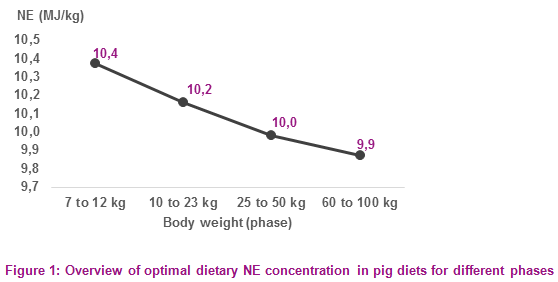
- Based on the results of published literature, the dietary net energy (NE) concentrations to optimize growth performance of pigs with average body weight of 7 to 12 kg, 10 to 23 kg, 25 to 50 kg and 60 to 100 kg fed low protein diets are 10.4, 10.2, 10.0 and 9.9 MJ/kg (2.48, 2.43, 2.39, 2.36 Mcal/kg), respectively.The estimates of corresponding optimal standardized ileal digestible (SID) Lys:NE ratio for 7 to 12 kg, 10 to 23 kg, 25 to 50 kg and 60 to 100 kg pigs are 1.37, 1.31, 1.05 and 0.83 g/MJ, respectively.
- Growth responses of pigs fed diets with adequate Lys level are greater than pigs fed Lys-deficient diets even though diets were balanced for the same SID Lys:NE ratio. This suggests that balancing for an adequate Lys level is more crucial and it may not be appropriate to maintain the same SID Lys:NE ratio in pig diets when SID Lys levels are different in these diets.
- The NE requirement estimates presented in this review article are slightly lower than current recommendations for NE (AMINOPig®). One possible reason is that today’s pigs with a greater lean protein gain and less body fat would need somewhat lower NE compared with their counterparts with greater body fat, because energy requirements for retained protein are about 1.7 times lower than the same unit of body lipids. Furthermore, pigs fed with reduced protein diets require less energy for the breakdown of excess protein.
- More research is needed into energy nutrition of pigs to better understand under which dietary conditions the dietary NE level affects feed intake, body weight gain or gain:feed, and if the different sources of energy (starch, fiber, protein or lipids) influence these parameters.
Introduction
To achieve maximum growth rate, adequate dietary supply of amino acids (AA), particularly lysine (Lys), is important because it is the first limiting AA in typical pig diets. Through continuous selection for lean gain, modern pigs are leaner and have a greater gain:feed (G:F) ratio compared with pigs of over a decade ago (CCSI, 2010). Because the main role of Lys is for body protein synthesis, an increase in lean gain of pigs means that these pigs need more Lys to meet their genetic growth potential. Indeed, an increased Lys requirement has been reported for pigs of different body weight (BW) ranges (Kim et al., 2011; Nemechek et al., 2012; NRC, 2012).
Energy is not a nutrient per se, but it is required for metabolic processes, and it is associated with the nutrient content of the diets. Dietary energy density can influence the control of feed intake of pigs. Because the intake of feed can be influenced by the energy density of the diets, some nutritionists maintain an optimum Lys to energy ratio in different phases of swine diets. Increasing the dietary net energy (NE) concentration increases energy intake, body deposition rate and content of lipid but not protein deposition rate (Oresanya et al., 2008). This also means that changes in dietary energy concentration alter the composition of gain without necessarily changing overall BW gain.
The energy requirement for 1 g of retained lipids (9.46 kcal/g) is about 1.7 times greater than that of 1 g retained protein (5.66 kcal/g) in pigs (Ewan, 2001). Increased fat content in the body leads to an increased energy requirement per unit of BW gain. This also means that today’s pigs, with a greater lean protein gain and less body fat, would need less energy for a given amount of BW gain compared to their counterparts with greater body fat.
Energy is important because it is the most expensive portion of the feed, and it can affect feed intake, nutrient utilization, and therefore animal performance. Our current understanding of energy nutrition is not at the same level as for AA nutrition in pigs. Among the energy systems for pigs, NE is the closest estimate of the energy that is actually available to the pigs because it considers heat loss associated with metabolism and ensures a more consistent growth and carcass quality (Kerr et al., 2015).
However, the majority of the experiments conducted to determine the optimal Lys to energy ratio have used diets formulated on the basis of metabolizable energy (ME). Studies evaluating the optimal NE concentrations and/or optimal SID Lys:NE ratios in pig diets are scarce and inconsistent. Thus, the aim of this article was to do a literature review and provide an update on the optimal NE concentrations in low crude protein diets for weaned, grower and finisher pigs.
Optimal net energy concentration in diets for weaned pigs (7 to 12 kg average BW)
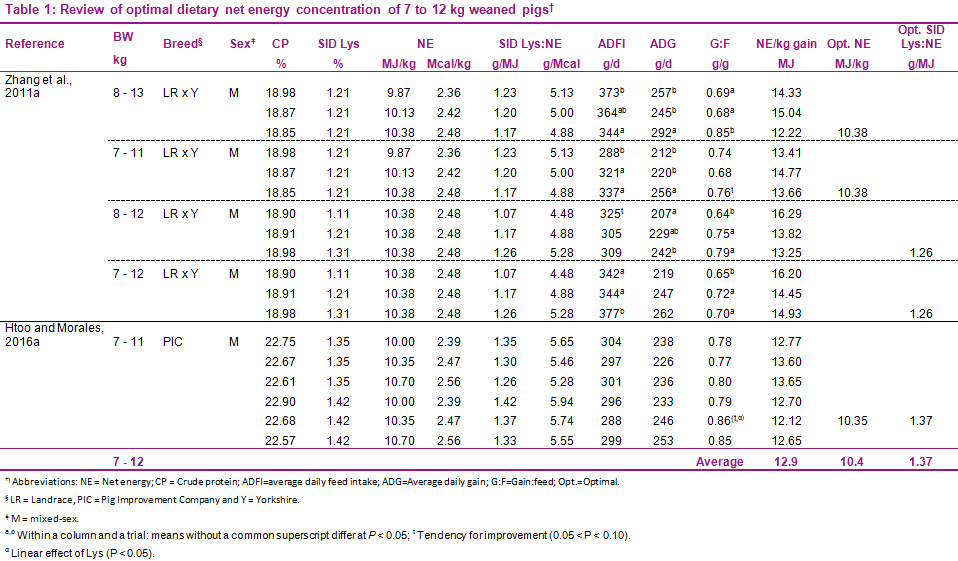
The optimal dietary NE estimates for weaned pigs (7 to 12 kg BW) are summarized in Table 1. Zhang et al. (2011a) conducted four experiments to determine the optimal NE concentration and SID:NE ratio for pigs about 8 to 13 kg (Landrace x Yorkshire) that were raised under commercial conditions. In Exp. 1, pigs were assigned to one of three diets adequate in AA (1.21 % SID Lys) but varied in NE (10.38, 10.13 or 9.87 MJ/kg). Average daily gain (ADG) and G:F maximized when the diet contained 10.38 MJ/kg. Average daily feed intake (ADFI) increased when the diet with the lowest NE content (9.87 MJ/kg) was fed to the pigs. The diets used in Exp.1 were also fed to 7 to 11 kg pigs in Exp. 2. Similar to Exp. 1, the ADG and G:F reached its maximum at a dietary NE concentration of 10.38 MJ/kg. In Exp. 3 and 4, pigs were assigned to one of the three diets adequate in NE (10.38 MJ/kg) but varied in SID Lys (1.11, 1.21 or 1.31 %) corresponding to SID Lys:NE ratios of 1.07, 1.17 or 1.26 g/MJ. In both Exp. 3 and 4, the ADG and G:F maximized and the ADFI was the lowest at a dietary SID Lys:NE ratio of 1.26 g/MJ. Based on these results, the optimal NE level was 10.38 MJ/kg (2.48 Mcal/kg) and the optimal SID Lys:NE ratio was 1.26 g/MJ (5.28 g/Mcal) to maximize ADG and G:F of 7 to 13 kg pigs.
Htoo and Morales (2016a) evaluated the effect of dietary SID Lys and NE concentration on growth performance of 7 to 11 kg PIC pigs that were assigned to six diet regimes using a 2 x 3 factorial arrangement with two levels of SID Lys (1.35 or 1.42 %) and three NE levels (10.00, 10.35 or 10.70 MJ/kg). Increasing SID Lys from 1.35 to 1.42 % increased G:F but did not affect ADG. The dietary NE content did not promote significant differences in ADG. The ADFI was not affected by SID Lys or NE levels. Overall, the G:F of 7 to 11 kg pigs reached its maximum when the diet contained 1.42 % SID Lys and 10.35 MJ/kg NE, which corresponds to a SID Lys:NE of 1.37 g/MJ. They found that ADG and G:F responses of pigs fed a higher SID Lys diet (1.42 %) were greater than pigs fed a lower SID Lys diet (1.35 %), even though diets were balanced for a similar SID Lys:NE ratio (1.33 and 1.35 g/MJ, respectively). This indicates that formulating swine diets with an adequate Lys level is more crucial and it is better to individually evaluate the optimal dietary levels of AA and NE as suggested by Cline et al. (2016). Based on these results, the optimal dietary NE concentration for 7 to 12 kg pigs was 10.4 MJ/kg (2.48 Mcal/kg). On average, 13.9 MJ (3.32 Mcal) is required to achieve 1 kg of BW gain for 7 to 12 kg pigs.
Optimal net energy concentration in diets for starter pigs (10 to 23 kg average BW)
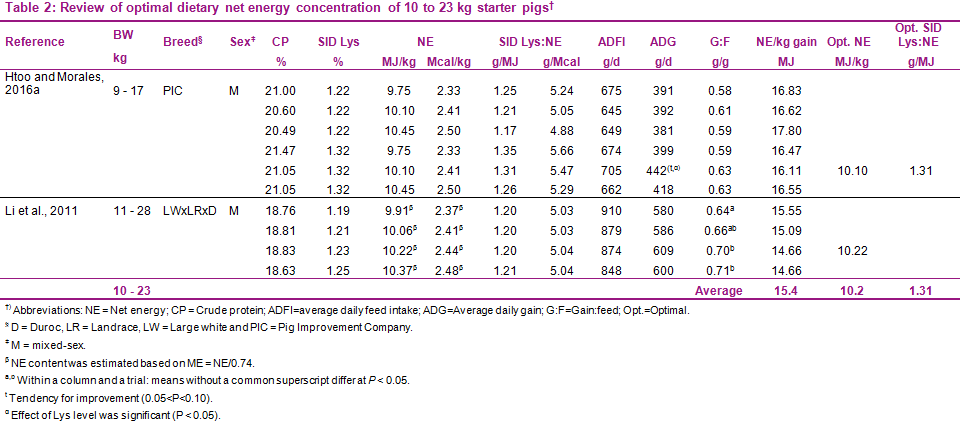
The optimal NE estimates for 10 to 23 kg pigs are given in Table 2. Htoo and Morales (2016a) used 9 to 17 kg PIC pigs, which were assigned to six diet regimes using a 2 x 3 factorial arrangement with two levels of SID Lys (1.22 or 1.32 %) and three NE levels (9.75, 10.10 or 10.45 MJ/kg). Increasing dietary SID Lys from 1.22 to 1.32 % increased ADG but did not affect G:F. The dietary NE level did not significantly increase G:F. Feed intake was not affected by SID Lys or NE levels. Increasing SID Lys from 1.22 to 1.32 % slightly decreased the amount of NE needed per kg BW gain from 17.2 to 16.5 MJ/kg BW gain. Overall, the ADG of 9 to 17 kg pigs reached its maximum when the diet contained 1.32 % SID Lys and 10.10 MJ/kg NE, which corresponds to a SID Lys:NE ratio of 1.31 g/MJ. It should be mentioned that ADG and G:F of pigs fed 1.22 % SID Lys diet were lower than pigs fed 1.32 % SID Lys diet despite the fact that both diets were balanced for a similar SID Lys:NE ratio (1.25 and 1.26 g/MJ, respectively). This suggests that it may not be appropriate to balance for the same SID Lys:NE ratio in pig diets when SID Lys levels are different in these diets.
Li et al. (2011) also determined the optimal NE level for 11 to 28 kg pigs (Large white x Landrace x Duroc) by assigning the pigs to four dietary treatments (4 NE levels of 9.91, 10.06, 10.22 or 10.37 MJ/kg). The ADFI and ADG were not significantly affected but G:F maximized at a dietary NE content of 10.22 MJ/kg. Based on these results, the average optimal NE concentration in diets for 10 to 23 kg pigs was 10.2 MJ (2.43 Mcal/kg). Taking the average of both experiments, 16.0 MJ (3.82 Mcal) is required to achieve 1 kg of BW gain for 10 to 23 kg pigs.
Optimal net energy concentration in diets for growing pigs (25 to 50 kg average BW)
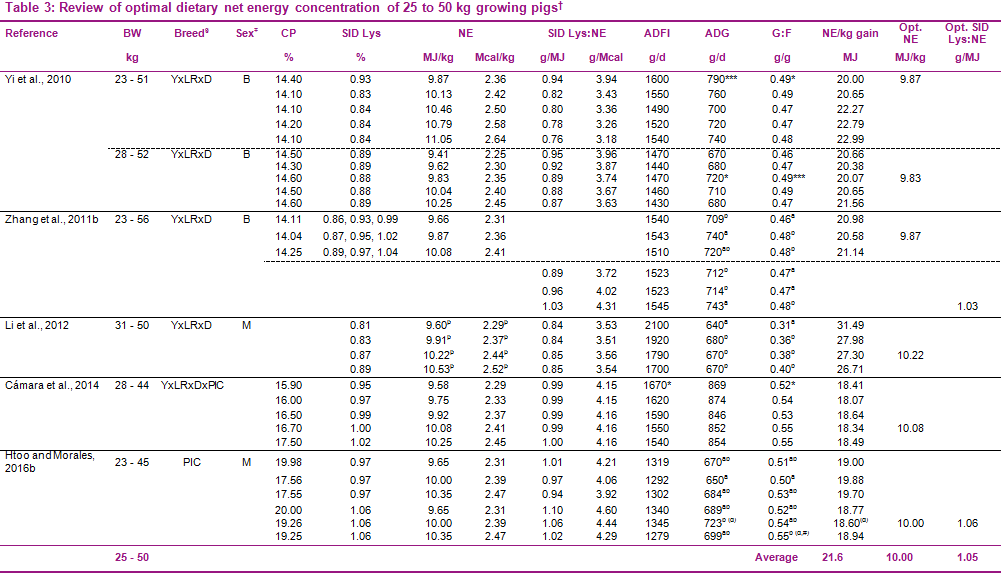
The optimal NE estimates for 25 to 50 kg growing pigs are summarized in Table 3. Yi et al. (2010) conducted two experiments to estimate the optimal NE level for approximately 25 to 50 kg barrows (Yorkshire x Large White x Duroc). In Exp. 1, the ADFI was not affected but ADG and G:F were affected by increasing dietary NE levels (9.87, 10.13, 10.46, 10.79 or 11.05 MJ/kg). Both ADG and G:F reached their maximum at a dietary NE content of 9.87 MJ/kg. Similarly, the greatest ADG and G:F were achieved when pigs were fed a diet containing a NE content of 9.83 MJ/kg in Exp.2.
In a 3 x 3 factorial arrangement with three levels of NE (9.66, 9.87 and 10.08 MJ/kg) and three SID Lys:NE ratios (0.89, 0.96 and 1.03 g/MJ), Zhang et al. (2011b) evaluated the optimal NE and SID Lys:NE ratio for 23 to 56 kg barrows (Yorkshire x Large White x Duroc). The ADFI was not affected but the ADG and G:F maximized at dietary NE level of 9.87 MJ/kg and a SID Lys:NE ratio of 1.03 g/MJ.
Li et al. (2012) determined the effects of graded levels of NE (9.60, 9.91, 10.22 or 10.53 MJ/kg) on performance of 31 to 50 kg mixed-sex pigs (Large White x Landrace x Duroc). The ADFI decreased when dietary NE content was increased from 9.60 to 10.22 or 10.53 MJ/kg. The ADG and G:F were highest at dietary NE level of 9.91 and 10.53 MJ/kg respectively, which gave an average optimal NE content of 10.22 MJ/kg for these pigs. Cámara et al. (2014) also assessed the effects of graded levels of NE (9.58, 9.75, 9.92, 10.08 or 10.25 MJ/kg) on performance of 28 to 44 kg gilts, boars or immune-castrated males. The ADG was not affected but there was a linear effect of NE level on ADFI and G:F. For maximizing G:F, these pigs need a dietary NE content of 10.08 MJ/kg whereas ADFI was highest at a dietary NE content of 9.5 MJ/kg.
Htoo and Morales (2016b) assigned 23 to 45 kg PIC pigs in a 2 x 3 factorial arrangement with two levels of SID Lys (0.97 or 1.06 %) and three NE levels (9.65, 10.00 or 10.35 MJ/kg). Increasing SID Lys from 0.97 to 1.06 % increased ADG and G:F. At adequate dietary Lys (1.06 %), the ADG and G:F was highest at a dietary NE content of 10.0 MJ/kg (2.39 Mcal/kg) and 10.35 MJ/kg (2.47 Mcal/kg), respectively. Overall, the ADG of 23 to 45 kg pigs was highest at a dietary SID Lys of 1.06 %, which corresponds to a SID Lys:NE ratio of 1.06 g/MJ.
Based on these results, the average optimal dietary NE concentration for 25 to 50 kg pigs was 10.0 MJ, which corresponds to a SID Lys:NE of 1.05 g/MJ. On average, 21.6 MJ (5.08 Mcal) is required to achieve 1 kg of BW gain for 25 to 50 kg pigs.
Optimal net energy concentration in diets for finishing pigs (60 to 100 kg average BW)
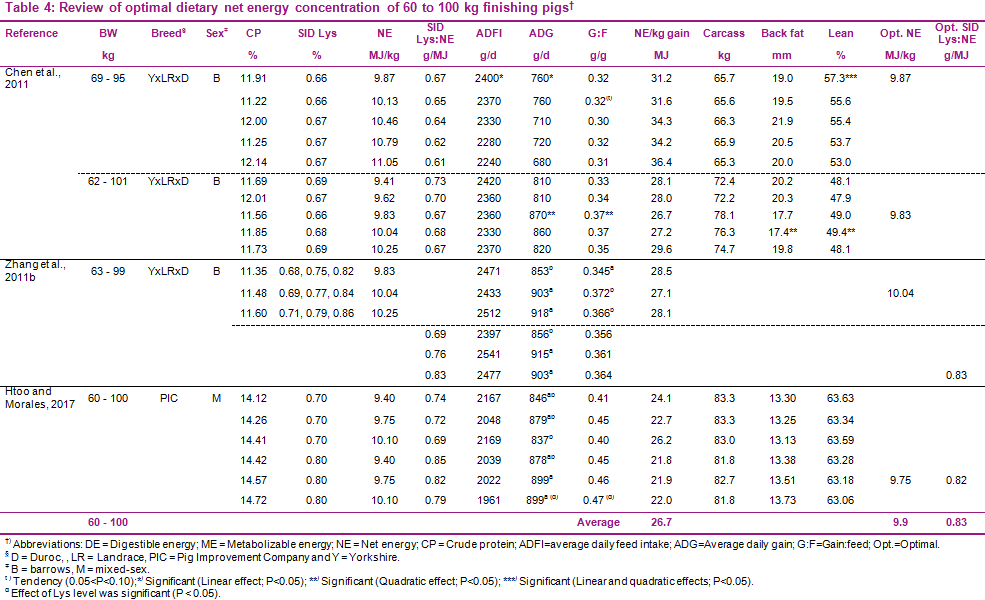
The optimal NE estimates for 60 to 100 kg finishing pigs are given in Table 4. Chen et al. (2011) conducted two experiments to estimate the optimal NE level for approximately 60 to 100 kg barrows (Yorkshire x Large White x Duroc). In Exp. 1, the ADFI and ADG were significantly decreased by increasing dietary NE levels (9.87, 10.13, 10.46, 10.79 or 11.05 MJ/kg). Both ADG and G:F maximized at a dietary NE content of 9.87 MJ/kg. The lowest back fat thickness and the greatest carcass lean gain were achieved when the diet containing 9.87 NE MJ/kg and 0.66 % SID Lys was fed to these pigs. Similarly, the greatest ADG and G:F were achieved when pigs were fed a diet containing a NE content of 9.83 MJ/kg in Exp.2. However, the lowest back fat thickness and the greatest lean percentage were achieved with 10.04 NE MJ/kg and 0.68 % SID Lys.
Zhang et al. (2011b) tested the optimal NE level and SID Lys:NE ratio for 63 to 99 kg barrows (Yorkshire x Landrace x Duroc) using a 3 x 3 factorial arrangement with 3 levels of SID Lys and 3 NE levels. The ADFI was not affected but the optimal ADG and G:F were achieved at a dietary NE level of 10.04 MJ/kg and a SID Lys:NE ratio of 0.83 g/MJ.
Htoo and Morales (2017) conducted an experiment using 60 to 100 kg PIC pigs in a 2 x 3 factorial arrangement with 2 levels of SID Lys (0.70 or 0.80 %) and 3 NE levels (9.40, 9.75 or 10.10 MJ/kg) for 45 days. Increasing dietary SID Lys from 0.70 to 0.80 % increased the ADG and G:F, and reduced the amount of NE need per kg BW gain from 24.1 to 22.0 MJ/kg BW gain. Carcass yield, back fat and lean gain were not affected by dietary NE contents. Overall, the ADG of 60 to 100 kg pigs maximized when the diet contains 0.80 % SID Lys and 9.75 MJ/kg NE, which corresponds to a SID Lys:NE of 0.82 g/MJ.
Based on these results, the average optimal NE concentration in diets for 60 to 100 kg pigs was 9.9 MJ (2.36 Mcal/kg), which corresponds to a SID Lys:NE of 0.83 g/MJ. On average, 27.9 MJ (6.66 Mcal) is required to achieve 1 kg of BW gain for 60 to 100 kg pigs.
Conclusions
Based on the evaluation of the available published data on NE requirements of pigs, the optimal dietary NE concentration are 10.4, 10.2, 10.0 and 9.9 MJ/kg (2.48, 2.43, 2.39, 2.36 Mcal/kg) for 7 to 12 kg, 10 to 23 kg, 25 to 50 kg and 60 to 100 kg BW, respectively (Figure 1). These NE values are slightly lower than the current Evonik recommendation for NE of 10.7, 10.4, 10.2 and 10.0 MJ/kg for these BW ranges (AMINOPig®).
This may be partly because the energy requirement for the same unit of body lipids is about 1.7 times higher than that of retained protein, as today’s pigs with greater lean gain and less body fat need somewhat lower NE compared with their counterparts with greater body fat. Furthermore, pigs fed reduced protein diets require less energy for the breakdown of excess protein. Thus, the NE requirements of the lean pigs fed low-protein diets may be lower than the current recommendations.
Future perspectives
More research is needed in energy nutrition of pigs to better understand under which dietary conditions the dietary NE level affects feed intake, body weight gain or gain:feed, and whether different sources of energy (starch, fiber, protein or lipids) influence these parameters. Moreover, research should aim to increase knowledge about how NE is utilized, partition of body protein and lipids by the pigs, and how to optimize daily energy supply for a desired carcass quality to achieve the highest possible profit.
†) Abbreviations: NE = Net energy; CP = Crude protein; ADFI=average daily feed intake; ADG=Average daily gain; G:F=Gain:feed; Opt.=Optimal.
§ D = Duroc, LR = Landrace, PIC = Pig Improvement Company and Y = Yorkshire.
? B = barrows, M = mixed-sex.
β NE content was estimated based on ME = NE/0.74.
a,b Within a column and trial: means without a common superscript differ at P < 0.05.
t ) Tendency (0.05< P< 0.10);*) Significant (Linear effect; P< 0.05); **) Significant (Quadratic effect; P< 0.05); ***) Significant (Linear and quadratic effects; P< 0.05).
α Effect of Lys level was significant (P < 0.05); #Effect of NE level was significant (P < 0.05).