Cross-Contamination in Premix Plants: Regulatory Challenges and Practical Solutions
Published: December 16, 2025
Source : Marc Perel, Independent Consultant in Feed Technology | Premix | Additives
When a Laboratory Result Changes Everything
The laboratory report arrives late in the morning. The batch complies with all nutritional specifications… except one. A trace of a coccidiostat is detected in a premix intended for a non-target species. The level is very low, only a few milligrams per tonne. And yet, doubt immediately arises: where did it come from? The previous product? Residual material in the circuit? A fraction of dust trapped in a filter?
Nothing points to an obvious failure. Procedures are in place, operators are trained, and the plant is certified. And still, the contamination is there. Invisible to the naked eye, with no immediate impact on production, but potentially carrying serious regulatory, commercial and sanitary consequences.
This is precisely what makes cross-contamination in premix plants so difficult to control: it cannot always be seen or detected during production, and it often becomes apparent only when it is already too late to correct.
Premix Manufacturing: A Simple Process with High Stakes
Cross-contamination is a concern for all feed manufacturing facilities. However, in premix plants, the risk takes on a very specific dimension.
The process itself is often simpler than compound feed production: no grinding, no pelleting, fewer unit operations. But the high concentration of additives, the wide range of active substances, and the very low downstream inclusion rates make even minimal carry-over potentially critical.
In this context, controlling cross-contamination becomes a key pillar of industrial performance and product quality, alongside traceability, dosing accuracy and mixing quality.
Cross-Contamination: What Are We Really Talking About?
A Practical, Operational Definition
In practical terms, cross-contamination refers to the unintended transfer of residues from one batch to another through equipment, conveying systems, dust or the production environment.
It mainly results from:
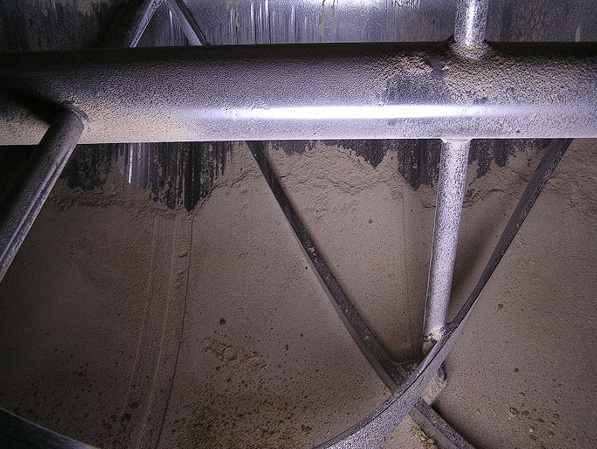
-Retention zones (mixers, conveying equipment, hoppers, filters),
-Dust accumulation and resuspension,
-Leaks or poorly controlled air flows,
-Inadequate batch sequencing.
The contamination level is usually expressed as the percentage of the previous batch recovered in the following batch, at an equivalent batch size. Even at very low levels, such carry-over can become unacceptable when regulated substances or sensitive species are involved.
A Strict Regulatory Framework with Decreasing Tolerance
At the European level, the framework is clear:
-Regulation (EC) No 183/2005 requires feed business operators to identify, prevent and control cross-contamination through appropriate internal procedures;
-Specific legislation defines maximum limits for the unavoidable transfer of coccidiostats and histomonostats, both in feed and in food of animal origin.
In addition, manufacturers must comply with:
-certification schemes like GMP+, FAMI-QS,
-and increasingly demanding customer specifications, often more restrictive than regulatory limits.
Cross-contamination is therefore no longer just a compliance issue: it has become a matter of industrial credibility and market access.
Assessing the Risk: From HACCP to Real Measurement
Identifying Hazards and Quantifying Them
HACCP analysis makes it possible to identify risks based on:
-raw materials and additives used (antibiotics, coccidiostats, minerals, animal by-products, etc.),
-production circuits,
-operating practices.
However, identifying a risk is not enough. It must be measured.
Measuring Inter-Batch Carry-Over: The Principle
Qualification trials rely on the use of a tracer, deliberately introduced into one or more batches and monitored in subsequent productions.
In simple terms:
1. one or more tracer batches are produced,
2. they are followed by collector batches, with no tracer added,
3. samples are taken,
4. tracer concentration is analysed,
5. the carry-over level is calculated and interpreted.
A batch generally corresponds to one mixer load.
The Tracer: A Critical Choice
A suitable tracer must:
-be absent from other ingredients,
-be introduced through a single source,
-allow detection of at least 0.5% carry-over,
-remain stable throughout the process,
-be measurable using a reliable and cost-effective analytical method.
In Europe, ferromagnetic external tracers are commonly used, although in certain cases internal tracers (e.g. coccidiostats) may be considered.
In France, the Tecaliman method is widely recognised as a reference for cross-contamination qualification in feed and premix plants.
Reducing Cross-Contamination: Technical and Organisational Levers
Reducing cross-contamination is rarely achieved through a single action. It requires a coherent combination of technical design, organisation and operational discipline.
Key levers include:
-Limiting contamination sources (nature, form, volumes), favouring low-dust products.
-Separating circuits, fully or partially, from raw material reception to packaging, whenever technically and economically feasible.
-Adding high-risk substances as close as possible to the mixer to minimise retention.
-Controlling air and dust flows, especially through efficient aspiration and filtration.
-Mechanical cleaning without dispersion (brushing followed by vacuuming) and banning compressed-air blowing.
-Identifying leaks and dead zones through preventive maintenance and regular inspections.
-Implementing strict sequencing rules, based on:
o the nature of the substances,
o species sensitivity,
o batch sizes, o concentration levels.
-Limiting flushing batches to truly necessary cases and avoiding their recycling.
-Designing short, fully dischargeable and cleanable circuits, while minimising condensation and product build-up.
Conclusion: Mastering the Invisible
Cross-contamination is rarely the result of a single mistake. More often, it is the consequence of an accumulation of small deviations, unverified assumptions or practices that have gradually become “routine”.
Effective control requires:
-robust risk assessment,
-periodic qualification trials,
-living, risk-based sequencing rules,
-regular audits,
-and continuous staff training.
Over time, processes evolve, formulations change and regulatory pressure increases. Periodically stepping back, challenging established practices and confronting technical choices with an experienced external perspective often reveals improvement opportunities where everything seemed already optimised.
It is often in these everyday, invisible details that the long-term control of cross-contamination is truly built.
Related topics:
Authors:

FeedSphere Solutions
Recommend
Comment
Share

Would you like to discuss another topic? Create a new post to engage with experts in the community.







Featured users in Animal Feed