Co-Occurrence of Mycotoxins in Tropical Feedstuffs: Why Single-Toxin Testing Is No Longer Enough
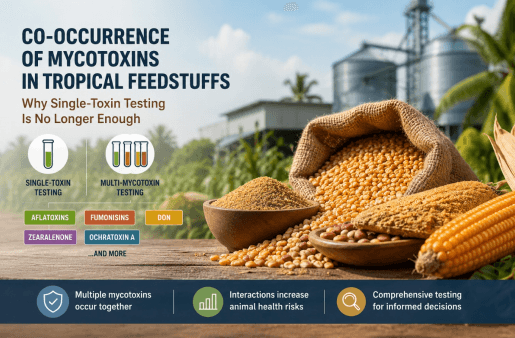
Tropical and subtropical regions across South and Southeast Asia, Latin America and sub-Saharan Africa contribute a major share of worlds maize, sorghum, groundnuts, cottonseed and other important feed ingredients.
However, these regions also face a major challenge- climatic condition that strongly encourage fungal growth and mycotoxin contamination. High temperatures, heavy humidity and regular rainfall create an ideal environment where several toxin producing fungi can grow together- often contaminating the same batch of grain at the same time.
For many years, feed safety programs in these areas have mainly focused on identifying one mycotoxin at a time, especially aflatoxin B1 because of its high toxicity, strict regulations and the convenience of ELISA- based testing methods.
Although this approach has been practical, it no longer gives the complete picture. Research over recent years increasingly supports what field veterinarians and nutritionists have observed for a long time: multiple mycotoxins appearing together is far more common than rare in tropical feedstuffs.
The Scale of the Problem
Research conducted during the last decade shows that between 60% and more than 90% of tropical maize samples contain two or more mycotoxins, depending on the season and region studied. Feed samples that test positive for aflatoxin B1 frequently also contain detectable amounts of fumonisin B1 and B2, deoxynivalenol (DON), zearalenone (ZEN) or ochratoxin A and in some cases, several of them simultaneously.
Fusarium fungi alone are capable of producing fumonisins, trichothecenes and ZEN within the same grain batch, while Aspergillus and Penicillium species contribute aflatoxins and ochratoxin contamination.
These toxins do not simply combine in an additive way. Lab and animal studies have confirmed interaction effect of their combinations such as aflatoxin B1 and fumonisin B1 have been shown to potentiate liver toxicity and carcinogenicity in chickens and pigs, to a degree higher than with either single toxin alone. Increased reproductive effects were found in pigs fed combined DON and ZEN in higher degree than the sum of single effects in the same concentration.
As a result, even feed containing several toxins below their individual “safe” limits may still create serious health risks for animals.
Why Single-Toxin Testing Falls Short
Regulatory limits for mycotoxins are designed for individual toxins only. Because of this, most testing systems access each compound separately, overlooking the real-world issue of simultaneous exposure to multiple toxins.
A nutritionist may receive a report showing aflatoxin B1 at 8 ppb- slightly below a regulatory limit of 10 ppb- and assume the feed is acceptable. However, the same sample could also contain 3,000 ppb of fumonisins and 600 ppb of DON. While these levels may also remain below individual action thresholds, together they can still contribute to immune suppression, intestinal inflammation and reduced growth performance in animals.
The challenge becomes even greater in tropical regions because mycotoxin contamination is rarely evenly distributed. Differences in storage conditions, moisture and contamination hotspots within grain lots create major variations inside the same batch.
This makes sampling errors extremely common. Even one ELISA test strip applied to one sample of feed might represent only an instantaneous result and may not be an indication of the actual mycotoxin burden in the feedstuff.
A More Holistic Approach: Multi-Mycotoxin Risk Assessment
A solution will need both analytical advancements and change in attitudes. From the analytical point of view, multi-mycotoxin analysis using LC-MS/MS has recently been shown to be increasingly feasible and economical. These systems can detect and measure more than 30 mycotoxins in a single analysis.
Laboratories in countries such as India, Brazil, Thailand and Nigeria are now offering these services at commercially feasible prices for larger feed manufacturers and integrators.
From a management perspective, feed quality teams and nutritionists need to adopt cumulative risk evaluation methods. Approaches such as Mycotoxin Equivalent scoring, where toxin concentrations are adjusted according to their toxicity and interactions with other contaminants, provide a more realistic understanding of the actual danger posed by contaminated feed.
Broad spectrum mycotoxin binders and detoxification products, especially those that combine clay-based adsorbents with enzymatic or microbial detoxifying agents, continue to be amongst the most effective practical solutions at the feed mill levels. However, selecting and dosing these products correctly requires a complete mycotoxin profile rather than relying on a single aflatoxin reading.
The growing urgency around feed safety is also reflected in market trends. According to a recent report by Consegic Business Intelligence, the animal feed additives market is projected to reach USD 76.9 billion by 2035, with mycotoxin binders and broad-spectrum contaminant control agents forming a significant share of the 'Other Additives' segment- a growth trajectory directly tied to rising awareness of multi-mycotoxin risks in tropical feedstuffs.
Conclusion
For feed producers operating in tropical regions, the debate is no longer about whether multiple mycotoxins occur together in raw materials. The scientific evidence has already made that clear.
The real challenge now is determining whether current testing and risk management practices are advanced enough to deal with this reality. Single toxin testing can create a misleading sense of safety. In tropical feedstuffs, understanding the complete risk requires full spectrum testing- along with a proper understanding of how different mycotoxins interact instead of evaluating each one individually.







What Are Mycotoxins? The Silent Enemy of Livestock Profitability
North American Renderers Association (NARA)