
Content sponsored by:
Norel Animal Nutrition
Supplementation with sodium and calcium salts of malic acid positively impacts productivity and mitigates methane emissions in ruminants: Goats and dairy cattle as case studies
Published: June 29, 2026
Source : Javier Lopez-Paredes, a,*, Idoia Goirib, Juan José Mallo, a, Mónica Puyaltoa, Hanen Benhissi, b, Manuel Romero-Huelva, c, David Yañez-Ruiz, c, Aser García-Rodríguez, b. a NOREL S.A – Jesús Aprendiz, 19, Madrid 28007, Spain. b. NEIKER - Basque Institute for Agricultural Research and Development, Basque Research and Technology Alliance (BRTA), Campus Agroalimentario de Arkaute s/n, Arkaute 01192, Spain. c, Estación Experimental del Zaidín (CSIC), Profesor Albareda, 1, Granada 18008, Spain
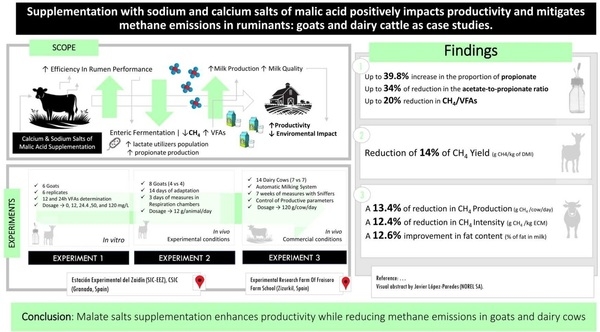
This study aimed to evaluate the effects of sodium and calcium salts of malic acid (RUMALATO (R)) supplementation on rumen fermentation, CH4 emissions and productivity parameters in ruminants. Three studies were conducted. The first two trials, carried out with goats, included both in vitro (trial 1) and in vivo (trial 2) trials under controlled conditions using respiration chambers to measure CH4. Trial 3 involved dairy cows managed under commercial conditions with an automatic milking system. In the in vitro trial, various dosages of calcium and sodium salts of malic acid were tested (0, 12, 24.4,50, and 120 mg/L), showing a shift towards more efficient rumen fermentation routes, with an increase in the proportion of propionate (up to 39.8%) and a reduction in the acetate-to-propionate ratio with the increasing levels of malate salts (up to 34%) observed in the Trial 1. This suggests a potential decrease in methanogenesis, as evidenced by a 20% reduction in CH4 relative to total VFAs (p < 0.05). This trend was also observed in the in vivo trial with goats, where CH4 yield (g CH4 per kg dry matter intake) decreased by 14% (p < 0.05). Finally, the experiment with dairy cows demonstrated a significant reduction in CH4 production (g CH4 per cow and day, 13.4%, p < 0.05) and CH4 intensity (g CH4 per kg of energy corrected milk, 12.4%, p < 0.05), and an improvement of 12.6% in fat content (% of fat per litter of milk, p = 0.06). Overall, these results indicate that malate salts supplementation has the potential to reduce CH4 emissions while positively impacting productivity.
López-Paredes, J., Goiri, I., Mallo, J. J., Puyalto, M., Benhissi, H., Romero-Huelva, M., Yañez-Ruiz, D., & García-Rodríguez, A. (2026). Supplementation with sodium and calcium salts of malic acid positively impacts productivity and mitigates methane emissions in ruminants: Goats and dairy cattle as case studies. Animal Feed Science and Technology, 342, 116845. https://doi.org/10.1016/j.anifeedsci.2026.116845
Related topics:
Authors:




Recommend
Comment
Share

Would you like to discuss another topic? Create a new post to engage with experts in the community.
Featured users