INTRODUCTION
While the fat of ruminant products in many cases is considered harmful to human health for its excessive content on saturated fatty acids, in latest years has been found that a component, the conjugated linolenic acid (CLA), content anticancer properties, in addition to lipolytic activity, prevention of atherosclerosis and diabetes (NRC, 1996).
The CLA is the term used to describe one or more positional and geometric isomers of linolenic acid (cis-9, cis-12) containing conjugated double bonds. Duch bonds generally were found in the 9 and 11 positions, or 10 and 12, configuration can be cis or trans. Biologically active form of CLA be represented by the isomer cis-9, trans 11 CLA which represent between 80 to 90 % of total CLA in fat of milk (Belury, 2002).
The linoleic and linolenic acids are essential fatty acids, as they are synthesized by plants, but not by mammals. Must therefore be provided by food and play a role in precursor for the synthesis of polyunsaturated fatty acids (PUFA) of longer-chain and unsaturated n-3 (omega 3) and n-6 (omega 6) respectively (Gagliostro, 2004).
The precursors of CLA are the PUFA presents in rations of the ruminants as the linoleic acid (cis-9, trans-12 C18:2) and the α linolenic acid. The first result absolutely in the corn silage, in the cereals and several grains oilseeds as sunflower and soybeans. The α linolenic acid is present in greater quantity in tender pastures and in flax. These compounds suffer a great ruminal biodegradation (Chilliard et al. 2000) . In man were performed studies that demonstrated fatty acids omega 3 eicosapentaenoic acid (EPA), and docosahexanoic acid (DHA) presents hipochoresterolemic properties, antithrombosis and anti-inflammatory (Williams, 2000).
Many authors consider that in human health is more convenient use the relation omega 6 / omega 3 concept instead the individual concentration of the same in food. A relation omega 6 / omega 3 between 6 and 4 prove to be optimal for human food ( WHO, 2003). The principal source of CLA in human diet is milk and dairy products, which contain mainly cis-9, trans-11 C18:2 (rumenic acid) and trans-9, cis-11 C18:2. Many factors may influence in increasing of CLA in milk as seasonal factors and number of lactations (Van Nieuwenhove et al. 2004) but undoubtedly the animal diet has the highest prevalence (Bergamo et al. 2003).
In buffaloes the research are still scarce, there are very few studies in other countries which determined CLA in milk (Fedele et al. 2001; Medeiros, 2002; Lopez Oliveira et al. 2004). In our country only recently works about CLA content in milk (Tyagi at al, 2007; Van Nieuwenhove et al. 2007; Patiño et al. 2008) and cheese (Van Nieuwenhove et al. 2007) have been published.
The objective of this investigation was to know the basal values of conjugated linoleic acid (CLA) and fatty acids 3 (C18: 3 n-3, EPA y DHA) in buffalo milk produced in the province of Corrientes, fed natural pastures and verify if, when diets are supplemented with corn and sunflower oil (Helianthus annuus), these values could be increased.
MATERIAL AND METHODS
Geographic place and experimental group: The animals belong to the campus of a establishment located in San Cosme, province of Corrientes. The trial was performed which 32 multiparous buffaloes of Murrah breed and Murrah x Mediterránean crossbred, identified with alpha-numeric ear tag and distributed in four groups, integrated for 8 animals each; 4 buffaloes Murrah breed and 4 half-bred (Murrah x Mediterranean). All groups were fed with natural pastures on grazing; the group I received only natural pastures, the group II received also a dairy supplement of 2 kg of milled corn for animal; the group III also with corn received 210 ml of sunflower oil for animal and the group IV received 420 ml of sunflower for animal. The natural pasture was comprised mostly species like Andropogon sellononaus, lateralis, Cynodon A. dactylon, Elionorus sp., Paspalum notatum, P. almun chase, Sorghastrum agrostoides, Desmodium canum and Shylosanthes macrosona. Before starting the test the animals of the groups II, III and IV received a supplement of 1 kg of milled corn during 10 days to adapt them to the consumption of grain.
The animals received the supplement according the treatment at the milking moment in an individual feeder. The buffaloes were milked by hand in the morning. The test was performed during 35 days between the months of October and November 2007, in the corresponding period of the second stage of lactation. The annual average of rain during the year 2007 in the zone was 1.054 mm, when the regular average is 1.690 mm, which shows the pluviometric deficit produced during the year of the test, mainly in the previous four months and during the month of sampling.
Samples: The samples (n = 64) were obtained at days 1 and 35, between the months of October and November 2007, during the milking routine. After eliminate the first jets, 200 ml of milk for each animal were taken. The samples were collected in disposable containers, frozen to -20ºC and packaged in boxes of polyurethane until arrival at the lab.
Laboratory techniques: Each sample was processed in duplicate to obtain the lipid profile. To extract the total lipids, a mixture of chloroform and methanol according to the Bligh and Dyer (1959) technique maintaining nitrogen atmosphere, were used. The conversion of the fatty acids in methyl esters was carried out with NaOH and BF3 methanol to 14 % boiled for 8 minutes. The methyl esters extracted with hexane and were analyzed with a gas chromatograph. Were used Standard of methyl esters of fatty acids of 99% purity (Lipid Standard 189-19 Sigma-Aldrich). The fatty acids composition was obtained in a gas chromatograph of the Agilent signature equipped with a capillary column of 60 mm long and 0,25 mm of internal diameter (Supelco 2340) and a flame ionization detector. The gas chromatography method used (GC-FID) was adapted to the standard ISO 15304 (2002).
Statistical analysis: Statistical analysis on the samples for each treatment (average, standard deviation, coefficient of variation and minimum and maximum ranges) have been applied. Previous the analysis the descriptive behaviour of the sample was evaluated through confidence intervals and graphics box & whisker. A completely randomized design, with the additive linear model () was performed.
RESULTS
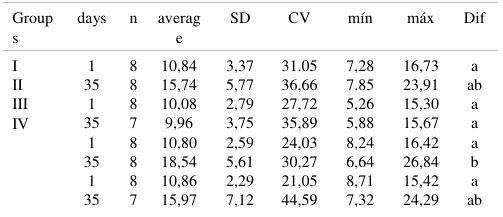
Conjugated linoleic acid (CLA): The content of CLA in the milk of buffaloes fed the four diets is presented in the Table 1. At day 1 no significant differences between the four groups there were, it was observed at day 35 (p< 0.05) between the groups II and III. The highest value of CLA in average (18.54 mg / g of fat) of the four groups was obtained at day 35 of test in the buffaloes of group III with a increase of 71,66 % in comparison with the day 1.
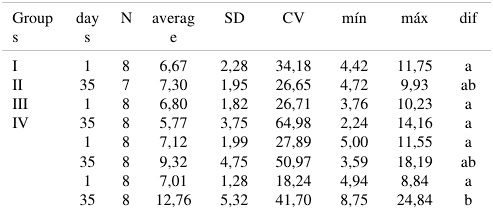
Omega 6: The content of fatty acids omega 6 in the milk of the buffaloes fed the four diets is presented in the Table 2. At day 1 no significant difference among the four experimental groups was found, it was observed at day 35 (p< 0.05) between the groups II and IV.
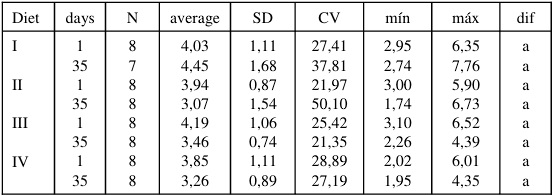
Omega 3: The content of fatty acids omega 3 in the milk of buffaloes fed the four diets is presented in the Table 3. At day 1 and 35 no significant difference among the four experimental groups was found.
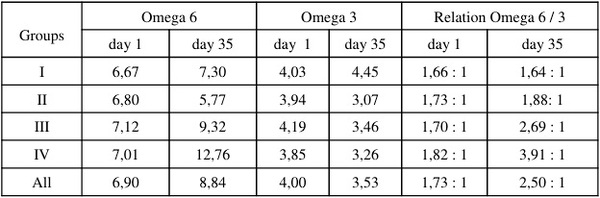
Relation Omega 6 and 3: The relation omega 6 / 3 (mg / g of fat) in buffalo milk is presented in the Table 4. No significant difference among the four experimental groups was found.
DISCUSSION AND CONCLUSIONS
The differences of CLA could be attributed to the different diets used. It was observed that the concentration of CLA in the group II was the minor of the four groups, this could be attributed at the minimum availability of precursors of CLA in the corn. Instead when is supplemented with sunflower oil, which contains a good linoleic proportion (18: 2 c) induces increase of CLA.
The average values for CLA found in the present work in the group I (exclusive diet based on pastures) both in the day 1 (10,84 mg /g of fat) as at 35 (15,74 mg / g of fat) was higher than the obtained one in Murrah buffaloes (Van Nieuwenhove et al. 2004) and in half bred Murrah x Mediterranean (Van Nieuwenhove et al. 2007), in both cases on natural pastures in the province of Tucuman, Argentina.
The highest average value of CLA obtained in the present test, was higher than the registered in Brazil (Lopez Oliveira et al. 2004) with diets based on corn and soya oil (5,08 – 10,80 mg / g of fat); in Italy (Fedele et al. 2001; Bergamo et al. 2003) with diets based in organics systems (6,3 – 3,9 mg / g of fat) and traditional (9,0 – 6,2 mg / g of fat) in Mediterranean buffaloes; in India (Tyagi et al. 2007) with diets based on corn silage (7,7 – 13, 4 mg / g of fat) in Murrah buffaloes and in Pakistán (Talpur et al. 2005) with concentrated diet based on corn silage (7,1 – 8,0 mg / g of fat) in Nili– Ravi and Kundi buffaloes.
The only value which was slightly lower (17,0 mg / g of fat) to that obtained in the present work was registered in India by Tyagi et al. (2007) in Murrah buffaloes fed exclusively clover (Trifolium alexandrium).
The diet have a big influence on the content of CLA in ruminant miles and metas because this provides the substrates for the formation of the same (Schmid et al. 2006), then it can be assumed that the corn used in the diet II has a minimum presence of precursors of CLA since animals milk presented at 35 days the minor content of this conjugated fatty acids.
However when the diet contains a highest dose of sunflower oil (420 ml) the content of CLA at end of test was increased less than the lowest dose used (210 ml). Then the high quantity of oil disturbed the environment of rumen inhibiting microbial activity responsible of the isomerization and/or ruminal biohydrogenation (Schmid et al. 2006). Other explanation could be that the excess of unsaturated fatty acids caused a certain amount of this escape to microbial modifications and pass directly to the adipose tissue of animals, increasing the content of linoleic acid present in milk. In this case can be verified an increase approximately equal to twice from initial value.
The highest average values of omega 6 was obtained at day 35, in the groups III (9,32 mg / g of fat) and IV (12,76 mg / g of fat), which included in diet the sunflower oil, which indicates the importance of this oil in the diet for increase the content of this fatty acid. Instead in the group II that included in diet only corn showed similar average of group I in omega 6. The highest average value of omega 6 (16,0 – 16,4 mg / g of fat) was obtained in India by Tyagi et al. (2007).
The highest average values of the omega 3 was obtained at day 35 in the group I (4,45 mg /g of fat) with exclusive diet of natural pastures. The others groups including corn and sunflower oil showed lower values of this fatty acid at day 35 in comparison to day 1, indicating that these foods did not contribute to increase the levels of omega 3 in the fat of buffaloes milk. The highest average value of the omega 3 obtained in the present test (4,45 mg / g of fat) was most lower (14,2 mg / g of fat) than that one found in India by Tyagiet al. (2007), with a diet based on clover, which shows the role of different pastures in the concentration of this fatty acid.
Which respect at relation omega 6 / 3 29 was observed that this relation is increased with sunflower oil, that has a high content of linoleic acid; however the values obtained are still below the recommended parameters for human intake for the WHO (2003) who suggest optimum relations of omega 6 / 3 between 6 and 4. In India with a exclusive diet based on clover was a relation omega 6 / 3 of 1: 1 (Tyagiet al, 2007).
Table 1:Content of CLA (mg/ g of fat) in buffalo milk of the different groups.
Table 2:Content of omega 6 (mg/ g of fat) in buffalo milk in the experimental groups
SD: standard deviation; CV: coefficient of variation; min and max: ranges. dif: difference (Different letters indicate significant differences between averages, p< 0,05).
Table 3:Content of omega 3 (mg/ g of fat) in buffalo milk in the experimental groups.
SD: Standard deviation; CV: coefficient of variation; min and max: ranges. dif: difference (Different letters indicate significant differences between averages, p< 0,05).
Table 4: Relation omega 6 / omega 3 (mg / g of fat) in buffalo milk in the experimental groups.