As dairy cattle productivity continues to increase through genetic advancement, providing adequate quantities of key nutrients has become increasingly challenging. Encapsulation technologies offer nutritionists a means of delivering nutrients that are susceptible to ruminal degradation, improving precision and formulation flexibility.
However, not all encapsulated products perform equally. Differences in encapsulation technology and manufacturing can significantly affect nutrient delivery and animal response, making it essential to evaluate products based on durability, rumen protection, intestinal release and biological performance.
Introduction
Lipid encapsulation is used to protect nutrients from degradation in the rumen and from environmental challenges before feeding, with the goal of allowing those nutrients to reach the small intestine where they can be absorbed and utilized by the animal. As the number of encapsulated products available in the market continues to grow, selecting a product that performs reliably and remains cost-effective can be challenging. Although many products may appear similar, the technologies, ingredients and manufacturing processes used to produce them can differ substantially, resulting in drastic differences in performance.
When designed and manufactured effectively, encapsulated nutrients can give nutritionists greater flexibility to optimize rations, support animal performance and manage feed costs. However, encapsulated products should NOT be viewed as interchangeable. Understanding the differences among encapsulation technologies helps nutritionists, veterinarians and producers make more informed decisions about which products are most likely to provide value in the diet.
Lipid encapsulation
Lipid encapsulation is a widely used protection strategy for a variety of nutrients. However, the term itself is broad, and product performance can be influenced by several key factors:
1. The starting form and inclusion rate of the nutrient
2. The coating system utilized
3. The manufacturing process used to produce the lipid encapsulate
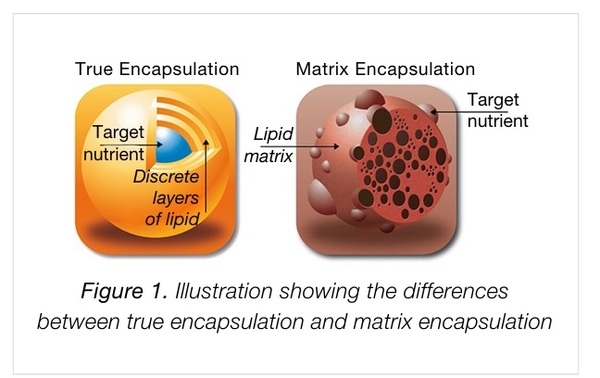
Two forms of lipid encapsulation are commonly used in the feed industry: matrix encapsulation and true encapsulation. In matrix encapsulation, the active nutrient is dispersed within a fatty acid matrix. In true encapsulation, fatty acid layers are applied around the nutrient to create a protective barrier (Figure 1), surrounding the active ingredient with lipid layers designed to limit exposure in the feed and the rumen.
Understanding these two forms of encapsulation is particularly important when evaluating products designed to protect hygroscopic nutrients, such as choline and lysine, from environmental and ruminal degradation. Without effective protection, these nutrients can rapidly absorb moisture from the surrounding environment, compromising product stability, and reducing efficacy.
For an encapsulated nutrient to be effective, it must demonstrate performance in four areas:
1) Durability (feed and mixing stability, freeze/thaw stability and shelf-life)
2) Rumen protection
3) Intestinal digestibility
4) Biological Performance
Durability
Durability refers to an encapsulated nutrient’s ability to maintain its protective structure during mixing, transport and storage, as well as during exposure to moisture and acidity in total mixed rations (TMR). Damage such as abrasion, cracking, fracturing, melting or reductions in particle size can compromise nutrient delivery and may substantially reduce product effectiveness.
Mix Stability
Mineral mixes can be especially abrasive for encapsulated products because ingredients such as limestone and salt have hard, irregular particles. Extended mixing can damage the encapsulate coating through cracking, fracturing or surface abrasion. To reduce unnecessary physical stress, mixing time should be limited when possible, and encapsulated ingredients should be added as late as practical in the mixing order, ideally among the final ingredients introduced into the mixer.
Feed Stability
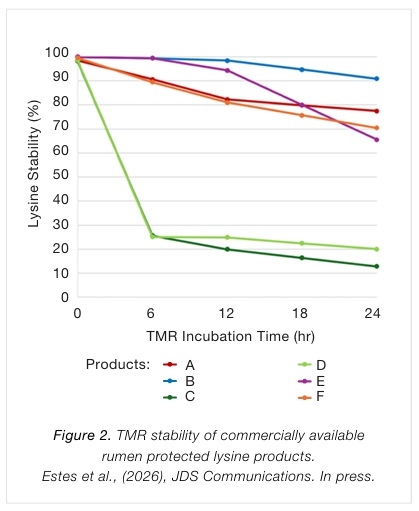
Research evaluating the TMR stability of rumen protected lysine has shown substantial differences among commercially available products that use different encapsulation technologies (Figure 2). The marked loss of TMR stability observed in some products demonstrates that certain technologies may not adequately protect nutrients from moisture, acidity and microbial activity before consumption. These results emphasize the importance of accounting for TMR stability, as damage to the protective coating can occur before the cow consumes the feed which may reduce product efficacy.
Freeze/thaw stability
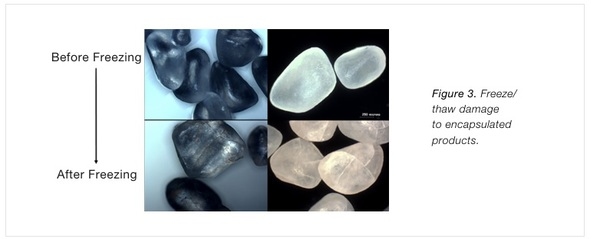
Freeze-thaw stability is another important but sometimes overlooked consideration. When lipid encapsulates are frozen and subsequently thawed, the coating may expand and contract which can cause cracking of the coating. This can create opportunities for water penetration during storage or after feeding, weakening rumen protection and reducing nutrient delivery. Some lipid encapsulates are not stable under repeated freeze-thaw conditions (Figure 3).
Temperature
Temperature can also affect coating integrity. Feed encapsulates generally are not designed to tolerate the heat and pressure associated with pelleting. The elevated temperatures used to gelatinize starch and produce a firm pellet can damage the encapsulate, reducing protection of the nutrient. In addition, the mechanical pressure of pelleting can crack or fracture encapsulates, further compromising rumen stability.
Rumen protection
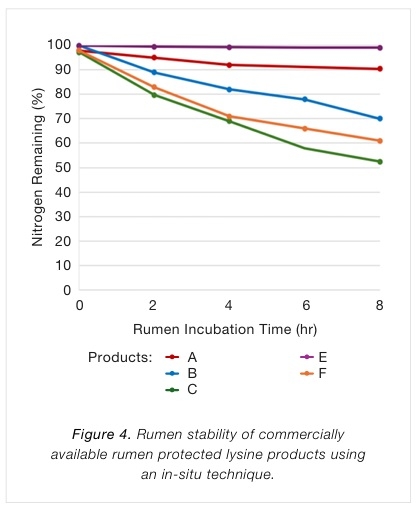
Unprotected nutrients such as choline, niacin, lysine and methionine are extensively degraded by rumen microbes, often at rates greater than 87%, leaving little nutrient available for digestion and absorption in the intestine. Rumen protection describes the ability of an encapsulation technology to limit degradation in the rumen so the nutrient can pass to the abomasum and small intestine for utilization. Ruminal stability is commonly assessed using in situ or in vitro methods. In in situ studies, dacron bags containing the protected products of interest are placed in the rumen of a cannulated cow to measure product stability. In in vitro studies, laboratory procedures using collected rumen fluid or artificial rumen-like solutions are used to estimate degradation. In both approaches, digestibility or disappearance can be measured at one or multiple time points. As observed with TMR stability, commercially available rumen-protected lysine products can also differ substantially in rumen stability when tested in situ over time, largely as a result of the encapsulation technology used (Figure 4).
Intestinal Release/Bioavailability
An effective encapsulated product must do more than resist degradation in the rumen and during feed handling; it must also release the nutrient in the abomasum and small intestine so it can be digested and absorbed. Both in vitro and in vivo methods may be used to evaluate intestinal release. In vitro procedures that simulate animal digestion are typically faster and less expensive, but they generally provide relative comparisons rather than absolute bioavailability estimates. By contrast, in vivo approaches can provide more accurate estimates of bioavailability for encapsulated nutrients. In vivo stable isotope methods, in particular, have successfully been used to determine lysine absorption from rumen-protected products with adequate precision and accuracy (Fernandes et al., 2024; Rebelo and Lee, 2024; Hopkins et al., 2026), where differences in bioavailability have been detected across products.
Biological Performance
The final test of an encapsulated nutrient is the biological response observed when the product is fed. Depending on the nutrient, these responses may include changes in milk yield and components, health, reproduction, offspring outcomes or growth. Positive responses are most likely when the encapsulate successfully meets the key requirements of durability, rumen protection and intestinal release. When these criteria are met, supplementing lactating dairy cows with rumen-protected lysine has shown to increase milk production, milk fat percentage and yield, milk protein yield and improve feed efficiency (Arshad et al., 2024).
Summary
As genetic progress continues to increase the productivity and thus the nutrient requirements of modern dairy cattle, farmers need tools that can deliver nutrients with greater precision and consistency. Encapsulated nutrients can help meet this challenge, but their value ultimately depends on the technology and manufacturing process used to protect the nutrient, deliver it past the rumen and make it available for absorption.
Because encapsulated products are not interchangeable, evaluation should focus on the amount and cost of bioavailable nutrient delivered to the animal, not simply the cost of the product itself. Durability, rumen protection, intestinal digestibility and biological performance all influence the quantity of metabolizable nutrient ultimately available to support production, health and efficiency. These attributes should be validated through a combination of in situ, in vitro and in vivo research.
When evaluating an encapsulated nutrient, consider the following questions:
• Can the product maintain its integrity during manufacturing, storage, feed mixing, TMR exposure and freeze-thaw conditions?
• Does it provide sufficient rumen protection to maximize nutrient delivery to the intestine?
• Has bioavailability been validated through in vivo research under real-world feeding conditions?
• Are bioavailability data supported by measurable production, health or performance responses?
Ultimately, the value of an encapsulated nutrient should be measured by its ability to deliver metabolizable nutrients to the cow at the lowest cost, thereby helping nutritionists meet the increasing nutrient demands of today's genetically advanced animals.