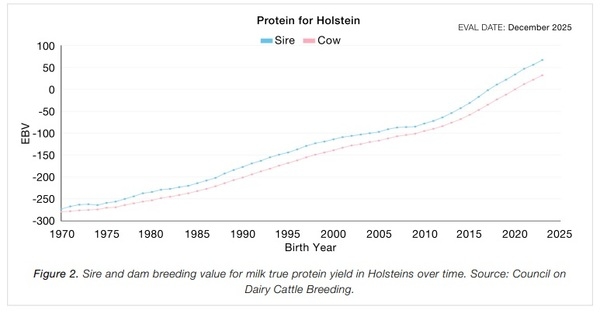
Due to genetic selection for specific production-related traits, genetic progress in dairy cattle, particularly Holsteins, has accelerated greatly. Advances in genomics have dramatically increased the potential for milk fat and protein yields (Figures 1 and 2). Today’s cows are genetically capable of producing levels of components that would have been considered impossible just a decade ago. However, fully reaching that potential now depends highly on more precise nutrition.
As genetic potential continues to increase, traditional approaches to feeding dairy cows may no longer be sufficient to express their full potential. Though many components of the diet are vital to reaching a dairy cow’s full potential, this article will focus specifically on amino acids (AA).
GENETIC PROGRESS IS RAISING THE CEILING FOR MILK COMPONENTS
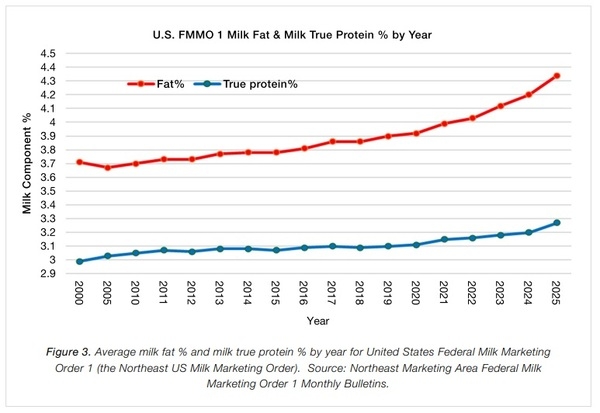
Genomic selection has driven consistent improvements in production traits of Holstein cattle. Industry data clearly show upward trends in both milk fat and milk true protein percentages over time (Figure 3). While some of this progress can be attributed to improved nutrition and management, a large component is due to genetic advancement. This becomes even more apparent when comparing breeds. Jerseys, which generally receive similar nutritional management, have not experienced the same magnitude of increase in milk components. Their genomic progress has also been more modest, reinforcing the conclusion that genetics are a primary driver of today’s elevated production potential in Holsteins.
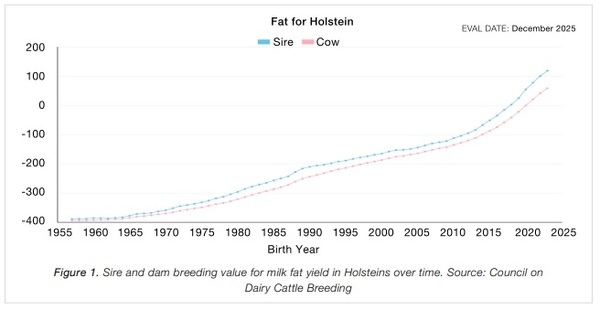
As we look to the future on how to feed these cows, we must understand that each new calf born represents the opportunity for an improved genotype. These calves will eventually develop into replacement heifers in the herd and have a greater capacity for milk component yields than the previous generation.
While this progress is exciting, it presents a significant challenge for nutritionists and researchers: determining how to feed cows whose production ceiling is still unknown and rising rapidly.
WHY AMINO ACIDS MATTER MORE THAN EVER
Historically, amino acids were often considered feed additives used to fine tune diets. That mindset no longer aligns with the reality of modern dairy production. High genomic cows require amino acids not only to support milk protein synthesis, but also to maximize milk fat production and overall energy corrected milk (ECM) yield, as all components of milk require protein synthesis, which is an AA intensive activity. To refine amino acid (AA) requirements, researchers have shown that formulating diets on an energy basis improves both efficiency and production (LaPierre et al., 2019; Higgs et al., 2023). This approach is intuitive because the synthesis of milk components requires metabolizable energy, making energy supply a key driver of AA utilization, and this in turn increases the demand for metabolizable AA. In theory, this framework should allow nutritionists to meet the needs of higher producing cows as intake and production increase together.
However, emerging evidence suggests that highly selected cows are producing more milk and components at similar energy intakes. In other words, they are using nutrients more efficiently – a key component of nutrient partitioning. This implies that AA requirements per unit of energy may actually be increasing as genetic potential rises. As cows become more efficient, determining nutrient requirements becomes more complex. What was adequate in the past may now limit production, not because energy is insufficient, but because AA supply does not match the cow’s enhanced ability to convert nutrients into milk components. Interestingly, this does not only pertain to milk protein yield, but also milk fat yield.
Research conducted at Cornell University has shown that diets balanced for grams of metabolizable AA/Mcal of metabolizable energy (ME) for methionine, lysine, and histidine at 1.19 grams/Mcal, 3.20 grams/Mcal, and 1.19 grams/Mcal, respectively can increase de novo fatty acid synthesis, meaning fat the cow produces herself given the nutrients she consumes (Van Amburgh and Benoit, 2025). Notably, this was achieved with additional AA, highlighting that AA are not only needed for milk protein but also for reaching the potential of milk fat yield.
EVIDENCE FOR POTENTIAL OF HIGH GENOMIC COWS
Data supporting the extraordinary potential of high genomic cows continue to emerge from both research trials and commercial dairies. In the same study conducted at Cornell University (Benoit et al., 2025), Holstein cows produced milk fat as high as 4.72% and milk true protein at 3.39% when diets were balanced for methionine, lysine and histidine at the levels described. Previously, these levels of components were unheard of in Holsteins.
Beyond controlled research, commercial dairies in Central New York have reported production levels of approximately 58 kg of milk with milk fat exceeding 5.48% and milk protein reaching 3.53%. These results illustrate that the genetic potential for exceptional component production exists under commercial conditions—raising the question of whether most diets are truly formulated to support it. It is likely that the above recommendations for methionine, lysine, and histidine will need to be even higher per unit of energy as genetic potential rises.
EARLY LACTATION: SETTING THE COW UP FOR SUCCESS
Early lactation remains one of the most critical periods for influencing performance for the rest of the lactation cycle. Cows experience rapidly increasing milk yield, while dry matter intake lags, creating a period of heightened nutrient demand in very early lactation.
Research from Michigan State University evaluated if feeding low and high metabolizable protein (MP) diets with varying levels of fatty acid inclusion during the fresh period impacted production. Cows fed a high metabolizable protein diet of 122 g/kg dry matter intake with 2% fatty acid added produced 8.9 kg more ECM than the control, representing the highest production among all treatments (Parales-Giron et al., 2025).
Similarly, a Cornell University study examined feeding higher levels of metabolizable protein (MP) during the transition period (112 g/kg dry matter intake prepartum and 130 g/kg dry matter intake postpartum). Cows receiving higher levels of metabolizable protein (MP) both before and after calving produced 7.2 kg more ECM (Westhoff et al., 2024). Most notably, this increase in ECM persisted even after the transition period, indicating that feeding adequate amino acids during transition can have a positive influence on the rest of lactation.
In both research studies, rumen protected methionine and lysine were included in the high MP rations to balance AA supply. These findings underscore the importance of high MP fresh cow rations, a strategy that will become increasingly critical as the genetic potential of dairy cows continues to advance. Utilizing rumen-protected amino acids such as AminoShure™-XM (38% metabolizable methionine) and AminoShure™-XL (34.6% metabolizable lysine) from Balchem Corporation allows for a concentrated and consistent delivery of amino acids, which becomes increasingly important during the transition period where diet space is tight due to low dry matter intake.
FEEDING THE FUTURE OF DAIRY GENETICS
As genomics continues to push the boundaries of dairy cow performance, nutrition must evolve alongside genetic progress. Feeding strategies that once supported “high producing” cows may now limit performance. To allow cows to fully express their genetic potential, supplemental AA must be recognized as essential, not optional additives. Feeding more AA per unit of metabolizable energy may be necessary to keep pace with cows that are converting nutrients into milk components more efficiently than ever before. Additionally, supporting the cow through the transition period with adequate metabolizable protein will become even more vital.
Each new generation of calves brings higher expectations for production. The question is no longer whether cows can achieve exceptional levels of milk fat and protein but whether we are feeding them in a way that allows them to do so.
About Dr. Laura Niehues
Residing in Florida, USA, Dr. Laura Niehues obtained her Bachelors degree in Animal Science from University of Florida and went on to complete a Masters in Equine Nutrition from Kansas State University and a PhD in Dairy Cow Nutrition from University of Illinois. During her PhD, Laura focused on amino acids during the transition period of dairy cows, specifically rumen-protected lysine. After completing her PhD, she worked as a Technical Services Manager for Novita, working specifically with bypass protein for dairy cows, and for Native Microbials working with rumen microbes and on farm technical support. Currently, Dr. Niehues is the Technical Services Specialist for the Eastern United States and Canada at Balchem. Laura greatly enjoys providing technical support for balancing for amino acids in modern dairy cow rations.
About Mike Van Amburgh
Mike Van Amburgh is a Professor in the Department of Animal Science and a Stephen H. Weiss Presidential Fellow at Cornell University, where he has a dual appointment in teaching and research. He earned his undergraduate degree from Ohio State University and his Ph.D. from Cornell University.
Van Amburgh was hired to conduct research in dairy nutrition and to help grow the Cornell Dairy Fellows Program. He teaches multiple courses and, since 1995, has advised hundreds of undergraduate students and serves as the advisor for the Cornell University Dairy Science Club.
Mike currently leads the development of the Cornell Net Carbohydrate and Protein System (CNCPS), a nutrition evaluation and formulation model used worldwide.
He has authored and co-authored over 100 journal articles and many conference proceedings. He is the recipient of several awards, including the American Dairy Science Foundation Scholar Award, the Land O’Lakes Teaching and Mentoring Award from ADSA, the American Feed Ingredient Association Award for Research, the Journal of Dairy Science Most Cited Award, the CALS Professor of Merit Award, and the CALS Distinguished Advisor Award. In 2016, he was named Stephen H. Weiss Presidential Fellow, the highest teaching award given by Cornell University.