Home
Search
Explore
Publish
Explore

Advertise on Engormix
Home
Publish
Search

Growth inhibitory effect of a triple-strain bacillus-based probiotic on enterococcus cecorum isolated from broilers: an in vitro study

Published: October 29, 2026
Source : D. SANDVANG 1, L. SKJOET-RASMUSSEN 1, L. CAPERN 1, A. MEUTER 1, H.L. MOK 2, J.C. BODIN 2, C. CULLEY 3 and P. DOYLE 3 / 1 Animal and Plant Health & Nutrition, Chr. Hansen A/S, Denmark; 2 Chr. Hansen Animal and Plant Health & Nutrition, Chr. Hansen APAC Singapore; 3 Nutriment Health Pty Ltd, Australia.
Summary

Twenty-two E. cecorum isolates were collected from broiler chickens, 12 isolates from West European farms and 10 isolates from US farms, to evaluate the in vitro inhibitory capability of a triple-strain Bacillus-based probiotic, consisting of B. subtilis(DSM 32325), B. subtilis(DSM 32324), and B. amyloliquefaciens (DSM 25840). The triple-strain Bacillus-based probiotic was hypothesized to exhibit a significant in vitro inhibitory effect against E. cecorum. This study assessed this hypothesis through a pathogen inhibition assay of the probiotic supernatant against twenty-two different E. cecorum isolates. The inhibitory effect of the supernatant against bacterial growth was evaluated using optical density (OD 600 nm) by measuring the turbidity of the broth. All experiments were conducted in triplicate. Results revealed that the triple-strain probiotic had a growth inhibitory effect against E. cecorum that ranged from 80% and 96% for the 12 France and 10 US isolates. The in vitro capability for direct inhibition of clinical E. cecorum isolates may result from the release of specific inhibitory lipopeptides like surfactins and fengycins that inhibit bacteria through the formation of pores in cell membranes as biosurfactants. 

I. INTRODUCTION

Enterococcus cecorum, a gram-positive coccus, plays an integral role in the composition of the gastrointestinal microbiota across a diverse array of mammalian and avian species. It is worth noting that this range encompasses not only a variety of avifauna, such as chickens, ducks, and pigeons, but also several mammalian species, including pigs, calves, horses, cats, and dogs (Baele et al., 2022). E. cecorum has been implicated sporadically in a range of human illnesses, including peritonitis, septicemia, and empyema, typically presenting in individuals with preexisting conditions or vulnerabilities such as alcohol abuse, liver cirrhosis, malnutrition, or undergoing continuous ambulatory peritoneal dialysis (De Baere et al., 2000). Human disease associated with E. cecorum has been documented in only a small number of publications (De Baere et al., 2000) (Greub et al., 1997) (Hsueh et al., 2000) (Woo et al., 2004). In the last 15 years, E. cecorum has surfaced as a noteworthy opportunistic pathogen affecting poultry. The infection attributed to E. cecorum was detected in 2002 in broilers aged 4-5 weeks, originating from Scotland (Wood et al., 2002). E. cecorum is usually recognized as a harmless commensal within the gut of broiler chickens. However, the occurrence of dysbiosis, an imbalance in the gut microbiome has the potential to compromise the gut barrier integrity resulting in a "leaky gut". This condition can facilitate intestinal bacterial overgrowth, providing an opportunity for E. cecorum to exploit weakened tight junctions with potential to translocate into the blood stream followed by transport to specific sites (e.g., joints) or organs (e.g., heart). E. cecorum has been implicated in causing bone lesions, notably chondronecrosis and osteomyelitis in broiler chickens. Disease outbreaks associated with E. cecorum were characterized by a range of symptoms including sepsis, pericarditis, local myositis, and particularly bone and joint lesions, which encompass purulent arthritis of the hock, femoral head necrosis, and T6 vertebral osteomyelitis. E. cecorum presently poses a significant threat to the global profitability of broiler operations with increased mortality rates, poor production, and increased condemnation (Dolka et al.,2017). Therefore, for poultry production, evaluation of probiotics has been undertaken to determine the potential effect of growth inhibition of E. cecorum.

II. METHOD

From USA and West European farms, twenty-two isolates of E. cecorum were collected from broiler chickens displaying clinical signs of lameness. The goal was to evaluate the in vitro inhibitory capability of a triple-strain Bacillus-based probiotic, consisting of B. subtilis (DSM 32325), B. subtilis (DSM 32324), and B. amyloliquefaciens (DSM 25840). Out of the 22 isolates, 10 were provided by the University of Arkansas (Prof. Douglas Rhoads and Dr. Adnan Ali Khalaf Alrubaye), while the remaining 12 West-European isolates were obtained from a laboratory in France. These E. cecorum strains were isolated from various body sites including the heart, liver and joints or via cloacal swabs. 
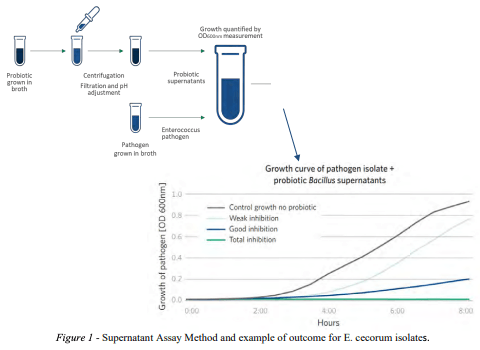
Figure 1 - Supernatant Assay Method and example of outcome for E. cecorum isolates.
A pathogen inhibition assay was conducted to determine the ability of the probiotic supernatant to inhibit the growth of the different E. cecorum isolates. The probiotic was cultured in BHI broth and the E. cecorum isolates were cultured in TSA-sheep blood agar at 37˚C for 24 hours. The probiotic broths were centrifugated for bacterial cell sedimentation, separating the supernatant from the precipitates through filtration. A 100 µl aliquot of this cellfree probiotic supernatant, which has previously been shown to contain active substances including bacteriocins, was subsequently combined with 100 µl of new BHI broth and 20 µl of E. cecorum in saline diluent inoculated in wells. Post-inoculum incubation to assess the inhibitory effect of the supernatant against bacterial growth was evaluated using the Optical/OD plate reader for 96 well plates by measuring the turbidity (Figure 1). All experiments were conducted in triplicate. The average OD of triplicates are calculated for both probiotic and control growth. This is the inhibition percentage for each timepoint. To calculate the percentage decrease in growth, an average of these percentage inhibition were performed to get one number per strain.

III. RESULTS AND DISCUSSION

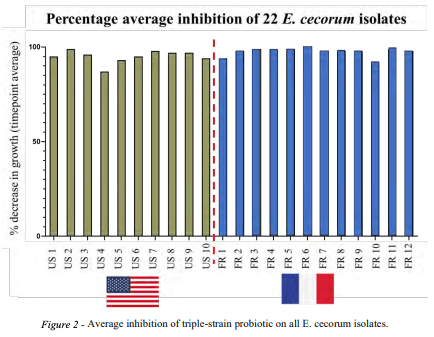
As presented in Figure 2, results revealed that the triple-strain probiotic had a very high inhibition of the growth of E. cecorum ranging from 80% and 96% for the 12 West European and 10 US isolates. 
Figure 2 - Average inhibition of triple-strain probiotic on all E. cecorum isolates.
This strong in vitro capability for direct inhibition of clinical E. cecorum isolates can be explained by the ability of the different Bacillus strains in the probiotic to release specific inhibitory substances (such as lipopeptides like surfactins and fengycins) to its surrounding that inhibit bacteria through the formation of pores in cell membranes. The in vitro activity shown in this study suggests that the probiotic should have in vivo efficacy.
In conclusion, the observed direct pathogen inhibitory effect in vitro as demonstrated through supernatant assay is just one facet of the multifaceted modes of action attributable to Bacillus-based probiotics. The action of triple-strain probiotic has been shown to reduce the in vitro growth of E. cecorum.
    
Presented at the 35th Annual Australian Poultry Science Symposium 2024. For information on the latest and future editions, click here.

Baele, M., Devriese, L., Butaye, P., & Haesebrouck, F. (2002). Journal of Applied Microbiology, 92, 348–351.

De Baere, T., Claeys, G., Verschraegen, G., Devriese, L. A., Baele, M., Van Vlem, B., Vanholder, R., Dequidt, C., & Vaneechoutte, M. (2000). Journal of Clinical Microbiology, 38, 3511–3512.

Dolka, B., Chrobak-Chmiel, D., Czopowicz, M., & Szeleszczuk, P. (2017). PLOS ONE, 12, e0185199.

Greub, G., Devriese, L. A., Pot, B., Dominguez, J., & Bille, J. (1997). European Journal of Clinical Microbiology & Infectious Diseases, 16, 594–598.

Hsueh, P. R., Teng, L. J., Chen, Y. C., Yang, P. C., Ho, S. W., & Luh, K. T. (2000). Journal of Clinical Microbiology, 38, 2450–2452.

Wood, A. M., MacKenzie, G., McGillveray, N. C., Brown, L., Devriese, L. A., & Baele, M. (2002). The Veterinary Record, 150, 27.

Woo, P. C., Tam, D. M., Lau, S. K., Fung, A. M., & Yuen, K. Y. (2004). Journal of Clinical Microbiology, 42, 919–922.

Content from the event:
Related topics:
Authors:
Antoine Meuter
Jean-Christophe Bodin
Recommend
Comment
Share
Profile picture
Would you like to discuss another topic? Create a new post to engage with experts in the community.
Featured users in Poultry Industry
Dr. Algis Martínez
Dr. Algis Martínez
DVM, Diplomado ACPV - Poultry Veterinarian North America Cargill
United States
Ana Maria Villegas-Gamble
DVM, MS, Ph.D. / Directora de Nutrición
United States
Carolina Hall
Carolina Hall
United States