I. INTRODUCTION
Necrotic enteritis (NE) is a major intestinal disease in commercial poultry. It affects ~40% of broiler flocks and costs the industry through increased mortalities and reduced growth performances. The causative agent is Clostridium perfringens (CP) a Gram-positive member of the normal intestinal microbiota of poultry. A disturbance in the intestinal microbiome or a change in the behaviour of CP can result in the development of NE. CP can produce > 18 different toxins (Revitt-Mills et al., 2015), including α, β, ε and Net-B toxins. The Net-B toxin, produced by type G strains (Emami and Dalloul, 2021), has been identified as a key virulence factor for NE development and can cause symptoms of NE even in the absence of the pathogen itself. No effective vaccines against NE are available. In vitro cellular models have a history of use in human biology for drug screening and elucidating infection processes for the subsequent identification of potential targets for future solution development. Until now, an intestinal immortalized chicken intestinal cell line has not been available. A new chicken enterocyte cell line, CHIC clone 8E11 (Tentamus Pharma & Med Deutschland GmbH), has become available and is starting to be applied to the study of pathogen-host interactions (Ali et al., 2020). In this study, the CHIC-8E11 cell line was used to characterise pathogenic traits (adhesion to host cells, pathogen exclusion, effect on cell permeability and cytotoxicity) of 4 CP strains and of pure Net-B toxin. We then investigated in vitro the potential of probiotic Lactobacillus acidophilus strain AG01 and Bifidobacterium animalis subsp. lactis AG02 to reduce the negative effects of CP and Net-B.
II. METHOD
The chicken cell line was obtained from Brandenburg University of Technology, Germany. Four C. perfringens strains (CP1; CP10; CP21 and CP22) isolated from broilers and pure NetB were used in this study. All C. perfringens strains carried CPA+ while only CP21 and CP22 were NetB+. C. perfringens cell-free supernatants were collected from overnight liquid cultures grown in brain heart infusion (BHI) broth at 37°C/5% CO2. Three assays were conducted to evaluate the use of the CHIC-8E11 cell model for NE infection purposes: adhesion; cytotoxicity and permeability, comparing challenged and unchallenged cell preparations, and Kruskal-Wallis H test was used for statistical analysis (Graph pad Prism 9). P < 0.05 was considered significant. Assays were repeated to investigate the effect of pretreatment of CHIC8E11 by two probiotic cell-free supernatants (Lactobacillus acidophilus AG01 and Bifidobacterium animalis subsp. lactis AG02) obtained from cultures grown in MRS for 48 h at 37°C/5% CO2.
For the adhesion assay, isolated CHIC-8E11 cells were seeded in 96-well cell culture plates at a density of 2.0 × 10⁴ cells/well and grown for 48 h. Fresh cultures of 4 C. perfringens strains were grown overnight, and cells loaded on to the CHIC-8E11 cells at a dose level of 50 µl/ml (OD600 = 1). The plates were incubated for 1 h at 37°C/5% CO2. Cells were rinsed, lysed and serially plated on TSB agar for C. perfringens enumeration. To determine the impact of probiotic cell-free supernatants, the initial culture media was replaced with fresh media plus cell-free supernatant from 1 of 2 probiotic strains and incubated overnight. Cells were PBS washed and the assay conducted as above. Cell culture media without cell-free supernatant acted as a control.
Cell permeability was assessed using the fluorescein isothiocyanate-dextran (FITCDextran-10 µg/ml) permeability assay. Cells were challenged and incubated for 2 h at 37°C/5% CO2 prior to adding FITC-D for 3 h. To determine the impact of probiotic, the cell-free supernatant was added to the apical compartment and incubated overnight. The challenge was then conducted as above.
The cytotoxicity of the 4 C. perfringens cell-free supernatants added at 10, 20, 30, 40 or 50 µl/ml or pure Net-B toxin (added at 1 or 2 µg/ml), against CHIC-8E11 cells was assessed using the 3-(4,5-dimethylthiazol-2-yl)-2,5-diphenyltetrazolium cell viability assay (CyQUANT MTT™ Cell Viability Assay). Cytotoxicity was expressed as the percentage absorbance in the treatment (test) wells compared to the control. To determine the impact of probiotic, cell-free supernatants was added at a volume of 10, 20, 30, 40 or 50 µl/ml prior overnight incubation at 37°C/5% CO2. After incubation, C. perfringens cell-free supernatant was added, and the assay conducted as above.
III. RESULTS
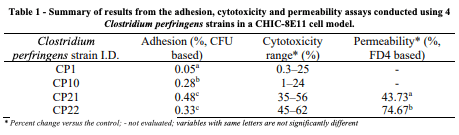
Using the cell model CHIC-8E11, adhesion, cell permeability and cytotoxicity of pathogenic C. perfringens strains were quantified (Table 1) and used as a challenge control then after to assess the potential of cell-free supernatants from L. acidophilus AG01 and B. animalis subsp. lactis AG02. Permeability effect of the probiotic cell-free supernatants were tested in the absence of pathogen challenge as quality control. AG01 cell-free supernatant had no effect on CHIC-8E11 permeability, while AG02 cell-free supernatant significantly improved the permeability (P < 0.01) compared to negative control.
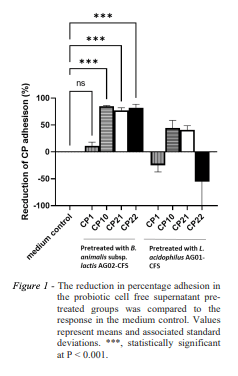
Overnight pre-treatment with cell-free supernatant from AG02 markedly reduced cell adhesion of CP10, CP21 and CP22 (respectively, by 84.8 ± 3.7, 77.4 ± 14.0, and 82.3 ± 15.6, vs control: P < 0.001; Fig. 1) but had no significant effect on CP1 adhesion. Cell-free supernatant from L. acidophilus AG01 had no statistically significant effect on adhesion.
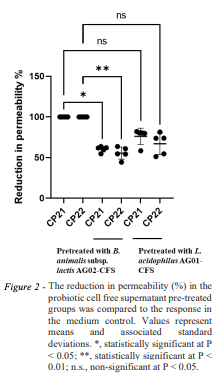
Cell-free supernatant from AG02 significantly reduced the change (increase) in permeability of cells challenged with cell-free supernatant from CP21 or CP22 [respectively, by 40% points (P < 0.05), and by 44% points (P < 0.01), vs no probiotic preculture] (Fig. 2). The change in permeability of cells challenged with cell-free supernatant from strain CP21 or CP22 was numerically reduced by pretreatment of cells with cell-free supernatant from L. acidophilus AG01.
Overnight pre-treatment of CHIC-8E11 cells with cell-free supernatants from L. acidophilus AG01 or B. animalis subsp. lactis AG02, prior to challenge for 4 h with cell-free supernatant from C. perfringens strain CP01, CP22, or with pure Net-B toxin, numerically reduced the percentage cytotoxicity compared with the control treatment. The magnitude of reduction appeared to be dependent on the concentration of probiotic supernatant applied (greater with increasing concentration) and differed between the two probiotic strains. At the highest probiotic cell free supernatant concentration (50 µl/ml), both probiotic strains numerically reduced the cytotoxicity of CP21, CP22, and of Net-B against CHIC-8E11 cells, but with differing efficacy: cell free supernatant from B. animalis AG02 was numerically more effective than that from L. acidophilus AG01 at reducing the cytotoxicity of CP22 and Net-B (-21% compared with -16%, and -34% compared with -18%, respectively, vs control), whereas the two probiotics were equally effective at reducing the cytotoxicity of strain CP21 (-24% and -24%, respectively, vs control).
IV. DISCUSSION
The cell adhesion assay results indicated that all 4 C. perfringens strains could adhere to CHIC8E11 cells, and levels aligned with previously reported pathogen adhesion values of 0.5-2% (Trejo et al., 2006), with significantly higher percentage adhesion of the Net-B-positive strains. The significant and marked reduction in the adhesion of three out of four C. perfringens strains (CP10, CP21 and CP22) to CHIC-8E11 cells following their pre-treatment with cell-free supernatant from B. animalis subsp. lactis AG02 suggests the presence of beneficial effector molecule(s) in the cell-free supernatant from both probiotics that disrupted or blocked C. perfringens adhesion to cells.
In the present study, only cell-free supernatant from C. perfringens strain CP22 significantly increased the permeability of CHIC-8E11 cells after 2 h incubation compared to control (BHI only), suggesting that substances within the supernatant secreted by the pathogen disrupted barrier integrity. The specific nature of these substances cannot be confirmed. Cell-free supernatant from B. animalis subsp. lactis AG02, but not from L. acidophilus AG01, significantly reduced the negative effect of C. perfringens cell-free supernatant on host cell permeability. Given the critical role of epithelial barrier integrity in regulating the passage of substances into the body from the gut lumen, and the knowledge that this permeability is impaired in NE (Latorre et al., 2018), a beneficial effect of cell-free supernatant from B. animalis subsp. lactis AG02 in reducing epithelial permeability would be expected to reduce toxin and bacterial translocation and CP pathogenesis.
The cell viability assay results demonstrated that CHIC-8E11 cells were permissive to cell-free supernatants from pathogenic CP strains. The effect of cell-free supernatant from each of the probiotic strains on CP-induced cytotoxicity was suggestive of a beneficial effect of both, but the absence of statistical significance when compared to the response of the control treatment limits the ability to draw firm conclusions. The numerical reductions in cytotoxicity were of the order of 15 to 25% across both probiotics when applied to CHIC-8E11 cells at the maximum dose level of 50 µl/ml. Their differential degree of effect against individual CP suggests a complementarity between the two probiotic strains.
In conclusion, this study confirms that CHIC-8E11 cell line could be a useful model to study the implications of CP pathogenesis and used as a high-throughput screening tool for solution development. These results support the combination of L. acidophilus AG01 and B. animalis subsp. lactis AG02 in future in vitro and in vivo assays to further assess their potential as alternatives to antibiotics for the prevention and control of NE in broilers.
Presented at the 35th Annual Australian Poultry Science Symposium 2024. For information on the latest and future editions, click here.